
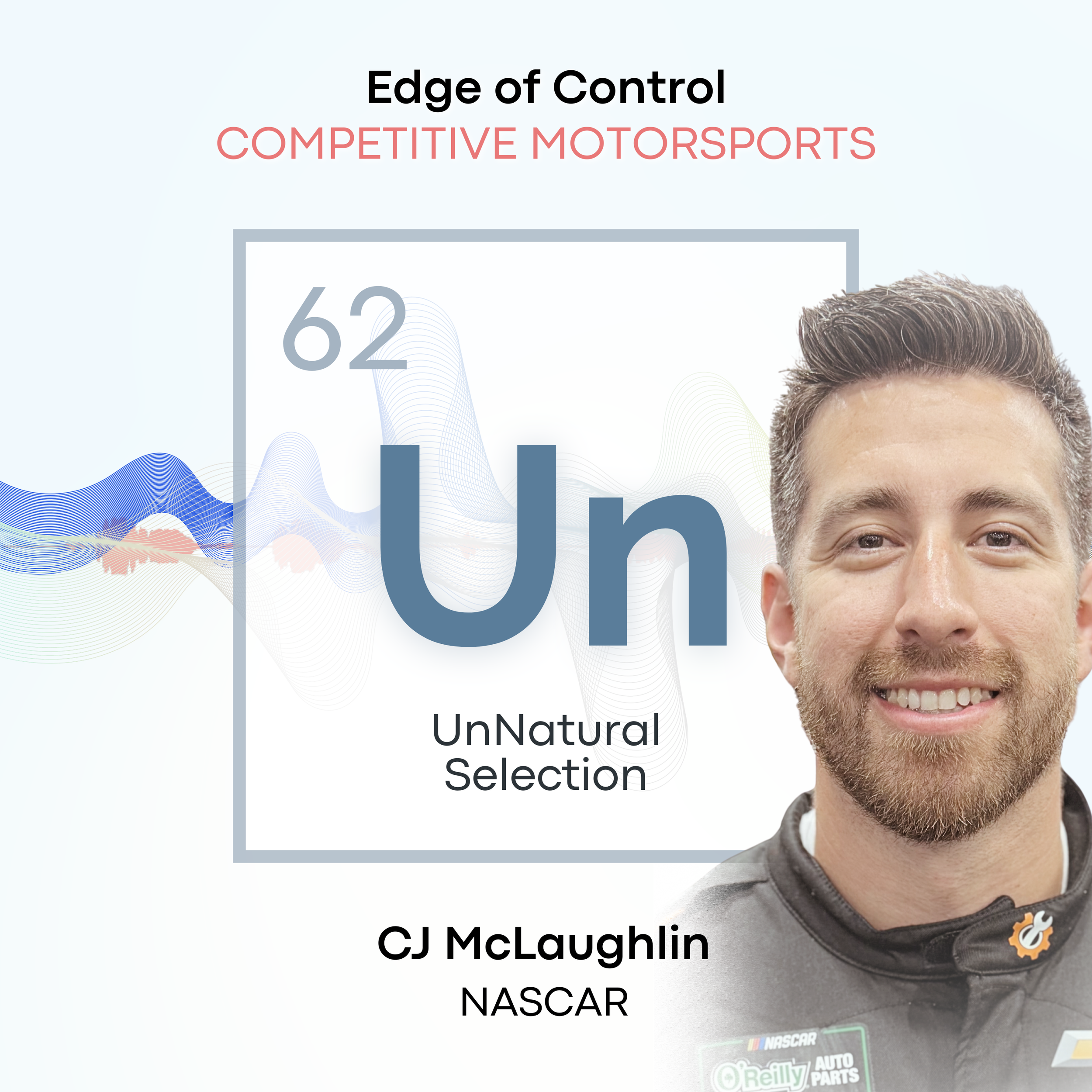
Competitive Motorsports: NASCAR • CJ McLaughlin


Margins at the Edge: Human Performance in Standardized Markets
Most people think NASCAR is about driving fast. It's actually about competing within constraints.
In this episode of UnNatural Selection, Nic Encina sits down with professional NASCAR driver CJ McLaughlin to explore how innovation survives when almost everything is standardized.
From aerodynamics and simulation to sponsorships, psychology, AI, and race strategy, CJ reveals how milliseconds—not massive technological breakthroughs—separate winners from the rest of the field.
The conversation explores why constraints often fuel creativity, how competition evolves when everyone has access to similar technology, what other industries can learn from motorsports, and why the future of competitive advantage increasingly belongs to organizations that master systems rather than individual brilliance.
Whether you're interested in innovation, leadership, business strategy, or simply how elite performers operate under extraordinary pressure, this episode offers surprising lessons that extend far beyond the racetrack.
-
Nic (01:55)
CJ, welcome to our natural selection.
CJ (01:57)
Thanks so much for having me, Nick.
Nic (01:59)
It's it it's great to meet you, and I'm really looking forward to hearing more about the world that you live in, which is completely foreign from mine being in like, you know, healthcare and and life sciences and biotechnology and so on. So with that, one of the the the level setting question that I always start with kind of gives context to what you do, especially for people that are not familiar with your world. Could you please let us know in your own words what need or impact drives your work?
CJ (02:27)
the need to go fast. I'm a general junkie by by default. I was ever I was that way. The only thing I'm scared of is heights. That's the only thing that gets me but like two hundred miles an hour doesn't shake me. and I just there's a there's a need of going fast and then winning that ties in close to NASCAR. So those two things that just get my mortar running, so to say. So to speak.
Nic (02:51)
I love that. And you know, for people who see only see like the cars on their tracks for a few hours, can you give us a simple behind the scenes overview of what your organization actually does and what NASCAR industry actually is at its core? Like who are the real customers and and what value is being created?
CJ (03:11)
That's a that's a load of questions. So throughout the course of the week, like once the once the season gets started, there's really no days off because once Daytona kicks off, you are getting re once we leave Daytona, we're getting ready for the next track, the next track, the next track. There's no downtime really in the sport because you are prepping your next car, hopefully three weeks in advance. But sometimes the smaller, low budget teams are prepping that car
the Sunday night that they get back from the racetrack. in terms of like who the customer is at a race, it could be the general fan, it could be the sponsor of the race weekend or the sponsors guests. You know, like sometimes I have sponsors and and they bring their customers and the and the customer, their sponsors, customers, is what what makes this work around. So it could be anywhere from the fans in the stands to corporate sponsors to the sport corporate sponsors guests that are attending the race that weekend.
Nic (04:08)
Yeah. And and and is that that framework that you just described, is has it been fairly stable as of the last ten or twenty years?
CJ (04:22)
it's definitely been evolving. I think from the two thousand eight market crash to social media campaigns where people are spending their dollars, what makes it authentic and and how sponsorships are structured have to have changed like completely. I think the focus is now more of a B2B focus in NASCAR rather than the business to consumer aspect of the people in the stands. NASCAR still is the most sponsor loyal sport in every like
When you see the M's car, you wanna go by and M's or or Monster Energy or Grow Mine Energy or whatever energy drink the, you know, race car you're cheering for is is going past you.
Nic (05:01)
Mm. Yeah. Yeah. Highly influential and and I you know, you see little kids playing with the little cars and everything like that, right? So it's really a part of the culture and a part of society as in general.
CJ (05:11)
Yeah, so that's what kind of got me hooked is like when I would go to the races with my dad, right? That was a fond memory of what me and my dad would do together. And so very fortunate to have have those times and go to the races with him and experience that. And you know, like there's definitely periods where like, I don't want to do this, I want to go do something else. But then you look back on it, like it was the it was the funnest times at the racetrack, just hearing large coast c lar cows go by. And there's something that like happens to you like physically that like when you see forty cars with eight hundred horsepower whizzing by you.
at two hundred miles an hour. It's like that's it's something that T V can't capture. And that's what the toughest thing is, is you have to go to a race track to experience that firsthand.
Nic (05:51)
Yeah, because it's not just a sound, you feel it.
CJ (05:54)
Yeah, smell it everything, right? Like the race race gas that's like gets in your blood and you're like, wow, need to sniff that again.
Nic (06:03)
Yeah, and and and and there's also that element of excitement coupled with fear. You know, I think about bullfighting and people are watching it, but in the back of your mind there's always that sense like something could go wrong. This is not a fully safe and scripted environment. Things could completely go off the rails, if you will. And and so there's always that element in the back of people's minds, right?
CJ (06:27)
So yeah, our next race coming up is is Daytona and they always talk about the big one, which is the big wreck that collects twenty cars at a at a swipe. So sometimes if you're sitting 25th and all of a sudden you're driving 200 miles an hour, you can't slow down that fast. So you're crashing into a crash. You know, you're on the brakes and you're trying to avoid the crash as best you can, but sometimes there's no avoiding it.
Nic (06:48)
Yeah, I I definitely want to get back into that. But actually I I wanna ste take a step back and ask you something because you brought that up about being a kid with your dad. again, my background, I I don't have much experience with NASCAR or motor sports, but I I do have with tennis. And so, you know, I grew up loving tennis and then and th there was a path towards becoming a professional, no matter how
Distant it seemed, you know, it's a lot of work, a lot of commitment, a lot of luck in many ways, and a lot of things that go into it. But I could kind of see that, what that looked like, you know, going to college and camps and all that stuff. What's the trajectory for a little kid that's like, I love NASCAR. I want to become a professional NASCAR driver.
CJ (07:30)
Yeah, so like we talked about this with Formula One comparison to NASCAR and how much money it takes, right? So like my family, middle class through and through, right? We're all blue-collar, blue-collar families. And what gave me the ability to make it to NASCAR was sponsor to pay for my racing. And so similar to Lewis Hamilton's story where he had to go out and find the funding to bring to a race team, that's what I'm basically doing is is going out finding companies to partner with to bring me into
a seat and a car and and give me the ability to go testing. because you know, as an escrow driver living in a one bedroom apartment just trying to just trying to make it. But it just comes down to funding and and a little bit of luck, right? So yeah, just saving every penny you have. And my my dad kind of jokes around, not to make light of addiction, but he goes, I'm glad I got you addicted to racing 'cause you have money for nothing else, you know?
Nic (08:26)
it and so so there but in order to get the funding, you've gotta have like the training, the skills, right? You can't just be like, Well, you know, I drive my Volvo on the street and I'm gonna go to NASCAR, right? So i is there like a path, like is there a school you go to to become a better NASCAR driver?
CJ (08:41)
There there are schools out there for road courses. for NASCAR, it's it's kind of like I try to classify it as an adult league and a junior league. you start out basically at go-karts and then you move up to a series called Bandoleros. And then from there you go to a a class called there they're different classes, right? So the classic car would be the next step is legend car, which is essentially a motorcycle engine for like a four foot, like a mini
Like a go-kart on steroids. wow. And from there you progress up and it just takes money and funding. And and I had a I heard a joke recently and they were like, Man, what does it take to win in that series? And the guy goes, Everything you have. Because at every at every level of racing, it's everything you got. Sure. Every
Nic (09:28)
For sure.
CJ (09:29)
penny you got, it's everything you have.
Nic (09:31)
How fast do those go karts with motorcycle engines go?
CJ (09:35)
They
go pretty well one ten, one ten at certain tracks. So they are ripping with no no protection around you, a little no protection. Those that is the f one of the funnest classes to be in. And it's so funny when I'm racing at the ser the level I'm racing in, when I reflect with my friends that I would go racing with, man, those were the days, you know, like those are the funnest times we had 'cause there wasn't much of a budget. I wasn't nervous about losing a sponsor. I wasn't really nervous about the race. You know, I knew I was gonna go out and win. And
You know, but at that point in time, I just want to make it a NASCAR and then you make it a NASCAR and you're like, man, I wanna go back and race those legend cars again.
Nic (10:13)
Yeah. I mean that sounds like fun.
CJ (10:15)
Nice circle.
Nic (10:17)
so now if we if we take a look at the industry itself and we f you zero in and kind of like innovation, this is really fascinating to me because from what I've heard, the there are such constraints on what you can and can't do with your vehicle and your engine and pretty much everything that goes into a race. Can you tell us then
What's your definition of innovation when it comes to NASCAR? What does it actually mean to you in the context of motorsports and and does it show up in real practical ways in your field?
CJ (10:50)
Yeah, the biggest focus in NASCAR right now is arrow aerodynamics and how we mount the bodies onto the roll cages. again, you know, I'll mention a couple of times the what we call the highly funded teams and the lower funded teams. And you can equate that to Red Bull versus maybe a Williams and Formula One. for some of you listeners that may not be fluent to NASCAR. But you'll you'll
We had a test last year where the higher funded teams had about 200 more pounds of down force in the middle of the corner. And down force matters a lot for grip as opposed to a lower funded team. And they're just doing something different with how the air flows around their body and how they can get more down force on their front tires, making more grip throughout the corner. Then when you go into the cup series, that's a whole nother ball game because they again they have such tight tolerances.
The way that their cars are manufactured, it's basically a kit car where you buy certain components from certain vendors and you can mount the body and you have certain tolerances from the X, Y, and Z axis. And that's how you can mount the body onto the chassis and how you can kind of twist and turn it. Right. So they definitely try to play with that and and push the boundaries as much as as possible as they can. And with the innovation comes to cheating. So like
Last year they caught someone we we get water bags inside a car and like one of the teams had a poured like mercury and had a lead lined water bag just to get a little extra weight in the car.
Nic (12:28)
Wow.
CJ (12:28)
So that's like that's how they innovate, right? Is the how they can kind of push the limits of of cheating and and yeah.
Nic (12:36)
So so weight is not a constraint. You can weigh as much as you want.
CJ (12:41)
You want to wait as least as you possibly can. And they had that lead that lead lined bag on the left side of the car so they could kind of place it where they wanted to and have that weight there. When
Nic (12:52)
Interesting and it's amazing.
CJ (12:54)
they so so they can make weight when they go over the scales and they take that water back out when they're racing. Right.
Nic (13:01)
It's I I don't know how much more weight that bag gave, but it's amazing just the the mic
CJ (13:07)
Even three to four pounds, you know, like
Nic (13:09)
That's what I'm saying. Yeah, like just the micro changes that affect the race so significantly, right? Sure.
CJ (13:15)
Yeah, for sure.
Nic (13:19)
So what are the kind of constraints that are put on innovation? Because I I can understand the one side, right? So the constraints are important because a very well-funded team could go buy like a jet engine and put it in a car, right? And so it's like, well, you want to have some constraints, so it still becomes an apples to apples kind of a competition, but it obviously limits what you can do. So what does that look like when you're thinking about
CJ (13:45)
Yeah, I think the first constraint that was put on with NASCAR teams is the amount of wind tunnel testing they got. Right. So bringing their car to a wind tunnel and figuring out how the air is flowing around the car. And then, you know, that that changed to cab models and everything and how, you know, they're doing their they're building their their computer models in the car for the car. And then the next constraint was having a
set up vendor for where you're buying a car. So the teams used to manufacture their own car, right? And the smaller teams would have to buy cars from the bigger manuf the bigger teams that would be able to manufacture cars. so that kind of even the playing field. But as far as innovation, like there hasn't been that much. So I know of like what teams would do to try to create more downforce is lower the tire pressures on the rears to get the rear diffuser down to create more downforce throughout the corner.
And it just it's really I think it I think it's limited the engineers that have come into the sport because there's less innovation that's happening, right? They can do less. like the bodies when you when you see the old race car bodies that were twisted and they look all distorted, but they were perfect if we were going around the corner. And now you look at everyone, and it's kind of like everyone has the same car. Yeah. So that doesn't create
that type of exciting racing that I think the fans are kind of yearning for.
Nic (15:16)
And do some of those constraints become nullified over time? Like for example, you mentioned the first one where the the wind testing, right? But you can simulate some of that now in computer. So is that really a constraint anymore?
CJ (15:29)
For sure. because someone at a bigger team, again with the resources, will hire more engineers to develop different models. and I'm talking like there's quite the stark difference between a a higher tier team and a lower tier team. The lower tier team probably has let's say ten to fifteen people on the payroll, where a higher tier team has three hundred. Right? So there's a stark difference between just manpower itself. So
Looking at that aspect, yeah, there's there they just have so many more people like, you know, more the more people have what's that saying where you can, you know, with enough people in time you can put a man on the moon.
Nic (16:10)
Right. yeah, no, I mean that's material. You know, going from fifteen to three hundred, that's you know, that that creates titles, right? It's it's a whole different playing field. And and I'm sure that they're also pushing the boundaries across different fields. I mean, there is the car, there's also the driver, you know, and and
That goes back to the other saying, which is like, is it the horse or is it the jockey? Right. And so I'm sure that both play into this because you can't just put any Schmo into a car and expect them to win. It takes n you know, the the discipline, it takes a a certain amount of cognitive skill and reflexes, a physique, right, that fits within that constraints of the car.
CJ (16:51)
Yeah. And by no means am I coming on here to bash bash NASCAR, but there's been some major changes in the sport within the last five years post COVID. So what they did during COVID is they eliminated practice. So what the bigger teams could do is they could laser scan the car with a creoform, you know, the different types of Ramer arms that they would use to measure every aspect of the car. Because no co no two cars are the same. Right. Like you can be pretty good with a tape measure, but that roamer arm is gonna get to the third decimal place.
So they take they take a Roman arm, they measure the car, they upload it into their software, and then you can go to the a manufacturer simulator and drive your car on that track. From me being a driver on a lower tier team, I don't get that ability. So when I go to the track for the first time that weekend for my 30 minutes of practice, I'm out to lunch for the first 10 to 15 laps, where you get the higher tier guys who have been practicing all week and know that car.
They can put down their fastest laps in the first three laps 'cause they know how the car's gonna react as it hits the first corner.
Nic (17:55)
So they constrain how much you can practice.
CJ (17:58)
Exactly. NASCAR does. And then which benefits the higher tier teams because they have their own simulators and their own alliances with with these big manufacturers.
Nic (18:09)
I so that I that's that's flabbergassing. I c I could not have imagined that they limit how much you can practice. I I can't imagine another sport where they
CJ (18:18)
It goes back to, you know, quote unquote cost savings, but ends up costing some teams more because they don't they have limited practice, right?
Nic (18:26)
Yeah, sure. Yeah. I mean it's just it's it's so disproportionately favorable to the teams that can take practice off the track and do it in other places. Wow. yeah, that's a that's a big one. I mean back to my comparison with tennis, you I'm thinking to myself, like, you know, if they put limitations on how much time I can spend on the court versus other people, it's just like I couldn't even imagine.
CJ (18:48)
And again, those bigger teams aren't renting out private facilities, but they're just doing it on a sim on on a simulator where that's how they get to practice, right? I can use my home simulator, but the car again is gonna drive differently. Sure.
Nic (19:03)
Yeah, I know for sure. And and so then you know, when we think about so obviously practice plays into the jockey, right? The driver. what are the kind of things that you as a driver or the field in general, looking at drivers, how the driver itself is changing over time? Is it like physique? Is it mental preparedness? Like what are the kind of things that make for a good driver versus a great driver?
CJ (19:30)
I think like what I've learned personally is the ability to stay calm and understand how many factors are outside of my control. one of the great drivers right now is Kyle Larson and he's gonna really lay back personality and how he interacts with a team, right? So you have a in Formula one you have like a team principal. In NASCAR we have a crew chief. The crew chief is responsible for the whole car. And him and his crew chief have a great have a great relationship where his crew chief talks him down off the ledge if he gets worked up about something. He's a great leader.
And then you have a spotter who's watching the race occur. And the spotter is kind of like an offensive coordinator for a football analogy, right? Where the where he's a offensive and defensive coordinator, where he's telling him where to go on the track, where where the cars are seeming fast, or how to put
Nic (20:15)
All in real time. Yes. Okay. Sorry, I interrupted you. I say so you're driving out there, you're dealing with all the elements, and you've got this person telling you real time like go on this side of the track versus that side of track.
CJ (20:29)
Yep. You know, like or like, hey, you have a car trying to make a pass on your right side, take take his air away from him. You know. You're gonna wanna run down on the low side, take his air away again. You know, and he's kind of he's giving you a play by play in your mind of how how everything's unfolding around you.
Nic (20:43)
Yeah, it's incredible. I mean, the other analogy I think about is the like the cycling. And you know, I've always thought to myself, as an outsider looking in, it looks like a bunch of grown men riding bicycles, but there is so much incredible, like minute detail technique that goes into that. And when you mentioned about taking somebody's air out and things like that, these are the things that if I were to watch a NASCAR race, it'd be invisible to
I would just see cars going really, really fast, but there's just like an incredible amount of strategy, technique, physics that goes into like every single move that you're making, all while trying to like control all the elements that you possibly have like some control over, right?
CJ (21:22)
The bet yeah, the best exclamation is like I'm I'm on the brink of losing control every single lap. That's where I'm gonna be the fastest, is on the brink of losing control for 200 laps. Wow. Right. So having consistency every single lap. And that's something, you know, sometimes I struggle with, you know. Sometimes like if I get a little out of control, I'm gonna be reserved for the next five laps to gain that confidence back. You know, and it's that ability to like snap back into it and go back out there and risk it all. Cause I
I had a tough year a couple of years ago where I had to work with a performance coach because I crashed right off the gate at Daytona and I crashed again at Las Vegas and that that killed my confidence for a little while, you know.
Nic (22:02)
I can totally see that. Yeah, I mean you get shaken, right? yeah
CJ (22:07)
The big analogy is like a skier like going through the woods, right? You're not focusing on the trees, you're focusing on the path forward. So, you know, prior to going to a race and saying, No, I'm not gonna crash, I'm not gonna crash, it's like I I need to change that mentality and that that strategy and mindset.
Nic (22:20)
yeah, totally. yeah, and and so obviously like in and tons of psychology go into this because you mentioned that you've always loved speed and and you're the motivation here is to go fast. But you're going at such blinding fast speeds that psychology must play a huge factor in this, right? There's like very little room for error. And you've got to be able to control the elements, but also your physiology, your psychology, your emotions while you're doing this.
CJ (22:47)
Yeah, so and again, like so what I struggled with going from racing locally to racing on a national scale into NASCAR was the heat. I wasn't prepared for the heat. And so like that would affect my mind, right? Overheating just like and then the mental exhaustion that would come from the overheating. So just doing a lot of sauna work to get ready for these like two and a half, three hour races. And like I had a race in Texas a couple of years ago where inside of the car it was 130 degrees. So
for two and a half hours, which is no joke.
Nic (23:18)
That's
CJ (23:19)
You know, or having, you know, again, like being a lower funded guy, I didn't have a cool suit like the other drivers didn't. So saving my pennies up for a cool suit and being able to have that and again change my performance because I had the ability to go out and get that and stay cool throughout the race.
Nic (23:36)
It's yeah, it's you know it's incredible. I mean again back to just the conditioning and the preparation and the innovation. is there going back to tennis, physical preparedness has changed dramatically over the last 20 years for tennis, where before it was like you know, you you were in physical shape to play a match. Now you know you have to
be able to just go from the baseline to the net in a fraction of a second and do that for five sets straight. Because if you can't do that without losing a beat, you're going to lose because the guy who you're playing against can do that. And so the physical training is exceptional. Is it the same way when it comes to like, you know, the physical training for NASCAR? Because like you said, you got to endure like hundreds of miles in blistering heat driving these cars, which aren't like power steering, right? There's an enormous amount of physical and mental preparedness that goes into this.
CJ (24:34)
Yeah, I think if you look at the drivers from like 10 years ago, it's definitely changed to a more fit, more in shape driver for now. You know, things get better, more data, right?
Nic (24:43)
yeah. And and you as a driver, I mean it it's you know, obviously the physique and the skills. I believe you also have a degree in mechanical engineering, right?
CJ (24:51)
Yeah, it's so funny you say that. I haven't really used that much. I use that I put a show car in a in one of my sponsors' buildings and I had a draw out a free body diagram for weight distribution. And then the structural engineer kinda laughed at that. He was like, This is a joke and I like, this is the best I could do. You know, I have a degree, believe me.
Nic (25:11)
All right. Well that nullifies my next question 'cause I actually I was gonna ask you about that because, you know, with your technical lens, does that change the way you think about innovation strategy when you're inside the cockpit?
CJ (25:22)
I I try to leave that up to the team. I'm I'm a artsy engineer, right? Where like I kinda go by feel and I'm a I go by feel in the seat and that's kinda what have to go by from my from my standpoint, right? Like how I approach race weekend and how I approach the car and gotta go by vibes and feel and stuff. And I and I know maybe that's a poor aspect to look at, but I try not to get hung up on the engineering aspect of racing, which is weird because I do love to work on
things and design things, but that's how I approach it.
Nic (25:55)
Yeah.
When we talk about the the innovation, again we talked about kind of like the the aerodynamics, the you know, the motor and how you develop the the technology that you're driving. Now there is an enormous amount of data, which also manifests itself into like wind patterns and how you do that. And then with an emergence of like tons of data, now there's like AI. To what extent does AI kind of
infiltrated the field or or at what levels is it being used if at all, or big data generally?
CJ (26:31)
You know, I'm not too privy on what the big teams are using. What I can extrapolate is that they're probably gonna use it to sort through data faster and make better judgment calls throughout the course of a race. So out throughout the course of race, all the data that like that they're getting lap times, tire temperatures, tire wear, they're gonna be able to make adjustments to the car throughout the race and make those quicker and make just better judgment calls throughout the race.
Is what's probably gonna happen the next year to two years.
Nic (27:04)
Interesting. Yeah, and do that in real time, you know, as you're getting all that data, being able to make like split second decisions in the moment.
CJ (27:12)
Yeah, so like the big adjustments, we can't really make many adjustments in the car as far as like we can make brake bias adjustments, but like when we come in for pit stops, tire pressure adjustments, track bar adjustments, where how the car is like the attitude of the car from the rear, they can make those adjustments probably a little better with using AI.
Nic (27:35)
Do you think there would be a moment where like the hum some of the human element of these races starts becoming replaced? Because you mentioned before you have teams. So you're in the race, you're driving, you've got a coach that's saying, take this guy's window, go on this side of the track and all that stuff, because they're watching from a different angle. They're seeing things that you don't see. Now imagine you have a camera out there with an AI agent that's doing all that, taking in all the data, and I can tell you specifically the optimal way for you to drive your car. Like, i is that where you think the field is going, or do you think there'll be constraints to
tell you how much you can and can't use technology.
CJ (28:07)
See, that's I don't think NASCAR is that innovative where they're gonna do that yet. Maybe five years down the road. I think that's a great that's a great idea though, Nick. Like that's not a bad idea because like they can go without judgment, right? The human human judgment factor. yeah, I'm not sure I'm not sure if we're that innovative, but I definitely think if like technology is there that could be useful, I think that like wouldn't be a detriment by any means.
Nic (28:33)
'Cause I mean, that would also not only be able to process the data that you just mentioned much faster, it would be instant, it would be real time and it would get to you faster because now there wouldn't be a a lag in communication, right? Because a lag in communication is some real person capturing this information, processing it, and then getting on the speaker and saying, like, hey, CJ, do XYZ. All that would just instantly come to your helmet and you'd hear it and know exactly what to do.
while you're driving the car, so that human element lag would just kind of go away for optimal decision making.
CJ (29:07)
Yeah, but there's still this human error with the driver. For sure. So like yeah, as a driver, you can still make it this like a a bad call or not trust the AI that could be making that call too, or like just a mechanical failure. That could of course, you know, a flat tire, a blown engine, you know, things like that that could happen throughout the race, that could change it up. But yeah, I definitely don't think that's a bad idea by any means.
Nic (29:30)
Hm. Yeah, it's it it seems entirely doable. I mean, other fields are doing it, you know, whether in healthcare or other areas, it doesn't seem like something that put it this way, it doesn't sound like science fiction anymore. I think, you know, a handful of really competent engineers might be able to prototype that pretty quickly.
do you think that I mean, if we do project forward where that technology becomes real and all the drivers are using this, all the teams are using this? Is there a risk? And then all the cars are almost identical. Like you said, they're kind of like one car to the next one, are pretty much the same from a a layperson's perspective. is there a risk that these things become a little bit too predictable?
Where everybody kind of is like operating with the same data, same technology.
CJ (30:19)
Well,
that's my frustration with the limitations that NASCAR has put on on these cars that kind of where the teams on load at throughout practice and qualifying is where they end up at during the race. That there it limits the passing and the racing that occurs and that you don't really have much of a roll of the dice throughout race weekend, you know?
Nic (30:42)
Yeah, yeah, it becomes very calculated.
CJ (30:44)
Yes, becomes a very follow the leader at that aspect.
Nic (30:47)
Yeah. So from that perspective, then if we think about just competition in general, what creates sus well, first of all, before we get to that, what determines whether you win or lose a race? Is it I mean, I'm sure there's some luck to it, you know, like the right opportunity you seize upon it. the technology for the most part is, you know, similar.
'Cause it's constrained. There's obviously l elements about how much you practice versus how much you didn't practice. Do those things factor in very heavily to make it for someone like you that doesn't have like unlimited practice time, how much of a a handicap is that for you in real race time environment? Like do you have the capability of winning in those environments? Or
CJ (31:31)
I have the capability of winning at certain tracks. Like Daytona and Talladega are like level sets for fields, right? Where it's it's you're playing chess throughout the whole race and it's about being at the right place at the right time, making sure to avoid the crashes and to be there at the end. mile and a half tracks like Charlotte, it's a huge detriment. handling comes into huge play there. Short tracks,
You know, or maybe even road courses sometimes if I you know, I have experience on road courses, which I don't. but you know, you can see the past where road course people who are really apt to racing road courses, for example, Shane Van Gidzburg, who was from Australia, he came over and won his first race, being his first time in a car and didn't get much practice. So that was a true testament to his racing abilities. But yeah, at the majority of tracks it is a huge handicap or
For most drivers and teams that are not getting the practice that they truly need.
Nic (32:33)
That makes sense. But but like you said, some tracks are engineered to level set and and kind of even out the playing field, right? Hmm.
CJ (32:41)
Correct, correct, yeah.
Nic (32:44)
Interesting. And so then so then d do you tend to focus more on the ones that even the playing field? Because otherwise w why go to the ones where like the odds are stacked against you?
CJ (32:55)
Yeah, so like with my scenario of having to raise funds to go racing, the the races I try to essentially sell is Daytona Teledega. but if I was racing for a championship, you have to attend all the races, right? And compete in all the races.
Nic (33:12)
That makes sense. Yeah, okay. Is there a qualification? I mean, there must be a qualification. So you have to go to the smaller races to qualify for the bigger ones?
CJ (33:18)
No essentially. It's it's just a schedule basis where you have to qualify each race. So they'll have a practice session and a qualifying session. And they top the they take the top thirty five cars.
Nic (33:30)
Okay. And so, you know, if we okay, so let's talk about the the where the playing field is even and so you anybody stands a chance at winning, then how do you convert like a single win into something that's sustainable or a sustainable advantage over a period of time? Is there such a thing or is it like when you as soon as you have that advantage, the whole field catches up?
CJ (33:54)
so if you were to win at Daytona, the only advantage you would have is a points buffer and some monetary funds that come into the race. Like if I was the lowest tier team and I won Daytona, and so let's say I just had a sponsor for Daytona, you know, like there would be an opportunity to like convince them to come back. It's like, hey guys, we just won. don't you want to do that again? But from like a
From like an engineering standpoint, there's no there's no real benefit, you know.
Nic (34:22)
Hmm. Okay. Now if you shift courses and we think about like the evolution of the sport itself, and we talked a little bit before how it's been evolving over time. and you just mentioned like street courses and so on, which I think are are been very popular in Formula One as well. is is that primarily driven by like fan psychology and what they want to see? Like what's actually pushing the field towards, you know, away from the track in other scenarios?
CJ (34:50)
That's like what I I do applaud NASCAR in doing is that we've kinda changed it up. Like recently we had a road race in Chicago. That was just a whole new thing and a different it felt like a whole event, as opposed to just a race. And now this year they're going to the naval base in Coronado in San Diego. And I think that's just gonna be a it's gonna be on Father's Day weekend, it's gonna be a huge event. And I like that they're doing it, they're just changing it up, you know, seeing s seeing what else works with the racing. It just
He has an another aspect too to NASCAR, not just going around in circles.
Nic (35:22)
How do the peerists feel about that?
CJ (35:27)
you know, I think some people were closed minded, some people were open to it. It's just you know, I think the race in in Chicago is just a whole new demographic for sponsors that want to be involved.
Nic (35:38)
Mm hmm. I mean it it sounds like an enormous amount of fun. Is do you have a favorite race? Is it Daytona? You've mentioned it a few times.
CJ (35:47)
Daytona's
definitely yeah, Daytona's up there. Daytona I I get I've crashed like each Daytona race I've been
Nic (35:53)
Yeah really? man, you know erase that. We'll delete that from the recording.
CJ (35:58)
No, we
can keep it in there. You know, there's some good highlights of me on YouTube.
Nic (36:01)
Yeah, for sure.
CJ (36:02)
Daytona's a tough one. but I love it. And then Bristol's a tough, a really tough, vigorous racetrack. The lap times are around sixteen seconds, so it's really fast paced. We're we're going 130 miles an hour, but it's a half mile. So it's things happen very quick fast there.
Nic (36:18)
So that's interesting. Actually, you mentioned if we do unpack that well, you you crash Daytona every time you've been there. Why is that? Is it because like you have like everybody just pushing it to the limit? Is it because there's more drivers or people are more careless or you know, what what is it that causes you to crash more at Daytona versus other places?
CJ (36:37)
me personally, I don't know, man. This is the thing I have with the track. I think it's a first race of the year. Everyone wants to win. So like if my if my dad was driving in front of me, I would crash him to win, you know, right? If I was in second and he was coming to the finish line. So whatever it takes in that for that mentality. But yeah, I just have a thing with Daytona.
Nic (36:57)
Yeah, no and you know, I mean, we we talked a little bit before the recording about you know, you being originally from Massachusetts, right? You're living in Framingham. what you and you mentioned there's a race in Chicago. Any up here in like the New England area that you're
CJ (37:10)
There's
New Hampshire, there's New Hampshire Motor Speedway up in Concord, New Hampshire, just north of Concord. that's pretty much it. And then Watkins Glen and then Dover Delaware is the other closest racetrack to to us in New England. But there's a lot of a lot of small tracks. So like there's Star Speedway in Epping, there's Hudson Speedway in Hudson, New Hampshire. There's a bunch of racetracks in Maine, a couple in Vermont. there's Seaconk, Seacon Speedway down in Massachusetts. And then Thompson has a couple of great racetracks. Tom, sorry, Connecticut has a couple of great racetracks.
Stafford Springs in Thompson, Connecticut.
Nic (37:42)
Okay.
CJ (37:44)
Mm.
There's a lot of local short track racing that occurs in New England.
Nic (37:50)
When you say short track racing, you mean like
CJ (37:52)
like
the s that's like the stepping stone to get into NASCAR. is like racing at a local level. it's essentially like the Providence Bruins. in a way.
Nic (38:05)
Okay. Interesting. Yeah.
CJ (38:07)
Pee hockey.
Nic (38:10)
and so obviously the the industry and the field itself is evolving. We talked a little bit of how, you know, introducing road races and and other things. How how do you see the the field taking shape over the next like five or ten years? What's the trajectory you're seeing as far as like technology and constraints and money, you know, fields, you know, road races and so on, like
Wh what can we anticipate or in your perspective, what's what do you anticipate NASCAR looking like in let's say five years?
CJ (38:42)
So the Cup series has gone to a spec, pretty much a spec car. I'm hoping that they keep the series that I run in the NASCAR O'Reilly Auto Parts series the same way it is with having a naturally aspirated motor. So the Cup series has a fuel injected motor. We have a naturally aspirated. It's kind of like old school in a in a sense, because no, you know, current cars run naturally aspirated, no one there's not many carbureted cars on the road these days.
so it's more of a purist sense and I hope they don't get away go away from that because like we do have some of the best racing that occurs. I I I'm not sure. I think we're at a pivotal point with NASCAR and their leadership team, with the lawsuit that just occurred. And I'm not sure where we go from here. I I hope we I hope we go away from certain things as far as like a one lug tire, because
You know, as you assimilate NASCAR to a real life, there's no car on the road that has a one lug tire. Yeah. You know? so I like our series pit stops that have five lugs and the tire changer has to hit those five lugs and call it to thirteen seconds. I think it's just cool. It's just different, you know.
Nic (39:59)
I mean it definitely adds an element
CJ (40:00)
Where we're at.
Nic (40:01)
Yeah, it definitely adds an element of excitement. You know, i is the guy gonna, you know, mess up or is he gonna get them all in the exact five seconds he has time to do each tire or whatever and get that car out of there? Yeah.
CJ (40:12)
Exactly. Exactly.
Nic (40:15)
yeah, no, it's it it's interesting to see how it's how it's evolving and yeah, and you played obviously like being in the field for something that for most of us looks like a black boxer
You know, what are the kind of things that you, having now lived this world, wish that more people were aware of? Like what other kind of things you're like, you know, whether it be behind the scenes or, you know, your love for the sport or you know, what is it anything that you think more people should be aware of when it comes to NASCAR?
CJ (40:44)
think from a business standpoint how valuable like going to the races is with your clients, right? But of course I'm just looking for more sponsors. I I think it's truly valuable. I think what's amazing is like the camaraderie and things that go on and how like how exciting it is to go to a racetrack and and feel those cars go by you at 200 miles an hour. It's it's it's amazing. It's a great experience to be there live.
I think I wish more people get to experience that and weren't closed off to seeing that.
Nic (41:19)
Yeah, no, I can see that. Yeah, it I have been to some when I was a little kid, I remember going to some race cars and some races. And yeah, it's it's hard to explain express or explain the feeling when those cars are approaching and you feel that Doppler effect just approaching you and passing you. It's so much more than sound. I mean, it's like almost terrifying how much it shakes you to your core.
CJ (41:42)
Yeah, right, right.
Nic (41:43)
Yeah.
So now if we take a a step and and just zoom out and and just think about you know your your career in general and and obviously you're you're still very much building it, so we're not talking anytime in the near future, but if you can like project forward into say 10, 20 years, whatever that course would look like, and you look over your body of work, what would be the ki best case scenario that would make you feel that you've achieved the fullest impact?
That you were capable of and really gives you the most fulfillment over what you've accomplished over your career.
CJ (42:18)
Yeah. So I've struggled with raising funds to go like race full time. And so like that's the near goal future. I started coaching this younger kid and that's actually brought me a lot of enjoyment and that's something I wasn't expecting is coaching him and all the mistakes I made along the way. And that was kinda interesting. So maybe do a little bit more of that, you know? Yeah the coaching aspect and seeing how not to screw up.
Nic (42:42)
Yeah,
yeah. No, it's it's I mean it it's definitely meritorious and I hear a lot of people they get a lot of fulfillment from just coaching and teaching.
CJ (42:49)
Yeah. Yeah, I had no idea. I had no idea. I had that and and maybe, you know, maybe I wasn't the best coach the first time around, but like you know, learned a lot. It was so funny, like I would drill into him all the stuff that he needed to do, and I like would look back and be like, I need to do this stuff too, you know?
Nic (43:04)
Yeah.
Funny how that works, right? Where you like, you know, as you're teaching, you start learning yourself because you're like, wait a second. You know, I I I do I make the same mistake that you make. well, CJ, this has been extraordinary. Thank you so much for this conversation. I mean, for me it was all brand new, so it's super interesting, which is the whole reason why I do this podcast in the first place. And again, thank you for your time. Pleasure to meet you. And I'm gonna have to look up some of these races and hopefully try to come to one of the ones that you're
Racing in and cheer you on.
CJ (43:36)
Sure, Nick, thank you.
