Ocean Exploration & Science: WHOI • David Gallo


Unconstrained Exploration: Unlocking High-ROI Discovery Paradigms
What if the greatest frontier for innovation isn't space – but the ocean beneath our feet?
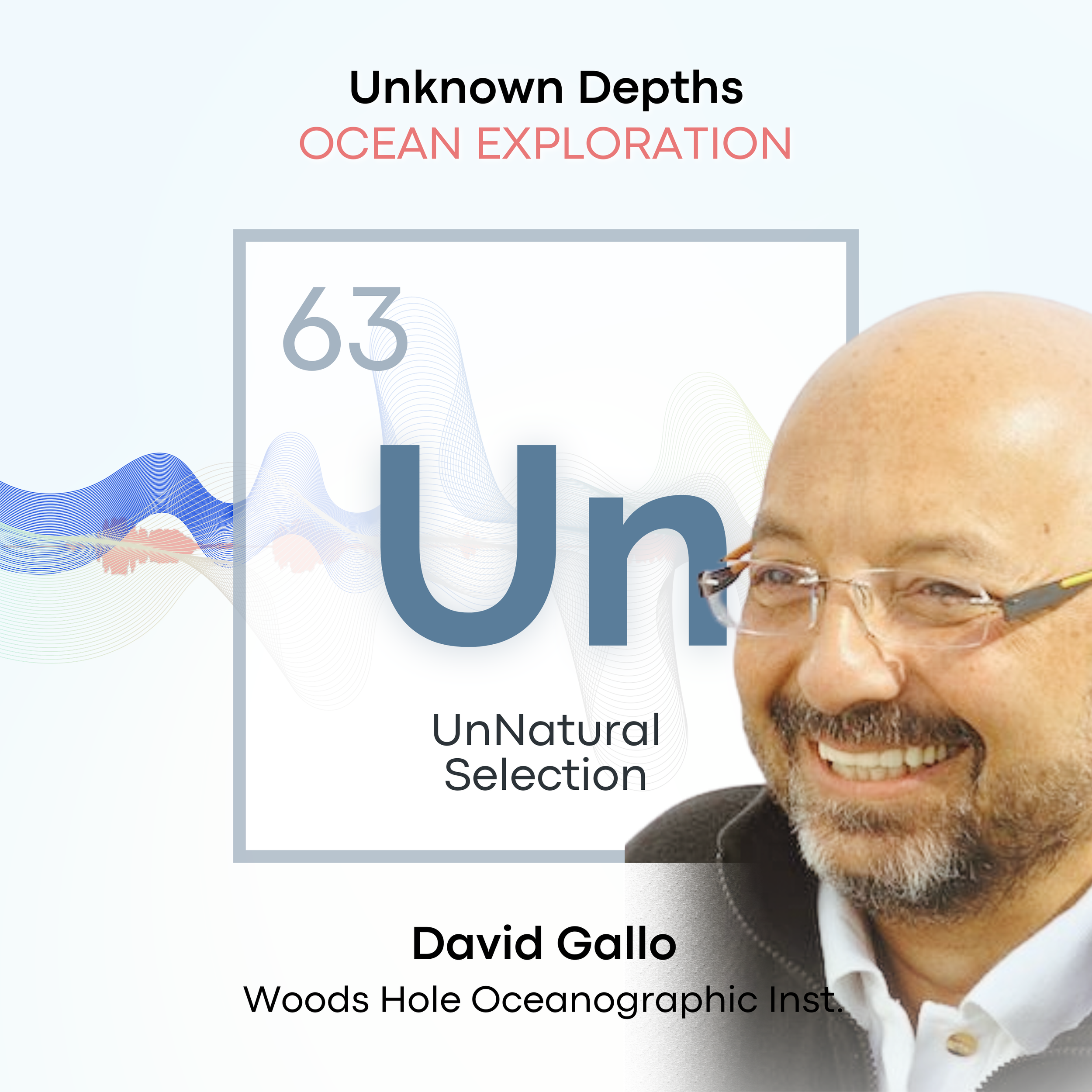
In this episode of UnNatural Selection, Nic Encina sits down with legendary ocean explorer David Gallo to explore how curiosity has driven some of humanity's greatest discoveries. From mapping the RMS Titanic and searching for Air France Flight 447 to pioneering deep-sea robotics and uncovering alien-like ecosystems thousands of meters below the surface, David shares what it truly takes to innovate in one of Earth's most unforgiving environments.
Together they discuss how enabling technologies unlock entirely new industries, why exploration is fundamentally a search problem, how AI is transforming oceanography, and why storytelling may be the missing ingredient in science and innovation.
Whether you're building companies, leading teams, or simply fascinated by discovery, this conversation reveals why curiosity remains humanity's most powerful competitive advantage.
-
Nic (01:58)
David, welcome to UnNatural Selection. It's great to have you here.
David (02:01)
Thanks, Nick. My pleasure.
Nic (02:03)
This is one of those topics where I get the true joy of doing this show because I know so very little about what you do. And at the same time, it terrifies me. The ocean has always been just a source of wonder and fear for me, not least alone because of sharks, but also storms and all the unknown that is there and how much we know about
the solar system and the galaxy so much more than what's seemingly right at our doorstep. But before we jump into that and the Titanic and all the other things that you've done, which are tremendous, I always like to start with a question that gives you the opportunity to just tell us in your own words why you do what you do. So before we get into the deep of it, can you please let us know, David, what need or impact drives your work?
David (03:00)
Well, curiosity, actually. And it goes right back to my elementary school. have ADD, had a hard time in class, like many people that I know, and had a really hard time reading. But I read Contiki when I was younger. I must have read it 10 times. I was focused on that book, Lipped at the Vines. know every...
In fact, the book is on the bookcase right there. That very book is on the case right behind me. And so I like the idea of people going to see in search of the unknown to do something that's never been done before. And that stayed with me all the way through high school. At the end of high school, I was told, don't bother. You shouldn't even bother for college because you just don't have the aptitude. You don't have the grades.
Give it up, buddy. And I did the next best thing. I sold shoes for about six years. I always kept my curiosity. You know, it's odd as I was out every night with my telescope, mapping constellations and things like that. I was building model rockets. would look and build the ones that the kit was made for. Then I'd have a small team and we'd build other ones. And yet I just didn't have the aptitude or the grades.
to follow my dream, which was to be a scientist. I can't explain that part. Must be the curiosity part again. Anyway, one day in the shoe department, it 1976, I was in my mid-20s, I opened up a National Geographic and there was an article about exploring the bottom of the sea and it showed a little speck on this underwater mountain and the speck was the submarine Elvin.
from Woods Hole and in that submarine were three people, this little tiny speck on this big underwater mountain. Who knew about underwater mountains? And there's something about that, that six years into selling shoes, that just flipped a switch in me. And I said, that's exactly what I want to do. And two years later, I had my bachelor's degree. Then after that, my master's degree. After that, my PhD.
But you know, it wasn't driven to get a degree. I was driven because there was something I wanted to know more about. So it really was pure curiosity. I think even to this day, it's curiosity. And you know, it's a good thing and it's a bad thing. Sometimes it's tough to put down your curiosity, to turn off curiosity. So I've loved it really pretty much every minute of this. And I've been in the field for
in terms of school, about 40 years. was at Woods Hole 30-something years. So it's been great, but just driven by my own interest and my own curiosity.
Nic (05:56)
Yeah. And I mean, that curiosity is really taking you in so many directions that you have been a an innovation leader in this space. have you have done mappings of the Titanic. You have led international efforts searching for aircrafts, famous aircrafts that have gone down in the Atlantic. You've also given a very, very popular TED talk.
and you're also a speaker in CNN and in so many other areas. Clearly, this spark of curiosity that you had in creativity led you in wondrous directions. you know, I mentioned a couple of like the
David (06:38)
it.
Nic (06:39)
obviously like those of us in my shoes, we hear about the big stories, you know, the Titanic and you hear about the Atlantic search expeditions and so on. But
There's a lot of work that goes into this behind the scenes. Can you tell us a little bit about what the world of oceanography looks like? What you have an organization now, I believe also it's called the Blue Foundation.
David (07:03)
yes, just just started the blue foundation, which is really more about storytelling than it is about science. But I think the big thing about ocean exploration is to be able to observe underwater observations, the cornerstone of science and then technology in the ocean, especially is dependent upon technology. The oceans are deep, average depth, two and a half miles there.
eternally dark, no sunlight after about a thousand feet or so. It's pretty, pretty dark. That makes them cold, incredible pressure, 6,000 plus pounds per square inch and more in places. So to do that, it's not like you can go to a Hertz rental car or whoever and rent a submarine for the day. Actually these days you can almost, you can almost do that. So
When I began in this, we started with a submarine because you could make a titanium or a steel sphere, put some portals in it, and pretty much that would protect three people, like in that picture in National Geographic, would protect you. Just put oxygen inside there. On the outside, propulsion, say, have batteries and things like that, lights. And then that's
great except for you don't know where you are in the ocean. You dive to the bottom, takes about two and a half hours to get there. But in the beginning we had no maps, no detailed maps. You didn't know where you were at any given time. So in a way we started backwards because ideally we would have had the maps first and then the submarine last. And so we've done things completely upside down. The age of robots and you raise a very good point because
people think about robots, but it's the enabling technology that made robots happen. was the cable. The cable's gotta be two, three, four, five miles long. fiber optics through that cable telemetry, electromagnetic waves. can't use radio in the, in the ocean. you have to use sound, navigation. Same thing. We have to, there's no GPS. So we have to put down our own navigation net.
So it's all those things, the enabling technologies that make the, let the robots and today the submarines do what they do. And I was fortunate to be at Woods Hole and got to have a, a front row seat in the development of a lot of these technologies as they were created. that was very unique and just, it's a,
It's a experience I would have never had if I was just a pure scientist in some other laboratory. here, here, here it was fantastic. Every day, every night I'd walk around and talk to see it. I'd see a light on walk into a laboratory and have some engineer tell me what they were doing. Incredible stuff.
Nic (10:06)
That is it. So that actually takes me to the next question. So what is the how do you define innovation in this space? I would imagine one vector would be as new technologies become available. You mentioned these cables, fiber optics, mentioned robotics and so on. A big part has to be like, oh, look, this and this is interesting technology. How can we apply it? But I don't want to speak for you like what does innovation look like in oceanography? Because what you do today in oceanography clearly wasn't what you were doing 50 years ago.
David (10:35)
Right. No, you're absolutely right. I mean, even today I was talking to an engineer about cameras and I said, boy, it'd be great to have holographic cameras. And he said, well, I'm actually working on that idea. And there was no program at Woods Hole for him to do that. It's just coming out of his own interest to do that. Not often do you have the case where you have technology looking for a problem to solve.
Typically here we have a problem. You have a scientist that's asking questions and an engineer that's providing the technology to answer that question. It doesn't always work that way, but pretty much it does. And it's been things like the lighting. Let's have better lighting so we can see further and that the colors at the bottom of the sea are most like they would normally be. Navigation, we want to know now.
where we are or where instrument is to a few, maybe half a meter, maybe better than that. The speed at which vehicles move across the bottom instead of a submarine typically used to go half a mile an hour or something like that, some incredible speed like that. But now that's up a mile or so covering terrain used to be one robot at the bottom.
Cable to the surface ship. And now we've got autonomous vehicles so you can launch a whole fleet of them fleet three, four or five sticks of them, turn them loose. They go out and mow the lawn or we or plow the field as we say, and come back to the ship. So all those things in each one's, there's someone looking at an issue. Oh, so you want to cover more of the ground, the seafloor than what you're doing. Let's try this. You need better navigation. Let's
Let's do that. Any better cameras? Okay, let's see. Let me try this. So it's been something like that. And I don't think some of the things, know, it's the, the, navigation one, the telemetry has always been, interest to me because we've never been able to get around that idea that radio waves don't go far beneath the sea. have to use sound, but I'm waiting for someone to crack that problem. And, to me, that's irresistible.
when you have an issue like that, that you've got to have a solution for and turning smart people, some of the brightest in the planet loose on that idea. Love that stuff.
Nic (13:12)
Yeah, you know, in. And I'm going to speak just from my perspective, which a lot of it is just naive, right? So take these questions for what they are. When I think about aerospace, when I think about flight, we've had the benefit to learn from a lot of the work that governments have been doing like NASA. Right. And so, you know, they come up with a new propulsion system or anything like that. Eventually that trickles down into society. And then now we have things like Velcro all the way to
jet propulsion and so on. Is there anything similar on the ocean side? I wouldn't imagine, for example, that nuclear submarines are publishing how they work. Do you get to benefit from anything that's happening? Because as you talk about these submarines that go to certain depths or the challenges of going down there, I'm speaking out of turn, but I think about nuclear submarines and I'm like, well, how deep do those go? You know, do they have technology?
David (14:07)
No, no. Well, they're very different because, you know, a sphere is very strong under pressure. These long cigar-shaped tubes, not so much. So they're up there thousand feet, a little bit deeper than that. we're talking about, well, today we're talking about 11,000 feet when you're looking at the trenches. So we're quite a bit deeper. And so in many ways, I think we were ahead of the game. Now I say that, but, I've always,
proving myself wrong when I remember. Well, I remember once when we first had our first robot in 1988, it was called Jason developed by Bob Ballard, the guy that found the Titanic developed by his laboratory. And I went to Houston to see an oil company to pretty much show off this robot. And I remember sitting there in the conference room talking about it. And then
We took a break and a gentleman walked me down. said, I got something to show you. We walked across the parking lot and to a warehouse. opened the doors. Both sides of the warehouse were lined with robots like Jason. So I learned pretty quickly that it's pretty difficult to make something in complete isolation and be alone at the top of that chain. But in the deep ocean,
There aren't many groups or in the military, for instance, to make use of that kind of stuff, maybe for listening posts and things like that. Yeah, but for vehicles and the like, not so much.
Nic (15:42)
Yeah, so we talked a little bit about what innovation looks like in oceanography. I guess if we turn that lens towards a real case scenario, what kind of things did you have to innovate or invent in order to do some of the things that you did, whether you go from the Titanic to looking for, I believe you worked in the Malaysian airline disappearance in the Atlantic as well.
David (16:10)
In the very beginning, I was working with the working group to try to, because we had the Air France experience years before that. And so I wanted to give them some examples of what worked or what didn't work. Mostly what I wanted to tell them was we had the case where the first year we were out there, day and night, people just working. I was so proud of that team.
but didn't find it. Didn't. And so after that, letdown, the pressure, pressure from society, from the media, from the families of the victims, from the government, was terrible. And, so I tried to warn them that, that, you know, this is one of the tough things that you might be facing, but don't let that get you down. You've got to focus in, in, in, if you're confident of your technology, you know, keep stick with what you're doing.
no, in both cases, it meant, being able to collect really high resolution imagery and, and to cover a lot of ground quickly. The trouble with looking for, with Titanic, we know where it is. We know what it is. It's broken into a lot of pieces, but there's no surprise finding it was the tough part. And if there's a tough part now, it's to make very detailed maps of where all the different artifacts are. There's a ring here, a pile of coins there.
Why do we do that? Because it's a world heritage site and there's a company RMS Titanic Inc. and their job is to be more or less curator of that site. And how do you do that? If you don't know what's there, very different for an aircraft, which you might think would be easy to find. but, you know, we, we, for instance, in air France, we knew with a 40 mile radius of where the aircraft was, that was the estimation.
which is a huge area under the sea. So it took an awful lot of time. It would have taken to do that entire area. If we did the entire area, would have taken about three months to do. And there's a ship out there right now from ocean infinity that launches many, many of these robots. They've gone back to a spot they've looked at before. And that's a worry that you might go over a spot in the ocean.
because you're using sound mostly and someone's got to interpret those shadows to see if are those rocks or is that it's up an airplane and it's worrisome if you go over a spot and miss it that there's no real reason to go back to that spot again to say oh you know let's turn around and go back and look at that spot so in our case in Air France we were very very careful
not to leave any spot behind that we might want to go back to. In this case, Ocean Infinity must have seen something during one of their, when they were processing the data that said, you know, we better take another look at this spot. But I think that was the toughest part of finding aircraft is to be able to cover as much ground as you can with, and at the highest resolution that you can.
So in many ways, it's that simple, but it's not simple at all, very difficult to actually do.
Nic (19:37)
sure, I mean as you were talking about this, my experience is more with things like radiology. Yeah, well you have these scans that people are looking at and trying to interpret this massive cells versus some other massive cells. And then my mind goes to well now over the last few decades or so we've been developing machine learning technology to be able to do that more in a more automated, more precise way. Now there's AI, they can interpret that even that much more advanced.
That technology making its way towards oceanography, would imagine so because it's largely academic. So you have access to these people.
David (20:12)
It
is. Yeah, it's, just getting there. So we're at the beginning of, of all that. And I think it'll make a huge difference. When I got into this game, we used a ship with a single sonar. We just ping, you know, how fast that wave takes to get to how fast it goes. So, you know, how long that bounces from the bottom up, and then you can put a dot on a map and then go on to the next and another dot and another dot. And then by hand,
try to connect these dots. Later on, had multiple sonars, multi-beam sonars, and so we'd have a lot of these measurements. We got the first 3D maps of the ocean, which was amazing because now we were seeing underwater valleys, underwater peaks, cliffs, fracture zones with topography that's much steeper and higher than anything on land.
You could have the city, a city the size of any major city sitting on the bottom. with that tool, as great as it was for science, you would never see that. So you have a hard time picking out that city because the resolution just wasn't enough. Every, every depth was about 250 meters on the side. that was the size. So for two and a half football field area.
size area in every direction, you had one depth and a lot goes on in the oceans inside that box. So it was tough. anyway, think that, again, knowing where to look, again, it sounds very elementary, know, well, yeah, I got it. So just like finding your keys, you know, you go there, you look, I don't see the keys. Okay. But tough to do because again, you're working in several miles of water and
really no telemetry, you don't know what the robot's really doing or seeing. So it's tougher that way.
Nic (22:17)
Well, and also, as you were mentioning, it's not like you can scour every square inch of the bottom of the ocean. You can you have to pinpoint and try to extrapolate based on these findings. And so if you happen to search in two wrong places and what you were looking for is in between, it's just it's invisible to you. And it truly is looking for a needle in a haystack. It's it's it's remarkable. And then the other thing that you're not mentioning, though, is just the conditions, right? Because
You know, this show is about innovation and competition. I would imagine that the biggest competitor that you have is just physics. It's the environment, it's storms, it's waves. All the stuff that happens out there that you're having to cope with trying to stay as safe as possible while looking for this proverbial needle in a haystack that all of society now is watching you saying like, what's wrong with you? Why can't you find this?
David (23:09)
Yeah, that's right. And actually, you know, we use that a lot to say needle in the haystack, but we've got to find the haystack first, you know, which haystack is that needle and once you find the haystack, then you're in pretty good shape. Yeah, and the last in 2024, we had an expedition to Titanic, and the weather wasn't bad. But we had the Gulf Stream is kind of around that area. And we had the Gulf Stream going one way and the winds going the other way.
And so it was really difficult for the ship to hold position. In that case, we had robots that were tethered to the ship, had a tethered cable. And so we wanted to stay in one spot over the seafloor. And it was really, really tough. yeah, then at a certain point in the winds and the waves, you've got to give up surveying, pull all the equipment in, and in some cases run for your life.
And we've been in the 2010 survey of the, of the Titanic. think we had to run from hurricanes three times. If, if hurricanes were on railroad tracks, those tracks would go right over the top of Titanic. It's about a day and a half to get into Canada, St. John's Newfoundland from the Titanic and hurricanes can go at 10, 20, 30 miles an hour even.
a ship like that and a good day, 10 miles an hour. So you'd have to keep a close eye on those storms as they were coming up the coast. And then at some, at some point, the captain says, we got to get out of here. And, and yeah, you don't want to be caught by, especially not on an older boat. You don't want to be caught in a storm like that.
Nic (25:00)
yeah, mean all the hurricanes go up that way, right? Whether they go into the mainland or if they stay across the coast, they all veer up in that direction.
David (25:09)
They
go safely out to sea is the word that you hear and except for the boats out at sea. You know, one thing while you've got made me think about this, is that there's a software at Marine traffic.com. And if you look at that, you'll see all the ships pretty much out in the Atlantic, the big ones, that are out there right now. And it's amazing to see how many ships are out there on the ocean. And at any given time, cargo ships and tankers and fishing boats.
Just pretty amazing. And you'll see that there's highways in the ocean from Asia through the Panama Canal and then up into Europe in the Indian Ocean through the Straits of Balaka and Singapore. Impressive to see that. There's the same thing for aircraft. Any FlightAware, I think is the name, where you see all the aircraft. But the ocean one really interests me because of the number of ships.
And many of them in harm's way, because they've got to deal with, you know, if you're on a big boat, a tanker or a big cargo ship, your boss wants, the owners want you to get into port as fast as you can. So they don't, know, going away out of your way to avoid a storm is not, uh, sometimes looked on very favorably.
Nic (26:29)
Yeah, I'm on it right now and it's extraordinary. It definitely shows, there are definitely patterns, you so it's following obviously certain ports and then you're what looks like following the jet stream as well. then I see a big empty spot, you know, I'm always fascinated by that point, Nemo, the furthest away from
David (26:51)
Yes, yes.
Nic (26:52)
here. Yeah, a lot of empty space around there, I'll say.
David (26:56)
There is well, it's between all if so if you draw lines from the ports of Asia and coming around the Africa or South America, then you the highways kind of missed that spot. But it's an interesting spot. Nothing really special about it except that it's the furthest point from any land. And here I'm saying that there's probably some giant some massive UFO, what do know you will coming and going of some
underwater city on that spot.
Nic (27:27)
You know, if I was an extraterrestrial, that's probably where I would dock. It's interesting that you see it over the, I guess you don't see it so much over Asia and Africa, but over the US, you see a lot of vessels because of the rivers. So it actually maps that as well. And you see some in South America, but it's interesting. You see none in Australia, almost none or none at all in Africa.
some in Europe, it just shows the amount of river passageways that are in the U.S. It doesn't seem to be that common in other places.
David (27:59)
No, you know, if you click on any one of those ships, should, depending, they've gotten, uh, a little bit tighter with their information. Now have to pay a premium to be able to ships and get navigation, uh, for any ship. But a lot of them you can, and it's pretty interesting. And I love, can't help myself at night, but to check in on ships because it takes, you know, five days so I can watch a ship leaving. You know, if you look at, that, uh, say Gibraltar,
between Europe and Africa. It's fascinating to see how many ships are waiting to get through that little chokehold.
Nic (28:38)
thing.
Yeah, probably similar to like the Panama Canal, right?
David (28:44)
Yeah, very exactly the same same same thing. Choke hold on both, you know, one passage that boats have to come and go through in both.
Nic (28:53)
When you said with the experience and the amount of work that you've done, when you approach a new challenge, whether it be the Titanic or a flight that goes down to the notion, is it a lot of it is like, this is how we do it. And you go about that way or are the conditions so unique in places that you have to innovate on the spot? You have to solve new problems and address new challenges because what you did in the Atlantic.
for looking for the French airline is different than what you were doing in looking for the Titanic, for example, and other examples.
David (29:29)
Yes.
Well, Titanic's on a fairly flat sedimented seafloor that's 4,000 meters beneath the sea. Air France was in fact at about the same depth, but it came down on top of a rugged mountain range called the Mid-Ocean Ridge. And that thing's 50,000 miles long. It's volcanic on top. Most of the earthquakes on the planet are along the top of that, the axis of that mountain range.
It's cut by valleys that are three, four, five times wider and deeper than the Grand Canyon. So that's where Air France ended up. I remember going to, it's not like we were invited right in the beginning, but it was a French aircraft. The French were out there right away and didn't find it, but they didn't have the time or the luxury to think about where to go, what to bring.
They were just told, get out there and find this aircraft. We had time to think about it. But I remember the first time I went to Paris to talk with the BEA, that's their NTSB, it wasn't the most pleasant welcome. Like, who the hell are you? This doofus from Winsor and Oslo, Mr. Big Shot.
And in that room, when I was presenting, were various industries as well. Like there's academic dunderheads coming to tell us how to do things. Fortunately, we had done a lot of work on that mountain range. I did in my thesis, but Woods Hole did through the ages. So we knew how to work that terrain. We knew what kind of vehicles to be able to bring to that terrain. Our seagoing teams knew what to do, how to handle it.
And it paid off. was great. But you're right. think you have to in shallow water. There were some aircraft that came down in fairly shallow water in, in fact, Malaysia. Again, I forget which one exactly. It's got its own challenges. The visibility goes down to almost nothing if you're in a river. And you've got the current, which is much higher typically than anything at the bottom of the ocean. So, you know, on CNN,
They would say, you know, we'll find it tomorrow. In fact, on Malaysian air, they heard some sounds, aha, that's the pinger. We'll have it tomorrow. This is a great thing. No, no, no, you won't. In fact, I found it interesting that the pinger that they thought they heard was moving day by day around the ocean. We said, no, actually, pingers don't, the black box doesn't do that. And so yeah, you've got to know.
what to bring, you're looking for and go about your business. But once you get a plan, mowing the lawn, you really pretty much have to stick with it. in Air France, we had all sorts of ships that wanted to show up and help. the problem with that is that it's like having six or seven people mowing your lawn, except in the dark of night. you know, in the morning when the sun comes up,
it'd be unusual to have a nicely neat manicured lawn because they would be going all different directions with different widths of lawn lawnmowers. And that's the problem. So we were better off with just one chip with one team, taking our time going back and forth. But a lot of these things don't make sense to people that don't quite understand why, why is that the case? Why can't you have a five different chips with all these different tools? the Titan.
for instance, the submarine that imploded off Newfoundland at Titanic, by the way, that kind of happened there. When that sub imploded, there were a number of ships looking for it and too many. So we get a lot of false alarms and false hopes and just horrible. Finally, they got down to one or two groups that knew what they were doing.
had the experience working in those waters and they found the submarine remains of the submarine.
Nic (33:52)
It's forensic work, right? You don't wanna have a thousand detectives all trampling all over the evidence. You wanna have a few that are coordinated and know where to stand and where to work and what to pick up. you know, it's, yeah, I can, as you were talking about this, I couldn't help but imagine the scene in Jaws when they knew it was a shark and then you had everybody out in a ship throwing like dynamite into the water. It was complete chaos.
David (34:18)
Yeah,
exactly right. That's exactly right. And it's unfortunate because sometimes if there's an accident, think people smell money. And so you do get people out there trying to get in on the in on the action, so to speak. And it's tough because you do have the people, the loved ones of the victims of those accidents. Air France was a great example.
I would talk to the family members, many of them routinely at night. And NTSB warned me, don't do that. Don't engage them because it's tough to deal with. It was, it was really tough to deal with. Same thing, Malaysian Air, even today, some of them feel that their loved ones are going to walk through the door and say, well, I've been on this island for the last X number of years. you know, you try to do your best to tell them.
what's, how, what you're doing to try to find, their loved ones. Boy, it was, it was difficult though. Very difficult. in
Nic (35:24)
I
David (35:25)
fact, for Malaysian, yeah, even as we speak, there's a ship out there and, to the Southwest of Australia, they should be about ready to come in horrible place to be in terms of weather and waves, wind and waves, any place South, pretty much South of Australia or Africa.
is just the seas are god-awful horrible in those places.
Nic (35:49)
Yeah, it's a well, that's actually what I going to I was going to ask you that same question when I when I spoke with NASA. You know, it's it's really interesting how innovation works there because they have to think in terms not of weeks and months as we do in software, you know, and if something breaks, you fix it on the fly and you ship it out. When you're working somewhere like that, you've got to think generations ahead because you might send a spacecraft out there that.
with the technology that's built in the 70s needs to still be operational now, 50 years later. And in the times humanity may have invented new technology and you still need to be able to course correct and gather all the information. And so you've got to think about all the elements out there. And in some cases, these are manned spaceships as well. So you have to now think about exploration and innovation while at the same time thinking about safety. Not to say that we've sent people out to Mars or anything. Obviously we haven't.
But if we are thinking about a trip to the moon or to the International Space Station, there is an element of risk. And whenever you do innovation, there is an element of risk that you inherit with that. a disaster would be so catastrophic for the mission itself that you also can't take those risks. And I bring that up because I think of your world and it's similar, right? If you're going to send people in a submarine and we learned it from the Titan. Yeah, the Titan. So if you're going to do something like that.
you're at the end of the day, are, unless you're sending just robots, but if you're sending people, there are human lives involved and any mistake could be catastrophic for not only those lives, but the industry.
David (37:25)
Yeah, well, absolutely. And rightly so in the case of Titan in a quote unquote touristy sub sub that needs to be looked at carefully. For instance, with our sub at Woods Hole Elvin, we have teams of people of engineers and the pilots that every day, every night before the sub goes down and right after it comes up, they're all over that submarine checking various systems, looking at things like the
port holes, the battery is making sure they're charged, every eliminating as much risk as possible. There's always a risk, but you want to bring it as close to zero as possible. Sure.
Nic (38:08)
It's got to feel somewhat claustrophobic though when you're in those submarines in the depth and it's dark and you're trying to move around but you're with a crew of five or whatever it is in a space the size of a closet.
David (38:20)
Stop it! Stop it!
Nic (38:22)
I'm
sorry, you know, we started the interview, I shared with you how terrified I am of the ocean, so my mind is wandering.
David (38:28)
It
is, uh, I made my first dive. I haven't had many dives, but it made my first one in 79. And, uh, there's a photo of me hopping into the sub. We're climbing down the ladder into the sub with a big smile on my face. I was scared to death. And, um, fortunately when you get in the sub, it's so different, so womb-like, uh, if the weather's decent, the sub rocks gently. That's all right.
The sound of the surfership, the smells of the surfership go away. That's not so bad either. And you've got this lovely dentist's office blue outside from the shallow water. You sometimes can hear dolphins, whales, you'll see sharks sometimes. The divers check the outside of the sub and then with a little bit of water in the ballast tanks down you go. And little by little you start to go from that world of light and sun. Up here you go through what we call the Twilight Zone.
where you can kind of see things, but you're not sure am I seeing something or not? And then into pitch black of the bottom. Now with and yeah, scary. It's, I'm laughing because I wasn't claustrophobic then. And on this last trip, which was all robots, wasn't a submarine, but we had to do a
ship evacuation lifeboat drill, and they had those big orange lifeboats on this ship. I think we had to put 70 people in this lifeboat. And we all had survival suits, these big bulky orange things, you can kind of, you have a little space to see out of that. So already you're feeling kind of claustrophobic. But then we have to climb into this big giant, I don't know how you want to call it, bubble.
no windows except for where the pilot is, which is way in the back, no real lights and like an idiot, I went first. So I was way up in the front of this thing. I had people on either side of me, people on top of me, and that made me instantly claustrophobic. So now the thought of an MRI or just when you said that, I'm thinking, no, no. And that's kind of the Titan, five people in that submarine. And basically it was a tube and they actually bolted.
the nose cone. And so you were in this tube. That's not for me anymore. But I'll tell you one thing, the robots, there's a debate about your robots can stay at the bottom for months, even longer. They've got all sorts of cameras, all sorts of sensors. Whereas the submarine, it's a clunky, you can only be down there for eight, 10, 12 hours at the most. Can't see very far out those windows.
So it's not the most, there's no bathroom except a bottle and you know, it's just not very comfortable. But to me, it's like going to a, say a football game in the winter. it's you go there, you've got to get it, buy a ticket, go through all that hassle, find a parking place, make your way to your seat. People are jostling you up and down, getting up to get something to eat or drink. It's just, the whole thing is really difficult.
And you don't have play by play. don't have pretty much, don't have reruns and things like that. Robots, you can just sit in the luxury or as opposed to that, you can be in the comfort of your living room watching on television, the bathrooms right there, the foods right there. The difference to me is that when you're in the seats at that auditorium or at that stadium,
there's an energy you get from being there, being in that space that a robot can never replace. And if we don't look at exploration as collecting images or data, if you look at it like the experience that you're giving to that scientist or engineer, that person's getting this incredible, again, experience for being there, it's incomparable to me. You know, I've done both things.
And robots are great. The images are stunning. And like I said, it's round the clock, but you don't get that one thing about actually being in the, in the location. So, yeah.
Nic (43:04)
Yeah, so, know, with these dives or the exploration that you've done, and we talked a little bit about in the beginning about how very little we know about the ocean. Obviously, we know more now than we did 10 years ago or 20 years ago. But I'm fascinated when I hear about the fact that some of the tallest mountain ranges are in the bottom of the sea and obviously tons of volcanic activity, but even really weird things that when you read into the
chemistry, you're like, okay, I get it. But when you first hear about it, like waterfalls under the ocean and lakes under the ocean, you hear about these like alien worlds down there. When you were exploring this and going down there or whether you're doing it with robots, what were some of the most surprising or shocking things that you got to see and witness first as you were exploring the bottom of the sea?
David (43:55)
To me, the most interesting place was a volcanic, little volcanic lump that wasn't very big, but on it were all these bizarre animals. I looked out the portal of the sub, it's with the submarine, and it looked like there was a claw on the end of a very long leg, a stork or something like that. And I thought that that's odd that it's holding onto these rocks. And as the sub rocked a little bit, the lights moved, I could see up the slope.
And there were a hundred of these things sitting there and some sort of, I forget what they were called, but, then on top they had like this web or looked like a butterfly net on top, which was obviously used to catch something in the, in the water column. That was one of the things that fascinated me. One of the experiences we had was that usually when you drop the weights of the sub, the stub starts to go up to the surface, very calmly and gently up to the surface.
And I used to like to look out the porthole and watch the lights slowly fade away thinking that I'm probably the last person, almost certainly, that's going to see this spot again, see these animals again. And in one case we did, it was the last dive of the series. were soon to get some gets on deck. There was a barbecue waiting. We go into a Mexican port and just have a great, great time. And the sub started up and then we went right back down again.
And the sub started up and we went right back down again, her plop. And you know, in the sub we're thinking this can't be good because we dropped the weights. that the only way to do that would be there must be, it could be a cable wrapped around the sub that's holding us, holding us down. So it would let us up a little bit, but then pull us right back down. So we tried everything rotating the sub around and eventually the pilot put the sub pointing up at the surface and used all the power he could.
in the propellers and we came slowly up and popped out of this thing. And it turned out to be one of these small underwater waterfalls that we were caught underneath that base of this. Couldn't see it. Well, when we came up and the sediments were in that water, we could see the sediments blowing across the seafloor. But, you know, that wasn't fun. It was a whatever. But, you know, it was pretty amazing to see. I've never seen the lakes with my own eyes, but
plenty of video and those they're fascinating that you go across the bottom and suddenly you're looking at a shoreline and there's animals that live along that shoreline that don't go into the water into this underwater lake water. And there's animals that live in that underwater lake, quote unquote, super salty water that don't come into the ocean. how weird, you know, life at the, at the hydrothermal vents at the top of that mountain range.
where there's volcanic activity and these robust where we said there should be no life at all. We find thriving communities of life in some of those spots. All the animals, very weird, almost alien life forms that they don't use directly, the sunlight, they live off of the hot springs coming out of the seafloor around the volcanic places. So sulfuric kinds of fluids that would kill us in a heartbeat.
these animals thriving from using those. again, so we were dead wrong. How elementary is that? We were dead wrong about life on the planet that you had to have sunlight, sunlight and plants and plants and animals. No, this is totally, totally different. So those things, when you think about that, and you're right, these that mountain range 50,000 miles long, dwarfs anything we've got on land, and the thought that we've only seen about 10%, but we find that
Polis Mountains, the deepest valleys, life that we never expected, underwater waterfalls, underwater lakes, et cetera, et cetera. And that's only in 10%. What's in that other 90 %? You know, is it empty? We just happened to find all that really neat stuff. And we know that from dives that come back, almost every dive comes back with something surprising. And in some cases, it comes back with something that never was expected.
And in some cases, it's something that's totally revolutionary. So the oceans are really, you know, waiting to be discovered what's inside there. So that part's pretty fascinating to me about, you know, what else is yet to be found out there. And I like this latest thing about the UFOs are seen going into the ocean. What do they call that? UAVs, UFPs?
Nic (48:43)
unidentified blah blah blah. It's the UFOs to anybody who's older than five years old. you know, it brings me to a good point though, because you you talk about these creatures, we talked about UFOs around Nemo. So I have to ask you a question, because my four-year-old wouldn't let me live it down if I didn't have you on the spot. Is it true that the Megalodon is live and well living in the bottom of the ocean, or our governments are hiding that information from us?
David (49:06)
You know, I don't know. I've learned not to say never, not to say no impossible, but yeah, not spin seen no evidence to say yes, but there's no evidence to say no, no either. I mean, who knows what you know what we have. Octopus is that that Ted talk that you mentioned. was working Roger Hanlon and to watch an octopus that got standing ovation. This octopus that's there and disappears into the into the.
Nic (49:36)
I recently saw, I think it was, I don't know if it was your video, it may have been a different one, squids, where they change color when they're showing aggression, but it's a different color when they're trying to mate. And one alpha one is trying to mate or pair with a female while trying to fend off the aggressors. And it managed to even have a different color on each side. And it was showing the friendly one to the mate, but the aggressive ones on the other one. It just is extraordinary what these things can do.
David (50:06)
It is. In fact, there's one case where the male can kind of fake it look more like a female so it can hang out with the ladies while the other men are out. It's a, know, the cuttlefish. And some of the things they do, hypnotizing some of the animals with these light shows that they put, it's all that stuff. Bioluminescence, absolutely amazing stuff. These twinkling lights when you're in the darkness of the sea that you see these lights twinkling.
In some cases if you turn your lights on you don't really see much of anything but turn your lights off and it you've got all these Fireflies so to speak lightning bugs all around you. Yeah
Nic (50:45)
because
like a techno concert. It's incredible what's down there.
David (50:48)
That's
a good way to look at a techno concert. Luckily, I studied cracks in the sea floor, faults in the sea floor that haven't changed over the last 10,000 years. So I can take the time to enjoy a lot of these animals without having to treat them as a scientific specimen.
Nic (51:06)
So what would you say, David, are the bottlenecks to innovation in this space? Is it lack of public awareness or public appetite for spending the money that we should be spending to explore the rest of the ocean? Is it just the physical conditions and how difficult it is? Is it lack of technology? Like you mentioned, know, it's like radio waves are, know, what's, I think you said radio waves are not used, and so you got to use sonar.
And you're waiting for new technologies that can be applied. Is it lack of funding, lack of imagination? know, why don't we know more about the ocean, especially because we are seafaring people, not me personally, but it's the way that we got along. We got around a hundred years ago, 200 years ago. So the ocean was clearly vital to our expansion and our exploration. And yet we know so very little below the surface.
David (51:59)
It controls climate, weather patterns, hurricanes, volcanoes, in many cases. So you go on and on that the things affect our life every day, no matter where you live on the planet. And yet we don't know about this thing that we rely on. Every other breath of fresh air you take is from the ocean. That's where the oxygen comes from. Most of the water that we drink from the ocean, 90 % comes through the water cycle. And food, protein for three billion people.
and yet it's something that we've hardly, we have hardly explored it, let alone understand it. And I think the, you know, money is certainly funding for some of the science and the engineering that's out there already is a big part of the issue. I don't want to pick on space. I've got a lot of friends that are astronauts, several anyway, that are astronauts. And I don't want to pick on the space program, but it really is lopsided. And I think part of the difference is the defense.
part of the space program that there's more money because it's a directly involved defense, submarines, and aircraft carriers, they're important. But yeah, I think it's that part of it. But it also is lack of the public's understanding about, and we've done a very bad job, I think, as oceanographers or as ocean scientists to make our case. It's so fragmented, the news we get.
out of the ocean. And it's tough to understand what's real, what's hype. And I think that we need to learn to speak clearer and speak English to people to let them know why we need to know more about the sea.
Nic (53:39)
I mean, that's a, I have long been advocating for better communication from science in general. mean, I'm in genomics and newborn sequencing. I started, I started my career in the human genome project and we do a terrible job communicating because we're so driven by facts and the general public is so driven by stories and what they can relate to emotionally. And those two things don't coincide, know, say, you get these scientists that are spewing out statistics and graphs and things like that, that just don't resonate with the public.
And so one of the interesting parts of this podcast is I interview people from Pulitzer Prize winning journalists for the New York Times to, I'm actually going to be interviewing later, an Emmy award winning writer and executive producer for Seinfeld and Veep, those shows. And part of my thinking there is like, how do we learn from people that are in creative writing to be able to become just better scientists?
so we can communicate what we're doing to the people so it actually matters.
David (54:41)
Yes, you mentioned early on the foundation, the blue that we're just starting, but it's based on the company that it's associated with called Weaver is into the world of experiential things, immersion and experience and some great Hollywood caliber writers. so, yeah, we want to turn that loose turn, you know, help them speak to the people in terms of stories, let's develop stories to get people involved. My octopus teacher, whatever the name is,
When I think of that scene about I would love to see a child in some sort of immersion situation, being having an experience, experiential thing where there would unfortunately be an avatar in that case of an octopus. So they get the feeling that you feel some attachment for it then you start to love it and then you want to protect it. you're absolutely right. It's and you know, with the people here, I do as much speaking as I can in the midsection of the
country where there's no ocean. I like to talk to miners and farmers and herders and ranchers and the like. And when I talk to them about climate, for instance, because they depend on climate, many of them, you know, what they say that they resent. That's the word resentment. And why? Because they're doing something, miners, for instance, where their daddy and their granddaddy and their great dad, that's where they spent their life doing that to a
keep their family, provide for their family. And then some scientists come along and just say, stop that. And the scientists have no skin in the game. know, they, they, and the whole thing there, the promises that will maybe in a hundred years, maybe two, maybe three, we might see an inflection in the climate graph. And that doesn't sit well with, with these. And I think it's because of communication and a little bit, lack of understanding that we need to replace that.
find a way to help them. If we really do need to have them change their way of life, we better do our job to help them make that transition a little bit easier. Because it is, you know, ranchers, I listen to rural radio every morning. I listen to see what's up with crops and things like that. And with farmers, you know, they want better climate forecasting, weather, yes, but you know, what they say,
Climate's what you expect, weather's what you get. But they want to know, it going to be a wet growing season, a dry growing season? And that helps them, but they just don't like the way things are being handled right now. They want, they need better.
Nic (57:25)
Yeah, I mean, you named it right. I mean, it affects weather, weather patterns. It affects supply chains with all the shipping. You we talked about marine traffic dot com. It's it's surprising how very little we know and how much there's still, like you said, I think you tend to be is a statistic that we know 10 percent of what's in the ocean bottom roughly.
David (57:45)
something like that. We make up stuff like 8, 10, 12, but let's just say 10 to be somewhere around there. don't really know. You hit the transport by ocean of goods coming in and out of this country. It's huge. It's 80 and 90 % of our goods come by sea. So it is something that we really depend on. And know, speak of innovation, there's this whole thing now with robotic ships.
that will leave port and come back into port, go to another port completely automated. And that's pretty cool, I think. I think that's pretty cool, yeah.
Nic (58:27)
Interesting. So with my last question, David, this has been such a fascinating conversation. I'm going to ask you something. I'm really curious to see what you say, but it's going to be, I think, a loaded question because you've accomplished so much in your career and you're obviously still doing things with the blue, what's it called?
David (58:49)
The blue, the foundation blue.
Nic (58:51)
the
Blue Foundation. But you you've done so much in your bio reads extraordinarily as well. But if you could just reflect on your work and fast forward, so at some point in the future where you could reflect back in and think about the body of work that you've accomplished, your entire body of work from the Titanic to the latest technologies and all the work in between, what would be the best case scenario that
that would make you feel like you achieved the fullest impact that you were capable of. What accomplishments or changes to the industry would make you the proudest given and give you the deepest sense of fulfillment for what you've done.
David (59:34)
Mm You're right. I've had a I was very fortunate to meet the people I met and let them give me the chances that I got and to be at Woods Hole. yeah, you I was and I've been there. I was in I've been in the field for a long while. So I've got you know, I've got just cleaning out my junk drawer and here's a medal that I'm not going to tell you. So I've got medals, awards and all that stuff. It's great.
But what means the most to me is getting a card. gee, I don't have it here. I got a card from a young man, fifth grade, drew the Titanic on it and, and crayon, but up above Titanic, it's, it's, I love that. But having someone write to me and say, you made a big difference to me. You've got me excited about the ocean. that honestly is the most important thing to me that someone
got it or I was able to touch someone so that they're A, understanding why I found the oceans exciting, but hopefully B, not everybody, but some of them will follow along the same path, maybe a little bit better, easier than I found to follow along, but that they would follow this. that's honestly what I would be most happy about. The discoveries, I keep thinking that
they're going to go on forever and ever. We're going to find new and exciting and revolutionary things. And it's just a matter of, in fact, probably a good point, technology. So it's just a matter of having the right technology and we're going to make discoveries. So it's not that necessarily. It's about influencing some other young mind and maybe older minds to say, yeah, now I get it. I understand what he was doing with all this.
is all about.
Nic (1:01:30)
I mean, you know, your career has been about elucidating the obscure. I think it goes without saying that you've affected many lives. I'm sure you won't hear from most of them. But but it's extraordinary what you've done and how much you've shown us or given us even a brief window into a part of the world that we know so very little about. In any case, David, this has been extraordinary. It's a true honor to have you here and to hear from you directly of all this tremendous work. Thank you so much for being a natural selection.
David (1:01:58)
Thank you, Nick. It's been a pleasure.
