


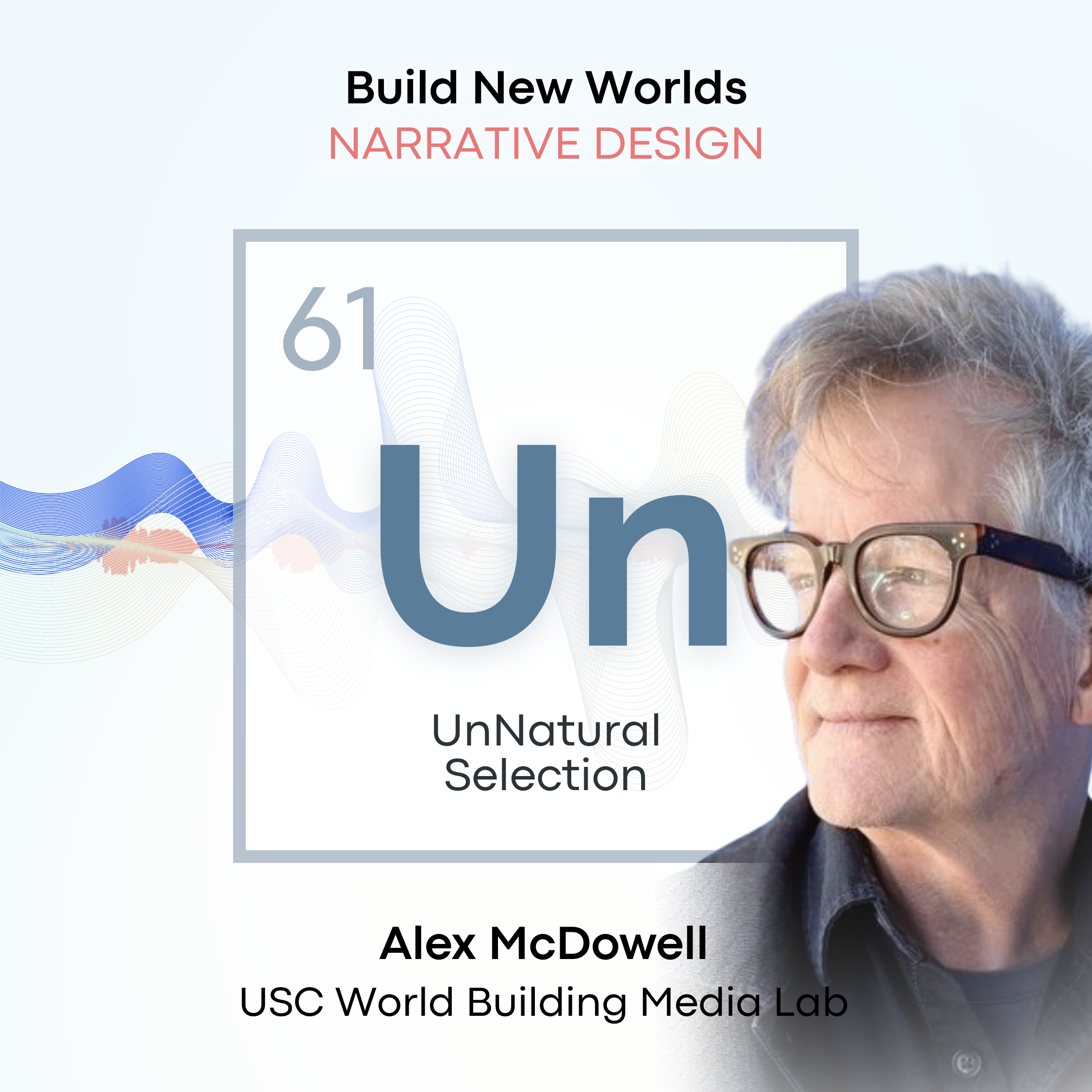
Future-Proofing Strategy: World-Building Over Product Cycles
What if innovation isn't about inventing better products – but about designing entirely new worlds?
In this episode of UnNatural Selection, Nic Encina sits down with legendary production designer and futurist Alex McDowell, whose groundbreaking work on Minority Report helped pioneer modern world building and accurately anticipated technologies that would shape our future.
From Michael Jackson and Queen to Steven Spielberg and USC, Alex's career has been built around one question:
How do we imagine futures that don't yet exist?
Together they explore:
Why storytelling is humanity's oldest innovation engine
How world building became a methodology for corporate strategy
Why multidisciplinary teams consistently outperform isolated experts
How AI changes creative work without replacing human imagination
Lessons from Hollywood that every executive, entrepreneur, scientist, and educator should know
Why the organizations that survive disruption don't predict the future – they build it
If you've ever wondered how companies should innovate in an era of exponential change, this conversation offers a fundamentally different way to think about competition, creativity, and the future.
-
Nic (00:00)
Alex, welcome to our natural selection.
Alex McDowell (00:02)
Thank you. Pleasure to be here.
Nic (00:05)
It's an honor to have you here. I know that we were connected because of your work in world building, which we'll get into in a second, but you've worked with some icons over the last few decades, Michael Jackson, Queen, Madonna, and so on. so I think we'll try to expand this conversation because I remember growing up seeing those videos and it seemed like every new wave
of videos innovated on something new. They were all pushing the boundaries and something that really redefined what videos meant to us in the early days of MTV and VH1 and so on. But before going down that path, I'd like to start with a foundational question that gives the listeners an idea of what drives the work and the body of work that you've been doing. So please, can you let us know what need or impact drives your work, Alex?
Alex McDowell (01:03)
Yeah, I mean, I think to start with, to say that I only ever work on one job. I think that I've been doing the same project since 1975. I've just asked a lot of different people to pay for it. What drives me, and first I'm a designer, so my through line is design, and I'm coming to design from the very beginning of working with music videos through film through.
Nic (01:18)
Yeah
Alex McDowell (01:33)
the work I'm doing now through storytelling. So that combination of design and storytelling, it's been proven to me and obviously to a large audience over and over again that you can create major change when you engage an audience at any scale of any type through that lens of storytelling.
My particular focus is on the power of oral storytelling going back, 10,000 years where storytelling was designed to make change fundamentally. was absorbing information, knowledge, data, the person who's killed by a snake, their brother standing next to them wants to tell you that snake is poisonous, that information transmits through the tribe, transmits horizontally.
And then most importantly, the accumulating knowledge from the oral storytellers and oral tradition starts passing that knowledge down through generations. So I feel that, and this is what world building is about, my kind of core practice, is that we are tasked with continuing that very broad sweep of knowledge.
And I believe we're only here today because of storytelling. That origin is distribute knowledge, create metaphors for that knowledge, create ways of changing complexity into comprehension through the very power of storytelling as ability to create empathy with an audience. And then transmit that down through all of the generations to now so that we become more more adept at negotiating.
Nic (03:23)
Yeah, it's a... please go ahead.
Alex McDowell (03:23)
Yeah,
think the other piece of it, which I think is crucial, is the West, since 1440, when the printing press kind of slammed down, has created a fundamental difference in what storytelling is for. I think it became a propaganda tool, it became a way of distributing knowledge from
single authors from people who wanted to send a directive out into the world, highly pyramidic, it's highly proscenium, someone's on the stage, we're waiting in the audience telling, being told what to do, and I think that linear storytelling and that lineage of now we are going to tell you what to do, not we're going to listen and transmit information that we accumulate and sort of democratically distribute it. So I think one of the
Tasks in my life is how do you build a platform back that is collaborative, co-creative and highly distributive and does not rely on this pyramid extract.
Nic (04:38)
It's funny because so much of this show focuses on the roots of communication. at the core of it, it's really the idea that human evolution at this point is much more aligned with societal evolution than biological. I mean, our genes can't evolve fast enough to help us adapt to the environment that's changing so quickly. And so really a lot of what defines our
health, our culture, everything around us is defined by societal evolution or cultural evolution. And you hit it in the nose with looking back millions of years ago when humanity first started coming up, those stories are the things that really kind of united us. In fact, you can probably see up here in the corner, I have a cuneiform tablet, right? It's a...
in my mind, just some of the seminal innovations in human history that have defined the course of human evolution. And obviously that was the very first time that we formalized the storage of knowledge in a way that could escape the human mind and become something that was parallelizable and then something that could be transmitted across generations. And so, so much of what you said actually resonates because
As our careers evolve and we become more leaders in our fields, we realize that the value of storytelling permeates everything that we do. It's not just a way of putting the pieces together, but it's a way of bringing people together and aligning with a mission and identifying with what you're trying to accomplish. And I've had conversations with everybody from chiefs of NASA to people building video games for Xbox.
And it's the same unifying story, which is like the story and the narrative is so critical for bringing people together to do magical things.
Alex McDowell (06:38)
Yeah, that's right. The interesting thing and I think the unique place we are now, I think we all understand that something has happened around us that has never happened before to an extent that, you know, to an exponentially larger extent than it ever has before. think it's reasonable to say and the pace of it is changing.
at an exponential rate that is never before. Yuval Harari said something I'm going to misquote, but basically the stories that we were brought up with, that we've become accustomed with, to no longer apply. And that we no longer have the stories that we need in order to survive. And I think that's a crucial recognition we have to make is that that notion of tradition
is actually massively disrupted. And I think we remain in connection. We remain bounded by generations that feel as if they still know what they're doing. And I think that that is absolutely untrue. And I think those people who say we have always done this way so it's the right way to do it, and we have all been in industries where that's been true, are not going to survive. And they're not
no one is going to listen to them anymore because it's not applicable. does not help us navigate to negotiate the world.
Nic (08:10)
I'm assuming you're speaking about the the AI revolution
Alex McDowell (08:14)
to an extent, but I think, you know, it's the social media revolution, it's the way that our brains have had to be rewired to understand a completely different form of negotiating storytelling, negotiating the way we communicate. I mean, the through line of all this is the human. We never become less stupid, you We remain in our own...
world space, you know, and I mean that in the nicest possible way. And it's our survival is that we do not adapt, we do not change beyond this kind of intuitive machine that we are, this ability to kind of ignore good sense and just keep on going. And it's sort of what catapults us forward. And I think that's what innovation fundamentally is, that we pay no attention.
to what we've been told. But it's much more crucial to understand that we have to reinvent. Innovation is something that is now fundamental. It's not building a new machine, it's building a new world. And I think we come to that very much with the understanding, again, my world of discipline, because it's multidisciplinary, very, very important, distributed.
is that we start with knowing nothing and we reinvent the rules for every challenge that's set in front of us in every world, condition, every life experience in front of us. We have to be open and agile to kind of not being bound by what we know. So I come to every project with, as a blank slate, as like really I do not.
the answer to what I'm being asked. I come to corporate projects that are very highly funded saying I have no idea. That it's my job to discover what the actual issues are and then to allow solutions to evolve and to discover, absorb knowledge and distribute knowledge with a very, very...
highly talented, highly experienced group around me who can bounce off each other and say, okay, we're getting ourselves towards a solution that is completely different than the solution we found for the last project we took.
Nic (10:58)
Yeah, it's funny how the more experienced you are and the more senior you become, the more confident you get in just saying that, I don't know. when you first start, it's like you feel the need to know everything. You feel the need to convey that confidence and for the right reasons. And then you get to a point in your career that you're just like, I don't know what you're talking about. Can you please explain again?
Alex McDowell (11:22)
That's right, and that is the benefit of your 40 years experience, or whatever it is, you can just go very calmly into a situation that is entirely unfamiliar and know that...
safety nets all around you, which are basically the people you collect and gather to you and who are willing to engage in that set of that kind of mindset. And they are what allow you to move forward. that's that actually, fundamentally, it's that ability to collaborate and goes back to the idea that we don't...
You know, we operate, I think, on two levels. One is absolutely non-hierarchical, which is we sit in a room, we sit on the floor with a group of people of very diverse disciplines, and we listen carefully to each other and we exchange. And then when we kick into production, which is also fundamental to my career, which is we are going to make stuff, we're not sitting here to theorise, then we kick into the very hierarchical structure.
I know what I'm doing and I'm hiring you who know what you're doing, etc. etc. so that we actually get stuff.
Nic (12:40)
If we pull it back for a second for people that don't know what world building is, can you tell us a little bit about, just in practical terms, what is the craft of world building?
Alex McDowell (12:55)
Yes, it's evolved, I would say, kind of very specifically located in time space with a film line design called Minority Report. And the very unique conditions of Minority Report was there was no script when we started. So we were in a place of research and a gathering of knowledge. as a
Nic (13:04)
Mm-hmm.
Alex McDowell (13:20)
part of that process and the outcome was we gathered what I would call a spherical set of knowledge. We didn't know where that story was going to go because we didn't have that script. So we gathered a lot of information to understand the context within which this story was going to evolve 50 years in the future of Washington DC, pre-cognitive beings that were going to disrupt the way that stories were, or that all this story was told. And that
we realized was a world, you could legitimately call that kind of gathering of information, that better understanding of Washington, D.C. 50 years in the future, down to the way in which cars functioned, we're all working within a set of logic and rules that apply to this particular world space. And at any scale,
what we've evolved since then, since that was the year 2000, we've evolved a process of asking questions, gathering the specific and unique knowledge that those questions demand, and then applying that knowledge to a very holistic and
spherical and a process of taking the outer context of this world and then moving in towards, a metaphoric sense, the city, the district, the neighbourhood, the street corner, to just in fine detail understand the rules within which that particular set of humans in that particular set of circumstances are going to behave.
Nic (15:02)
You could take this in so many directions because oftentimes when I interview people, they're innovating on a product line or a specific field, molecular biology or something like that. In your case, you create worlds from scratch.
And what really kind of threw me off for a second, you just said, you said when you started Minority Report, there was no script. So you literally had to create a world from scratch with actually with very little direction, in fact. So you had endless directions that you could take it. But you obviously had to stay on course with what generally the plot was about. And then you had to design a world that not only aligned with whatever evolving script was going to happen.
but you had to design it down to the most minute detail. And from my understanding, you even foresaw some technologies that we're kind of experiencing now, like self-driving cars and other things that, I'm curious, were these things that you did research on and you saw people working on it, so you're like, well, in 20 years we'll be there, or did he just kind of envision this and this is a story of reality following art or anything along those lines?
Alex McDowell (16:19)
We had a couple of directives from Steven Spielberg. First of all, we had a half a page of synopsis. So here's the context. We knew 50 year, know, Washington DC in the future, in a benign future. So that was a sort of framework. This is what the story is going to become. The other thing he said, which was the kind of kickstarting of what is
core to this, is, as you say, his research, was he wanted future reality, not science fiction. He wanted the world that we built to be believable to the extent that it was not perceived as fiction, but perceived as our future, as humans in that situation. And so we couldn't rely on the standard practice of film.
in the fantasy space, which is you gather at that point a lot of books around you and you go as rapidly as possible through those books and you imagine this future. In this case, we had to go, okay, what is reality going to actually look like? How can we substantially deliver a reality that is inarguable, that doesn't yet exist?
So research was fundamental. And luckily, Steven Spielberg's name opens a lot of doors. So we got inside some of the early Apple research. We were working with Lexis directly. We were working with major commercials and communications companies. We spent a lot of time at MIT Media Lab, where we were
sitting in labs with access to the very earliest stages of research and development that were going to turn into significant changes in the world. And we were 10 or 15 years privileged in advance of that sort of delivery, the production of those ideas, because we were in the labs. Excuse me. So.
Yeah, the end result was we had this, we weren't being so prescient in ourselves. We were just thinking like we have a vehicle here, which is very powerful and is able to deliver a very high resolution fictional outcomes. So if we hear this very small detail of a piece of flexible fabric that can turn black or white because the pixels go
you know, rotate from black to white, that is became the, you know, the tablet. What if that coated cars or buildings or became billboards, we could make those leaps. So yeah, we, we had to, the car has been a constantly useful reference because we had to, we asked what it would be, we asked
what would happen if you combined an elevator and a taxi car? If you had to move a very long distance vertically and a long distance horizontally, and what if that car elevator was attached to your house, so to your living room, so you step into this car and you have to move vertically, but how do you negotiate vertical to horizontal? And there was just some car design and physics and...
pure engineering involved in how you need to create a car that can rotate and make those that kind of four dimensional transition. And that taxi cab piece was why should I have to drive? So we did by a series of kind of logical steps get to the autonomous vehicle. And in the end, it is said that there's over a hundred patterns that are associated with
Nic (20:24)
Hmm.
Alex McDowell (20:32)
products or components of the storytelling and minority report because we went through the steps over and over again. And again, we were just using narrative logic. We said we have the ability to leapfrog into the future. So we're unconstrained by some of the reality of, what is it actually going to say to produce this card? But we were
Nic (20:37)
No way.
Alex McDowell (21:01)
substantiated by this is real research that we can go deep into. So we hired extremely innovative engineers into the company. We hired architects into the company who had never been engaged in filmmaking. We worked with DARPA and looked at their military development of non-lethal weaponry. You know, we were...
every question we asked was really just stimulating a conversation with a high level of innovators. again, I'll say again, it was just a highly privileged place, but it's driven by that first question is like, is future reality? And then it kickstarts a process. that's when after we saw my narrative board after it was completed and realized we'd built a world.
We also realized that we could have extracted any number of different outputs from that. We could have invented or developed a city. We could have gone directly into urban planning. We could have gone into car design. We could have gone into the sort of targeted advertising when you see Tom Cruise being targeted by posters of American Express all the way through his journey.
Nic (22:23)
Mm hmm.
Alex McDowell (22:25)
And so, and that led to our process now from continuing that in film to working with Ford and Volvo and Nike and a lot of corporate clients, all of whom were asking those questions about a future that they didn't have access to. That we could go in and ask those logical questions essentially and learn enough about the present conditions.
Nic (22:46)
And.
Alex McDowell (22:54)
by going in and saying we know nothing about the production of cars in the Ford factory process and get to work with Jim Hackett and work directly with the CEO and the executives and then say how does an autonomous vehicle impact the human condition in new cities.
Nic (23:15)
Yeah,
that's incredible. It must be really hard to design a world that's a future state that is also believable. And I'm thinking about this because if you would have described to anybody 20 years ago where we are right now in reality, they probably would have said, I don't believe it.
And so then to actually do that and still design a world that people are like, yeah, you know, that seems like the right thing. It's got to be really hard. And when we think about modern technologies and the course of at which in the pace at which technology has been evolving over the last 30 years, and I've been a part of it, I've been on the tech side. So I was part of the Internet revolution and then the browsers and then digital and then now AI. So.
Alex McDowell (23:43)
with
Nic (24:10)
As a computer scientist, I've been through that. And so I've experienced those massive leaps in how it unlocks human creativity and innovation. But then I think about your job in absorbing these technologies and incorporating it into world building. Does it make your job easier or harder? And the reason why I ask this is because if it's evolving slowly, can imagine, imagine maybe that's easier because it might be easier to imagine where things will be in 10 or 20 years.
versus if it's going really fast, like who knows where we're going to be in 20 years. Or maybe it's the other way around. Maybe because there's so much technology, you and your team of experts can sit around and really start thinking about where this could go. it, or am I onto something here or am I just kind of conflating things?
Alex McDowell (24:57)
No, it changes, radically changes my process and how I have to adapt to, you know, kind of concentration of the skills I have and people, I mean, I have into like, we have to really be agile, you know, we really have to. And this notion of imagination and storytelling, which is,
completely free. There's no place that we can't go. It doesn't use any sort of constraining resources to be imaginative. But it requires the development of this sort of absolute logic. So that doesn't change. By the way, it's worth saying that one of the things we did not predict in Minority Poll was the cell phone, which was kind of significant. We probably
Nic (25:53)
Kind of a big deal.
Alex McDowell (25:56)
I think it's probably legitimate to say that we anticipated AI or some of the consequences of AI. But yeah, so it's definitely for sure, you know, one will miss and one will go the wrong direction and not come up with, you know, what does it ultimately evolve. I think
it's, you know, working with the right people in the right context. I think you can say that storytelling has always influenced those futures. So once you go into that future, build something convincing enough, allow the people who commissioned you to build that future to step inside a place that doesn't yet exist and see themselves or see the pathways that they are moving towards. And a lot of the time, understanding that those pathways are not going to play out very
And I think that's something either in an incremental level, I mean, working with brands where we could say, what if these things change? Well, what if AI produces environments that are so convincing that I don't need to get on a plane to get to where I want to go? What if...
you know, the way in which transportation would be an element of this, you know, how if transportation changes radically, maybe companies need to radically change the way in which they consider their core product. So it's a powerful component, but that's not answering your question at all. I think that I'm now in a situation working in production facility, working in this very
exciting new company called Makemake, who are allowing innovation to happen on a daily basis and not saying this is how we do it. Very, very liberating, know, where they say world building should be the fundamental way we think about every step of our future, including tomorrow. Now we're working with AI where we're developing solutions.
as a set of production tools, which is where I'm interested in working with AIs, how do you extend it as a, or how do you use it as an extension of your capability and just know that you have more intuitive or more finely tuned ways of addressing problems. But we are now creating production solutions that are
getting to conclusions in four days that would have taken four months. So what that does is it doesn't remove the creativity at all. It actually focuses our ability to put our real skills, the sort of human intuition and the stuff that we have no idea what it really is, but we apply it to everything into an alliance with a set of...
Nic (28:41)
Mm.
Alex McDowell (29:06)
tools, know a set of capabilities and possibilities and all we have to do is say why does it not do this and now what we're saying is why does it not do this and we're reprogramming it, you know, we're writing code for that and a day later it does do that. So
Nic (29:14)
and
Alex McDowell (29:25)
You know, I think one of the things I think we can observe about AI is people are not being sensible about its value. They're just saying, it can do this. So I'm going to do this because it can do this. So I'm going to make bad art because it's making bad art, know, as opposed to just re just, just imagining it as an extension and one that allows us to be.
Well, again, it allows us to focus what we're actually good at. So there's no question. Well, it's not even important to go that way. Everyone talks about the job loss, cetera. But so what was I going to say? Oh, just that what we do in that space of storytelling and imagination, we have to hold on to the first thought we have.
So it goes back to that having the confidence of walking into the room knowing nothing, but also the confidence to know that you are going to make a decision in the moment that is going to be valuable. It's going to move things forward and not second guess it. And that requires everyone in round you, the collaborators, et cetera, to have great trust in one another, to listen much more carefully.
and to react much faster, but all of them just tuning the skills that they already have. But that sort of agility, which, but you know, we are trained in film and it's something that people don't fully understand who are outside that industry. That the ability to turn on a dime and work in a new set of circumstances that have never existed and...
Nic (31:01)
Mm-hmm.
Alex McDowell (31:20)
be so agile that the director can come in and say, actually, didn't mean any of that and we're shooting tomorrow. And reassemble all the components you have and solve it on the spot. I've never worked in an industry that's even closely capable of what the film industry is capable of doing when it puts it to good use. Every time we see a bad movie, we know they didn't take good
Nic (31:49)
You know, you said a couple of things there I'd love to unpack because it sounds like you work in teams, obviously when doing this and you've mentioned it a few times and and you're you're starting oftentimes with but a fairly vague idea of what you're working on and you said earlier you bring these multidisciplinary teams together. Engineering experts, car experts, people from NASA, whatever a whole bunch of people into the room that
may not even speak the same language, right? Some could be engineers, some could be biologists, and there's certain syntax and language that they use that are different. Some could be economists and so on. And yet, as the leader are tasked with creating magic out of that. the reason why I'm diving into that is because I come from the health and life sciences, and there is no shortage of projects with interdisciplinary teams where you're tasked with very complex things.
So much of the world is becoming that really a lot of the interesting problems require multidisciplinary approaches. And yet it's, hard, it's hard getting people to really collaborate, building the collaborative spaces, the teamwork, the ideation and all the things that go into your world. But that also maps into other areas. Since you've been doing it for so long and so extraordinarily well, what have you learned over the years that's made you
more capable of doing it, where you've just become better and better and better at doing it. Any tricks, any processes, how do you approach these things and say, okay, I'm going to be working with these highly disparate people that have never worked before, let's create magic. And you know, what's your approach?
Alex McDowell (33:33)
Well, we put in front of you something that you know intimately, which is molecular biology. So I've spent the last five years in my lab at USC being tasked with creating a new visual language for molecular biology. so if you want a more disparate set of people around the table, you couldn't find it, know, crystallographers and game programmers.
on opposite side of the table. you know, the Rosetta stone of that is the visual language. and actually the solution, the Rosetta stone in that project was folding, was that we understood as architects and biologists understood, molecular biologists in terms of proteins, that folding was a core component. And as soon as you understood that as a structural element of the way in which you
define language, you can move from the ball and stick model to a VR focused set of building blocks, in this case tetrahedra, that can be assembled in an infinite number of ways, where the center of each one represents the amino acid that has a coordinate from the atomic coordinates of a
of a protein data bank and assign a location for that in space and each one of those fits together in a way that accurately represents the protein. You've brought together disciplines that it's impossible for me as a designer to understand what an atomic coordinate of protein is.
It's of impossible for a biologist to understand that they can forget the ball and stick or the ribbon model and know that it's possible to create an entirely new and more accurate set of model, know, model based on data once we both see what that looks like vision. And I think that, you know, in that project, we work together like meeting twice a week for five years between the scientists and the artists.
to fine tune and be allowed to make no mistakes whatsoever by Dr. Helen Berman, who invented the protein data bank, is sitting next to us at the table going, don't even think about trying that. So I feel like that project is to some extent the quintessential answer to what you're saying, which is that...
Nic (36:12)
You
Alex McDowell (36:25)
Creating the ability to solve problems across disciplines is finding the common language as you say. I think knowing that story is a common language and the picture is a common language and sound and all the other components that allow us to go into say a cinema and take it on and not need to listen to the words necessarily to understand it.
And you know, our verbal language is a pretty big obstacle to understanding each other. So can we become sophisticated in a kind of real time interactive set of moving components that can be manipulated by anyone and the solution is visible. It fails or it succeeds based on the set of decisions you make.
And this comes back to AI is that real time thing. You know, we can try it and see it's wrong. a big part of what I use AI for is to see how badly it can make a decision. So I can say no, because that's, you know, that kind of idea of what it shouldn't be. It's probably more useful than knowing what it should be because you're going to miss it.
Nic (37:39)
Mm-hmm.
Yeah. So it sounds like aligning people around the common language and vision or story of what you're trying to accomplish is the first part in locking their creativity around working together.
Alex McDowell (38:00)
Yeah, and the ability to tune that because it comes back in this very sort of fundamental collaboration and listening is you maneuver your way towards solution because you've been influenced.
every step of the way by each other, by people who don't know each other's motive, language, ability necessarily, but equally committed to the solution. And they're so going to say, yeah, but you know, why not? And, and I've never been in a world building and we've done, you know, hundreds now that hasn't moved forward, you know, that they've never collapsed because there's such an investment in them.
reaching an outcome that is equally important to all the participants around the table, whether it's a bunch of kids who want to use 3D printing to make a model of their school or something to the molecular biologists or to people looking at the future of civil engineering.
everyone invested in that and step by step you move towards it knowing that you can tune it you're not going to shy away from the possibility of throwing out your ideas on the table I guess. it comes back to the fundamental of not telling people what to do but listening to them and knowing they know better.
Nic (39:34)
Yeah, that makes sense. it's making sure that everybody's aligned on a unifying mission, which is that story. And then from there, giving them enough freedom to operate with a trust and the safety to be able to do so in these highly charged and highly intellectual environments, which aren't always super safe because high intellectual people tend to be very judgmental sometimes. So you've got to create that environment that people can ideate.
But it always really boils down to the story, right? It really comes down to that. And in its essence, it sounds like to me, what would you do with this world building? It really is, it's storytelling. And you started with that. It's storytelling with a visual element. And that story starts, it's more than like a single thread. It's about a story that builds into a whole world and in such a way that it makes the observer.
feel like not only it's real, but they're almost like living inside of it, right? And so there's like an enormous amount of psychology that goes into your storytelling format because in a way, again, like Minor Report or any number of other projects that you've been a part of, it's not just people watching from the outside. It's like at some point they almost feel like they're along, like they're part of the ride, right? And I've seen movies, I've seen Minor Report and other movies where
where you when you walk out of the theater, you feel a little a little out of sorts. you almost feel like, wait, what world am I living in for, you know, the last hour and a half, I was in a certain world that my entire cognition kind of wrapped itself around. And now I'm back into this world. And there is a moment of just kind of like readjusting to the current life. And so there really is a psychological connection.
that happens with an audience and your world building storytelling that when done properly, it really does project this into a different universe. Is that intentional or is that a byproduct of just good world design?
Alex McDowell (41:42)
It's entirely intentional, yeah. And I think we're testing it because you're, the people involved in the evolution of the idea are the first audience. you're, you are constantly trying, you know, I think that my background, you you were referring to like music videos, my background is in punk music. You know, my background is break the rules all the time. And
and see where it goes kind of thing, you know. And that hasn't changed for me. I sort of refuse to follow preconceived ideas of how you get to solutions. And perhaps in a sort of punk 101 way, we start with provocation, which is on every project before we...
engage in the world, we are saying what if it turned into this? And that provocation is a motivation. And I think the then the other piece and we work well building in my design narrative design practice is is highly structured. We you know, I designed systems as much as a design kind of visual outcome.
because to your point, your systems are a kind of psychological framework within which you are able to set the conditions of evolution. And so that system starts off with this kind of...
a mandala, a holistic framework for gathering knowledge, then it pushes and I think the other important thing is that it starts at low resolution in visual terms, you know, that you go into a pre-visualisation or design visualisation at very low resolution, which means it's very rapid, which means you can change things without qualms.
And then as it moves forward, it increases in resolution in a very continuous arc of production essentially to full resolution and release, you know, production outcome and product on the market. So that is only to say that agility is not
it doesn't undermine or threaten the process because it's built in this very rigid way to allow people, I think this is a psychological aspect, to feel free to make mistakes. It's a kind of sort of mantra of industry, but to literally feel not only the ability to throw everything at the wall,
but to have a system that captures everything and tunes it. And that idea of the sort of holistic world is also why not equals a set of rules and conditions and logic.
and those become very rigid framework with that which says actually this solution now falls outside the framework of this evolved pathway and therefore it's no longer useful to the narrative so it doesn't kind of go
broader and broader because you're throwing imagination at it, which is the piece of it that demands that the people in the room are very good at what they do. Because if you don't have a very tight set of framework, a set of constraints around it, it will keep spinning off. And this system doesn't allow that. It becomes more and more precise. The precision of thinking then moves into precision of systems, which are
mechanical, know, which are now we're going to put this into a set of visual frame, you know, in mechanics like, like previs, or we're going to do prototyping. I mean, I think that's what you would call it fundamentally. We prototype from beginning to end. And like all prototyping, you're testing and rejecting, testing, rejecting until something becomes tuned.
to the point that it's ready to receive a lateral.
Nic (46:27)
Yeah, that's fascinating. As you were talking, there's so many parallels to my world. I've been fortunate enough to start innovation labs in Fortune 500 companies and even a program at Harvard in precision medicine. And one of the things that I like to always refer back to during periods of ideation with groups is the idea of there's a book by Edward de Bono, Six Thinking Hats.
where the idea is that you wear different colored hats as you progress from stage to stage in a project. Because one of the challenges with groups is if people aren't in the same stage, one set of people can squash the creativity of the other. Like for example, if you're in a white space of all ideas are good, if you have one person that's just shutting them down, that's the easy part. It's really easy to just kind of like exhaust.
the people that are coming up with truly unique ideas. That's not to say that somebody that by default wears a black hat won't get to that, but this is not the time. And so the idea here is that you start with a white hat, which is only yeses and ands. So you build up all ideas, knowing that you're going to go through the green hat, which is maybe the economics. Can we do this? Is it financially feasible? You're going to go through like the yellow one, which is maybe technical all the way to the very last one, which is the black hat, which is like, okay, now there are only nos and buts.
And if an idea can make it through this entire process and come out the other end, then maybe we have something that's worthwhile. But everybody gets their time, but everybody's on the same wavelength so that you don't squash something before it's due course. And it sounds like you have a very methodological process for that because like you said, you can't have just endless amounts of ideas because then you just never get anywhere. You have to have a process, but you also can't kill ideas before they have their chance to blossom.
Alex McDowell (48:20)
Yeah, yeah. There's a piece of and I may be misinterpreting what you're saying, but I think there is a logical what is, you know, in production terms, I would describe as the Victorian industrial ethos, which is we're going to go through these sets of different stages, and each stage is going to deliver to the next stage. And I would...
Nic (48:45)
Mm-hmm.
Alex McDowell (48:48)
and do fundamentally dispute that, that we work in a circular system where all participants are at the beginning and you know what the questions are going to be from the people who are going to paint the car or, you know, put in the windshield. We're going to have their questions when we say what the, you know, the outline of the car is.
It's this idea of what I would call a node-based development practice, a production practice where, and at the corporate level more and more, it's to do with agility, but it's to do with gathering resources that are necessary for the early stage thinking that are going to be thinking just about the backend, the final stage.
And that's the kind of multidisciplinary thing on a horizontal level, bring the experts. But in a vertical, it's bringing everybody who's going to be responsible down the line and all of their ideas and challenges are going to have a significant influence.
we have to undermine that Victorian industrial process in film.
And that's what we're doing with Makemake because you fold together the knowledge of multiple industries and you start solving that and you think about this circular prototyping as an evolutionary process as opposed to write the script, you know, and that's what we learned from minority input. Just start with the script. You've already eliminated everything around it. You've already decided what the end is going to be. And that's of no value whatsoever.
Nic (50:39)
Mm-hmm.
Yeah, it's, you know, I was going to ask you before, but you already answered it. I think that you've covered so many industries. You mentioned punk rock, major Hollywood productions, even academic research labs. So it's a huge span and across all those environments, you know, I was going to ask what single most consistent creative tool or mindset you relied on. But I think you mentioned that, that you start with a provocation. You start with like a what if kind of scenario, which is really interesting because
I'm in the, like I mentioned, sciences and technology, and I'll be, I've said often, and I'll be the first to admit, sciences are really bad at telling stories to the general public, like because we're so used to writing very technical scientific papers that are very inaccessible to the general public, not intentional, not because we don't want them to read them, but because there's a methodology for writing papers that are typically written to be judged by other scientists or other technicians.
But what that means that is some scientific discoveries like climate change or other things that are really important do need to get to the general public because the public needs to absorb these and actually make really important policy decisions or life decisions based on this information. And yet the story often falls in the hands of scientists to do that. And it's, it rarely happens well. mean, we think about COVID and the messaging around that. So given your
broad span and obviously experience in storytelling in the sciences, did you pick up any kind of ideas on how science could be conveyed better, what you would do better or mistakes that sciences do in messaging that maybe should be done better, especially in critical situations like a pandemic or climate change?
Alex McDowell (52:34)
It was definitely remains fundamental part of the conversation within this molecular biology pancreatic beta cell conversation because our job is to create the stories.
And yet part of our job is to launch those stories to see what the feedback is going to be, to sort of understand the context within which those stories are going to play out. And so we, and I completely respect that need for peer testing that comes out of the kind of white paper method or evolution. But yes, scientists are terrible at telling stories.
And it's that perhaps I'm taking a leap way outside my field, but I think it might be the inability to allow for the fact that it's okay to be wrong. You don't need that peer recognition from the start of your first sort of innovative prototyping ideas, even if that's 10 years of work.
we need new systems of testing but also receiving or outputting.
say guess but essentially best guess. know, COVID is a great example. I COVID, it combined with the agility that we have as storytellers to be able to tune it and not change direction but to say this is what we know now, let's look at see how that knowledge evolves. I think that if we had
put world building at the front of understanding that the pandemic existed at all and pooled that knowledge and information, we would not have come out with a little red thing with spikes all over it as the description of COVID. that, you know, a lot of people
don't need to be great storytellers, but they need to be ready to collaborate with great storytellers. And I think that's that idea of world building as a fundamental tool in the process applies to science, applies to corporate, applies to education. Because it's it's kind of from my point of view, it's a no brainer, but it's also not very. Expensive in many ways, you know, it's not expensive in time and in brain.
power, imagination, by the way money. It's a rapid iterative process and then it becomes as complex as it needs to. yes, telling stories is still the fundamental way that we survive.
Nic (55:34)
Yeah. the field that I'm currently in, I'm president of an international consortium of newborn sequencing, where we're trying to bring genomics into the newborn screening area. storytelling is going to be critical there because it's a very important area that saves thousands and thousands of babies every year in the U.S. alone, you know, scores more across the world. And yet the general public is generally
suspect, if not mistrustful of genomics and what people do with that data and governments and their access to that data. so it's going to be so important getting it right, because if we get it wrong, we could potentially ruin a whole industry that's made only to save babies from the very beginning. with that, you've been so kind with your time and I know we're at the end. So I do want to finish off with a zoom out question, Alex, around
And this is going to be potentially easy for you because we're going to fast forward into the future. Into a moment in time where you feel that you can reflect in your body of work and you can look back. And I'm going to ask you what would be a best case scenario? What would be the best possible situation and outcomes where you feel like you've achieved your fullest potential, where you saw the greatest impact?
and influence of your body of work. And that could be things that you've accomplished already or things that you're currently working on. What would give you the biggest sense of fulfillment?
Alex McDowell (57:09)
You know, I think I've referenced this a fair amount. I think it's still true. I worked with somebody from the UN, maybe 15 years ago, in a conference, actually. We were just working together for about four days. And he was working on managing a refugee camp on behalf of the UN. And he was frustrated enough to leave the UN because of this.
because they were putting people in boxes and leaving them there for sometimes, like the average amount of time people were spending at a refugee camp was over 15 years, but not allowing it to turn into something that would evolve. And there's a version, and this is sort of a metaphor, but if you could turn the conditions of a climate refugee, a war refugee,
camp into a city that was the foundation of a gathering of human people of a society that had all of the needs and probably all of the skills in the same space and allow them the ability to work together towards the common end, is just what I've been describing in any project, of building a city that would allow
them to inhabit it and would become a viable and valuable part of the evolution of that society. That would be a pretty good outcome of this project that I've been involved in in my life because I think it gathers together all of the things we're trying to learn to create change and it's a good story telling to be able to get to that.
Nic (59:07)
So Alex, obviously we talked about so much about the work that you've done before and your musical history, the movies that you've done, you've developed your skills in such an extraordinary way. What projects are you working on today? Where are you kind of unleashing that phenomenal potential that you have? What's your passion today?
Alex McDowell (59:32)
Well, one of privileges I've had since 2012 is I was invited to teach full time at University of Southern California in the School of Cinematic Arts. And what I was asked to do essentially was to teach world building. And I have been able to do that across disciplines, across a campus that is 15 schools, very, very broad range of disciplines being taught on that campus.
discover the ways in which world building is applicable and practical in very broad range of disciplines. We ended up working with the school of Michael's Michael's in school which looks at the biology that are now teaching storyboarding to their undergraduates. So we we've sort of introduced some fundamental disruptors. But
The purpose of teaching world building there is to train people in a practice that unpicks and undermines the idea that we should work in this kind of linear traditional way. We say that we're teaching people to navigate media that doesn't yet exist.
And the proof of concept right now is we're teaching a project which we call junk. And it's junk, junk of detritus essentially, you know, what, and the provocation is what if there's a society 300 years in the future living off the detritus of former civilization. And what it suggests is our world collapses.
It collapses in the next 50 years. The students have to destroy the world in 50 years. But it's not a dystopian project because they get 300 years to rebuild it. But they have to build it from the raw materials that are left behind, whatever they may be. Languages, religion, old cars, boats, whatever it may be.
And they do it within a tight set of constraints and they do it in world-building methodology. So they develop all the conditions of the world and they zero in on the characters that live in this world within this very tight set of constraints. No cell phones, by the way, the students are not allowed. Technology that they're familiar with to exist because the infrastructure collapses. There's no internet, therefore there's no fossil fuels, there's no healthcare system, there's no...
communication of any sort, can't escape to space. So you have to deal with the conditions on the ground. And their end product is an artifact, an object which carries the meaning of the world. And so they've had to condense from very, very high level global scale down to the thing that you hold in your hand that represents what has been and they've developed to be important about the world.
something that proves evolution and use of raw materials, use of junk essentially to get to that point. The exciting thing is that we're now teaching that in 20 and counting universities on five continents using that exactly the same provocation but we're teaching to all you know this is a consortium of teachers so faculty from all these different universities.
In Monterrey, they're teaching engineering. In Kenya, teaching philosophy and religion. In Canada, teaching anthropology. We've taught in schools of architecture. A lot of media schools in the Netherlands, production design in Denmark, game design, toy making in Milan, journalism in Buenos Aires.
we've discovered that well-building is applicable, I think, to anything. And so this core methodology is open enough to all of that. But most importantly, we're creating a new generation of students that are much more adept at negotiating different industries, different disciplines, different ways of thinking and moving forward.
which comes back to that original premise that the old story is no longer capable of solving our problems or addressing the problems we have now, the realities we have now, and how do we create new systems that allow us to navigate and mostly create the new stories that are necessary for the future of civil engineering.
or what kind of toys change children's lives or whatever it may be that they're thinking.
Nic (1:04:48)
That's so fascinating. So many questions. Okay, so it's like it's an exercise of world building applicable in whatever industry. It could be in genomic, no more screening for all I know. Like you said, architecture or philosophy, any number of areas. And it forces the students to imagine this future world after the current one, essentially.
is destroyed for whatever reason. And then they have to build with whatever artifacts are there. But then it forces them to work in teams and unlock their imagination, but with constraints because physics and chemistry and biology still apply. They can't make that up. We still live in a place with gravity. Right. And so now they've got to think about how maybe life originated, you know, back in the day and how that now takes course again.
for evolution to pick up again, for maybe humans that are left without modern technology, how they can use scraps of metal to do new and interesting things. It's so interesting. And then on top of that, I'm not sure if there's like a meta layer on top because now you're working with instructors across these places. Do you ever get to see the results that these students generate? Or is that opaque to you?
Alex McDowell (1:06:08)
No, all the time. We report to each other. Every class delivers to as many of the consortium that can attend. And we meet every month. So we're trying to keep addressing what world building means. So it's a very fluid methodology in the sense that we learn from those kind of challenges that are put in front of it.
Nic (1:06:17)
That's phenomenal.
Alex McDowell (1:06:32)
and then we try and adapt the system so that it can accommodate them. It remains pretty intact, the system, doesn't change a lot as a launch kind of methodology, set of tools for the student, for the teachers. But yeah, it's something we're seeing being carried into the world by teachers as well as students. We are definitely accumulating
all of that work and we're right now in the process of building the website that is the accumulation space that the archiving of all that all that narrative. The thing that I think is also interesting to what you were saying about the evolution is that one of the things that's kind of unique perhaps about this set of conditions is that engineers don't go away you know healthcare knowledge doesn't go away the tools just change radically.
And so you have this pretty sophisticated new population. know, there might have been a lot of culling, if you like, of the population based on whatever goes wrong. But the people who come into this new world don't forget what they knew, but they have to relearn completely how what they know and knew can be applied to a set of conditions that never existed.
And I think that's a lot of the interest that, you know, the fascinating outcomes, because we don't frame in any way what the story is. All we say is infrastructure breaks and you have do this. And by the way, you're on an island that is a very physical representation of constraint in an archipelago that
Nic (1:08:12)
Mm-hmm.
Alex McDowell (1:08:24)
can become anything, but you can put it anywhere. We've had students who put it in Greenland and coast of Madagascar. The Greenland one was interesting. It preempted a certain conversation around Greenland that actually came up with a lot of reasons not to do it. But yeah, it's one of the most interesting projects. I think to the sort of scope of where do I see
a part of my path, my career path going, it is how we use education to transmit new ways of thinking. And I think that that's still fundamental is that we are of no real value at the, at my age, know, the people who are going to make the change are obviously the generations coming out of schools now.
But if they're being taught in traditional methods, then they're not going to have a lot of value.
Nic (1:09:28)
yeah,
it's extraordinary. I I think about in my education, some of the experiences that I remember the most were the ones that came out of left field where an instructor had the imagination to do something that wasn't traditional and ran us through an exercise that was like, wow, that was different. And then you learn so much about the content and yourself in the process. I can imagine these students are just learning endless amounts of things about society and science and themselves.
and humanity in the course of doing this one exercise. And what keeps coming to my mind is obviously you're a master at world building. You've been doing it your entire career. And now you're seeing all these young students coming up with their own worlds. And I'm sure they're all great, but there's got to be like a gem every once in while that pops up that you're like Alex McDowell looks at and you're like, wow, this is cool.
Alex McDowell (1:10:21)
yeah, I learn much more from them than they learn from me. And I hire quite a few of them. Because it's hard to find people coming out of schools who are adept at negotiating multiple different platforms. They're being trained still in, I am going to be good at this.
Nic (1:10:27)
Okay.
Alex McDowell (1:10:46)
teaching of expertise, which is the Victorian industrial ethic. And it's not that we want to get to jack of all trades by any means, it's that we need to understand the ability to negotiate horizontally through multiple disciplines.
to understand each other's discipline and then to become adept. I think a lot of this is being conveyed in the way we have to think about AI because we have to understand its technological constraints and capabilities as well as the sort of impact of its outcome. So we are becoming more and more left brain, right brain and in my company, Makemake, everybody is needed to be that. If they want to tell a story,
like this, they have to understand how they need to go through certain steps to test that story if they're making commercial, if they're an object. They have to be able to understand how to pull all those, it's the nodal idea. If you want to be able to make the most of all of these disciplines, you've got to be able to speak their language. And so that narrative design core becomes the Rosetta Stone that allows us to.
disciplines and I suppose that's what I'm trying to teach.
Nic (1:12:06)
yeah, no, mean, in a very naive way. I remember the very moment when I was an undergraduate and I was studying all the various biologies and organic chemistries and physics. And up to that point, I think it was my sophomore year, they all were very separate fields. Their physics was just physics and math was just math. And I didn't see the connection. I was just taking them and just kind of drinking from the fire hose. And there was this moment in a biology class where we were talking about this subject.
And there was a reference made to organic chemistry molecules. And for some reason it was just one of these like duh moments, but it was so profound for me at the moment, which is like, wait, all these things are connected. And, and obviously I've lived that life ever since, but before that, I remember them being so siloed. And so I can see an exercise like this for young minds that are going through this, drinking from the fire hose, not making these macro level connections. All of a sudden being thrust into creating a world where
deliberately, now they have to start making connections to understand how these patterns start emerging and that must accelerate, project them forward in a way that otherwise they wouldn't have from just a textbook.
Alex McDowell (1:13:16)
Yeah, I think our job, I'd say, know, design is a sharp knife. Our job is to slice through the silos because...
disciplines like design are perfectly capable of flowing between silos and that's what we need to learn. yeah, you're absolutely right. And people like yourself are the ones proving that you don't have to stay in that single discipline because we're not really going to create change if we're just perpetuating the way in which we've always thought.
Nic (1:13:49)
Alex, this has been such a privilege. Honestly, it's been a privilege just having the opportunity to see the movies that you've been responsible for. We didn't get into the music, but I grew up with MTV and Michael Jackson videos when they would come out, they were a thing.
know, Madonna, I can't believe you work with Queen. It's just, it's extraordinary. You know, it's hopefully if you're ever in Boston or I mean, you already had loved to just get a drink and just hear about your stories because I'm sure that they just go on and on. And so thank you so much for your time. It's been a privilege having you here and I hope that we can catch up again sometime soon.
Alex McDowell (1:14:36)
Thank you, it's been a wonderful conversation. It's always stimulating and thank you for the questions you asked.
