
Elite Combat Sports: Pro MMA • Fernanda Araujo


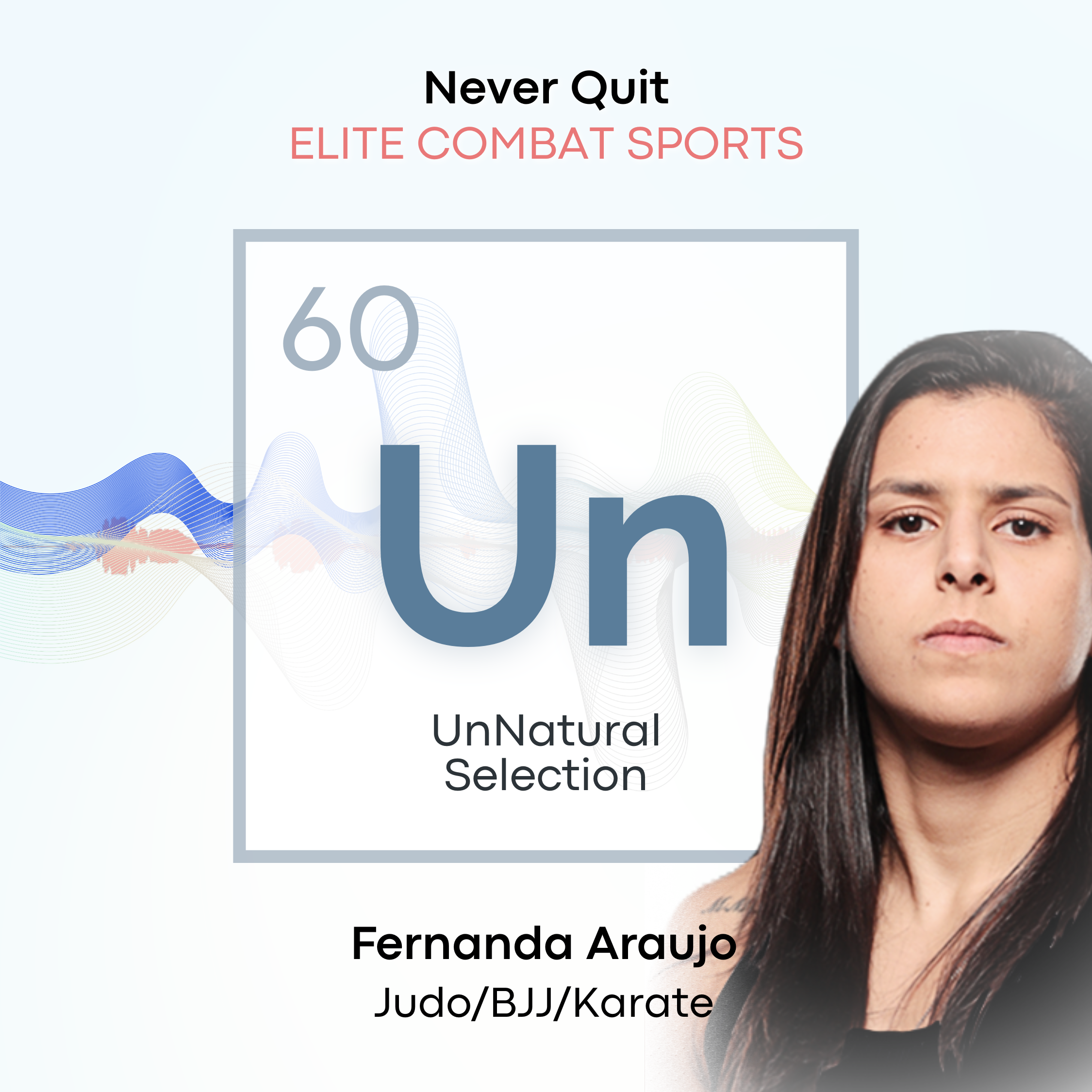
Cognitive Recovery Speed: Outperforming Raw Technical Talent
What separates elite performers from everyone else? According to world champion martial artist Fernanda Araujo, it isn't talent—it's the ability to keep moving forward when everything inside you wants to quit.
In this episode of UnNatural Selection, Nic explores competition, adaptation, resilience, and personal evolution through the lens of combat sports. Fernanda shares lessons from a lifetime spent mastering Karate, Judo, Jiu-Jitsu, MMA, and boxing, revealing how athletes develop confidence under pressure, recover from failure, and continually improve long after reaching the highest levels of their craft.
The conversation explores the evolution of combat sports, the growing role of women in martial arts, the psychology of elite competition, self-defense, overcoming fear, and why the most accomplished fighters are often the most humble.
Whether you're building a company, leading a team, raising children, or pursuing your own goals, Fernanda's lessons on perseverance and adaptation offer a powerful blueprint for thriving in competitive environments.
Because in the end, survival doesn't belong to the strongest. It belongs to those who refuse to quit.
-
Nic (00:00)
Fernanda, welcome to Unnatural Selection.
Fernanda (00:02)
Thank you. Thank you for having me. Appreciate it.
Nic (00:05)
Of course, I appreciate you being here and in full disclosure for people listening, Fernanda not only is an incredible MMA practitioner and trainer, but she's also the trainer to my children. And so we do have a connection there. But before getting started and unpacking all of that, Fernanda, I always like to start with the same signature question that gives the audience a chance to hear in your own words what motivates your work. So could you please let us know what need or impact
Fernanda (00:18)
Yes.
Nic (00:34)
drives your work.
Fernanda (00:36)
to become a better person. ⁓ It's the mentality of every day you can do better than yesterday. So that's what motivates me every day is in training, in teaching. The next day I always want to be better than I was today.
Nic (00:53)
Yeah. You know, it's, ⁓ that resonates so much because I didn't start, I, and I know we're going to unpack your history a little bit and you started very early on. I didn't start doing MMA until like five years ago. And I feel like I have changed so much as a person, not only in obviously like self-awareness and ability to defend myself, but even in, in perseverance, I, I wear, it's funny how the physicality of
having to endure people attacking you and having to fight through that. When you do it the first time, you are out of gas so quickly and you hyperventilate, you're like, my God, I can't breathe. And then you do it twice and you do it three times and you calm down and you start doing a little bit better. You do it 20 times and it becomes a different thing. And then by the second, third year, it's a totally different story. And then at some point you stop and think, I can do that in other things as well.
and it's affected my tennis game, so many other things that I do now that before I would have felt tired at a certain point, a bit like, all right, this is done. Now I'm like, I have easily six more hours to go.
Fernanda (02:01)
Yes, it's about that not quitting, know? It puts you in a position that you have to work through, that exhausting, that like mentally like, can't, no, yes, you can. So that's the beauty of the martial arts. It makes you drive, it makes you continue even though you're tired, even though your mind is telling you can't, but your body, you can do it. And so it is.
Nic (02:27)
Yeah, and you started very, very early on, right?
Fernanda (02:31)
Yeah, I started when I was three years old.
Nic (02:33)
Wow, and you started with, I think, karate?
Fernanda (02:35)
I
started karate when I was three years old. By five, I fought my first tournament. Eight, I won my first national. And when I was nine, I took third at Worlds in Japan. So I started, yeah. And then I switched to judo when I was 10. Got my black belt in karate, judo, jujitsu. I started competing five years ago, got my black belt. MMA, I started when I was 19. I had my first MMA fight.
Nic (02:48)
That's amazing. Yeah.
Fernanda (03:05)
And boxing, I don't know, maybe like 20, 21.
Nic (03:11)
That's amazing. as the bio reads, you have black belt in karate, judo, and jiu-jitsu. ⁓ Any one of those being a major feat, by the way. I know, like, I train with a lot of jiu-jitsu people, and I do partially that. I would never say that I'm anywhere close to being a good jiu-jitsu practitioner. But what I do know is that it takes a very long time and a lot of dedication to get a black belt in jiu-jitsu. I don't know about judo.
Fernanda (03:20)
Yes, correct.
Nic (03:40)
per se, but I know that you did take a long time to actually get one.
Fernanda (03:44)
Yeah, no, Judo too. It took me 10 years to get my black belt. Judo and Jiu Jitsu as well.
Nic (03:51)
That's amazing.
again, the audience that listens to this is very broad and a lot of them are professionals that probably never even tried MMA or Jiu-Jitsu or Judo. Can you give us a quick overview of the broader combat sports as like a sport, as an industry, ⁓ and especially for people who only see like the things on TV?
What is the world of a professional elite combat sport athlete look like for people that don't see behind the scenes?
Fernanda (04:32)
Oh, it's a lot of training. It's a lot of sacrifice. It's a lot of pain. You know, you only watch what depends on the mat is like 15 minutes inside of the cage. But behind the scenes is hours and hours of training. I stand up grappling, conditioning, weightlifting, diet because we got to make way to. So it's a lot of sacrifice. You know, it's to be in
Nic (04:36)
Yeah.
Fernanda (05:01)
professional athlete. He consumes, we're more in the gym, most time in the gym than in our home, our own home, you know. So we live in the gym.
Nic (05:10)
Yeah.
yeah. Yeah, it's, you know, you hear these people that watch these MMA fights and then they, obviously everybody has an opinion and then they see a fight go one way the other and like, I could have done better than that. And you hear that and you're like, you have no idea. It's...
Fernanda (05:28)
Yes, yes,
you get a lot of like, like I'm a fighter I did like street fight But and then like I want to see you last for five minutes inside of a cage, you know Yes, yes, yes You know you get that lot it sometimes it's frustrating but like we got to understand that they they don't they don't know they don't realize it's easy for you to sit behind a TV and make
Nic (05:42)
against a professional.
Mm-hmm.
Fernanda (05:58)
and criticize and make and say what they whatever you want to do but once you step there that's a different game you know that's why not a lot of people do it
Nic (06:05)
yeah.
yeah, well I mean again, I can only relate from my perspective and what I can say is before doing it at the studio that I do it, I thought that I knew even the simplest thing like how to throw a punch. And I realized, you realize very quickly I did not even know how to throw a punch. I didn't know how to stand, I didn't know how to throw a punch, I definitely did not know how to defend, I didn't even know that I could use knees or elbows or heads, all that stuff became new to me. And so like.
Fernanda (06:21)
Yeah.
Nic (06:36)
When all that is new and you have no idea how to use it all in combination against different attacks by different opponents, it's it's flabbergasting that people think that somehow that magically comes together if they need it.
Fernanda (06:49)
The fun fact is you don't even know how to breathe. People think that people that doesn't know, they're hold their breath and they're gonna and then they get out in 30 seconds. So I think the most important thing right there is learning how to breathe and have that like stamina, be calm, you know, because it's not about just rage. It's about a lot of thinking.
Nic (06:52)
Yes, exactly.
Mm-hmm.
Yeah. In fact, rage often works against you, right? I remember when I first started doing this, when I was doing the initial phases of Jiu-Jitsu, when you don't know what it feels like to have a 250 pound male just laying on top of you, you can't get that person off. And before you know, you start hyperventilating, you start losing your air and you literally feel like you're going to drown. You feel suffocated and there's nothing you can do about it in that moment.
Once you learn how to do the different things, then you might, right?
Fernanda (07:44)
Once you learn, you know
that like it's not about strength or how big you are. It's just about how you use your body and their body momentum to get yourself out of any position.
Nic (07:48)
Yeah.
Exactly right. Yeah, I love it so much. And again, it's not I don't do it professionally, but it has taught me so much about different factors of life. But if we go back to the focus of the show is innovation, evolution and and then how that maps to other things. Combat sports have been evolving like anything else, and they evolve very quickly because as soon as somebody brings up a new technique like the Gracie's bringing up Jiu Jitsu, then everybody's got to learn it. And and then as well.
I think travel, the ease of travel has made it so that the sports have had to evolve too because now it's easier to bump into somebody that does Muay Thai versus Thai boxing versus Jiu Jitsu versus Judo. Whereas before they were more localized, it was harder to find those people because it's like, those people do it in Israel versus these people do it in Thailand. Now it's everywhere. ⁓
Fernanda (08:47)
Yeah, it's beautiful.
It's the beauty. Yeah.
Nic (08:50)
You're right. It's
really evolving so quickly. So from your perspective, and you've seen it in multiple different angles, you've seen it not only as a whole field evolving over 20, 30 years, but also from the perspective of a female, because traditionally has not been a female sport, obviously.
Fernanda (09:09)
Yeah, I know. think it's just we're taking over and we're stepping in, as you said, it's a men's environment. little by little, we're getting our spot, our spotlight, and we're showing that we women can fight too.
Nic (09:27)
Mm-hmm. I know it's ⁓ But you know if it was I'm trying to position myself in your shoes when you first started though, right? Because I mean if I wanted to become going to MMA 20 years ago I probably just go into like probably less MMA gyms, but I would have found one and then I would have found 20 male people to practice with you being a female ⁓
It was it probably wasn't as easy to just go and find somebody to train with I mean How do you break into a field that was probably at the time all male?
Fernanda (10:00)
Yeah, when I started with karate, was one of the only females competing. So I used to have to compete against boys in the beginning. Yeah, until when I was a little bit older, there was more girls and then I was able to compete against girls. And even nowadays, it's still like, we're growing. There's definitely in our BJJ gym, we have more girls sometimes than guys in a class. So it's a shock. It's not, you don't get that a lot.
And most of our training partners, my training partners are male, besides my wife, because she's a top athlete too. But most of my training parts for MMA, they're male. I barely have any female to train MMA.
Nic (10:48)
Yeah. And I would imagine that most of the people that you compete against have to train against males as well, right? So it's like you're training with males and then fighting females. When you get into the ring, does that change anything or it's just athlete against athlete?
Fernanda (11:06)
It gives us little bit of more like strength, know. Men are biologically, you know, you can't compare. So give us a good way to train, be a little bit more tough. But once you get there, inside of the mat, it doesn't change much. know, yeah, it's female against female and they put their work into, you know, so we're in the same level.
Nic (11:34)
And I guess I'm gonna ask you an unfair question because it's kind of like asking somebody who their favorite child is But you have multiple black belts across all these disciplines Do you have a favorite judo jiu-jitsu karate boxing MMA? Is there like one that you're like? this one has my heart
Fernanda (11:53)
My Jiu Jitsu, of course, is my wife. She's amazing. She's a world champion, you know, black belt that inspires me every day. For MMA, I love Kris Heidberg. You know, she's one of the pioneers of a woman's MMA and she still fights. And I remember I was in high school when a professor showed me one of her fights and I was like, my God, I'm moving to America. I'm going to do MMA. ⁓ Judo.
Nic (11:56)
Uh-huh.
Fernanda (12:24)
I love Kayla Harrison. I used to train with her. That's why I moved from Brazil to America to train judo. ⁓ boxing, I love Canelo. He's amazing. Good full work. Yeah. Yeah, I think, yeah.
Nic (12:38)
Cheers.
And one of the things I guess is what I do in the practice that I do is more self-defense. And so there's no lines, there's no boundaries, right? There's no rules on how to do that. When you train, there are very specific rules in Judo and Jiu-Jitsu and karate and so on. When you step into the ring,
How does your brain process that, especially in the heat of battle? Do you find yourself sometimes kind of like using techniques from one to the other? Does your body naturally just do those things or can you stick to within the boundaries very easily when you're in that mentality?
Fernanda (13:21)
I because I have focused so many years in each martial arts I think my brand already a lot of people ask me that my brand is already shut down and like I'm in jujitsu all I can do is this I'm in judo all I can do is this MMA all I can do is this boxing so I don't know it's just that switch that comes in my head from all those those years training and focusing so I don't have yeah it doesn't I don't
It doesn't change for me or anything.
Nic (13:55)
Yeah, you've been doing it for so long, it's just second nature. You're kind of like either in karate mode or you're in jiu-jitsu mode. Although judo and jiu-jitsu are somewhat overlapping,
Fernanda (14:06)
Yes, you have the groundwork that's similar, but even though judo it's more a stand up. So yeah, and then when you hit the ground you have that 20 seconds to show that you're trying to submit or pin someone. then, no, no pulling guard. then those 20 seconds, they stand you up. And you did you.
Nic (14:23)
Yeah, there's no pulling guard.
Yeah, I see.
Fernanda (14:33)
is that stand up, you start standing up and most people can pull guard too. And then it's most on the ground. But yeah, they overlap, one help the other, that's for sure. The Jiu Jitsu base gave me a lot of good fundamental for my Jiu Jitsu journey.
Nic (14:44)
Mm-hmm.
Yeah. And when you prepare for these fights or these these ⁓ competitions, ⁓ is there a different mental practice in getting ready for one or the other? Because they are pretty different, right? I mean, if I think about if you're going to go into a jujitsu ⁓ match or judo match or karate match or an MMA match, the outcome could be different, right? You could get in some you can get.
much more hurt than another like the MMA one that has much more stakes. The other ones you might, you could get hurt obviously like anything can happen, but more than likely the worst that could happen is that you get a little hurt and maybe like you lose. And the other ones you could lose, but you could also get pretty hurt. Does that affect your mentality and how you have to prepare for that moment of competition?
Fernanda (15:42)
A little bit. Definitely when I go to Jiu Jitsu tournament I'm more relaxed because I know I'm not gonna get punched in the face, kicked in the face. Definitely, for sure. So I loosen up more but like the mentality is the same. I'm there to win, I'm there like anything can happen. So the focus and the mode is the same. I'm actually getting ready for MMA fight and also I have a Jiu Jitsu tournament one after the other. So I'm going to Brazilian National on the 20th.
Nic (15:47)
Yeah.
Fernanda (16:11)
of this month and then May 16 I have an MMA fight. So I'm training for both at the same time.
Nic (16:20)
That's amazing. Good luck on both of those. ⁓ Can you share a little bit about what the process is? What's the psychological process for getting ready for a professional fight? Do you have to go through something or I guess maybe let me phrase it a different way because you've done it so many times. I bet you it's ⁓ subconscious and second nature for you. So let's think about it from the perspective of you growing up and progressively getting
⁓ exposed to higher levels of competition as you're growing up. So when you were a little child, I'm sure just like anybody, had the butterflies, you were nervous, you didn't know what to expect and all that kind of stuff, you started becoming better and better. What kind of tricks or psychological preparation did you start learning to start getting better and better? Because at this point, you're a professional.
So I'm sure now when you go into a judo fight or an MMA fight, you know the things that you need to do to get yourself in that mental frame to compete at your at most best, right? But that took decades of getting there. What are the kind of things that you think, what evolution do you think you want to get to that?
Fernanda (17:30)
I think with, we start working a lot of on our mind because it's important, know, so be confident and believe in ourselves more and more. The butterfly is still there. It's just the same, that little nervous, that little butterfly in the stomach, but you learn how to be more calm. You work a lot of your like breathing. ⁓
and that affirmations of like, believe in myself and I can do it. When you're a kid, you go there just for fun. You don't have that pressure, but as you get older, that pressure, it comes and sometimes it can overdo you. So you learn to control your mind and your body at the same time.
Nic (18:17)
Yeah, I remember I interviewed the former tennis coach of Serena and Venus Williams last year, Rick Macy. we were talking about the psychology of tennis and what differentiates the top say 10 professional tennis players from everybody else. And it's not a forehand, it's not physicality, it's not how fast you are because they're all fast. They all have great forehands. mean, that's just table stakes.
What really differentiates is a psychological trick of being able to forget the last point and being able to believe in yourself in the next one. Because in tennis, at least, if you're dwelling on that last point that you lost, it doesn't allow you to compete at 100 % in the current one. And I've learned that as well in the crab that I do when we spar.
It's so easy for me to, if somebody throws a punch and I don't block it, to kind of dwell on like, why didn't I block it? And that I should have done that. I should have seen that that was so bad. And yet in the meantime, I'm doing that. I'm not seeing the next punch.
Fernanda (19:23)
Yeah, you
gotta learn how to calm yourself because until that belt doesn't stop ringing, the fight is not over. So you have that full five minutes even if you get in punch, even if things are not going your way, you still can overcome and win the match. So it is a lot of psychological, you know, even though you hurt there, even though you exhausted, you still have to work through, you still have to focus.
and believe in yourself until the last ring.
Nic (19:55)
Yeah, yeah, and absolutely. It's said there's so many lessons there. How have you seen the combat sports evolve over time? they both in, I guess we've seen more females come in. ⁓ Let's say for example, I mean, you take your choice, whether it's judo or Jiu-Jitsu or karate or any of the above, they're not say Jiu-Jitsu is not today what it was 20 years ago, right? Or judo.
Fernanda (20:22)
yeah, right,
right. So I think any sports wasn't, know, like I think with the technology and with the opportunity that us females are getting and to expose and get more little girls to watch and do. So it's evolving, it's changing a lot. So I think the technology, the opportunity to watch and see.
That's a big thing that is coming for us female, for the little girls, the future MMA fighters, Jiu-Jitsu girls, you know, because now they can see from the cell phone, from the TV and see that we're gaining our space and we can do the same thing as all the males can do.
Nic (21:10)
And are there specific things that you're trying to work on for yourself or ⁓ disciplines that you see coming up that you're really interested in? Obviously, you've mastered and are in the process. You're never perfect at anything because you're always getting better, Exactly, right? It's like, think whatever, it's like once you get your black belt, that's when your training really starts, right?
Fernanda (21:24)
Yeah, black belt's a white belt that never queets, you know.
that's when he
yes. Yes. That's when things are starting life is starting for you. So it's a it's not an ending learning. Now you always going to learn more and more and more with technology. There's more open drills, more submissions, more sweeps, everything they like. Now you can learn more and more. So.
Nic (21:37)
I
that's amazing.
even at your level, there are still say Jiu-Jitsu moves that you don't know.
Fernanda (22:04)
Yes, many, many, many, ⁓ It's a thing that you're going to learn forever. There's always something to learn, always, always. Yeah.
Nic (22:05)
Wow.
That's amazing.
That's incredible.
And I mean, especially you across multiple disciplines, that means that the combination of skills that you can pick up over a lifetime is just, you could never stop. So if we transition a little bit, because one of the things you also do is you train self-defense. that's, if we think about survival of the fittest, if we think about the pressure of having to be in the moment and having to adapt.
Fernanda (22:27)
Never.
Mm-hmm.
Nic (22:46)
because I mean, it is the ultimate form of adaptation. Like you don't know what's coming at you, who's coming at you in what way. ⁓ And you have to be able to be, you have to be prepared for almost anything. So the first thing that goes into it is kind of like self-awareness and being prepared by training and so on. But can you tell us a little bit about like your philosophy for self-defense? What are the kinds of things, even before you hit the mat and you train physicality?
What are the kind of things you try to put into people's heads about what it means to be a practice self-defense?
Fernanda (23:19)
One thing that I always say in every class that I teach is like we cannot train reality but we can train how we react. So it's about more like a lot of people like you're gonna freeze if something traumatic is gonna happen to them. So it's learn how to use our body and learn how to be not ready because you can never be ready you never know but you can work on how your body reacts.
You know, so I think that's one of the most important thing. And I always say like, for my woman's like every woman should know how to defend themselves. It's not about strength. It's not about how strong you are, how big you are, but it's how you use your body as a defense and as a offense, you know? So you have the tools, it's your body, it's your mind. So now it's learn how to use that in your favor.
Nic (24:13)
Yeah, yeah, it's, I actually started doing MMA myself really as an idea to try to get my kids to do it. I did it when my daughter was first born, mainly because I read the stats and I know that I think it's like one in every four or one in every three girls gets raped in college, something like that. I'd have to look into the exact stats. Whatever they are, it's still shockingly high. ⁓ Many are not rep... What's that?
Fernanda (24:39)
Human trafficking nowadays too, you know,
human trafficking. Now all the girls are getting snatched, know, like, so it's not just about the raping either, you know, this whole combo of everything that is, it's happening nowadays.
Nic (24:49)
Exactly.
Yeah, and so it's dangerous to begin with for a girl and then as a boy your ego gets the best of you and you end up getting into fights, which also can be dangerous both because you can get really badly hurt or you can hurt somebody else really badly. A lot of it for stupid things, know, things that you can actually really just avoid and if you're smart about it. And so I thought, well, instead of telling my kids to do it, if I do it myself, then it becomes a family tradition and we just kind of like do it together.
And it's worked out that way. They do Judo or they do Jiu-Jitsu with you, which is great. And they're both tiny, but they're learning and they love it. ⁓ And so when I think about that, it's so true that women especially should do this because you're at a disadvantage already. mean, regardless of how we want to think about society, I'm all for equity, I'm all for equal rights,
Fernanda (25:29)
They're amazing. And I love them. ⁓
Nic (25:51)
100%. But at the end of the day, you can't fight biology. You can't just ignore biology. And you said it before, there's different physiology, anatomy, there's musculature, there's skeletal differences and so on. And so you may say you can kind of get around those things for some sports and things like that. And you may have that debate, fine. But now if you're in the street and you get attacked, those debates go away. Now you actually have to get away. You have to be able to survive. have to be able to fight.
What's the mentality that you approach when you train, let's say, especially women? Because that's an angle that I think is really interesting. For men, you may think you know how to fight. You probably don't. But at the very least, you have your musculature and maybe your weight that you can try to protect yourself. And likely is, I don't know what the stats are, you're probably less likely to get attacked as a male randomly in an alley anyways. And so if we think about from a female perspective,
Fernanda (26:40)
Mm-hmm.
Nic (26:46)
What's your approach to teaching women how to train and in a combination of things, number one, given the physical differences between her and what her attacker would look like. And then secondly, the fact that probably most people that are training with you aren't doing it five or seven days a week. You know, they're probably doing it once, maybe twice a week. So you have to be very specific in how you teach them because they have to be able to pick it up pretty quickly.
Fernanda (27:15)
Yes, think the fundamentals is the most important is learn how to use your body. Learn how to move your body and use that as a weapon because our body is a weapon. it is that coordination is the basic, the foundation training for Jiu-Jitsu, for boxing, for MMA, for everything. It's the foundation of how to use your body coordination. So I'm very specific on that.
and I think it's important.
Nic (27:47)
Yeah. Is there one martial art over another one? And again, given the limited time that people dedicate to training, ⁓ from my experience, and ⁓ I've been doing this for five years religiously. It's rare that I miss a week, right? And that's usually because it's a holiday or something like that. So I do it fairly consistently. And even then I'm doing it twice a week, maybe three times a week. ⁓
And so when you get people like that, then if you were to say, ⁓ for self-defense purposes for a woman, what do you think would be the martial art discipline that you think from your perspective would be the best one for them to pick up, whether you look across in their arguments? Right. I mean, I think Jiu-Jitsu is amazing if you end up on the ground, but you don't necessarily want to be on the ground in the street. Right.
Fernanda (28:43)
But like even though Jiu-Jitsu is not about just the ground, you learn how to stand up, to throw. So they're going to come at you, you're going to close that distance and you're going to take the person down. So I think Jiu-Jitsu is the best one for self-defense. Yes.
Nic (28:47)
Mm-hmm.
really? Even over
judo.
Fernanda (29:06)
I mean, Judo and Jiu Jitsu. Judo is a lot on your body. So you got to start young. Getting thrown over and over and over and over and over. It's hard. I'm not going to lie, you know. So Judo is beautiful. I love Judo. Judo has my, it's number one on my heart, you know. But in self-defense, think Jiu Jitsu. Jiu Jitsu, I think Jiu Jitsu is the best and yeah.
Judo Jiu Jitsu are the hardest part to learn. They stand up, you can learn pretty fast. But like the groundwork, that takes time. But overall, I think Jiu Jitsu. Jiu Jitsu, Judo, if yeah. One of them, yeah.
Nic (29:53)
Yeah, you just confirmed something that I've always suspected because ⁓ as I mentioned, where I go to train, do the CROV is a combination of, you ⁓ know, boxing and grappling, definitely do a lot of Jiu-Jitsu and then weapons and some Muay Thai. so, but none of it is really judo based. And I know that judo is very intense and it's a really great discipline. So in my mind, I'm like, man, I wish we would do more judo. But then the other side of my mind is like,
That's a lot of throwing. Like, I'm not I'm not 20 anymore. I don't think I can handle that.
Fernanda (30:28)
It's a lot of throwing, I'm not gonna lie. It's exhausting and it hurts on your body. It hurts a lot.
Nic (30:32)
Yeah, yeah.
Yeah, no, in the Crop Studio, go every once in a while, we will do a throw. And when we do and you're just completely disoriented because you don't know what it's like and it hurts and you're like, oh, yeah, OK, that's that's good. I'm good with that.
Fernanda (30:47)
It's like people think like for you to be able to throw someone you got to learn how to fall.
Nic (30:53)
Mm, yeah.
Fernanda (30:54)
You know, so self-defense, that's one important thing. That's the first thing that I teach in my class for self-defense. It's learn how to fall properly so you don't hurt yourself and you're able to later on stand up, protect yourself and you know, move, run, whatever. So that's the basics. The first thing I teach in my class is how to fall.
Nic (31:04)
Mm-hmm.
Mm-hmm, that makes total sense. Yeah, fall breaks are critical. And they help anyways. I mean, like we live in Boston, and so like if you slip on the ice, a fall break will come in really handy.
Fernanda (31:26)
Yeah, we needed my sessions. Yes.
And one of my students, she's a nurse and she always, this time of the year, she always like, ⁓ I see so many people with like breaking, broken wrist, elbow, because that's the first thing is our instinct to put our hand to try to break that fall. But our wrists, our hands is not going to observe the whole impact of our body, you know.
Nic (31:49)
Yeah, yeah, when you have the momentum going with it. ⁓ And I guess if we think about self-defense as well, the martial arts are steeped in tradition, right? mean, so there's like, you know, the karate has this tradition, Jiu-Jitsu has this tradition, it's evolving, but it's still, they have their traditions, their rules, and their frameworks, how they operate. ⁓ Self-defense is a different story.
Right. So it's like when you teach people self-defense, you're not teaching them within boundaries of rules and scoring and everything like that. What's the what's your approach then? So I agree. think from everything that I've seen, I think that Jiu Jitsu and Judo are some of the best ones. think maybe some boxing in there throw a punch. You've got to you've got to know how to throw punches to try to keep them away. But ⁓ what is the approach that you take? Because every instructor that I know
They obviously bring their own experience and they bring the tools that they know and then they, the really, really good ones like you and Dennis and others that I know, they've practiced so many things. They know the things that they, they almost create their own martial art, their own MMA because they like, I like this from Muay Thai. I like this from Jiu-Jitsu. I like this. And then they start cobbling it all together when we talk about not ⁓ as a sport, but as a self-defense practice. So what's your mentality when it comes to like self-defense?
What are the kind of elements that you bring into now if we think about more like the actual practice?
Fernanda (33:14)
Using all my, I view the curriculum after like all the martial arts that I have trained and then I put it in, combine the most important parts and because if I'm going to teach one class, I have just a limited time. So I try to teach a little bit of everything. And I work from, as I said, groundwork, how to break a fall, how to get out of somebody's on top of you.
to part stand up, how to use your fist, your fingers, palm, elbow, knee, somebody's pulling your hair, somebody's controlling, but like I show versions of I can hurt somebody, but also I can just control somebody. So I don't need to hurt even though like they're trying to hurt me, I can just control the situation or if I need to, I can escalate and hurt somebody. So I try to teach it.
Nic (34:12)
Mm-hmm.
Fernanda (34:13)
both ways because it's not always we need to hurt somebody. Sometimes we just contend and hold that and just escalate the situation instead of making it bigger. So I like to mix up a little bit of both environments.
Nic (34:25)
Yeah.
Yeah, no, I think that makes total sense. I mean, in that very vein of what you're talking about, before a physical confrontation ever happens, there is awareness, de-escalation. How do you teach young women to handle that pre-fight phase? Like before you actually have to react and fight to survive? What's that phase beforehand? Like, how do you prepare women to be like, all right, you get a little hair in the back of your neck.
How do you prepare for that as a woman?
Fernanda (35:04)
As a woman, I always say like, you cannot just come in one class and you think you're ready. I think the more you do the more muscle memory, the more you train, the more common confidence. The most important is the confidence. If I show that I'm afraid, somebody's gonna come at me. But now if I stand up and I show that I'm confident and I can protect myself, I think that can escalate the situation. So it's just showing.
to set boundaries and show that like you're confident and you can hurt somebody, but also you can protect yourself too.
Nic (35:40)
Yeah, I agree. What's funny is that ⁓ you go through all this phase of training ⁓ in these martial arts, and I do believe that in the end, it probably decreases your chance of having to get into a fight, right? Because you walk around more confident, number one, but also you're more self-aware and you realize the kind of things that could lead to an altercation or an attack. You just don't put yourself in those situations. Or if you see yourself in a situation that might get a little
dicey, you try to like pull yourself out of it. Or if something is escalating, you know how to de-escalate. And if it's escalating too much, you know how to maybe stomp it and put it out before it becomes something bigger. ⁓ And as in males as well, I think it's a combination of both ⁓ that confidence that people are less likely to start something with you if you don't walk around sheepishly, if you're looking at people in the eye, if you're not confrontational, if you're respectful.
because now you have nothing to prove. But I think also there's the element, especially for boys, of exactly that. If I go and I'm training two, three times a week with black belts and they're kicking my ass, I have less of an interest in getting into a fight in the street. Number one is because I already got it out of my system. Number two is because I know how dangerous a fight can actually be. And it's like, you know, people that don't know.
then they're like, my God, I'm gonna go and kick this guy's ass. And it's like, you you have no idea how bad things could really get, not only to like me, but if I lose control and with all my training, I just go all out in this person, I end up in prison.
Fernanda (37:13)
⁓
yeah, it's the martial arts that teach you how to work on your ego. And I always say the ones that want to fight are the ones that doesn't know how to fight.
Nic (37:19)
Yeah.
Yeah.
Fernanda (37:25)
You
know, the ones that puff up their chest and like, can fight you are the ones that doesn't even know how to throw a punch. So martial arts teaches how to work on your ego. It's always going to humble you every day. You know, so I think that's the beauty of martial arts. You know, it shows that like, even though you're a black belt, you don't know anything. So it works on your mind, how to become, how to put your ego aside. And I think that's important, you know.
Nic (37:33)
Mm-hmm.
Fernanda (37:55)
We need that and all the kids in this generation needs that to humble themselves and put their ego aside, you know, and know that like we don't know anything. We're here every day. We're here to learn a little bit more and more. And we're always going to learn more and more until we die.
Nic (38:08)
Mm-hmm.
Yeah, it's amazing actually. And I know your experience, but the studio that I go, and I know studios vary, the culture is different, but the studio that I go to, you could find yourself talking to the sweetest, sweetest person, and then you find out that person is like a former welterweight boxer and jujitsu master, and that person could have destroyed you if they wanted to, but they're like the sweetest little person. And yet, you talk to some cocky...
guy or whatever who's like a white belt just getting started. And it's almost always like they're really, really the most trained people. You're like, wow, why are you so gentle? You're so nice. Right?
Fernanda (38:53)
It's
because no matter what, the first thing you learn is respect. You know, respect over everything. like you spread respect to your body, you respect your training partner, you respect the gym, you respect your equipment. So I think it's that culture of respect. So respect and no ego.
Nic (39:16)
Mm-hmm, yeah, yeah. And also giving you a perspective of there are much more important things than ego and your honor, right? I mean, at the end of the day, like a fight could make a difference in somebody's life, yours or somebody else's. And it kind of really does put perspective on a whole different thing. Not only the training, as we spoke about before, it shows you you're capable of so much more than you thought you were previously, which manifests for me when I play tennis to when I do other things.
you realize like, wow, I had so much more in me than I knew that I ever did. And it took me pushing myself to the limits physically in something like self-defense or Jiu-Jitsu or something for me to realize like, okay, I was capable. And you hear about these things, like when somebody's like in an emergency or like a child's in a car and a mom lifts a car, you you have to like swim through freezing water to save somebody. Like I never knew I could do that. You realize like you have so much more inside of you.
And this is like the world that you live in, right? Because you're living at that peak level, you're training, you're practicing every single day, you're going through brutal regimens to then compete at elite levels. So you're pushing yourself at that limit where your body probably can't give anymore and yet you still find more to keep going.
Fernanda (40:31)
Yes, yes, it's that mentality. It's all in you, but you need to work and you need to put yourself in those positions for you to know that you can. And I think this is why it's so necessary for this generation to be doing, because with technology, everything became so easy. So now it's so easy for them to quit, you know? So I think that's what parents need to do is like push them more and be like, ⁓
Nic (40:39)
Mm-hmm.
Fernanda (40:59)
I want to do soccer and then like next week, no, I don't want to do soccer. All right, so what do you want to do? Basketball. Put in basketball and then keeping the change instead of like putting in one. I know it's difficult. I know it's hard. It might don't like now, but like if you push it, if you keep working, you might like it later on, you know? So that's the drive of like don't quit.
Nic (41:24)
Yeah. And it sounds so easy, but it's so hard. know that when you're training and you're feeling that pain and you're exhausted and you've got, let's say, three opponents with body bags or ⁓ heavy bags or something, they're just, you're doing some kind of stress training and they're all pummeling you and your job is to get away or whatever it is.
It's so easy to get frustrated, to get exhausted, get to panic. And your mind goes into this mode of like, you know that it's a slippery slide because if you even think I quit very quickly, everything gives up your muscles. Like it's you're done at that point. So the last thing you can think is I quit like that. It's no matter what in self-defense and martial arts, I think I quit is like probably the thing you're always working towards. Never.
having to say that.
Fernanda (42:20)
having that,
yep, having that thought. That thought cannot exist in your head because it's the moment that it comes, it is crazy how your body shuts down and you don't react anymore. And it is true. It's working on not having that thought at all. So it's very hard, easy to say, the harder than done. yeah, that's how it is.
Nic (42:32)
Mm-hmm.
Yeah. So what kind of advice would you give to ⁓ young kids, my kids, ⁓ young girls as well, maybe especially that are listening to this right now or they see a fight and they're like, you know, I want to, I want to start karate or jujitsu or something like that. what, what's your opinion? How do you, how do you encourage or motivate people of that age to start going on this path?
Fernanda (43:12)
We're able to do whatever we want. We just have to put our minds and heart into, you know, and you can do it. You just have two most important things, believe in yourself. If that's what you want, put all you have into that and you will be successful.
Nic (43:31)
Yeah. And I'm sure you probably learned the hard way. mean, they were probably you've had a long and great career, right? So when you say that it's not flippant like you hear like, you know, you can put your mind to it. You can do whatever you want. I think it's most meaningful when you hear from people that were at the point of like, I don't know if I can do this anymore. I know like this is so hard or I just lost a battle or I did whatever it was. And it's like it genuinely it's not one of these like, feel
bad for myself, it's more when you hit rock bottom and you're like, I don't know if I can do this anymore. And then if you find the grit to persevere, and then you do that over and over again, and then you look back and say, if you your mind till you can do it, I think that's when it's the most meaningful because that actually has substance to it.
Fernanda (44:16)
yeah, you're gonna lose. You're gonna lose many times, it's learning how not to quit. And that's, think, the difference of an athlete and a regular person. A regular person will lose one time and then they will quit. Us, we're gonna lose one time, two times, three times, and we're gonna stand up and we're gonna keep going until we make it. you know, the difference is that you can't quit.
You're gonna do it, you're gonna fail one, two, three, four, five times. As many times as you, but you're gonna stand up twice, double, three times and you're gonna keep going forward.
Nic (44:56)
Yeah, if I think back to that interview with the tennis coach again, one of the other things that he said was, ⁓ if you're driven by the trophy, it's easy to quit because you either win the trophy and then you demotivate or you don't win the trophy and then you're discouraged. But if you're driven by the competition, then that's endless fuel.
And so whether you win or lose, you take win as like, great, that's what I'm training for. And if you take a loss as an opportunity to learn and to get better and so you can compete better, but you're ultimately driven by the competition, I think that's probably one of the best motivating ideas that you can put in a young child's life. It's like, don't teach them like win the trophy. That's the worst thing you can teach them. Teach them about how great it is to compete and become better as a person.
Fernanda (45:19)
Mm-hmm.
Yes.
The result, it's just that cherry on the top. The rest is what is meaningful. It's like the tradition, it's the drive, it's the passion that you have for stepping, for training, for work when you're tired, you know. I think that's the most important part.
Nic (45:48)
Mm-hmm.
Yeah.
Yeah. So Fernando, this has been such an interesting conversation. For a finishing conversation, I really like to think about just looking into the future. And you've had such a ⁓ decorated career already. And you're young. You're still very much in the prime of your career. You're competing. But you've had so many awards. You've won so many different tournaments. You have medals. ⁓ Obviously, you've
earned black belt and so many different disciplines. So you're like by all means an elite athlete in what you do. And so you've accomplished a lot, but I'm sure like there's a lot of stuff that you still have in mind that you're working towards. But if you can somehow just kind of like suspend reality and project forward to a moment in time where you're like, you can reflect back on your whole career. And that may be in 10 years or 30 years or whatever, whatever in your mind is like a reflection where you can think back and think to yourself about
what you have accomplished today to that point that gives you the most sense of fulfillment and reward for what you did. And that could be something you've accomplished already or maybe something you're working towards. What do you think ⁓ that accomplishment or impact that you drove would give you that greatest sense of satisfaction?
Fernanda (47:20)
My goal is to build a woman's empire, meaning strong confidence, know, like, women's prepared for the world outside and ready for whatever that comes in front of them. So my goal, what I want to leave behind is that looking back and having and see all the young girls that like I inspire or I train became successful and strong.
Nic (47:46)
That's awesome. Well, ⁓ I see it in my daughter. I see it in my son. I think they have so much to learn from you. I think it's a privilege. ⁓ It actually really is a privilege that they have you ⁓ as a coach. I'm fortunate and hopefully that I can consider you a friend. ⁓ Thank you so much for spending the time with me, Fernanda. And I look forward to many more conversations. Thank you for being on Natural Selection.
Fernanda (48:10)
Thank you for having me.
Thank you so much.
