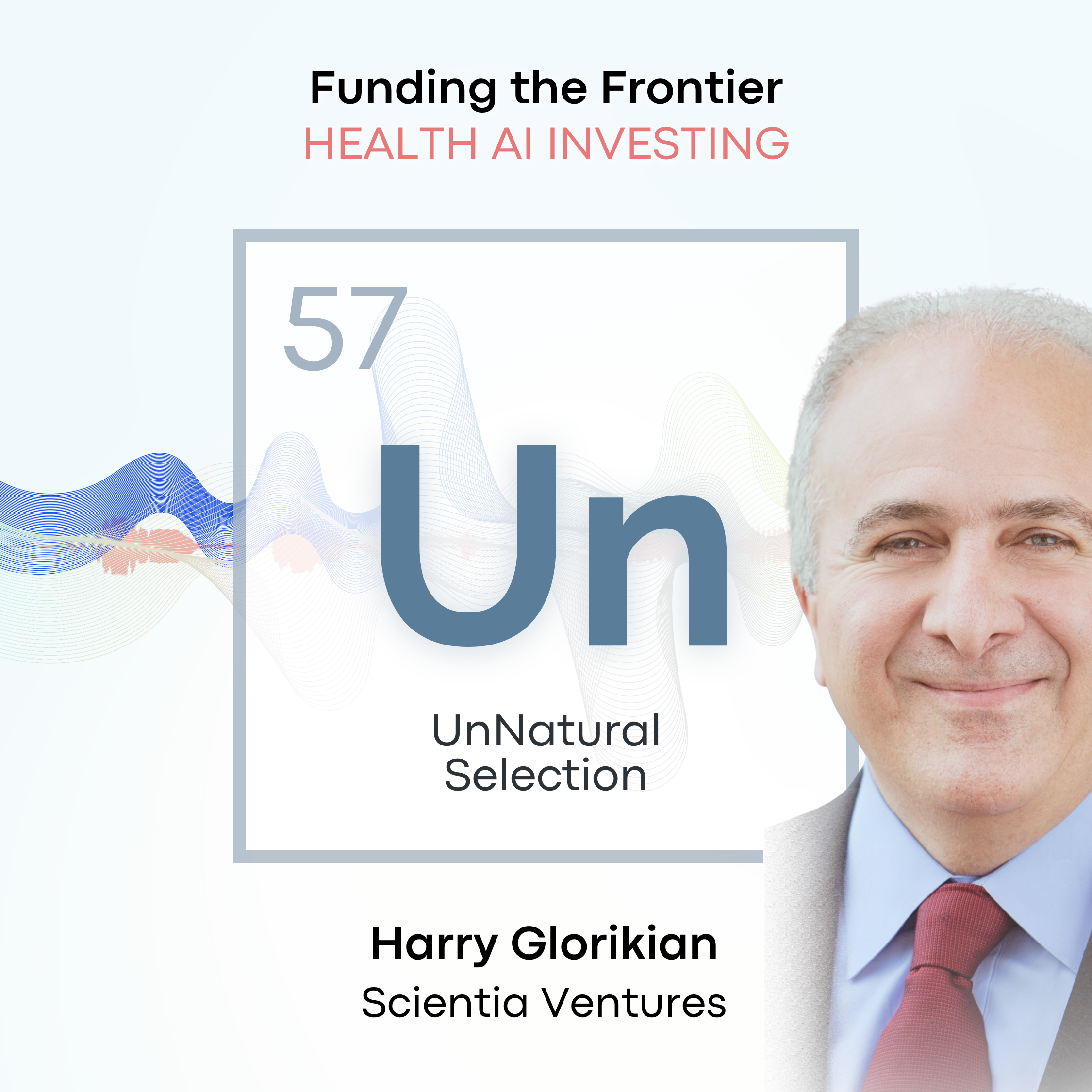
Health AI Investing: Scientia Ventures • Harry Glorikian


Defensive Moat Engineering Ahead of Generative Platform Shifts
Artificial intelligence is beginning to reshape healthcare, drug discovery, diagnostics, and even the structure of business itself.
In this episode of UnNatural Selection, Nic Encina sits down with Harry Glorikian — General Partner at Scientia Ventures and Research Affiliate at the MIT Media Lab — to explore the collision between AI, biology, venture capital, and the future of innovation.
Together, they discuss how investors distinguish genuine technological breakthroughs from hype, why data infrastructure and inferencing may become the next great competitive battlegrounds, and how startups are increasingly challenging legacy healthcare and pharmaceutical systems.
The conversation dives into the evolution from traditional AI to large language models, the future of drug discovery, clinical trials, intelligent agents, digital health ecosystems, and why companies that fail to adapt to accelerating technological change may suddenly find themselves obsolete.
From healthcare transformation to societal evolution in the age of AI, this episode explores what happens when innovation itself begins compounding faster than humans can comfortably track.
-
Nic (00:00)
Harry, welcome to our natural selection. Thank you for being here.
Harry (00:03)
⁓ great to have, great to be here. Thank you so much for taking the time.
Nic (00:07)
Now, of course, and obviously you and I caught up a little bit before starting to record and it seems like we have so much in common that I'm actually really looking forward to having this conversation. I'm surprised we haven't worked together at this point.
Harry (00:19)
And we just, you were going through your background and I'm like, ⁓ yeah, did, nope, we were there, I did that, nope. So much overlap, it's not even funny.
Nic (00:30)
Yeah, so this should be funny. You know, it's going to be fun. It's going to be enlightening. I can't wait to hear your perspective on these things. But before we get started, I always like to give the guests an opportunity to tell us in their own words what drives because for the listeners, A, they may not know exactly what you do, but B, ⁓ they may not know what your North Star is. So could you please let us know, Harry, what need or impact drives your work?
Harry (00:55)
You know, it's funny, it's changed over time as I've gotten older, but it's always been like trying to.
be on the bleeding edge and help new technology or new ideas make it to the forefront and impact people's ⁓ Whether that's ⁓ a therapeutic or a technology, but something that moves the needle for a bigger purpose, if you had to say that.
Nic (01:27)
Okay, yeah, it's similar to me to kind of like that creative process and trying to solve problems, big scale problems. And obviously, you're in the venture space, venture capital, ⁓ focus much more on like the life sciences and healthcare for people not very familiar, the audience is very diverse. So for people not too familiar with that, can you give us a quick overview of what Sanchez Ventures does and
what the health AI and health tech investment industry actually doesn't practice.
Harry (01:58)
Sure. So from ⁓ a venture capital perspective, it's taking funds that we raise from other people and trying to make the right choices of where we want to put that money and then help those companies strategically ⁓ grow because we're early stage for Scientia. ⁓ And I can't remember the second part of the question. Sorry.
Nic (02:28)
⁓ Well, we can actually move on. It's actually really good. ⁓ And so ⁓ I guess one distinction maybe to make from for investments again, for people that don't know this space that well, there's angel investment, people that invest their own money. Then there's VCs. And even within VCs, there are many categories. Some invest early stage, some mid stage, some scale up some. And there you can get hedge funds and
private equity organizations that invest a lot of money. In that space, sounds like Sanchez is much more early stage. Does that sound right?
Harry (03:06)
Yeah,
we're not what you would consider ⁓ seed stage, right? Where somebody has an idea and you're like, let's try that idea here. You know, let's throw a little, we need more proof than that. So I would say we're, you know, we're, we're bucking up against what somebody might call a series a when they, when there's some proof in the technology enough that we can evaluate the science or what they're doing and then make that leap of faith and help them move forward from there.
Yeah, I mean, we don't do any angel investing, right? We leave that to the individuals. We try to come in there when there's gonna be some institutional investment and we try to be early on where we can help somebody strategically, as well as think about regulatory and all the rest of the moves that they may need to make to move the technology forward.
Nic (04:04)
That makes sense. obviously, healthcare and life sciences is very, very broad. Do you have ⁓ a particular focus in an investment strategy or portfolio, like where you look and what specific fields you just kind of constrain, what investments you make, or do you just look for anything in healthcare and life sciences?
Harry (04:24)
No, I mean, ⁓ it's funny. You I almost like to say, you know it when you see it, but when we explain it to people, we've got five partners. ⁓ Many of the partners have therapeutic experience. So they will lean towards what they're comfortable with. ⁓ I can lean therapeutics, but I also like anywhere where data and biology sort of.
make magic happen. So I've been leaning harder into areas where artificial intelligence might make a big difference. I would tell you that before we, this whole gen AI thing, it was more analytics we were focused on. ⁓ But now, you know, the, the, the rage is AI, but you know, I like to think about old AI and new AI and, and how to bring them together to
Nic (05:15)
.
Harry (05:19)
to make sure that we're satisfying what we need to on the other end.
Nic (05:23)
I hear you. Again, back to like our backgrounds being so similar. ⁓ I tend to do the same thing in conversations, remind people like, no, we've been doing AI for 50 years, if not longer, right? mean, AI dates back to a best case scenario to ⁓ Alan Turing, worst case scenario to Socrates, depending on how you define it. And it was, think, first coined in a lab at Dartmouth back in the 1950s or something like that.
⁓ So it's been around for a long time and not just even theoretical. I we were doing AI 10, 20 years ago at the time it was called machine learning or neural networks. It wasn't the sexy stuff that people are doing right now. And it certainly didn't talk to you. I mean, so there is a big difference between what we're doing then versus what's happening today, which is why it's really kind of democratized the field and it's become such a popular concept in society.
But even before LLMs, yeah, we were definitely doing machine learning for image processing and detection and ⁓ language processing just at a very different scale. So with that, with your focus, you mentioned you like to look at things that are, you look at some therapeutics, but you like it when technology and data intersect and AI has become a big topic there. When you're...
looking at potential investments and you see hundreds of potential companies trying to raise money from you. How do you start to differentiate these A-powered, AI-powered companies from real and genuine technological breakthroughs from like sophisticated hype?
Harry (07:06)
⁓ Team is probably number one. I think the hardest part right now is... ⁓
everybody keeps talking about these new approaches of AI. And I mean, I'm like, did you come out of one of the big labs? you, Frontier Labs? you, I mean, what all of a sudden makes you, gives you the knowledge and the ability to drag this across the finish line. ⁓ And all of a sudden that just takes your population and starts to narrow it down. ⁓
I mean, the thing that I have is whether it's, you know, companies or consultants, most people go into companies and they're like, I understand AI. And I'm like, you're getting paid to learn. Like, just face it, right? You're really walking in with that understanding of how does a language model work? How am I going to connect it? How am I going to put in the guardrails? You know, how do I put in auditability tracking, those sorts of things.
people are just figuring that out. So when people say they really understand it, that's the first thing I try to judge. The second thing is, do I really like the idea and do I think it's, you know, it's going to move the needle? ⁓ And that's the second one. I mean, you know, ultimately that becomes where you, you know, your thesis and you want to pitch that to, to see if you can, at least in your mind, think it's going to be big enough. ⁓
But you got to believe the team is scrappy and is going to, you know, weave their way because nothing ever works exactly the way you want it to when you launch it. So you got to believe that the team is going to be able to sort of bob and weave to be able to get across the finish line. And that's, that's just tenacity, right? That's just, you got to find the person with the right mindset that's going to
walk through a few walls to make sure it gets to where it needs to go to.
Nic (09:21)
Yeah, yeah, it's I've lived that world from the other side, from the startup side. And the mentality is very similar. When I start a company, it's obviously the idea, the market, all that kind of stuff. You should do your homework there as well. But a lot of thing, a lot of my thinking goes around who my co-founder, my team is going to be, because for as much as I would go to an investor like you, Harry, and be like, this idea is amazing. Of course, it's going to work.
In the back of my mind, I'm thinking myself, it probably won't. But we need to be the team that figures out how to still create value. Or even if it's partially right, how to figure out entirely right by pivoting and being very market focused. So ⁓ I definitely agree on investing in teams, both as an investor and as ⁓ a founder of companies. It's so critical. And for the highs that you experience when you're in a startup, the lows are
just as low and you've got to have people there to help you dig out of those things.
Harry (10:23)
Well, mean, I, you know, it's funny because I've, I've, I've built a few companies and sold a few companies and I can tell you that, you know, the highs are great, but it's funny that there's incredibly short-lived cause you gotta go on to the next one. The lows are, those are hard. mean, ⁓ I can remember coming home and, and luckily, you know, my kids were very young and I remember just being able to hug them and that just somehow made things better.
⁓ Now they're all older, there's nobody to hug like that. I got to find inspiration in different places.
Nic (11:00)
You lost your muse. ⁓ Yeah, it's, ⁓ it really, you know, it can get, you know, very low at times. So, and I agree, I actually get yelled at by my wife because when we have highs in startups, I'm usually the least one celebrating. I'm just always thinking about what we need to do next. You know, even in ⁓ an exit, a lot of times it's like through an exit selling the company, I'm already thinking about, okay, what am I going to be doing next month? Which is probably a pretty bad habit.
Harry (11:29)
No, I agree. do the same thing. It's like, okay, great, next, right? What are we doing next? And every once in a while though, I've sort of tried to make a habit of writing down what I've done so that I can look at the list and be like, okay, you need to take it down a notch and relax because, you know, this is pretty interesting list. And then five minutes later, I'll be...
I'll be thinking about the next thing.
Nic (12:00)
It's in our nature. But if we pull it back to your investment strategy again, and if we focus on, well, I guess it could be life sciences or healthcare. From an investor's perspective, is the real competitive advantage when you're looking at AI, is it, are you looking at the algorithm? Are you looking at the data that they have access to? Are you looking at how they address workflow needs? How do you balance between
where they're trying to create value.
Harry (12:32)
So I think it depends on the...
the idea, right? ⁓ No two ideas are well, there's more and more that are starting to look the same, but in general, right, somebody might have access to a set of unique data. And then it's like, well, is it enough data? Are we really going to be able to train a model or do something unique with it? ⁓ Is that a sustainable advantage? Can we create some sort of moat?
⁓ I've been working a lot with a few companies on where they're getting consumer data and helping people make sense of their diagnostic ⁓ dynamic. And it's funny because one has pulled very hard towards labs and helping the labs then work with patients. And the other one is really going, doubling down and working directly with patients themselves. And so you could see that
the strategies they're taking, you can see parallels, but they're just different. And then another one, it's unique modeling and approaches using physics for drug discovery and drug development. And so that is much more understanding, what are you doing? I don't wanna know all the...
confidential information of how you're doing it, but I need to understand like what are the pieces you're using and then really evaluating the team to see if they can, do they have the chops to pull this off because that's not trivial. ⁓
the data we're getting is fantastic right now. So then it's helping them think about, strategically, what direction do you want to go in next? again, no two apples are the same, if you have to say that.
Nic (14:32)
Yeah, that makes sense. And if we talk about the drug discovery for a bit, obviously Google put out ⁓ Alpha Fold that was a huge breakthrough in protein folding a couple of years ago. And now that same technology, both by Google and others, is being used from genetics to even like chemistry and all kinds of things in between.
Where what are the kind of things that you're seeing as far as like you mentioned drug discovery? Where are the biggest most exciting advancements happening and related to that are those advances happening? Do you see them happening within big pharma or are you most excited by what the startups are doing?
Harry (15:19)
Wow, I always joke with people in our world and say like, mm, AlphaPold. No, we didn't do that. What is it? Alpha genome? No, we didn't do that one either. I like, you know, I joke with them because I'm like, guys, like.
It's funny because tech has been making this, you know, ⁓ run at healthcare for a long time, right? ⁓ and they've never been able to breach the walls. Well, now all of a sudden it's digitized and their data available and you're starting to see kinks in the armor of where they're able to make those breaches. And I find it fascinating, right? Because a bunch of guys who may not know a lot about biology.
They may have a few people on the team, it's like, how are they going to mathematically, you know, and, and structurally building these models, you know, take on this problem and they they're solving some huge problems for us in our world. ⁓ so I have a lot of faith that
tech in some ways is going to make more headway than pure pharma all by itself. It's also because they can throw a lot more money at it and compute than we can. ⁓ But I'm starting to see companies like Lilly where they've developed their platform called TrueLab where they're getting, they have their own model and then they're getting startups to contribute data.
and then the startup gets a better model and Lily gets a better model. So I'm starting to see some movement in that area that is exciting. They did a deal with Nvidia so that they can sort of grow more compute. ⁓ But some of the startups...
Sometimes it's really interesting where they don't know every last thing. And so you're not limited by what's in your background or experience. And so you're willing to go out and try something new and then lo and behold, something magical can happen. And I'm seeing that in this one startup that I've been working with on the drug discovery side. So.
You gotta look for that magic where you think it's gonna happen, especially on the investing side. then you've gotta be patient for five to 10 years for it to manifest itself in some positive manner.
Nic (17:58)
And one of the big challenges in pharma, both pharma and healthcare is access to data, right? I mean, it's for the longest time we've been talking about that being an issue and the life sciences, they go into like electronic lab notebooks, into specific different other storage data silos and healthcare, a lot gets trapped into the ⁓ electronic health record. ⁓ How are these organizations, small or large, dealing with that and trying to get
data into these analytical systems, these AI systems to be able to make knowledge out of them? Are you seeing less friction there? ⁓ yeah, essentially, how are people making data more liquid so that these large language models can actually do something with that information?
Harry (18:39)
Maybe.
Making data, certain data liquid has been hard, has just been impossible or I don't want to say impossible, just incredibly difficult because people don't want to share it.
Nic (19:03)
And that was going to be my next question because historically it's really hard getting data from some specific vendors. If you look at Epic and others, their customers have to sometimes sue in order to be able to get their own data out of these systems. And so they essentially try to protect their little gardens, which makes higher order analytics harder.
Harry (19:26)
Well, so I literally today pressed a button on an article on LinkedIn about how
forever, you know, these were your system of record, right? All your data was stored there. But in reality, if you took all the data that was on that system, I mean, it's not a lot. It's not a lot of data, right? And so if you put an agent in there that now can read that data,
who are you, you're not actually interacting with that system anymore. You're interacting with the agent. So that system now becomes more where data is going to get written, but it's not going to be the main interface anymore. that system of record is going to start to be less and less important. And now you start to see the system change as a result of that. And the reason that that happened is the Cures Act and
digitizing records and so forth, making that accessible through FHIR, right? Where now I have a way of taking that data out or having an agent go in and query that data. Now I would tell you traditional AI, we were not going to accomplish that. had to, it has to be this new direction that the technology has taken that would then make some of these capabilities possible. I mean, I'm playing with this every day.
to the point where my wife is like, you, you gotta stop, you gotta stop playing with this stuff. Right. ⁓ and I've been coding and Nick, don't know how to code. I mean, not me, I'm not the guy, but man, I can ask it and change it and play with it. And the next thing I know, poof, right. I've got applications that I'm using in different ways. ⁓ I mean, I just am finishing a new book and it's, I believe that
the interface is basically going to go away. And we're all going to end up with what I'm terming as a personal operating layer where, you know, your AI teammate is always there for you and just does things in the background and executes on different things that you need. Some people call it agents. I'm not sure it's necessarily going to be in agent per se, right? I think it's going to be an orchestrator that calls on different agents. But if you think about
Once the APIs are there, the, should refer to your audience, application interface where you can access the data, think of it like a plug that you plug something into and then pull data out of, and your agent can then go and get any information for you, ⁓ that changes the landscape dramatically, much more than I think people are anticipating.
Nic (22:33)
I completely agree. It's, ⁓ you know, and in healthcare, the challenges are different from life sciences, but in healthcare, the data also tends to be very messy, because it's ⁓ clinicians, nurses and others putting the data in, they may have different terminology, different ways of interpreting results. And that plays a big factor in clinical trials and drug discovery, if you're trying to pull data out of like EHRs. ⁓
But I think these large language models can start putting in some level of QA, QC, cleaning up some of the data, structuring some of the data, drawing connections, and so on, that I think is really going to help. Like you said, old AI wasn't going to help with that. But I think the large language model approach really helps us now start asking much more sophisticated questions from data that was historically kind of muddy.
Harry (23:28)
Yes. I think that people, that's another thing when I'm talking to people, are they a database person or do they really understand inferencing and where this is going? If you're a database person, your expectation is I'm going to reach in, I'm going to take out this one data point and I'm going to put it on a table for you, right? If you're an inferencing person, you're really looking for like, how do I make sense of this, a lot of different pieces of data and pull out unique insights that I can then make a decision from?
The big question on that side is, I think the biggest battle or where the next big company is going to come from is going to be the company that can, this data came from here. This is how I know it's correct. And be able to provide that sort of proof layer and provenance that the information that you're getting is accurate so that you can then take that and then make a decision with it. And if you said, what sort of companies am I starting to look for?
it's starting to look for where these theories that I've put together in this book sort of, they can match up to where the industry is going.
Nic (24:38)
Okay, yeah, that's exactly where I was gonna ask you a question about companies that you're looking for, but also ⁓ a big chunk of the data that's necessary for drug discovery, maybe less so in healthcare, but definitely drug discovery's tabular data. You mentioned databases, right? And so are you seeing more effort being put into pulling that data out and associating that with non-structured data?
Harry (25:07)
Yes. Yeah. I mean, it's blending the two. don't think one or the other on its own is enough, I think, because you need the lab data. You need all the information that comes that's in structured format. And you can do a lot with that. And then making sense of the unstructured that you can then take the two combined to then do something with.
Nic (25:36)
⁓ You also mentioned confidence in the data. And when you're using AI in an advanced way as you and I do, ⁓ I can't help also when information comes back, I have to dig further and give myself a level of confidence that what I got back is actually right. Whether it be asking the same question in different language models or looking at the raw data and figuring out is this something that
passes a sniff test. And along with that confidence, I agree, at some point it'd be nice to have language models that give you information back with some kind of confidence quotient, telling you this is the confidence level of this answer versus I'm just gonna give you an answer just because you asked for it. But along those lines too, ⁓ replication in the sciences has been really, really ⁓ challenging.
over the course, I mean, we've been noticing for at least 10 years now, if not longer, how low replicability across the literature has really been. And I wonder if AI will help us in addressing some of that at some point, maybe seeing references, connecting the dots in ways that we can't do it as humans. But that's become a big issue as well. And my concern there is now if AI is eating from all of these publications and a lot of those are not replicable, what does that do to the underlying models?
that are making decisions for us.
Harry (27:05)
Yeah, that, I mean, it's funny. was having lunch with a friend of mine who has gone from cardiology to being CEO of a therapeutics company. And he was just like, you know, so many papers are not reproducible. And then you see so many pieces come out about somebody fabricating data. And, you know, I think hopefully AI will make it easier.
or us to identify when someone is fabricating data and keep people honest. ⁓ But the systems that I've been looking at, which are not in healthcare just yet, but more like in finance and other areas where they've been launched is, how do you get people to adopt it is the first question, right? Cause this, it hallucinate?
ideas as I hear that everywhere. And so it's like, how do you set up a structure that there is a confidence interval, there is a link back to a source, there is enough there that you decrease the time that the human needs to spend saying, is this right or wrong? And can then move to the next step in the process. And if they want to go back and check, they can actually click or and follow through and
get to the data so that they can make a better decision. ⁓ That's the sort of systems I'm seeing being launched. And you'd sort of want to see that dragged into a lot of other areas. I think there's a lot of work that still needs to be done. ⁓ But I see...
The tech industry starting to understand that these are problems that need to be solved. If you look at OpenAI and Anthropic, they've launched into healthcare. I mean, they know very well that some random piece of information can cause a lot of harm. So how do we build the right systems and the right guardrails so that we don't have these problems going forward? these are not impossible problems.
You can narrow it down to the point where.
not going to say it's 100 % and which I find actually sort of funny that everybody is expecting 100 % from the machine, but they won't expect 100 % from a I mean, even right now, these systems are performing better than most humans. So I think there's going to have to be a balance there and the ultimate judgment is going to have to come down to the human.
Nic (29:53)
⁓ When it comes to technology, we're definitely living in this ⁓ space of hyper innovation. ⁓ It's been increasingly growing and growing. mean, personal computers were a part of it, and then eventually, obviously, the internet and then cell phones, now AI, and it's just becoming faster and faster to the point that technology and its capabilities are changing. It's not even yearly anymore.
It's just like month to month, if not week to week. And the reason why I'm bringing this up is because as an investor, number one, are there high level patterns that you're seeing from the type of companies that are coming your way or the type of investments that you get excited by? That's part A. Part B is how do you keep up like like your job? This is to get to the front edge so you understand what the opportunities are and and can make.
real investment decisions on that. So I guess part A would be what trends are you seeing as things are evolving, let's say monthly? Are there macro level things that you're seeing that like, okay, this kind of gives me a sense of what the North Star is. And then B, it's how do you stay up to date?
Harry (31:07)
⁓ So if my data is correct, if you look across the space ⁓ in tech, I think there's a new announcement every three days, ⁓ which really makes it ⁓ difficult to sort of keep up. ⁓ So you try and look at where the trends are going, right? In a sense.
⁓ and that's what I do. ⁓ although I try to voraciously, I mean, every day I'm reading something. the other thing that I do is I try to write. So that forces me to sort of crystallize my thought process. then sometimes when I'm writing, I, I come up with something and then realize that, my God, for that to be true, these underlying.
pieces have to be true. And then it forces me to look down a few avenues to just crystallize my thought process. I do spend time talking to people that are in these areas. What gives me comfort is even the people that I talk to in these organizations have told me they cannot keep up. I don't feel completely bad. And then I look at my other job as a lot of the companies that I'm investing in is
I mean, you know, talking to the CEO or their CTO and being like, did you see this paper? Did you see what's going on here and at least helping them think about it? Because you know the drill. If you're building your heads down and you're trying to get something across the finish line, you just need to see that if something is coming orthogonally that might either help or hurt what you're doing.
Nic (33:05)
and
Harry (33:06)
I try to tell people, don't build something that's right in the path of the juggernaut. You saw it, Anthropic launched one skill in finance and legal and a trillion dollars in value just went, oof.
Nic (33:26)
Yeah.
Harry (33:30)
I keep telling every CEO that I'm friends with, you got to step back and rethink your entire strategy. If you don't do it now, you could be way too late. Just because of the speed and the way things are changing, mean, if even a third of what I've written in this book is correct, it's going to have a dramatic effect on...
businesses because of how business is going to get conducted by these systems. If you're number two on what the agencies, you don't exist.
I mean, if you think about that, you're like, wait, no, wait, that's not good. I can't be number two. So how do I become number one?
⁓ So it's sort of interesting the direction things are taking.
I just see that by the end of this year, we're going to be...
an order of magnitude, if not more than an order of magnitude, these systems are going to be much more accurate, be able to do much more, ⁓ be much easier for anyone to use through language. So the complexity that the system has sort of hid behind, I think it starts to
not become as big of an issue. There's still the understanding. You need to have the understanding of what you're seeing. But even that can be brought down to a level of accessibility to explain it to someone.
Nic (35:23)
Yeah, it's, throughout my career, you're, when you're working on something in the back of your mind, you're always thinking of yourself back to your point about, you know, talking to CTOs and making sure they stay on top of technology trends. When you, know, when I was building stuff 10 years ago, 20 years ago and so on in the back of your mind, there's always the idea that somebody's going to create new technology that's going to change everything. And it'll probably happen the next couple of years, you know, maybe in the next decade or so. Now I feel like.
That question to me is accelerated to the point that any month there could be a new discovery that changes everything. So it's almost like you're building stuff. And I am a computer scientist, so I've been developing and writing software my entire career. And it makes it really hard to think about how to build stuff now because it's like, no, there could be an asteroid that hits next month. And then if you dodge that one, there could be one the month after that.
Harry (36:19)
You know, everybody that I talked to that's in the Bay Area, it's their sort of this 996 mentality, which is, know, 9 a.m. to 9 p.m. and some of them are actually more than going in earlier than 9 a.m., six days a week. ⁓ If you're not, I don't know how you keep up with the pace.
Nic (36:45)
I don't even know that that's even the solution for it. And the reason why I say it is because it's only going faster and broader. And so there has to be a different way of being able to address that because 996 is not going to cut it in a year. Human time doesn't scale that way.
Harry (37:05)
No, it doesn't. mean, it's funny because I try to use multiple brains at the same time, right? I could be running.
five or six different processes simultaneously in the background while I'm, where my human brain needs to focus on this one thing, there's other things happening in the background. ⁓ And then the biggest impediment is my ability to cognitively switch to the other topics to sort of keep up with them. ⁓ But that's the only way that I've been able to sort of
keep up, right? Start a Google notebook, start a research project, have it go check references for something. And all of them are running simultaneously. ⁓ And then going back and then trying to absorb what's there.
Nic (38:01)
Yeah, I'm looking forward to when somebody can create ⁓ an agent that just keeps me up to date on everything that I need to know. But with a caveat that it doesn't become an echo chamber. ⁓ One of the big challenges of how they've been using AI and everything from Google News to social media has been that as soon as you click on something, you spend too much time reading an article, it says, aha.
We know what you like, Harry, so we're gonna feed you everything about that article or everything about that sentiment. And before you knew it, your whole feed starts looking like one singular, one dimensional conversation. And ⁓ I think it's good if you really like something about AI and you wanna know everything about that, but then it just puts on these blinders. And ⁓ it'd be nice at some point if there's a way of knowing a lot about one thing.
but keep an eye on other things that don't start funneling me down into a singular topic, ⁓ which tends to happen across these things. It'd be nice if at some point they step back and start feeding you information that you probably should know that's not in that funnel.
Harry (39:09)
I think that's, I think you could design a system like that right now, right? Like either you and I could write some crazy good prompt, right? Or, you know, I just built a system the other day where it was like, I wanted two different models working on something for me. And each one is critiquing and looking at something to then come back to me with a much, much better answer.
So I think it's possible today, right? I mean, if I can build it, Like anybody should be able to build it. But I think social media, I can only pray that this is true, dies, right? Because these systems are moving from.
totally captivating your attention to a scroll, to giving you an answer so that you can then move on and have more time to do what it is that you want to do. And if you look at what's happening is even when you're in a social circle, you ask somebody a question like why debate it? Just go to one of these platforms and ask for the answer and get an answer instead of scrolling on Google for
hours.
Nic (40:37)
⁓ If we talk about productivity, which that kind of relates to a little bit, you've written about friction in healthcare decisions. And ⁓ for lay listeners, why does it take so long for a breakthrough technology to reach real patients? And ⁓ what could structurally reduce that delay?
Harry (41:02)
⁓ So friction I use in different ways, right? Friction is important for us as humans. Otherwise we don't learn anything when we don't have any friction in our lives. ⁓ Nobody learns anything when everything goes right. I just don't think they learn all the right lessons. For us in healthcare, when we're trying to move something forward, there's a lot of...
impediments along the way, depending on what it is that you're, always tell people like, that's great idea. It doesn't mean biology is going to agree with you. Right. Wow. I got this great molecule. Yes. But the minute you put it into a biological system, it doesn't mean it's going to work correctly. If we had platforms that could
more accurately be able to tell us from ⁓ you know, toxicity or adverse reaction perspective, you know, what was going to happen so that we could make better decisions. And I'm not saying it's going to, because I know a company that's actually working on this platform is, it's not going to give me all the answers and give me the perfect answer. But if it actually said, okay, out of these 10, if you're going to put your money on something, you're the one or two.
that you really want to take forward and it helps accelerate the human expertise. I think that can start to compress time to a certain degree. But you and I both know that if you need to do a human trial, you're like, I'm not going to make that much faster, right? I got to wait it out to see what happens in the end. But I think a lot of the other parts of the process with technology
and rethinking the workflow, you can start to bring that down here and there. ⁓ Clinical trials, trying to find the right patients faster. ⁓ Remote clinical trials, being able to do things where they're not having to come into a center. ⁓ Drug development or drug discovery, where you can use these AI systems to sort of help you find that molecule faster, right? ⁓
I think there's a lot of these areas that we're going to see improvement. ⁓
Like you said though, I'm not sure they're going to come from.
the core industry itself. I think there's going to be some interesting approaches that startups are going to take that will maybe be able to bring it to the large organizations. ⁓ But even there, mean, most of the companies that I look at in this space are, I'm just like, I just don't believe what they're doing.
mean, you look at it, a great hype. Don't misunderstand me. Phenomenal hype, but I'm like, in reality, I'm like, just, I don't see it.
Nic (44:09)
Yeah, it's definitely interesting to get even a glimpse of the world that you live in from obviously having started companies, but now investing across health care, life sciences, and being at that bleeding edge of how technology is starting to gobble all that up. If I could ask you ⁓ one zoom out question to finish things off. You're obviously nowhere close to being done with your career, ⁓ an extraordinary career, and you're building on that.
But if you could fast forward in the future to a point where you can look back on your body at work, what you've done and what you anticipate doing over the next few years, what would be a best case scenario that you might look and reflect back at what you've accomplished that would give you the maximum set of fulfillment over the things that you have or will be doing over the next few years? What would give you that sense where you can kind of feel like maybe it feels a little bit like that hug you got from your son ⁓ way back in the day?
Harry (45:03)
Yeah, I don't know, maybe, you know, character personality flaw. it's my wife is always encouraging me that I need to get to get there. ⁓ I don't I don't
You know, it's funny, I'm writing this new book only to sort of get the word out about where things are going and try to bring it to a management level to get people to think about preparing. Cause you don't want the asteroid to come and not have been waving your hands, letting people know that the asteroid is coming or the change is coming. ⁓ that would be one where I can get people to wake up and, or give them frameworks to think about how to put this in context for themselves.
That would be one. ⁓
I don't know when I'm gonna be done, Nick. That's the funny part. ⁓ Part of me says, you you should be done sooner rather than later. And the other part of me says, I see a new shiny object and I get excited and I start to go down the rabbit hole. ⁓ It's hard. I can't explain it, but it's been difficult to sort of just be content with what it is. And I'm just trying to be honest and transparent for everybody.
Nic (46:24)
No, I appreciate it. I hate to have to answer that question myself because I think you and I are kind of similar beasts. in ⁓ the same way, know the thing my wife yells at me is that I that were to use content. I don't know the definition of it. It's it's, you know, whatever, you know, we accomplish whatever we do, there's always that next thing or I don't know. I guess I'm just not driven by content. And so I can I can completely relate to the.
trouble that you had in defining that because it seems like it's, it's the next thing.
Harry (46:59)
Yeah. And there's always some, mean, I look at something and I get super excited, whether it's something in science. my God, we don't like this drug or this molecule did this. And I'm so excited, right? ⁓ to, wow, did this technology just surpass this next thing? The implications are the following. And it's funny because I want to run around and talk to people about it. And those people are like, really don't care, which is sort of interesting to me.
But so I've learned to just keep my thoughts to myself for the most part.
Nic (47:33)
Well, I for one am grateful that you've shared your thoughts here with me today. It's been really such a ⁓ pleasure getting to know you and talking to you about your thoughts in this industry, Harry. Thank you so much for sharing this time and for being on Natural Selection.
Harry (47:49)
Thank you very much for having me. It's been great.
