Consumer Productivity & AI: Microsoft • Sam Schillace


The Execution Advantage: Learning Velocity vs. Incumbent Scale
What allows some companies to survive technological revolutions while others disappear?
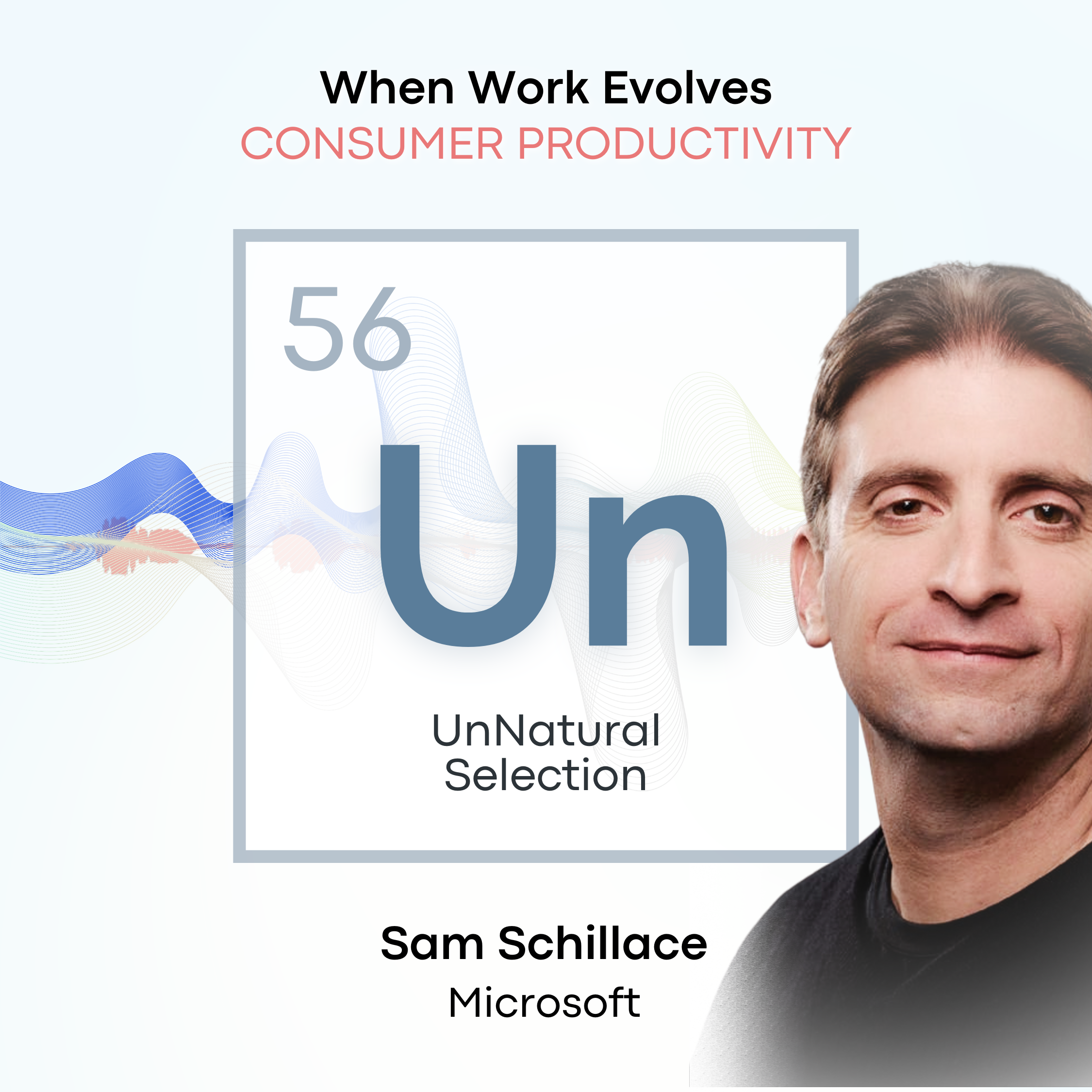
In this episode of UnNatural Selection, host Nic Encina sits down with Sam Schillace — CVP and Deputy CTO at Microsoft, serial entrepreneur, founder of Writely (which became Google Docs), and one of the leading thinkers shaping the future of AI and software platforms.
Together, they explore how major platform shifts — from the internet and cloud computing to artificial intelligence — fundamentally reshape competition, organizations, and society itself.
This conversation dives into:
why successful companies struggle to adapt
how AI is changing the nature of work and software
the importance of self-disruption
why speed of learning matters more than size
startup survival and technological evolution
the future of intelligence, platforms, and human collaboration
A fascinating conversation about adaptation, innovation, and what it takes to survive when technology changes faster than institutions can evolve.
-
Nic (00:00)
Sam, welcome to our natural selection. Thank you for being here.
Sam (00:03)
Thank you, happy to be here.
Nic (00:05)
And
it's it's great to reconnect you and I met for the first time. I think like 14 years ago or so back in 2010, 2011 it was post the rightly acquisition and we were talking about online documentation and collaboration online and so on and it's your career is definitely gone through many different revolutions ever since then. Right, you went to box and now you're at Microsoft.
Sam (00:34)
I'm saying, yeah, that's right. I mean, I think I even was a venture capitalist for Google Ventures for a year. I think that was before and after, but yeah.
Nic (00:39)
That's right.
Yeah, so and it's great to connect with you because I think you bring so much different perspectives to this conversation, right? Because right now you have this deputy CTO role at Microsoft where your phone you're working on AI, agentic AI, you're working on some tools around productivity. But you started, obviously, and rightly, with kind of creating this online collaboration experience that we've all grown to just use on a daily, I would say hourly basis.
And so like to, you you've, you've lived and you've pioneered this transition from standalone documents to living your desktop. And now we mail back and forth and we have these like version control issues to collaboration online and zoom forward now to agentic AI, which is now starting to kind of transfer some of that authorship from humanity into, bytes and, and software. it.
I think this conversation is going to be super interesting. But before we get going, just to give us in your own words, what drives the work that you do? Can you please let us know what need or impact drives your work?
Sam (01:49)
That's an interesting question. By the way, like I still have the very first Google Doc in my personal account.
And it's funny, it's a really funny little thing to like, both of the back end and the front end have been rewritten at least twice that I know of probably more. like, it's this sort of document of theses like I think an NFT would be a more authentic, actual first Google Doc than the actual first Google Doc. like, in the Computer History Museum wanted to like curate it. And I'm like, I don't know how you're gonna check and print it for you. But what does that do you?
Nic (02:22)
It's
a
Sam (02:24)
So
like, so what motivates me? mean, I don't know, like I've always been a maker. I think that's probably the most core part of my personality is I just like to make stuff. And I think, you know, I hang out with some other folks that are makers and you know, they're sort of like the pioneers, the town planners and the, you know, the settlers kind of, think it's planners, settlers and town planners, right? Or there's like these personalities that are like really out there and really exploring. And there's people who are like kind of settling once a place is found in this, people are like.
plan the town and scale it out. And I'm very much the first kind of that maker. And I just like to explore stuff. so a lot of what I do, I just kind of do it because it's fun to do more than anything else. And it's puzzles, it's interesting, I'm curious about stuff, I like to build things. It's obviously really gratifying to have built something like Google Docs, like rightly. I don't know the last count, I think it's.
It's part of G Suite, which I think is a 2 billion user product. So it's way up there. people talk to me about it all the time. So it's really neat to have done that. That's super gratifying that you have built something that lots of people have used. ⁓ So that's really fun. It's kind of hilarious. I go give talks at universities and go back to University of Michigan. And I'll tell them I'm a GDocs inventor. And they'll be like,
It's like telling them that like I invented water. They're like, what? You didn't, didn't get that. What? No, it's always been, I'm like, no, I invented water. It's like everyone was thirsty before me and then I invented water and like then there's, and they're like, you're lying. You know, it's like, they just don't believe that I invented like that. Like I did Google Doc and have the first one and everything.
Nic (04:05)
It's so transformational. I can totally see that, especially kids in college, somebody like 19 years old or so, they don't know a world of not using, especially in academia, mean, academics are using it. ⁓ I can definitely see something like that, which is like, how'd you invent something that I use every single day? I don't know a world without it. I don't know, what is it? One fourth of the human population uses it.
Sam (04:29)
Right. And it's something like that. I mean, yeah, like there's, are a few, like I used to give a talk on like how to invent Google Docs. And like, I don't think it's, it's both really easy and really hard is kind of the answer, right? Like the patterns are pretty straightforward if you can get your head there. And then the hard part is like luck and persistence. Like, you know, the, the, the, the all, you have to care. Like you have to care about building interesting things, but you, kind of get, know, you get yourself into this disruptive mindset.
that you're open-minded to things. This is kind of the most important thing, I think, which is, you know, we have this natural reaction to things that challenge our worldview. ⁓ If you're wrong about your worldview, you know, if something challenges it, like, there's this very stark choice of, like, either you're wrong or it's wrong. And it's really hard to be like, I was wrong, I'm dumb. The world's actually this different way. That's a hard transformation to make. And so, like, people kind of wind up telling what I call why not stories.
where they'll have the emotion first and then they'll come up with a story for why that's not actually challenging. And so that's a really easy trap for anyone to fall into. I still fall into it. So that's the very first thing when you're gonna go try to do something like this. And then the rest of it is basically just lots of shots on goal. Get interested in something, get your tools to be sharp, make it very easy to do interesting stuff at the edge of what's possible and make it really easy to do experiments and iterate. And that's really the formula.
You know, like, cause the first piece, the why not versus what if, even for my two co-founders of rightly, when I started having this idea and I wanted to go play with JavaScript in the browser and start building this thing, they were skeptical, like, cause they were deep experts in desktop applications and were processing. so like, they did exactly what I just described. They had the why not reaction of like, that's not going to work. Like the browser isn't good enough. The, you know,
JavaScript isn't good enough, people aren't gonna trust it. There are all these stories that people make up. You can't really argue with an emotion is the thing. People have this negative emotion, it's very difficult to argue past it. So what you wind up doing is make your experiments cheap. And in that moment, what I did with them was say, well, let's just try for a week, let's just build it, see how far we get. And since it was cheap and we had some tools that we could build it out of really easily, we did.
like instantly both convinced us that it was really compelling and also broken. And so we had to go spend a bunch of time like making it not be broken, but like that, you know, cheap experiment was the thing that let us get there. People always look back at something like rightly in Google docs and think of it as like the straight path. Cause you can just see the path through the brambles from, from afar. But like, you know, I had to go through brambles to get here. Like it's not obvious at the time.
And that's like, I always try tell people that it's like, like you can be an innovator too. Don't think, don't sit around waiting for some idea where somebody's like, I have this idea. It'll be a billion user idea. Let me just go do it. Like it's never what it's like. It's always messy. It's always uncomfortable. It always feels too early. It's always got hair all over it and problems that you don't know how to solve. There's always skeptics. You know, people think you're nuts. People think it's stupid. People think it's a toy. Like that's always.
I'm not the first person to say this stuff, but it's like really, really true that like, that's just like how it is. So it's a little bit later in here. Sorry, I'm in the cave. It got dark, it like gonna rain out of 10 minutes.
Nic (08:05)
⁓ What you're saying definitely resonates. yeah. For one lesson. Yeah, what you're saying definitely resonates because ⁓ I've started like innovation labs at Fortune 500 companies. And when you do something like that or at Harvard, it's not just coming up with the ideas. You have to create an environment and a culture that fosters innovation. And part of that is creating a space of like intellectual safety, psychological safety.
Sam (08:08)
It's always like that.
Nic (08:33)
⁓ but then also creating mechanisms. One of the things that I really like to do, and this goes back to your white, what is it? You said, why not versus what if. No, in the thinking there is it's, it draws from a book, six thinking hats by Edward de Bono, which talks about how when you get a group of more than like two people trying to work on something, especially ideation, where things clash is where people are wearing different hats. So if I'm wearing a white hat where I'm saying coming up with.
Sam (08:40)
Yeah.
Nic (09:01)
new ideas. New ideas are really hard and they're always almost always imperfect. And at the other extreme are black hats, which basically are just saying like nose and butts. It won't work because of this. It won't work because of this. And in between there are stages like green is really looking at financial. Like is this financially feasible? All the way through yellow, red and all different colors. So it's six hats overall. And if you have a group of people and if you have white hats, all it takes is one person with a black hat that's going to kill the...
Sam (09:29)
Yeah, right. Yeah. Yeah, I'm super sensitive to this. like, you know, one of the real gifts of rightly in my life is that, you know, that one I feel really lucky about, but I take advantage of it now because I'm just like, oh, no, man, like I created a billion user thing. Like, I'm gonna go do this fun thing over here. You don't think it makes sense. That's fine. But you don't get to come, you know, like I'm gonna go do my thing.
And so get to just go build stuff. And I've just learned to be confident about that. Right. Like I've been right enough about crazy stuff, crazy sounding stuff after rightly like that. I just like I don't listen to the black hats. I just come to them out. You you just you can be part of the brainstorm. It's yes. And right. It's it's improv. If you can't do the improv, you have to go somewhere else.
Nic (10:14)
exactly, because like you said the innovation process is inherently messy and it starts really precarious and so you can snuff that out very quickly but if you give it a chance and you're working collaboratively you can build it into something. before we get past the Ripley stage, what problem were you trying to solve with it? Because we can always look back, like you said, we look back in history it's very linear but I could say collaboration online, could say like a bit of like diversioning problem.
Sam (10:38)
Yeah, no, it's more accidental than that. Again, by the way, I'll answer this question, but I want to say one of the things that I embrace a lot in my life is mess. can kind of tell it's kind of messy here. And I have this saying that is kind of my personal model is like, from error comes virtue, which means mistakes are often where innovation comes from. It's like...
embracing that mess and like letting a mistake happen and then seeing it and seeing the value in it. One of my favorite stories is how stainless steel was invented, which is that like somebody was working with his intern on early metallurgy research and the intern screwed up and put like literally 3000 times as much chromium in one of their samples as they're supposed to. And they just threw it away. You know, was like, that one's bad, you know, like throw it away. like two weeks later, they're like, why is that one shiny? Like in the pile of
whole ingots and like figured out what had happened. So like, you know, from error comes virtually like, you know, mistakes are often like where this stuff comes from. But to like, to answer your question, like, and like, it's a little bit related, like I didn't, I was in that experimental mode. I did not have, this is again, like exactly what I just said. Like, it is not the case that I sat down in 2005 and was like, I shall invent web 2.0 in cloud computing and I will like bring, you know, no, like that's not what happened. Like what happened was,
I read about JavaScript, which was like called Ajax at the time, right? And I was like, that's like as a nerdy programmer who's familiar with the tech and who likes to play with stuff. I'm like, ⁓ like an interpreted language in the browser. That sounds like fun. You know, I don't have to deal with a compiler in our environment. Let me go like mess with that. And kind of concurrently, I found out about like this feature of the browser is called content editable, where you could just like tell the browser to go into edit mode for the document.
And I was like, that's kind of fun. Like you could kind of put those together and like you could run some JavaScript and like do stuff to that browser and like, blah, blah. And we had a server and so we like wired it in. And I was just like, let's just see what happens kind of thing. Like, it seems like fun. Let's go build this. Like literally. like, you know, like I said, my teammates were like, this is a bad idea, dude. Like, what are you doing? And you mentioned it before, like at the time there was a pain point. It's always good to have a pain point. It was a broad pain point. It was like, if you wanted to share stuff, you were either in
the misery of sending emails around with documents attached when you had version trouble and people would never find stuff or you were in the misery of.
a shared file server, which most of your listeners probably don't know what it is really, but like, you know, people would like check the document out, lock it and go home and then nobody could do anything with it. And it was like, it really broken. Both of these were like miserable broken solutions for working together. for like, we instantly, we were working out of our garages. We set it up, you know, we were in separate places. We were like, this is amazing. We're working together. Cool.
naive implementation like last in wins, we're just like, crap, that doesn't work. Like, you know, stepping on each other. So I guess we have to go figure out how to do concurrency like concurred editing. That turns out to be a really hard problem. Like that took us like six months to get right. You know, especially at the time when like JavaScript wasn't standard and browsers are weird. Browsers will render the same document with a different underlying.
text structure, like you can say the same document different ways. So syncing across different browsers, like kind of going back and forth between that like logical and semantic mode is like really, really hard to do and all this pre-operation transfer is really hard to do. like, you know, it's another good illustration of like, if we really fully confronted the idea at the beginning, we might not have done it. You know, we might've been like, it's going to be way too hard to do it.
But it was more just like, this is an interesting experiment. And then we had this visceral feel for how good it was. And then a lot of the skepticism was like, well, I don't know if the browser can really handle it, but the value that it brought into the world, like that kind of rang that bell of like cloud apps. The whole ecosystem pulled browser performance and cloud performance forward. And we just got to ride that wave right away. So at the time, some of those, that's kind of another, I really think this is another thing that people don't get.
write a lot is they see the point, not the line. So in the point in time in late 2005, if you're like, can I build Google Docs G Suite of today in those browsers? I think it's like IE4. No, you can't. They won't really work. But the world changes. if you can see the trend and you're adding value and the world's motivated to add value, you can anticipate this stuff. This is another.
That lesson emerged really strongly in the early AI days for me, where I could just see like, this is amazing. Like these early models are incredible. Yeah, they're broken. Like they hallucinate, they're weak. They have small context where those are not that smart, et cetera, et cetera. But like, you can see the outline of what's coming and you can see the trend. like, it's like a lot of the commentary around AI just seems really laughable to me, because I've lived through this kind of thing.
Nic (15:38)
No, I totally agree. I see. Same thing happens in science. When people talk about like, can't treat this or we can't cure this and whatever. It's like, yeah, today. But, think about how far we've come in 100 years. Give us another 50. And I'm sure a lot of these things will be solved and there's going to be new problems. But I totally agree. It's like that point in time. And, ⁓ know, to that point, when you talk about the skeptics, whether it be with rightly, but if you project all the way forward now, you've written things like ⁓ no prize for pessimism. And we talked a little bit.
earlier before we started recording on why not versus what if. What do pessimists considerably get wrong today about AI in the future of work? Basically, the things that you're working on today.
Sam (16:19)
Yeah, mean, it's another, it's a great, like all this stuff is a great illustration of like all the same patterns kind of over and over over again, right? You know, I think like, ⁓ well, first of all, that sort of point versus line is a really good opportunity to ask yourself a why not story, tell yourself why not story, ⁓ right? So like, it's just a good way to be pessimistic if you want to be pessimistic. There's one, by the way, like the title of that book, No Prize for Pessimism,
is basically I had this realization at one point, I'm like kind of, I'm an engineer, engineers are naturally kind of pessimistic. I was just like trying to break myself of that habit. And I had this like realization at one point that like, there's just, there's no prize for being pessimistic and right. You know, if some new technology emerges and it doesn't really work, and you were early critic and you were right about it, okay, we'll give you a blue ribbon, who cares? Like prizes for being optimistic and right. Like it's not that interesting to like be the naysayer.
⁓ So there's definitely a lot of that going on in AI. think like, you know, there's definitely a lot of concern and worry about stuff because it is a very disruptive thing, right? Like a lot of stuff is changing. It is kind of a category shift. We are really industrializing thinking, which is a very new thing. These schools are incredibly capable and they're moving really fast, which is also really disorienting. What I've been finding, I've been spending a lot of time doing agenda coding. We built this thing at Microsoft. It's an open source project.
called Amplifier, ⁓ which you can find on GitHub. It's an agentic, it's very open, very modular, agentic coding harness. And so we've been using it on these frontier models to build stuff. And it's just really kind of incredible how fast you can build things. Like I had an Amplifier session run for 62 hours over the weekend and it built this terminal UI.
for the thing that's actually up in my personal repo right now. It's just a giant app, hundreds of features, literally like 25 feature epochs, 90 total feature groups, all of it tested, all of it working, super customized, really fun. I have this other tool I built that builds presentations, we call them amplifier stories, that's up on GitHub. So I wrote a story that documented all that, and then it wrote another story to show off the app itself. it's really fun. for me, what I see is,
AI is letting you get past lot of toil, which is really what innovations and inventions are typically about, is removing human toil. So lot of the work that I have done for most of my career programming is toil. It's figuring out what's the syntax of this program, figuring out why this piece of code doesn't compile, why is this package not installed in my environment, why is this bug not working the way I thought, all that stuff.
Nic (19:02)
I remember early days for me coding, the toilet I was dealing with is why does this modem, this 56K modem not connect to my Linux box?
Sam (19:12)
Right, all of it. And like, it's not like there isn't toil, like there's still toil in the AI world, but you know, it will do a lot of it for you. And so what that means to me is that, you know, now if you have ideas and you're creative, you know, you're actually more busy rather than less busy. I spend a lot of time on like, you know, a lot of the Valley spends time on like private WhatsApp groups and stuff. I'm on WhatsApp group with a whole bunch of very senior people, very elite coders and to a person, we are all super busy.
Now, it's not like, ⁓ cool. I wasn't writing that much code before this started to happen. It's not like, cool, I was writing 100 lines a week. Now I'm writing zero, yay. Well, I'm still writing zero. I wasn't really writing that much. But now I'm building massive things. I will easily build in a week what would have taken me at least a year in my prime as a coder to build routinely. so you're kind of only limited by your imagination. What you start to find is that the real bottleneck is human attention.
The only thing that's really constant now in your cognitive environment is your ability to pay attention to stuff because you're only awake and have energy for so many hours of the day. That's the fixed resource. You can't change it. And so you got to be really careful that you've got this thing, this agentic thing that does stuff for you. It'll do whatever you ask it to do. You got to make sure you're not asking it to make more work for yourself. It's easy to do. It's easy to ask it to make work for yourself.
And so there's some thoughtfulness and some strategy to it. But when you're careful about it and you understand it, it's just incredibly enabling. so personally, I think I'm just predisposed to be a what if kind of person in general. I just like to play with new toys. I think that's kind of where you have to be right now. I'm just like, let's just say what if. What if these things are really that valuable? What if they can do all this stuff? What if I learn them? What if I can build stuff?
Nic (21:10)
Well, you think and if you're an executive, think you actually ⁓ it's dangerous to think why not because the field is moving so quickly that you could spend six months saying why not and you're already outside the game.
Sam (21:12)
room.
Yeah, it's really, it's very true. like, and we've gone, something has happened in like the last six to eight weeks. Like we've tipped over. So I've been doing AI coding for about three years at Microsoft for like.
starting before even ChatGP with like GP4 a couple months earlier, built this thing called the semantic kernel, which is an early orchestrator to orchestrate models and a whole bunch of like early rag stuff and early multi-agent stuff. Like we've been really like playing with this a lot and trying from the beginning.
The thought was always like, this thing is smart. It's like the self-referential, like first-class programming object. Like I'm going to put it in my code and it'll do stuff for me. And that'll be like a totally different kind of coding. And it hasn't really worked until now. And in like the last couple of months, mixture of like,
people like us getting better at the agentic harnesses and the models themselves getting better. So Cloud Code Emerging, Codecs got really good, GitHub Copilot got really good. The underlying models, a couple of them are very, very good now. All of that has like come together and now the systems are good enough.
that they understand themselves and you can, you you can build tooling. have like, Amplifier is its own foundation expert that understands how it's built. And so you can ask it like, I need to do this, like figure out how to add it to yourself. Here's a cool paper. That's some interesting techniques. Go read that paper and tell me what you might build that would be useful that we're missing from the system. We do that all the time. It's really fun. ⁓ Stuff like that. like really, really, yeah, really cool kind of climb the stack, stuff like that. ⁓ And that's just like, it's been really merging.
Nic (23:06)
Yeah, talked about how there have been these waves.
Sam (23:10)
Sorry, I was going to say, I was going react to you. Sorry to interrupt, but I was going to just, I was trying to react to your thing about being out of touch for, know, if you say no for six months, you're kind of out of the game. It's like weeks now. It's like, you know, it's, if you're really like, it's so fast now. Like I was just going to say it's six months, one month. Like you really have to stay on top of this now if you're an executive, really, really. So sorry. mean,
Nic (23:35)
No, no, not at all. I was just going to say that ⁓ you and I have been around in this industry long enough that we've seen all these waves of innovation that have disrupted the field from personal computers to the internet to the browser to mobile, IoT. We've seen these waves and it's like everybody needs a browser strategy. Everybody needs a mobile strategy. What I think really makes this difference is that
And the idea came to me from reading one of your papers around like what documents really mean and how they're morphing the way that we work. The idea that for the first time we've created a tool that is transferring some of the authorship away from humanity. If you think about every other creation, every other innovation that we've created has freed us from doing some of that mundane work all the way back. What we're talking about just hand axes all the way through everything that we've talked about since. But at the core of the creativity has always been humanity.
humanity has been using these tools to create something bigger than itself. Now, for the first time, we've created this tool and you're talking about it from the perspective of agentic writing its own code and self-referencing and all that kind of stuff. in a way, it's its own author too. It's the first transference of that authorship to a non-human entity. And I think that's what makes this both potentially scary, but also something that I could see scaling.
at extraordinary speeds once we get it fully at scale.
Sam (25:01)
It is. mean, there's lots of different ways to think about kind of what's going on. You know, there's a couple different ways that I like. So one interesting thing, this is really out there. By the way, like you keep mentioning in my letters, I should just say to people like, I have a sub stack, it's Sunday letters from Sam. So if people want to read my stuff, I read it every Sunday. like, so this one kind of, this will be really weird and I'll give you a less weird one. ⁓
But like, you know, why are we humans? Well, we're humans because we have big brains. We have big brains because we basically got comfortable with fire and fire let us move some of our digestion out of our bodies. Like fire basically pre-digests the first technology we ever used as humans. that, you know, the animals have a fixed tissue budget. You can't just decide your brain is bigger. It has to make something else be smaller.
And so we have a very small gut relative to our brain because fire let us do that. We externalize our digestion and we got this cognition in exchange. And I kind of feel like AI is starting to let us externalize some of our cognition as well in this interesting way. And so like, almost feel like it's, it's this huge category shift where it's like, it's going to make us into something different in some way. So that's, that's kind of interesting. The other really big thought that others have said, it's not, not unique to me is, you know,
The industrial, first industrial revolution was the first time we had a surplus physical power in the world beyond just muscle and a little bit of wind and water, right? We like, figured out how to kind of capture physical energy and industrialize it. And this is essentially the first time we're doing the same thing for cognitive energy, where we have an excess of real cognitive energy. And we've been trying to do that with computers for the last 30, 40, 50 years, where we've been sort of climbing the stack where it's very syntactic and mechanical.
And what's really different now is that it's broken through into the layer of semantics and meaning and intention, right? And so now we really have this industrialization of like complex semantic thought that's actually really, really powerful. that's that, you know, all of everything that you, you know, is on the screen here is the result of the first revolution where like, you know, we can have these comfortable lives because we have physical excess. 200 years ago, you're, you know, by far the odds
or that you are a farmer basically barely surviving. Like that's what 98 % of the world was 250 years ago. Now, you know, we all live like, you know, medieval royalty plus plus like, and that's the industrial revolution. So like that's the, I very much think that's in the cards, you know, if we grow up and live up to it with the cognitive revolution.
Nic (27:42)
Yeah. Well, and you mentioned also that this technology allows us to shift past some of the mundane work. A lot of people are worried. Maybe a lot of the, you know, why nots are worried about displacing mass amounts of humanity because people can't find jobs, right? Because we're replacing a lot of that. But at every single stage, if I just think about my own career, like software development as well, I was writing stuff in code years ago that I wouldn't even think about now because there are libraries for it.
People creating libraries didn't displace me. It just made me more effective and more efficient.
Sam (28:15)
Right. Yeah, this is somebody asked me recently, you know, what would you what's your advice to the kids like coming out of college? was like, I don't know who cares. Like when I was when I was a kid coming out of college and somebody asked a guy my age for advice, I asked a guy my age that for advice here, like, I don't know what you're doing with these PCs. They're shitty computers. Like you should be working on a mainframe. Like, well, you know, he kind of looked down his nose at me and like.
Okay, that was more for me, like whatever, you know, the kids, like, I don't know, like I'm having fun. I'm doing my best to like figure this stuff out, build cool stuff and like understand it. Cause that's what I will always do, but I'm 59. Like, I don't know what like kids are the natives are going to do diff, different stuff. Then they'll figure it out. And like my only real advice to kids coming out of college is like, get your hands on it. Like the one thing that I really don't love is like, was joking with somebody the other day is like, you know, I hate the zoomer pessimism about
the world is ending, we're just gonna be passive and lay around. I'm like, man, I came of age when like Reagan was making fun of gay people for getting AIDS. like, the world is always kind of a shitty place if you look in the right way. Like just go get off your butt and do stuff. Like hands on it. Like, and really that's a grandpa statement for sure. But that's the what if mentality, right? Like it's like, gotta, you can't, it doesn't do you any good to be pessimistic and.
Nic (29:28)
Back in my day.
Sam (29:36)
You know, say why not? Like go do stuff. Do whatever you can do.
Nic (29:41)
Yeah, if you think life is so bad right now, you should try maybe a couple of years in medieval Europe or something like that. I mean were a lot worse back then.
Sam (29:51)
Yes. I mean, I realized like, that's an old guy thing, but like, you know, I, I, I do, you know, I think you just have to get your hands on stuff and play with it and have that open mindedness. There's no, there's no, and it always does feel messy. everybody always thinks like, well this time it's like, you were so lucky. Like, you know, rightly it was obvious. The internet was wide open or whatever. That's true. It's like, it's always messy. It's never, it's never the right time. It's never easy. It's never simple. It's never ready.
Nic (30:12)
Of course. ⁓
Sam (30:20)
Like that is the time to engage with stuff is when it's early and uncomfortable. I joked about like, you you can tell like something's a good idea as a technologist because you look at it, you get the like sinking pit in your stomach of like, wow, that's totally yes, that's going to happen. And man, is that going to be a pain in the butt to do right now? It's really going to be hard. yeah. And like, that's like, that's how you know that that sinking feeling of like, this is going to suck. You know, like we've got to do it, but it's going to suck.
Nic (30:48)
If you're not feeling that, then you're probably too late. ⁓ Where I draw some optimism for what's going on is actually at the core of this show is the idea that humanity is evolving. It's much more, the evolution of humanity is far more influenced at this point by societal evolution than it is by biological.
Right? Like your genes define your journey from the beginning. But at this point, if you get sick, it's not necessarily your genes that are going to like help you. If you get cancer or something like that, they might actually be causing it. But treatment comes from the environment that you live in, the hospital systems, medicine, modern medicine, pharmaceuticals, the care that you get by your community. Basically, you as an individual surviving today and how your longevity as a human being is much more determined by the plumbing.
system and the quality of water that you drink and so many different factors that aren't really associated with you mutating your genes. And so like we as like I said, as humanity, we're evolving far faster. And what this really creates is another ⁓ pressure system to evolve our society even faster. And so I'm optimistic to exactly what you said. Kids will figure it out. Like for us, it be a little bit scary because like, shit, I've got a
I've got to frame shift my thinking so quickly that it's actually changing on a week to week basis.
Sam (32:10)
That is the hard part. Yeah, that is the hard part. I mean, we really are in this kind of exponential curve. Like, I feel it. It's hard. Like, there's a lot going on. It's like, you I was joking with somebody like, I try to kind of predict things. I'm usually about six months out. I can kind of see what's coming or whatever. I'm like, I don't even think I have a model for May at this point. You like, I'm just like, I don't even it's going so fast. I'm just
Nic (32:31)
The funny thing is is that if you're saying that then shit the rest of us don't have a chance because I tell people this the same thing and like back in the day you say even ten five years ago you could do stuff you could write code or create a product and think okay at some point somebody's gonna create something that's gonna change the game that could happen in a year it could happen in five years now I have that feeling every single month like at some point this is gonna change
Sam (32:52)
Oops, oops. Yeah, I know. It's just like all this stuff. Yeah, I don't know. Like, I don't know what the end state of that is. I think, you know, it's funny, like, I've been in these communities and there's like a couple of different competing, agentic frameworks, you know, and like your instinct is like fight over them. Like, adopt mine, adopt mine. I'm like, our thing, just call it gene transferring. We just like pointed at stuff. Like, you got, that's a cool idea. I'll just like take that. You know, I'll just like grab that idea and like build it for myself. It's like trivial.
What's the, like, I don't care. Like you can, your thing can win. My thing can win. don't know. Like I don't need there to be a big community for my thing to be successful. I'll just like take the ideas I want. It takes like 10 seconds and a dollar. And then I have that idea. You know, it's like, whatever, like, you know, it's like, I think there's some, you know, that some of those rules are really kind of, kind of erasing and changing. I went to this talk years ago to your evolution idea of, uh, at Sanfe Institute, were talking about, I don't really quite remember it, but they were talking about like,
there's sort of arrows in evolution, right? Where like you have the kind of pre-genetic era where you're just like banging around with chemicals and it's very slow. And then you have the replication, you start to get replication era and it's like learning is happening inside the genes, but that's like generational, you know, it's not that very fast. And then you like get things that are smart enough to like convey information within a lifetime. So like you've got kind of simple culture where like,
The mama cat teaches the baby cat how to like hunt and like that kind of propagates. But then you get the next level up from that is like, you know, writing basically, where like get longitudinal culture that can feed and get and go more than one. And like each one of those is like a order of magnitude factor of 10 faster than the last one. And so like, you know, we're kind of at the next one where, you know, and there was actually a speculation that the next one up was basically you get your, when you get past culture, you kind of get to self-modifying culture.
get to minds that can self modify directly. And all of these are like, what's the timeframe over which you can learn something and modify your yourself. So like now you're at the point where like, we have AI models that can, you know, in theory, like just change the way their brains work. We're going up a notch. So I think that's true. Like, I think we are actually moving faster.
Nic (35:05)
Well, you're at the the bleeding edge of this stuff. So are you still shocked or surprised by this stuff that you're seeing? And I'll tell you from my perspective, right? I'm nowhere near at the edge of where you are. But I still code and I still work with stuff. And and I'm still baffled when I'm like in my ⁓ coding environment, my ID and, the the software, the ID just.
It suggests to me what my method should look like. And I'm like, how the F did you even know what it was supposed to do?
Sam (35:37)
Yeah, which is funny. so, yeah, the only, like, I don't like, I find it quaint that you're reading code. Let me just put it that way.
Nic (35:48)
That's
really weird.
Sam (35:50)
That will sound quaint soon. That will sound like punch cards soon. so like, actually like really what I think is going on right now is, you know, you can imagine this sort of stack of abstraction in the computer industry. Like we started off with physical analog circuits and we decided like, oh, these could be actually like computers. So like, let's do binary and like literally like bits getting punched in punch cards and magnetic tape and all that stuff. And then we like went a layer up from, so there's like virtual circuits, but there's no circuits. And we got the layer from that.
We're like, let's make this little pseudo language called assembly language and that we can write, it's easier to build these than toggling in zeros and ones. And then we're like, well, that's great, but let's make something that's even more like language. It's like a low level programming language like C. That's cool. that outputs like that. And then we go up to higher level languages, like interpretive languages, functional languages, whatever. And every time you go up that stack, the layer below you becomes the, well, as the input, it becomes the output.
And it's not that you never look at it, but you almost never look at it. You could go look at assembly. There are people who make money writing object code directly. It's very rare now. It's very specialized. You mostly don't. You mostly just trust your compiler to do its thing. we've moved to level up. And again, if you think about what that stack is, it's always getting closer and closer to language and intention. And so now we're up at this layer where it is language. It is intention.
not perfect now. We don't have a perfect deterministic compiler the way we did before. we're still working out best practices. There's still frameworks. Sometimes it'll feel a little bit like magic incantations. But yeah, to answer your question, I do still get surprised. Like I said, I wanted to this terminal user interface for Amplifier.
And I got it started and it was like working. It was very basic. And I was like, okay, great, man. Like, tell me what all the features are. And it like told me like the features it wanted to do. And I was like, cool. Okay. Here's what you're going to do. Like you're going to act as an orchestrator. So you don't get your context exhausted. You're going to like make sub agents. You're going to like keep a note file somewhere so you don't get lost. Just work on this. And if you get done before I come back in the morning, like just kind of keep going and make stuff up and like, you know, add features that seem to make sense. It like, do you remember that first Star Trek movie where they like sent
Voyager out and it comes back and it's like this giant thing and it's like learn, know, it's like this artificial intelligence. It felt like that. I woke up in the morning and like, it's still running. Like it's been, and I go like fire a second session of amplifier up. There's this thing called session analyst. I pointed back at the first one, which is still going. like, what's going on over there? Like, is it okay? And he's like, it's okay, but it's really tired. Like every time it does something, it has to like flush its entire context. It's like constantly getting compacted.
Yeah, but it's been running like it's been running for like all these all this time. It's written like 90 different packages of features. They're all passing. You know, it's, you know, the code's a little messy. It's been a little bit redundant a couple of times. We're at less track of stuff, but basically it's fine. It worked out of the box. I'm just like, okay, great. You know, I stopped the first session. I had the second one do some refactoring and add some tests. And it's like, it's like, it's working. It's up in my repo now. It's like, I use it. It's great. Like, you know, that's just like,
Like, I don't know, I managed to say the magic spell and like this thing just kind of popped out. Yeah, I had another one recently. I was working on some web stuff and it was having a lot of trouble debugging the UI. Cause I think it was like looking at it with like the model, multimodal stuff. And I was like, okay, this is silly. Let's not look at it. Let's go see if there's gotta be some like packages out there like Python or whatever that do like.
object segmenting and image recognition, whatever, go find those. So it goes and finds those and it goes like, okay, I found like four things. I'm build this pipeline, it'll look like this. I'm like, great, cool, I'm not even reading that. Okay, great, now like here's the snapshot, screenshot of the thing I want you to copy, go copy it for me. And it's tool set that it built for itself worked so well, that not only did it copy the web, so it like copied the webpage and turned it into YAML that it could then go turn into HTML. So like did this nice intermediate thing.
Not only did that work, worked so well that it picked up all of my browser tabs and all of the icons in my task tray.
Nic (40:04)
And a tris for all your cookies.
Sam (40:06)
It got everything. I know it's just like, oh my God, like this thing. So you'll get a little stuff like that all the time where it's just like, wow, this stuff is powerful. I was having this today where I've got like a bunch of these sessions open it and like, I'm kind of tired because I haven't been able to keep it busy enough today. Like I keep giving it these big tasks to go to and it gets them done. And I have to like go back in and do work to like figure out what to do next. like they're constantly like, oh yeah, I'm like been making stuff up all day. Like, well, it's done now. Let me try this other thing.
Nic (40:36)
So how do you see the work that you're doing, this agentic AI stuff, how do you see it transforming, if we go back to your employer, Microsoft, the productivity business that Microsoft's been in this whole time? mean, the documents, do they go away? Does the essence of work change?
Sam (41:00)
Well, so like, I should be careful because this is like maybe a little bit more my opinion than, know, that Satya would say. But if I look at Microsoft or any software company from a distance, like, what's the point of all this? Like, why do we do software to begin with? Well, because we want to get stuff done, right? So software is this mediation in between like what we intend and some action that happens, right? And like, Microsoft
kind of came of age in the era where like that was really hard to do. And so Microsoft had this idea of the software factory, right? Like we're gonna figure out how to like make software like a factory where we're gonna like figure out what intention is, like aggregate a bunch of intention into this kind of similar packages, build that really well. And then like you get a bunch of like similar actions out the backend and like that's the software, but that bundling it's been the software business. And I guess we'll like AI is unbundling, right? So that model is gonna start to wobble. ⁓
you know, that bundle doesn't matter as much because you can get more directly from your intention to your actions. But you still have all of the needs that you had along the way. Like the reason like Microsoft is so Microsoft is like, those are enterprises. They're doing stuff in these compliance environments, these secure environments. They're, you know, things have to be recorded. Things have to be safe. Like there's all sorts of stuff that you have to do around that, that Microsoft does. So like, I think the core of it, like the like,
what are you using to make the pixels be arranged into a document is not really that interesting. One of the things I wrote about maybe a year ago is pixels are free now, the way that the internet made communication free, like AI is kind of making pixels free. It's getting cheaper and cheaper to put a pixel in front of somebody. It's like the assumption of friction is going away. But that's okay, because there's other stuff that needs to happen around that platform. ⁓ Microsoft started off by building
you know, a literal platform and operating system for humans to build software. I think the next thing is to build one for agents to build software and the agentic operating system looks very different. You can see pieces of it emerging. It's actually one of my jobs this morning that I was working on was having Amplifier go think about this with me. But you like you, you watch, like I did this thing called Amplifier Stories where I just use HTML and Git to build PowerPoint like decks in, in browser. They're very pretty. I told it to make
know, Apple keynote minus the sort of marketing stuff. So they're kind of pragmatic Apple keynote style. And they're like, you know, they work really well. I'm like that, you know, if I told you like, Hey, I've got this great new presentation layer for you. It's, it's a browser and like this really complicated command line thing called Git. You would tell me to go pound sand because it's very useful. from the model's perspective, those are very clearly defined primitives that have
clean orthogonal behaviors that are very predictable and easy to direct. And it's perfectly patient and happy to build on top of them. And so that's an operating system now for a browser. And so I think the role for Microsoft is something like, let's go build operating systems for people to build safe software or agentically for their enterprise. We don't have any less intention in the world. We probably have more of it. And we don't have any less need for the action.
We just have a different mediation mechanism now. So, I don't know, it's not that interesting to think about how does a document get created? Because that's never like, Microsoft doesn't charge per document for reason, because that's not actually the valuable thing. The valuable thing is helping you get your business intention done. So that's what the company, that's what I think all software companies will do. And that's particularly what Microsoft do in Microsoft's That said, all of that is kind of like me.
Nic (44:49)
Yeah. More. Well, it definitely sounds like what you said before, know, like that shifting of low level assembly language, working up the stack and at every phase you're abstracting the levels below it. Right. So it sounds like from a productivity standpoint, we're starting to abstract away the concept of documents and now working at a higher level of intention, which in a way empowers us to do things at a higher level of thinking as well.
Sam (44:50)
Personally, I in the Al's.
That's right. That's I think exactly the point. And this is, we talked about this before, but like I wrote this, I've been watching documents for 30, 40 years now, you know, right? Like, and when I was in junior high, like a document was like high transactional costs. So was like very formal. had to like type the business letter and hit with the, you know, all that stuff. And then they just like got less, you know, formal over time, right? And like, you know, I got to the point where I thought it was like zero, like in the crypto age, it was like, if you texted diamond hand poop emoji, that was like,
you know, a business document, right? Like how much less formal can it get than that? Like that had gotten to the zero. And then I wrote something where I said, like, I actually think we're at the negative interest rate era now of documents where like they're actually, you know, and the reason I said that was like, we had, at one point somebody tried to a engineering guide for one of the systems we were building. was like, that's like instantly out of date. Like, I don't want that. I want the system that has the context to write it for me.
so that I can interrogate it and get it updated and everything else. It just felt like the static artifact felt like litter almost, so it had negative value. So I think it's kind of interesting. think documents are now complicated. They're just mediations now. They're just a transfer of something that's transient. I don't think they matter as much as the intention and the action.
Nic (46:32)
And maybe this question is hard to answer right now, if historically the document, sure, it was the intention, but it was also the interface. so now if we're doing away with the document as the record of truth, and if we're doing away with that as the record or even the higher level intention, what becomes the interface?
Sam (46:56)
So this is an interesting question and I think you are correct that we don't really know the answer yet. So I think that like, I feel like we're a little bit in the era, if you remember like the really early era of like word processor where everybody was like making documents with all the different fonts or like the really early era of the internet where like Amazon's webpage was like green for a while and like
Nic (47:19)
Animated
GIFs and stuff.
Sam (47:21)
Yeah, yeah, like, you know, like, I think we're kind of in that era right now in terms of like AI interfaces, like identically native AI interfaces, like chat interfaces are great for a lot of stuff. You know, we're almost certainly going to get to something like a GUI experience where you talk to the experience and it changes itself. This is one of the things, like the internet trained everybody that everything should be connected, right? Like if you get something that's a
piece of software or tool or whatever that's not connected to the internet when it could be, it just feels broken and annoying to you. Like not everything like your hammer doesn't need to be online, but like, everything is kind of connected now. And like, think chat, chat bots are teaching us that everything should be responsive and adaptive in the same way. Like if I can't just go ask my software to do what I want it to do, I'm going to be annoyed at it pretty soon. Like I'm already annoyed at my phone for not doing enough stuff, know, things like that. like,
You know, it's like, think that's like, but like, if you take that to its logical extreme, naively, you know, everybody has a different interface. No one knows how anything works. Interchange is a nightmare. Okay. So that can't clearly can't be the whole answer. We got to go figure out how that works. But I think we're, definitely heading for this world. We're like, you have your software, like, you you build what you want, you tell your system what you want. And then when it needs to interact with my system, they interact on our behalf. They do the translation for us.
Do it, figuring out how to do that in a safe, sane, efficient way is the hard part, but I think that's pretty clear. Like that's where we're headed. know, like highly personalized software, you tell something what you want, it does what you want. If you need it to be GUI for some reason, you have it build a GUI, have it you want it to be, et cetera, et cetera. think that that's, you know, something like that is emerging, but I think, you know, we don't really know yet. I think it's early. I we're still looking this out.
Nic (49:15)
with what you just brought up is, obviously the, the feature has a lot of agents doing things for us. One of the things that I was thinking about in this, recently wrote a paper about this kind of like transference of, um, of authorship. But if I think about kind of project forward, I, have agents now that, uh, if I have a question, the agent's going to go to the internet and do the research for me and come back to me with an answer. Right. Um, and then over time, eventually the agent's just going to write stuff for me as well, maybe create web pages and all that kind of stuff.
But if we project forward at this, then what is the reason for me to go to the internet? Do we see ⁓ a place where there's a collapse of the open web? Because what's the point? If I project five, 10 years when an agent is doing all of that for me.
Sam (49:59)
Yeah, so it is a little bit of worry. I hope not. mean, I hope we still use the internet. I hope we still do interact with stuff directly. I think it's going to be a mixture of things. I still spend plenty of time on the internet reading things and researching stuff. The agent stuff, the other thing that's kind of funny about it, one of the techniques we use a lot is it's almost like psychological warfare with these things sometimes, it feels like. know, we're like, we'll have one of the amplifier sessions do something.
And then I'll have an, I'll start another one of them. Like this guy over here is an idiot. Like go check his work for me. And like, you know, it'll come back with like, yeah, like that guy lied to you. Like, you know, it's really funny. So like ⁓ there's it's more complex than just being like completely dependent on one agent. Like there's definitely like, and then like, you know, hopefully we continue to have a rich ecosystem of different models doing stuff, but I don't, I don't know what, what happens with that. think like.
Nic (50:37)
I'm gonna take a picture.
Sam (50:57)
There's definitely always going to be new information created. Then the question is like, how novel, how compressible is that? Like how novel is all the stuff that's coming out there? How much do they need to know that's new versus what they just know already? ⁓ There's always current events and that kind of stuff that you'll go out to. I don't know. think it is probably the case that there's going to be an evolution in those business models as well. ⁓
I think that's kind of unavoidable. Of what it is, I have no idea. I think anyone knows.
Nic (51:30)
Yeah. Well,
it's interesting to of also what novelty really means because I think one of the things I think about a lot is the sheer, the surprise and the shock that I have at seeing something write code before I even know what I intend on doing with it makes me think, is it because of technology so advanced or is it because we truly don't do a lot of unique and original thinking? Right. Most what we do. Yeah.
Sam (51:59)
There's a little bit of, mean, you can definitely, you know, we're really stressing these systems and you, I definitely hit edges where like, you know, I'm trying to do something and it just is not understanding what I'm trying to do. like, you know, there, there, there is a bit of like, oops, I was holding it wrong. Let me like think about it differently, coach it into something. Yeah. But you know, example of, ⁓ that I gave about the user, the debugging. ⁓
the tabs and everything. So a good example where like it was just banging its head against this problem. And then I was like, oh, I have to think about it better. then was fine. Yeah. I mean, like, I don't know, like we have written a lot of software as a, as humanity, like there's a lot of stuff out there. So I'm sure it's hard to get out of that shadow. You know, I'm sure there's not much that can be written that hasn't been that's of value. Um, but, but who knows? And like, you know, it's like,
Nic (52:32)
Give us some constraints.
Sam (52:54)
I don't know, it's a little bit like, it's a little bit of a funny thing. It's just sort of like, man, you know, I can't remember the last time I saw a word that didn't have one of the 26 letters in it. What the fuck is the matter with humanity? know, like, we're not making any new letters up. Like, this is boring. Like, I'm saying the same words over and over again. That's stupid. maybe, what mean? Like, don't know, like, language is huge, right? Like, you say a lot of stuff with 26 letters, so, in however many words we have, so.
It doesn't matter. You're like, this model speaks English perfectly. We must not have anything to say. We must be stupid if we could learn English. I don't think that's really quite how that works.
Nic (53:32)
Well, know, Sam, this has been such a fascinating conversation. If I can ask you one last question, because interesting to see you've done so much already from creating these massively successful and popular online documents all the way through now, which is really spearheading a lot of this work around agentic AI. And you're nowhere close to being done. You're a creator, as you said. You're a tinker.
⁓ But if you could somehow project forward into a place in the future where you can reflect back in your body of work, both what you've done and maybe what you aspire to do over the next few years, what would be a best case scenario where you feel like you would feel the biggest sense of accomplishment for what you've been able to produce?
Sam (54:13)
Yeah, I like, so I mean, I'm just a nerd, like, I just like to do this stuff. So that's probably the biggest criticism of me is that I just like to play with it. But I really try hard to like, understand, like, what am I doing? Is it actually have value positive value net value for humanity or people? Right? You know, I've never really worked on anything where I'm like, yeah, I know this is harming people and doing it anyways, because the paycheck is great. Like, I've never done that. Not to say that, like, I mean,
there's been bad stuff, I'm sure, in plenty of Google documents. You can't build anything without people using it somehow. ⁓ But I do my best to build stuff that's valuable. I think right now, the legacy is mostly just, I do think this is a dramatic transformation. I think it is virtually unprecedented. So I wouldn't miss it for the world. And I think you have to try to be your best self. I actually really think that
The real answer to the anxiety that people feel about AI is, we keep getting these better and better and more powerful tools. And we learned in the 20th century, when you get atomic bombs and mustard gas and bombers, you gotta be your best selves. Humanity has to take it up a level and be better. And I think we do have to, I think we to do that again with AI. And that's kind of the thing, I just try to...
think of, I don't know if I'm contributing that much to the larger cause, but I try to build good things. try to understand how to be in the front of it, in the middle of it, try to understand it, try to call out risks to people who can make a difference, try to build useful things. That's enough. think that's just kind all you can do really is just kind of try to build things with a sense of ethics, wonder, and amazement. And I also just kind of remind myself like,
We got here by tinkerers messing around and screwing up the stainless steel lingots and noticing and just making messes and finding virtue in them. Like that's how, you know, life is 4 billion years of mistakes that somehow didn't die. Like that's what evolution is, right? So that's the game.
Nic (56:30)
did.
Well, definitely true to cause and I identify with so much of what you said. But any case, ⁓ Sam, it's ⁓ it's an honor having you here. It's great to hear your perspective on the work that you're doing far too long since last time I saw you. I I can't believe it's been like.
Sam (56:47)
I can only imagine being an user of product Henry so often, man.
Nic (56:52)
No, but this is this has been extraordinary. It's been great having you here. Thank you so much for being a natural selection and I hope that we can catch up sometime soon.
Sam (57:00)
Yeah, that was great. Thank you for having me. Appreciate it. course.
