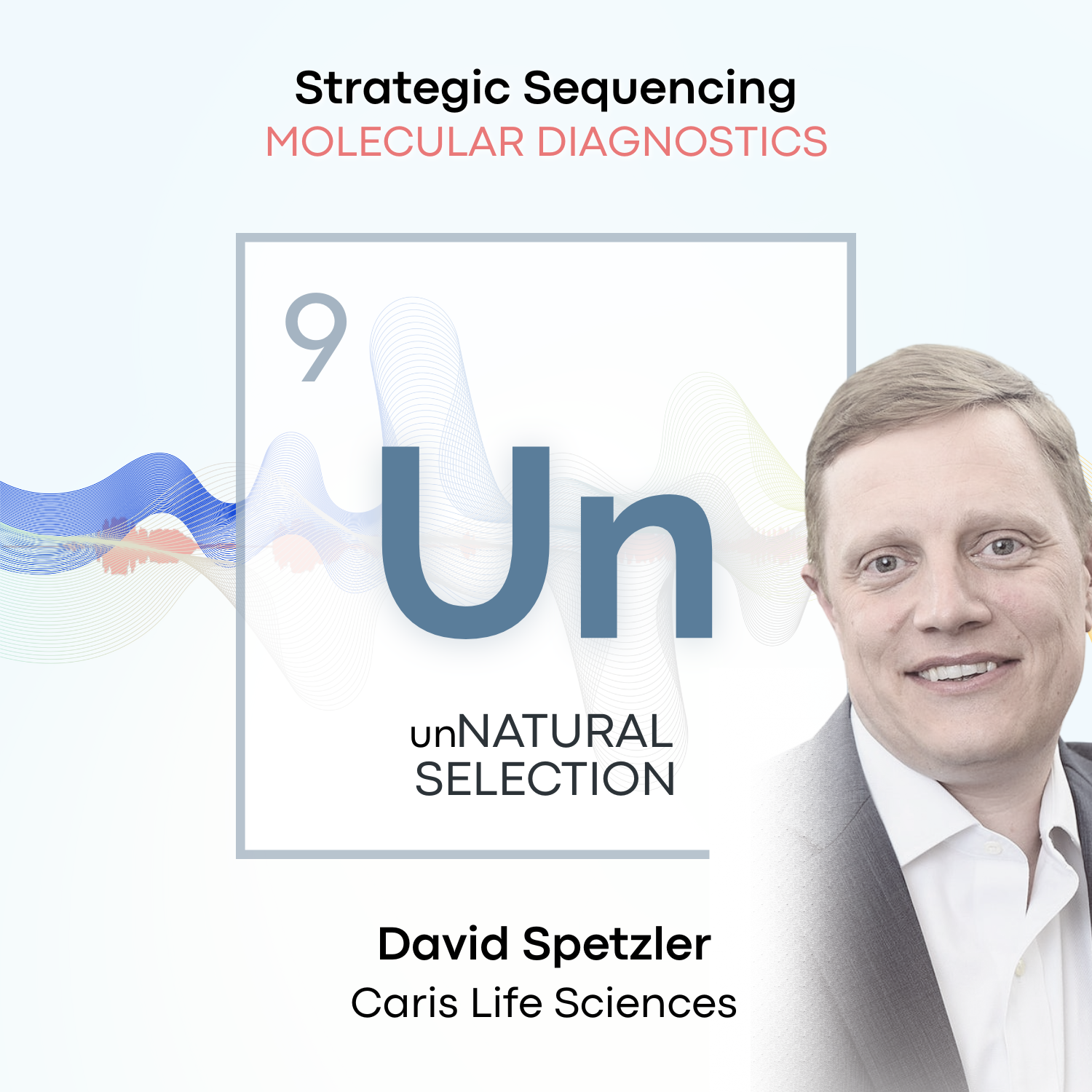
Molecular Diagnostics: Caris Life Sciences • David Spetzler


Timing & Sequencing: Why First-Movers Lose to Precise Scalers
Winning with Data in the Fight Against Cancer. In the high-stakes world of cancer diagnostics, precision is power. This week on unNatural Selection, we explore the fast-moving frontier of precision oncology with Caris Life Sciences, a company redefining how cancer is diagnosed and treated. Through advanced molecular profiling and AI-driven insights, Caris is helping oncologists tailor therapies to the unique genetic makeup of each tumor. We speak with President David Spetzler about the competitive landscape of molecular diagnostics, the role of innovation in staying ahead, and how data is becoming the most critical survival trait in modern medicine.
-
(Auto-generated by Spotify. Errors may exist.)
Doctor Spetzler joined Karis Life Sciences in August 2009 and has LED R&D and laboratory operations in a multitude of roles.
1:06
Dr. Spetzler’s background
As President, he currently leads the company's clinical operations, research and development, information technology, bioinformatics and biopharma services.
Doctor Spetzler has generated more than 330 patent applications across more than 35 different patent families and co-authored more than 120 peer reviewed journal articles.
1:26
As an innovator in molecular science and precision medicine, Doctor Spetzler has a relentless focus on improving patient care.
He's led the development of each of the Kerr's clinical offerings, including the launch of clinical whole transcriptome sequencing in 2019 and whole exome sequencing in 2020.
1:44
More recently, he led the launch of their first AI based clinical products.
And he also led the recent development and launch of a new whole exome and whole transcriptome liquid biopsy essay that sequences DNA and RNA from both plasma and Buffy coat to provide sensitive testing to patients without requiring a tissue specimen.
2:04
David, welcome to a natural selection.
2:06
David’s background
Thank you for having me.
2:08
Speaker 2
I always start with the same question.
Just to level set, before we get started, could you please let us know what business that you're in and what your role is within that business?
2:17
Speaker 1
I'm in the business of trying to help people live longer, and we do that by helping cancer patients.
I'm employed by Caris Life Science and I'm the president of the company.
2:30
Speaker 2
And so for those that have never heard Caris Life Sciences, can you give us a quick picture of what the company does and the problem you're trying to solve in healthcare?
2:39
Speaker 1
Absolutely.
So what we try to do is understand the molecular drivers behind disease, specifically starting with oncology and solid tumors.
And so traditionally what we've done is taken a piece of tissue from the tumor and looked at the molecular changes that caused that cell to go bad, understand the nature of that and then try to guide patients towards particular therapies that are more likely to work and guide them away from therapies that will less likely to work.
3:14
We've more recently taken that approach to the blood where we're doing the same thing.
And then with the blood, it creates an opportunity to start going earlier and earlier in the stage of disease.
So that instead of just looking for, you know, how do we treat cancer better?
3:31
How do we find it earlier?
And that leads to actually using the same molecular system to find a multitude of diseases because the, the real goal of precision medicine should be precision prevention, where we identify cells going bad before they can actually become a symptomatic disease and take them out.
3:54
Maintaining kind of the the health of the patients and the immune system so that we're not fighting the symptoms, we're we're fighting the source early on.
4:04
Speaker 2
It's excellent.
As you were describing that, a bunch of questions came to mind and and really thinking about the paradigm of Valkaris innovates.
4:13
How Karis balances incremental improvements versus reshaping the way oncology diagnostics works at a broader level
There are so many different ways that you can actually innovate a product or a solution.
And the way I understand it, you're not just adding data to a cancer diagnosis, you're trying to rewire the decision making process itself.
Innovation can sometimes be about adding new capabilities to existing systems, but at other times it's about fundamental rethinking how the entire system operates.
4:37
How does Karis balance incremental improvements versus reshaping the way oncology diagnostics works at a broader level, thinking about then the way that you Segway this product into clinical care?
4:53
Speaker 1
Yeah.
Well, we're pretty fortunate that those two things are tightly coupled together.
So as we make incremental improvements in how we interpret data and and measure changes, that leads to massive insights.
5:08
And so five years ago we made what was considered to be somewhat of a crazy decision to go to whole exome and whole transcriptome sequencing.
At the time people were measuring maybe 300 genes, 400 genes per patient and we went to 23,000.
5:27
And we did that because we looked into our database and at that time we were measuring 592 genes and we discovered a signature for colorectal cancer patients that would inform the order of chemotherapy that they should take.
5:44
And so going no chemo regimen A and then B or B and then A and getting the order right led to a 17 month increase in overall survival.
And when we looked at the markers that we were evaluating that were teaching us about that, that order, what we found was that about 60% of them weren't on anybody else's panel.
6:08
And so we were like, wow, look at what we can do with this extra information.
And yet we're only measuring 592 genes out of the 23,000.
So it became clear at that moment that we needed to go much, much bigger, much broader.
6:23
And so that was what motivated us to go after the entire exome and the entire transcriptome.
Fast forward to today, where we have over half a million patients with that and about five years of longitudinal outcome data.
6:40
And we're finding more signatures that tell us what's going wrong and how it's going wrong.
Because if you take a step back for a second and you think about the nature of disease, all, all diseases, disease are cells going wrong.
And if the cell is going wrong, there's something in the molecular system that's driving that.
6:59
And we now have the technology to measure those molecular systems.
So when you start to think about, OK, how do we start to improve human health, right.
It's, it's not just more treatments.
It's really, we need less treatments.
7:14
We need to find things early enough and diagnose them accurately and quickly so that we can minimize interventions.
That's how we save the healthcare system massive amounts of money and prolong life.
And so to do that, you need to measure everything that you possibly can on as many patients as you can, because the most precious thing in this entire value chain is actually the human sample that you're testing and learning from.
7:40
And so if a sample comes in and you only measure 600 genes, well, that's a huge lost opportunity.
Now, if we measure everything, then we don't know what's going to matter today, but we won't find out what matters tomorrow for not making that investment today.
7:55
And and that's what we've done.
That's the bet that we took.
And so now what we can begin to see is there are a lot of different ways that cancer is making cells go wrong.
And there's a lot of different ways that we can start to change that and as you said, rewire the system to be able to be far more efficient because these chemotherapies and these targeted therapies, even the immunotherapies, that's not a cakewalk, right?
8:23
That's hard on the patients.
And so the less intervention we can do, the better, as so long as we're, you know, maximizing life and quality of life at the same time.
8:33
Speaker 2
Karis combines a lot of scientific complexity, genomics, AI, diagnostics, but ultimately your impact depends on how easily that fits into the daily life of the oncologist.
8:45
How Kari can help oncologists reduce the burden of cancer
What's been the hardest part about making something this complex usable as a point of care?
8:51
Speaker 1
Yeah, it takes, it takes a lot on the kind of the the back end to reduce this to simple practice.
And so we, we try to do that for the busy clinician, the report that we get back, you know, we try to simplify it down to red as no green as go.
9:07
So, you know, they may have 20 seconds to prepare before meeting with the patient.
They don't have time to go in and and delve through the complexity of all the molecular aberrations that are driving the disease.
But they do need to know, hey, these are good drugs, these are bad drugs.
9:23
And so we can reduce that, you know, when there's a very short amount of time for preparation, but then also it's our job to to enable a much deeper review as well.
And so, you know, if you get to the point where it's past standard of care for the patient and it's time to really start to say, OK, you know, what are we going to do next?
9:41
We don't have any evidence guided rules to say how to treat this patient.
Now, that's when you have to delve really deeply into the biology to say, OK, this pathway is messed up.
Here's some drugs that attack that pathway.
Let's go ahead and try that direction.
9:56
That's 3rd, 4th, 5th line treatment where there are no trials, there are no indications that allow us to, to know what to do.
And so we have to extrapolate from our our base knowledge of of how these systems work together.
10:10
Speaker 2
You know, we often think about innovation purely as technology, but care seems to be innovating across the board, from how you generate insights to how doctors and hospitals use them.
10:20
How Kari creates value beyond technology
Where do you see Karis creating value beyond just the technology itself, and how has that shaped your approach to long term competitive advantage?
10:30
Speaker 1
Yeah, great question.
So, so we have kind of a, a road map that we, you know, follow.
So there's one thing that is creating data, right?
Once you have data, the goal is to take that data and turn it into information.
10:45
Once you have information, then you're hoping to turn that into knowledge.
And once you have knowledge, you want to turn that into wisdom.
And so that guiding principle really encompasses everything that we're trying to do.
So, you know, you measure as much data as you possibly can, and then you extract information from that.
11:04
Once you have that information, then you can start building these signatures that give you the knowledge of what to do.
And then the wisdom comes and being able to show clinicians that, in fact, that is the right thing to do and get them to act.
And so that whole philosophy really encompasses how we think about, you know, innovating.
11:24
So it's got to be fast.
It's got to be easy.
It's got to be, you know, something that is covered by insurance.
We worked very, very hard to become covered by insurance so that this is attainable by the vast majority of people.
And then it has to be something that is understandable enough that people can have confidence in it.
11:44
And so, you know, in addition to kind of that that philosophical road map behind how we develop things, the most important guiding principle at Karis is what we call the mom rule.
And the Mom rule says, is this what you would want done for your mom?
12:00
Because this company was founded by by a man named David Hulbert who lost his mom to cancer.
And so when he started Karis, you know, it was with the principle of this is I want to build a company that would have done right by my mom.
12:16
And so you know, that that guiding principle is, is evident in everything that we do because we don't put cost first.
It doesn't matter to us that, you know, when we went to these much bigger assays that it more than doubled the cost of goods.
12:33
We didn't change our reimbursement at all, but we did something far more expensive because it's the right thing to do.
It's what I wanted for my mom and it's what everybody would want for for their mom.
And so when you couple that, that, you know, pathway of taking data all the way through to wisdom and you couple that with, you know, what we need to do is figure out how to do right by the patient.
12:57
That creates a very powerful toolbox and incentive for all of us to work harder to, to get better and, and really make the world a better place.
I mean, there are very few people that are lucky enough to say, you know, I get to come into work every single day, invent things that, that help people live longer.
13:17
And I'm I'm lucky enough to be one of those people.
13:20
Speaker 2
And it sounds like what you do is you project, if I can say back to you what I what, what I heard is you, you think about the patient and you work backwards from there thinking about that experience to that person, how do we make their life better?
13:32
How Kari’s approach to research is based on the patient’s experience
And then what are the key steps in fulfilling that promise, which sounds like there's a bunch of invisible stuff happening there, You know, so Karis is obviously innovating on things that are obvious, like technological features and things like that.
But then they're probably less visible but equally powerful areas that you're innovating in, like service, brand, customer engagements and other things that shape the solution, not just a technological tool.
13:59
Speaker 1
Absolutely.
So, you know, every time one of our tests is ordered, we reach out to the patient to let them know what this is going to look like when insurance starts sending them information because they'll get what's called an explanation of benefits, which is not a bill.
14:16
And so warning them that, hey, you're going to get this documentation, that's not a bill.
You don't need to to worry about that.
That's your insurance company explaining to you, you know, the value of the benefits of the service that you're getting.
This is not something that is going to generate financial toxicity for you.
14:35
And we get to work with them and and warn them because, I mean, dealing with cancer is hard enough, you know, navigating the healthcare system, that's, that's almost equally as bad in some cases.
I mean, it's, it is not easy.
And so, you know, we want to, to set up a system and we have set up a system where we're supporting patients and where they can understand that, you know, hey, you, you just got a whole new team member that's here to help you and back you up because our, our job does not end when we deliver a report to the physician.
15:09
So one of the advantages of having whole XM, whole transcriptome is let's say there's a new drug that's approved tomorrow on a new biomarker that nobody has ever heard of before.
Well, it's already in our panel.
We've been testing it for the last five years.
15:24
So what we do is we go into our database, we identify all the patients that would be eligible for this new drug, and we reach back out to their physicians and say, hey, you remember Jane Doe from nine months ago?
Guess what, here's a new drug that she's eligible for.
You may want to check this out.
15:41
This is an ongoing relationship for us.
We want to help people for as long as as we can.
15:49
Speaker 2
I, I can definitely see the value to an ecologist there because you become a value added partner long term.
They're not just like a point of care.
It's more like a decision support tool that just keeps giving and, and monitoring developments to the science along with helping at point of care.
16:07
So, you know, so I guess it takes me to the, to the next question.
16:11
Karis’ core competitive advantages in the precision oncology space
There are a lot of companies trying to do something in precision oncology space.
You know, it's, it's obviously a very fiercely competitive space.
What's, and I think you've shared some of this already, but really just to make it concrete, what are Karis's core competitive advantages and how do you defend that as the field gets more crowded?
16:32
Speaker 1
Yeah, it's it's, it's actually pretty easy for us.
We don't think that there's very much competition honestly, because there isn't anybody else that made that decision five years ago to to go big.
And so when you think about what does it take to develop a new signature and we've got them coming out all the time, you need the the molecular data, but then you need longitudinal clinical outcome data.
16:57
So if you're changing a patient's survival by one year, 2 years, that means that you need to be collecting outcome data for probably three or four or five years.
And so we're so far ahead of everybody else in our accumulation of data that there they're not competing with us.
17:15
We're not doing the same thing.
They are, you know, selling a small test to try and give information for today, whereas we've been gathering information to try and change the world forever.
And so once our clinicians and our our our partners understand that, then there there really is no competition.
17:36
Because another big part of this is, you know, we're good at the science, we're good at the technology.
We need the partnership of the clinicians in order to make that step from information to knowledge.
So, you know, we've created what we call the Precision Oncology Alliance, that's an, an academic industrial collaboration where we've got 97 institutions around the world where all of those members have access to this enormous data set that we've compiled so that we can advance the science and the medicine.
18:07
Because now this is, this is going to take a village, this is way bigger than than one company, 1 institution.
You know, for us to start to really make the inroads that we need, we need the world's greatest minds all working together, hand in hand.
And so now that that also that is very unique to us because we're, we're not a vendor.
18:26
We're, we truly are a partner, not just in the clinical care, but in advancing the science.
And so we crossed our our thousand publication mark last year, all done in collaboration with, you know, great institutions like MGH, for example.
18:46
Speaker 2
That's amazing.
Congratulations.
You know, when you when you think about competition, you're not just competing against other companies, you're competing against inertia in the system as well.
What have you learned about getting new diagnostic approaches adopted at scale in healthcare?
19:04
Getting new diagnostic approaches adopted at scale in healthcare
So EHR integration is absolutely essential.
So if you're asking somebody to leave their EHR system to order a test through some other portal and then go and look for results somewhere else, that's that's a lot of extra work that's outside of the routine that creates a lot of inefficiency.
19:25
The very best systems are those that have integrated both ordering and results directly in the EHR.
And then a lot of systems now have identified, OK, these are the patient characteristics of somebody that they think should be profiled.
19:42
And so there's a an alert that pops up that reminds the physician, hey, this is the time you need to order this test now.
And so streamlining the workflow, making sure that, that they're doing what they want to do just makes everything easier for everyone else.
19:58
And we don't, we don't dictate, hey, this is when you should order.
That's their decision.
That's a clinical decision and it's patient specific.
But a lot of the, a lot of these institutions, they know that they can define, hey, we want to make sure that we're profiling every single non small cell lung cancer that's stage 3B or above, you know, within 5 days of diagnosis or within 5 days of, of recurrence.
20:24
Or progression.
And so they, they create the rules and have been built in those systems within their own EHR system to be able to, to make sure that there's a high level of compliance.
Because the saddest thing really is that it's, it's only about 30% of patients that are getting comprehensive genomic profiling today that that should.
20:46
And that means it's 70% of metastatic cancer patients aren't getting the opportunities to get some of these better treatments.
And it's not because insurance doesn't pay for it, It's because this is new stuff and we need to, to help physicians know what to do.
21:03
I mean, the average age of an oncologist in our country today is about 54 years old, which means that that when they went through medical school, they weren't taking a genetics class in a molecular biology class.
So they've had to learn this all along the way.
21:19
And it's complicated stuff.
So it's incumbent upon us to to ease that burden, to make this something that they understand can trust and, and act upon.
And to that end, we have a field force of about 55 PhDs whose sole job it is to to help translate the world of genetics and molecular biology to the clinicians so that they can know and understand exactly what it is we're saying and and know what to do for their patient.
21:48
Speaker 2
As cancer care becomes more data-driven, So what does the oncologist look like with your technology over the next decade or so?
21:57
What does the oncologist look like with your technology over the next decade?
Yeah.
So you know, in in the beginning we kind of said, OK, here's colon cancer, here's breast cancer, here's lung cancer.
And now we say, OK, here's non small cell lung cancer that's EGFR positive.
22:13
You know, here's non small cell lung cancer that's PDL 1 positive.
And so there's this this hyper segmentation of patient populations.
And there are many, many, many populations out there.
And so, you know, for some of the populations, we know exactly what to do.
For other populations, we don't know what to do.
22:31
And so we can only define the populations based upon, you know, the relevant insights.
And so a big part of, of where oncology is going is in defining these new patient populations.
And and that's going to be a big part of what oncologists are doing is OK, hey, here's my non small cell lung cancer patient that's EGFR positive, but they didn't respond to a TKI to how that's a new population that we need to study.
22:59
And you know, then they'll further enhance that and say, oh, and, you know, they were experiencing neuropathy as well.
And so there's so much information gathering that needs to happen.
That can only happen on that frontline where you have, you know, people that understand, you know, kind of the clinical attributes of a patient that are necessary to define these subpopulations.
23:23
That we can then go in and say, OK, now we know about this population, let's start to study their genetics, you know, what's driving their tumor because maybe we can then understand what that is.
So all right, I see, I see oncologist kind of leading the charge in defining the areas where we need to go in and say, OK, let's try and answer this question about this subpopulation.
23:43
Because if you look at at it at a population level, then we're we're doing a disservice to most people.
23:50
Speaker 2
Looping back to maybe some of what you said in the beginning behind the mission of the organization and how it was founded and what drives you everyday, which is making patient care better.
23:59
The future of precision oncology
And one last question, Doctor Spetzler.
The field of precision oncology is evolving rapidly with the potential to radically change how we diagnose and treat cancer.
So looking ahead, what do you see as the most transformative shifts on the horizon?
24:17
And how do you believe those innovations will shape the future of human health on a global scale?
24:22
Speaker 1
That's, that's a great question.
So we've been spending quite a bit of time looking at patients that don't have cancer, comparing them to those that do in order to be able to diagnose cancer from the blood earlier.
And one of the things that we found is that we can identify pathogenic mutations in the blood that nobody has ever seen before.
24:45
And we've done that by taking our tissue database of 500,000 patients and building an AI to identify these pathogenic mutations.
And if you look in the databases that are public, they're identifying about 15,000 different pathogenic mutations.
25:03
We're over 900,000 pathogenic mutations that we've identified.
And So what that means is that we can find these mutations in people that don't have disease yet.
And there are are lots of therapeutic modalities to target those mutations.
25:20
So, you know, peptide based immunotherapy, much like the flu vaccine is, mRNA, much like the COVID vaccine is.
So we have the technology to go after these bad acting cells and take them out before they turn into something that is bad for patients.
25:41
And that's, that's precision prevention.
So that's, you know, we're, we're skating to where that puck is going to be because that's where I think we'll evolve to in terms of a healthcare system.
Because then all of a sudden you go to this place where, OK, we're all just taking a blood test every year, finding out, oh, we got a little bit going on here now here's your shot and it takes care of it.
26:05
And all of a sudden, you know, the rate of chronic disease is going to plummet.
And it's not just cancer.
It's all sorts of different chronic diseases will be handled by by that approach.
So that's the big idea.
That is the future of precision medicine, in my opinion.
26:20
Speaker 2
Congratulations and all of your accomplishments.
Thank you for what you're doing for the field and thank you very much for your time today.
I look forward to meeting you, hopefully in person at the World Medical Innovation Forum later this year.
26:35
Speaker 1
Thank you very much.
I look forward to it as well.
