Clinical Documentation: Abridge


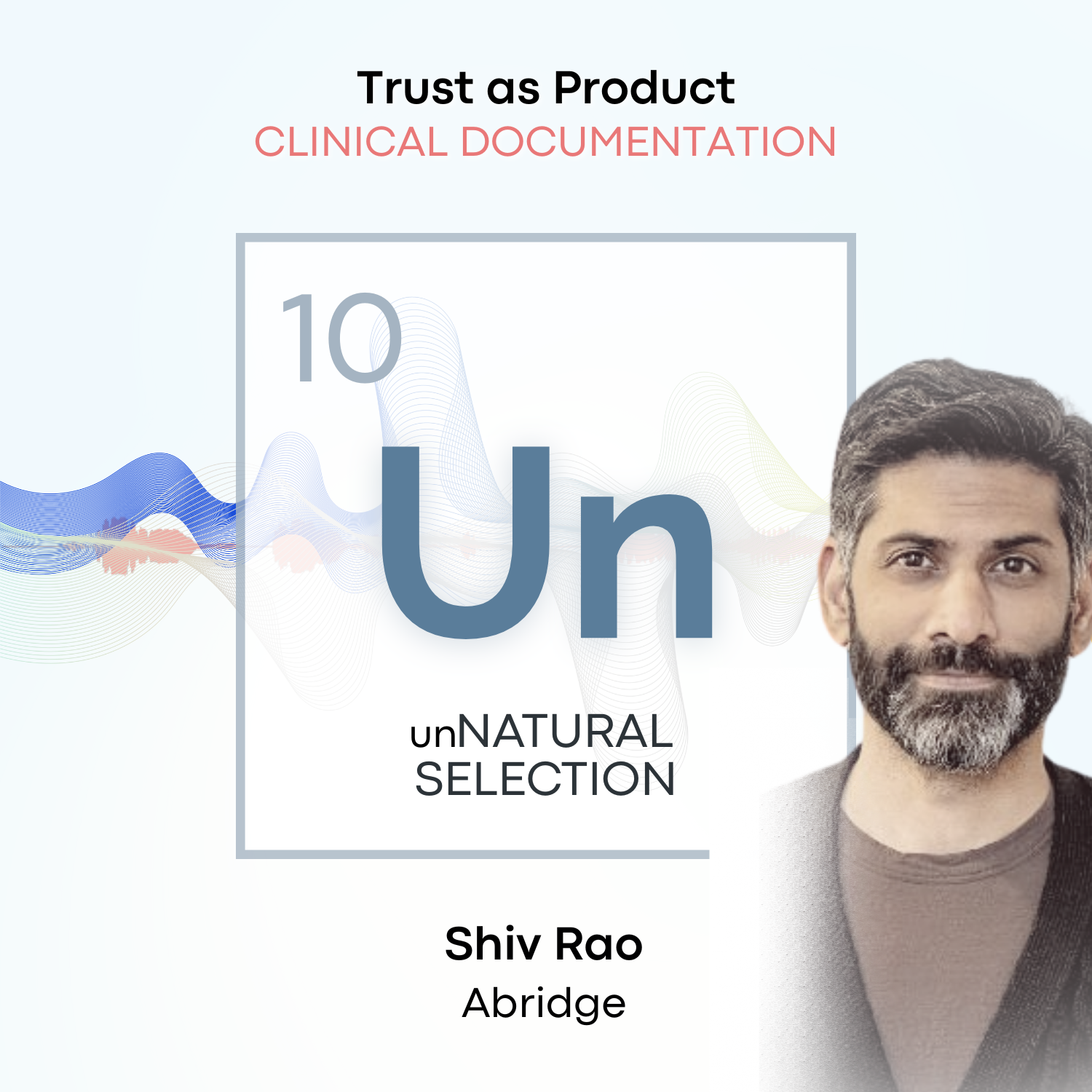
Trust as Product
When AI Listens In. AI is entering the exam room—not to diagnose, but to listen. In this episode, we explore how ambient AI is transforming clinical documentation, freeing doctors from keyboards and returning their focus to patients. Shiv Rao, CEO of Abridge, joins us to unpack what it means when machines start listening in, and what that could mean for the future of healthcare, trust, and the doctor-patient relationship.
-
(Auto-generated by Spotify. Errors may exist.)
Doctor Shiv Rao is the founder and CEO of Abridge, a generative AI platform that unburdens clinicians from clerical work such as clinical documentation, enabling them to focus more fully on patient care.
A Bridge integrates seamlessly within EHR clinician workflows, across care settings, specialities, and spoken languages.
1:15
In 2025, a bridge was named to the Forbes AI50 list and the Fast Company Most Innovative Companies list.
A bridge has also been recognized in the Fortune AI50 list, the Forbes Cloud 100 list, and is one of Time's Best Inventions of 2024.
1:32
Doctor Rao was also recently named as one of the 100 Most Influential People in AI by Time magazine, and it's one of the 100 Most Influential People in Healthcare by Modern Healthcare.
He's a practicing cardiologist, UPMC and previously led the provider facing investment portfolio for UPMC, where he invested in startups and helped fund a machine learning and health program at Carnegie Mellon University.
1:55
Dr. Rob completed his medical education and training at the University of Michigan and the University of Pittsburgh School of Medicine and studied at Carnegie Mellon, where he programmed visual synthesizers and skateboarded in IMAX movies.
Shiv, welcome to a natural selection.
2:10
Abridge
Thanks so much, Nick.
It's a privilege to be here.
2:12
Speaker 2
I always start with the same question, just to level set and give some context to the listeners.
Could you please tell us what business you're in and what is your role within that business?
2:21
Speaker 1
We are a vertical AI company focused on healthcare and I'm the founder and CEO of Abridge.
2:27
Speaker 2
And for those unfamiliar with Abridge or Ambient AI, how would you describe what your company does and how it fits into the broader transformation happening in healthcare right now?
2:37
Speaker 1
We are focused on unburdening clinicians from clerical work and the idea is really to use technology to bring people closer together.
So to give you a little bit more of a, of a sense, after every single conversation that a doctor has with a patient, whether it's in the outpatient world, whether it's in the emergency department, whether it's an inpatient hospital, they have to subsequently document all of their work, all of their thinking.
3:02
And they have to do that not just for clinical communication purposes.
So that the next nurse or doctor or resident or fellow reads that note and kind of understands where they were coming from with the care plant that they, the care plan that they subsequently prescribed.
But they also have to do that for patient understanding and follow through.
3:18
Because all of us as people, as patients, we have access to these notes as well to give us a sense of a reminder of what we actually have to focus on or want to focus on from our, from our own kind of health standpoint.
But then there's also the perspective of revenue side.
Every single one of these notes is actually a bill in some way, shape or form, and so getting it right the first time is super important for everyone involved, including administrators and health system executives.
3:44
Speaker 2
Clinical documentation has always been seen as a burden to clinicians.
3:49
How Bridges can change the way clinicians document
How do you think that a Bridges approach might change that dynamic?
3:54
Speaker 1
Yeah.
So over these last three, three years, we've we've had the incredible privilege of being able to scale our solution across the country.
We're now live across well over 100 health systems across the country.
And what those health systems, what their doctors are telling us is that this is an absolute game changer for them, that for the first time, they're able to be fully present with their their patients in front of them and know full well that after they hit stop on a bridge and they swivel their chair, they're going to have a draft of a note there for them to trust and verify.
4:26
And that note should not just be clinically useful.
It should not just be useful from the perspective of, of a cardiologist like me, for example, but also from the perspective of any specialist out there.
It also needs to be compliant from a revenue cycle perspective because of that administrative function and, and, and purpose that these notes serve, you know, as bills essentially.
4:46
And so we can check off all those different boxes and that's allowed us to scale and we can, we can also check off all the boxes that enterprises expect obviously from, from this technology in order to deem it trustworthy, in order to deem it, you know, safe and secure to be able to scale across their entire system.
5:04
Speaker 2
What are the hardest parts in in actually integrating via bridge solution into legacy clinical workflows?
5:11
The challenges of integrating TNGBT into legacy clinical workflows
How do you overcome resistance from entrenched systems or behaviors that have been around for 100 years?
5:19
Speaker 1
Well, I think that's part of what's helped serve our our growth over these last few years especially is that we can very deeply integrate into existing workflows.
Certainly I'm a, I'm a Doctor Who grew up with specific technologies.
5:34
And one of those technologies is the electronic medical record and Epic specifically.
And we can deeply integrate with Epic on the mobile front, what they call haiku, but also on the on the desktop medical record.
And that's really important, not just from the standpoint of where we are today, but also where we're quickly going, which is into work flows that are just beyond the note itself, for example, like order entry.
5:56
But just to kind of give folks a sense of where we came from, we started our company in 20, 2018 and we started just a few months actually after Google research had published a paper called attention is all you need.
And, and Transformers, which is what that paper was really all about, certainly underpin all the things that we've been doing and that we continue to do.
6:15
The TNGBT stands for Transformers and all of generative AI is underpinned by Transformers.
But my Co founder and I are my Co founder is is a is an associate professor at Carnegie Mellon University and he's our chief technology and science officer at a bridge.
6:30
His name is Zach Lipton.
But Zach and I, I think at that point in time also sort of sort of could could sense, you know, where things were going in terms of this, this technology and had a had a Spidey sense or a bit of conviction that Transformers in this type of technology could could change healthcare as well.
6:48
So we started with pre trained models, like for all the all the geeks listening like Bird and then Biobird and then long former and then Pegasus.
And certainly LLMS entered our our stack in 2022, I think in a very serious way.
And certainly since then we've just been going deeper and deeper and deeper.
7:04
But what what I think we've recognized that it is that it takes deep technology expertise to be able to go millions of miles deep and differentiate from a product perspective.
And that means that even if you're an application layer company, you want to be able to reach down in at least a couple layers into the stack to be able to own and control your destiny.
7:21
It also deep takes deep technical integration, you know, integration into electronic medical records, as I mentioned, in order to create the best possible user experience.
But it also takes, you know, good, you know, theses around all things related to go to market because certainly that's one of the big challenges in healthcare.
7:39
Prior to this, I used to be a corporate VC at one of the large health systems in the country and, and go to market was always, you know, 1 area where where companies could get it, you know, very wrong and and often times not have enough time to be able to course correct.
7:53
Speaker 2
That's great.
7:54
Where Bridge has innovated most deliberately
And if we look at you, you spoke about a bunch of different lovers across the innovation spectrum.
If we look at the full arc of innovation, from how you make money to how users experience your product, where do you think of Bridge has innovative most deliberately?
8:10
Speaker 1
Well, it all starts with products and technology.
So we take a lot of pride in how deep we're going there.
For example, in terms of our stack of technologies, there's a speech recognition system because it's a system of multiple models that we take pride in being best in class across, being able to recognize medical terminology across all the different specialties, the symptoms, medications, diagnosis and procedures that people verbalize.
8:36
Also being able to do this across all the different languages out there.
We can, you know, support probably just under 100 languages and we've benchmarked something around maybe like 1/3 of that.
We've benchmarked in terms of medical term recall and word error rate, technical kind of benchmarks that allow us to keep ourselves honest in terms of being best in class.
8:55
But speech recognition is still just, you know, scratching the surface in terms of the science and, and the R&D that we do in the company.
So much of it is on the text and language side of things.
And there it's it's about, you know, what we call pre training models, being able to think that expansive, but increasingly it's about fine tuning models that are available to all of us, being able to fine tune against a very specific use case, Being able to also post train where we're probably putting, you know, more and more of our effort is going into that world where we're now at scale and we're doing millions of encounters, probably every few every, every, you know, few days or so.
9:33
And so when we're at that kind of scale, how can we learn from all the edits and all the feedback that clinicians give us all the time?
And so that creates its own sort of, you know, loop.
And so that kind of a data network, if you will, is, is really core to, you know, our thesis around all things defensibility.
9:51
But that's, you know, still probably not the whole picture.
I think that you know, networks and you know, partnerships and alliances, distribution channels, Co development relationships, whether it's with an NVIDIA, whether it's with an Epic, whether it's with, you know any, any of the distribution channels out there which are their own kind of separate bucket of potential partners.
10:13
That's really important in healthcare.
And also on the experience side, how customers actually interact with this technology is super important.
It's not just customer service, it's really a whole discipline that we call partner Success Bridge.
And being able to land is one thing, but being able to expand means that you really need to demonstrate to every single health system partner that you understand the gravity of this product, of this technology that you've deployed and how it's increasingly a part of their infrastructure.
10:43
And so it's not just reliability from the standpoint of technology, but it's reliability from the perspective of how we collect and respond to feedback quickly and, and, and, and demonstrate that, you know, we can move as quickly as the best startup even if we're capitalized as well as any, any company in this space.
11:03
Speaker 2
And you're obviously in a space that's evolving very quickly, but at least a component of your business is AI, which seems to evolve in leaps and bounds monthly.
11:14
Speed vs. Safety
And yet you're in a highly regulated, high stakes environment.
So how do you think about speed versus safety?
But even thinking about the pace at which your customers can absorb new innovations, how do you balance all that?
11:29
You know where so much gas is going on the hardcore innovation of AI, but you're within healthcare, so there's a balance there and what you can and can't do and how fast, right?
11:40
Speaker 1
Absolutely.
I think good strong, solid process is really, really important and you know having process also in relation to how you interact with these health system partners, but how you develop product in the 1st place.
11:56
So a lot of folks talk about evals, how you do, how do you evaluate your technology, your your latest sort of machine learning pipeline, your AI pipeline and its outputs?
How do you demonstrate that it can these outputs, this product can really scale, this new feature that you've developed across all the different, you know, partners out there and all their different settings.
12:16
There's a lot to be able to account for and it takes real scientific rigor to do the experiments and to understand that something is safe before you deploy it.
Now, that's certainly a fabric of how we operate because we believe in our company that the actual currency that ends up mattering in Healthcare is trust.
12:33
The only thing that actually matters is trust.
And trust is some combination of transparency, reliability, and credibility.
So being able to demonstrate that we have this process, that we're transparent about this process ourselves internally.
And then when we come to our health system partner with the new feature that as they go through their governance process and give us permission, you know, give us a green light to turn it on and, and scale it that they can really hang their hat on the metrics that we're sharing with them is, is, is very important.
13:01
So I'd say evaluation and evals in general is super important.
Being on the same page with these health system partners around what we can ship, you know, dynamically, like how our machine learning's model models, for example, could learn about a personal preference of, of a nephrologist, you know, in Boston.
13:19
And how we can maybe dynamically, you know, just automatically potentially ship improvements if it's something that doesn't really have any deleterious, you know, consequences on some other aspect of, of, of the health system.
But also making clear that there are certain types of, of product improvements, iterations that require, you know, that level of, of governance and require us to be, you know, very, very deliberate together because, you know, perhaps change management is even involved.
13:50
I think that's that's that's a part of being enterprise grade in healthcare.
13:54
Speaker 2
Yeah.
And and for as difficult as enterprise sales are generally and then add the layer of regulation on top of it from healthcare, your product is still your your technology spreading through large systems like Mayor and Kaiser and other major health systems.
14:14
How to get your innovation adopted in a regulatory environment
Have you learned something new, or what have you learned about getting your innovations adopted in this kind of environment?
14:23
Speaker 1
I think that the current environment in Healthcare is, is, is it's a special kind of moment right now.
And, you know, I think it starts with a problem that we're all facing that that is really a public health emergency in a way.
14:39
It's that clinicians are burning out and that two out of five doctors don't want to be doctors in the next two to three years, that 27% of nurses per JAMA don't want to be nurses in the in the next year or so.
And so we have this public health emergency, we have supply demand mismatches in care delivery that are already impacting rural health systems and, and causing them to shut down and forcing patients to have to drive 5 to 6 hours into an inner City Hospital to see the rheumatologist who could potentially save their life.
15:08
So we have to do something about it.
And you know, perhaps, you know, for one of one of the, the, one of the first moments in the history of Healthcare is as at least as long as I've been following it very closely, healthcare technology.
We need, we need technology.
15:24
There's really no other way out.
We need some level of not just assistance, but also augmentation.
We need automation from technology in a way we didn't before.
So I think what the market has realized over these last few years is that there's certain use cases in healthcare that are lower stakes.
15:41
And especially when those use cases are high frequency, being able to point these new AI tools at those use cases can be incredibly high yield because you'll, you'll be able to quantify and measure that ROI very, very quickly.
And certainly on that end of the spectrum, there are about back office, maybe revenue cycle oriented work flows, but clinical documentation is, is one of those as well because we don't automate this documentation.
16:07
There's always a clinician in the loop to trust and verify the drafts that we've we've generated for them.
But you know, it's a very, very high frequency workflow that it is.
It is not and should not today be impacting clinical decision making.
We're not telling a doctor what antibiotic or all or oncolytic to use.
16:26
We're just capturing the ground truth of what they've discussed.
And so it's one of those use cases that sort of checked off all the right boxes in terms of being high frequency, lower stakes and something where this technology can truly sing.
So now what a, you know, part of the moment for us and part of what's helped us, I think scale is being able to demonstrate that we have the people and we have the, the culture and we have the resources to go millions of miles deep on what it means to be premium in the space.
16:56
To serve all the different clinicians and all the different settings and all the different languages.
And make clear that these notes are not just notes in a vacuum, that these notes should also serve, for example, other functions in in in the health system like revenue cycle.
17:10
Speaker 2
Ambient AI feels like just the beginning.
17:13
What will the clinician’s job look like in 5-10 years?
So as these tools evolve, what do you think the clinician's job would look like in five years?
And and what role will companies like a bridge play in shaping that?
17:23
Speaker 1
So in the next 5 to 10 years, we certainly do not think that clinicians, that doctors or nurses are going to be fully automated.
Now, there are there are probably people out there who think that's the case and we do not think that.
Now that might be my bias as a practicing cardiologist.
17:39
But when we think from first principles about what doctors and nurses do, there are any number of tasks that they do on a daily basis that we should absolutely aim to automate.
But when you think about all of the things they do, it's just impossible for us, for me to imagine, you know, full automation.
17:55
And there was an American Journal of General Internal Medicine article that was published a couple years that suggests years ago that suggested that doctors need 30 hours a day to get all of their work done.
So, you know, even if we're not automating all the things they do, we have our hands full here.
18:11
There's enough to go after.
And and it's a question of like sequencing the right tasks that we can help them with in the right order.
So we believe and we believe that clinical documentation is one of the first most important tasks.
Now, we also believe, though, that that conversation between the professional and the patient is upstream of any number of other work flows.
18:30
Those conversations inform, for example, order entry after I see a patient, I'm going to write a note, but then I'm also going to place my orders inside the medical record.
And we've had the privilege of being able to Co develop with Epic, for example, a workflow inside that medical record.
That can also be just as big of a game changer as clinical documentation in terms of being able to unburden clinicians and help them simply trust and verify, you know, the, the, the medications or the procedures or the referrals that they placed for that patient that they just, you know, took care of.
19:00
But there's other workflows that are beyond that.
I think conversations are upstream of not just clinical documentation, but revenue cycle, which means coding, whether it's in the fee for service world or the risk adjustment world, these notes need to be concordant with those codes.
We have a responsibility to generate the best possible notes, But then there are also upstream of care management, clinical decision support, upstream of of, you know, ultimately experiences and outcomes.
19:26
So I think over the next five years, what what we think we'll see is, is that this technology, you know, we're going to, you know, be able to scale it everywhere.
And certainly a big part of our investment over these last few years is building the infrastructure and the people and the processes to be able to do that, to be able to serve every clinician that's out there.
19:44
But then, you know, I think where does that leave us?
I think it leaves us in a world where healthcare feels even more human, you know, where clinicians are that much more present with the patients in front of them.
And when we started the company and everyone in our company and our our Zach, our CTO, has his own stories for what gave him conviction, You know, but for what me gave me conviction was in part my patients, not just my professional experience, but my patients.
20:07
And one of the stories that I frequently tell is that in March of 2018, I saw a patient in my weekly cardiology clinic.
She had a 10 year history of breast cancer and she was about to see me.
Because she was prescribed doxorubicin for, you know, chemotherapy that could potentially affect her heart.
20:22
So she needed a cardiologist to sort of evaluate and see, you know, weigh the risks, risks and benefits.
And she was super nervous and anxious over that entire encounter, crawling out of her skin.
And so at the end of the encounter, I asked her why, if there was something I did or something I said to make her feel so clearly, like, uncomfortable.
20:40
And she told me that for the last 10 years, her husband had come to every single visit with a new Doctor except this one.
He just couldn't make it for whatever reason.
And she's an English professor at the University of Pittsburgh.
Incredibly eloquent.
She told me that him taking notes in the corner of the room, which is what he would do.
20:55
That's, that's the differentiated thing that he would bring to these encounters, not just the sort of, you know, obviously like the care and the support, but it's this, this work he would do this this task that he would complete.
He would take notes in the corner.
But him doing that meant that she could feel more present with the clinician.
21:13
She could make eye contact and then they could go home and they could rewrite all the notes that he had taken and maybe Google all the big words, the medicalese and rewrite their story and then go to the next clinician and retell it and feel like the main characters as opposed to someone looking in from the outside.
21:29
And I think what her experience has in common with clinicians is that we, we feel the same way as doctors and nurses.
We want to be more present.
We want to make more eye contact.
We want to, you know, build stronger relationships, knowing the therapeutic value of that.
And we want to ultimately get closer and closer to what drove and, and catalyzed us to go to medical school and nursing school and make all of those sacrifices at some point in our life in the 1st place.
21:53
And So what we're trying to do is thread the needle through the most important people in healthcare clinicians, you know, the care team, but also patients at the center and, and create and, and not just these drafts of notes, whether it's a clinical note, whether it's a visit summary for the patient, but also unburden them from all the other tasks that, you know, inform these conversations.
22:12
But come after.
And you know, the idea is that this will just lead to more person centered care over time.
And I think from the perspective of business, this will also lead over time to new business models.
And I think if there's one industry that needs, it's more new business models, innovative business models, it's healthcare.
22:29
Speaker 2
That's incredible, Aisha.
This has been tremendous.
I, I thank you for your time.
It's been a privilege getting to know you and I.
I look forward to meeting you at the World Medical Innovation later on this year.
22:43
Speaker 1
Awesome, Nic.
Thanks so much.
It's been a privilege to be here as well.
Appreciate your time.
