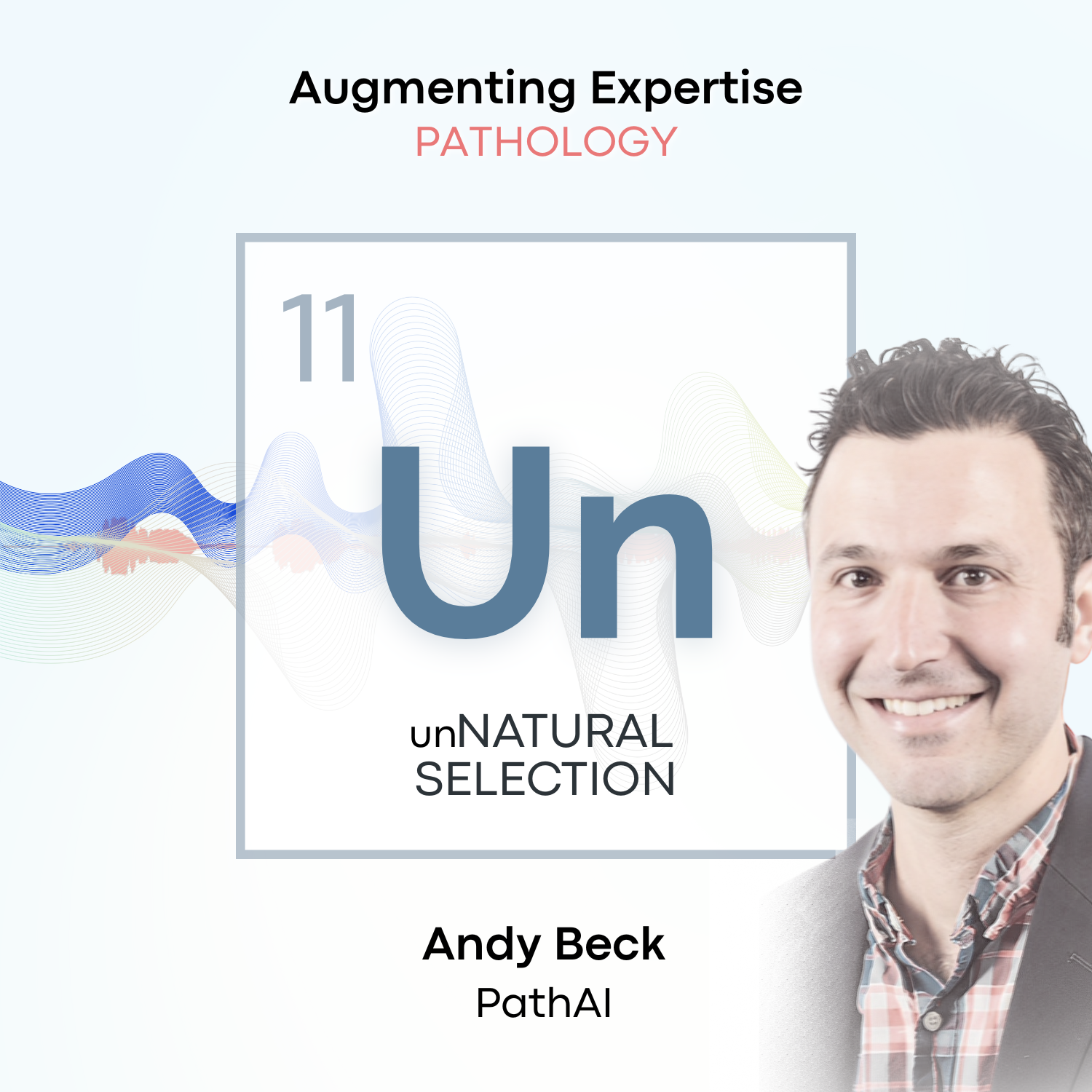
Pathology: PathAI • Andy Beck


Augmenting Human Capital: Precision as a Competitive Advantage
Training AI to See Like a Pathologist. In this episode of unNatural Selection, produced in partnership with Mass General Brigham ahead of the World Medical Innovation Forum, we sit down with Dr. Andy Beck, CEO of PathAI, to explore how machine learning is transforming the world of pathology.
From accelerating drug development to improving clinical diagnostics, AI is changing how we understand and act on disease. We discuss how algorithms are trained to "see" disease in digital slides, the competitive edge in AI-first platforms, and what it means to innovate in a field where precision is everything.
-
(Auto-generated by Spotify. Errors may exist.)
Andy earned his MD from Brown Medical School and completed residency and fellowship training and anatomical pathology and molecular genetic pathology from Stanford University.
He completed a PhD in Biomedical Informatics from Stanford University where he developed one of the first machine learning based systems for cancer pathology.
1:08
Prior to Co founding Path AI, he was in the faculty of Harvard Medical School in the Department of Pathology at Beth Israel Deaconess Medical Center.
He's published over 110 papers in the field of cancer biology, cancer pathology, and biomedical informatics.
Andy, welcome to a natural selection.
1:24
Speaker 1
Thank you.
Pleasure to be here.
1:26
Speaker 2
Andy, could you please answer what business are you in and what is your role within that business?
1:31
Speaker 1
Sure.
So I'm the CEO and Co founder of Path AI.
We build a digital pathology and artificial intelligence platform for applications in pathology, serving both drug development as well as diagnostic pathology.
1:51
Speaker 2
For those unfamiliar with the space, can you give us a layperson snapshot of what path AI does and what makes its approach unique within pathology and AI?
2:02
What is PathAI?
Sure.
So for a bit of background, the field of pathology is responsible for the diagnosis of disease.
The the subtype of pathology that we work in is anatomic pathology, which is the part of pathology that deals with analyzing tissue specimens.
2:22
So when biopsies or surgical resections are removed from patients, they're sent to the pathology lab.
And then whether that's for drug development or for clinical care, the job of the pathology lab is to both accurately diagnose that tissue specimen.
2:38
Does it contain disease, yes or no?
If it does have disease, what is the subtype of disease?
And ideally, if it's a subtype of disease that is known to have a therapy that's effective for to recommend a specific treatment for that patient to ensure that they get the right diagnosis and get recommended the right treatment, that will be the most effective way for them to manage their disease.
3:03
In the side of research and drug development, there's often additional information that's useful that we can extract from the tissue, including quantitative information about the disease state that can be used to help us better understand disease and and to provide new hypotheses for better ways of preventing or treating disease.
3:24
So what we do is that the sort of very traditional way that pathology has been done has been that a, a tissue specimen is sent to the lab and a a thin piece of that tissue is then applied to a glass slide.
3:40
And then those glass slides are just analyzed under a microscope by a physician.
Where the field is going is that instead of just having pathologist analyze slides under a microscope, those images will be captured digitally through what's called whole side imaging.
3:59
Basically taking a very large picture, microscopic picture of that tissue specimen.
So the tissue is stained and then put in this whole side imaging machine, which is sort of like a microscope inside of a big box that then not only magnifies the image but also digitizes it.
4:16
So it takes a digital picture, which then is sent to the cloud where our platform then ingest these whole side images.
That's really the beginning of where our platform and products start applying.
So they take as input these whole side images, these very large pictures and then analyzes those pictures to provide either diagnostic information or information to support drug development.
4:40
Speaker 2
When it comes to changing the paradigm of how healthcare was done, and you talked about that just now, pathology has historically been a field of microscopes and manual interpretation.
4:50
Challenges to the status quo
So what are the some of the entrenched assumptions that you're challenging and what does it take to get pathologists and regulators on board?
4:57
Speaker 1
On the diagnostic side, the biggest assumption that we're challenging or you know, to your question about competition, which we haven't covered, but I think it's, it's essentially the same predominant answer is the status quo.
5:12
And the status quo is the way things have been done for, say, 50 years is glass slides and microscopes being the core technology that's used in the lab, that the pathologist is sort of sitting next to the microscope interpreting images and then putting the diagnosis into the laboratory information system, which is already computational and digital.
5:34
But that first piece really isn't.
It's manual, it's a microscope and it's interpreting images which are not being captured digitally for perhaps something like 90% plus of the glass slides that are being reviewed every day.
5:49
So I'd say that's the that being good enough is the core thing that we think will change because we think there's going to be enough advantages of going digital and then on top of that using AI.
But I think proving that out is is the biggest, you know, job we have to do and then first proving it and then really enabling successful implementation of this digital transformation and then use of AI on top of that.
6:16
So, but I would say, yeah, that's the biggest sort of practice of medicine assumption that that you know is going to be important to change.
6:26
Speaker 2
And you mentioned that you're building at the intersection of AI and medicine, 2 fields with very different timelines and intolerance for risk.
6:34
How to manage the tension between AI and medicine
How do you manage the tension when scaling new products or really innovating at the pace of technology that AI can lead you to?
But then obviously adoption in Healthcare is a very different timeline.
6:49
Speaker 1
Maybe yes, maybe no.
I mean, A is been around a very long time, right?
It's been very bad for the beginning and it's gotten much better the past few years.
But I would say you've been trying to do AI for maybe 80 years or so with fairly little success up until, say, the past five years.
7:09
So it's in terms of timelines.
I mean, I don't totally agree with the premise of the question.
I mean, medicines changing all the time.
You look at like pick up, you know, new internal medicine comes out every week and there's new practice changing advances that literally aren't published, say in that journal or you know, there's a few other sort of that are at that level, but unless they're practice changing and there's practice changing advances happening all the time.
7:33
So medicine actually moves very fast in certain areas, but there's a certain amount of evidence in your point.
There's a certain benefit risk trade off that you need to hit to change medicine and you basically the only thing you have to do is prove that this is better than the standard of care.
So there's actually is a total framework built into the whole system for how it changes and it changes quite rapidly.
7:53
If something proves beyond a doubt that it's more effective and safe, like bam, that will happen.
So I think in a way, medicine's quite set up for for rapid change.
But the hard thing is it's changing.
So it it gets harder to then prove that the next change is better than the the current status quo.
8:11
So to some degree, I think medicine intrinsically is built for improving, and AI is also built for improving.
And I'd say AI has been around for a long time and only recently has it actually gotten rapidly better.
Decades went by where it didn't get much better and there have been some huge technical advances, I'd say preview this past decade that have made it tremendously get better.
8:36
So how do you actually change medicine?
Well, you have to prove that, you know, the intervention you're making is, is going to be significantly more effective than the current.
And that's either through improved quality or improved efficiency or kind of two of the biggest, biggest things we think about for patients.
8:56
So I would say AI is 1 tool, but the important thing is to think about how medicine changes and to not think about the AI.
Like AI is just one tool and it's a tool that doesn't exist by itself.
It's a tool that exists and to then products that you create.
9:12
And then products could turn into, say in our case, diagnostic products.
And then you really have to evaluate that diagnostic product.
And medicine has a, a real track record or history for how how they evaluate or how the field of medicine evaluates diagnostic products.
You have to prove that it's accurate and that it's effective.
9:31
And I think that the beauty is AI really does make diagnostics that can be more accurate and more efficient and be cost effective.
So I actually think there's a tremendous alignment between the two and, and not like they're coming from different worlds, but you know, when you're training an AI model, you're evaluating how, what's the sensitivity, what's the specificity?
9:52
And things like machine learning are designed to get better over time with more data changing Medicine requires the exact same thing that you have to prove that the sensitivity, specificity, and efficiency are better with this approach than the current approach.
And then if you're able to prove that and can do it in a cost effective way, then you know that will be incorporated into the practice.
10:13
So I think, I think surprisingly in a way, I think they're quite well aligned.
10:17
Speaker 2
What would you say are some of the biggest differentiators between Path AI and other players in the I pathology or digital diagnostic space?
10:25
PathAI’s biggest differentiators
When we look at you can innovate across a bunch of different vectors, strategy systems, experience, business model features, where do you think you and Path AI lean in the most that differentiates you?
10:40
Speaker 1
It's a great question.
So we've done All in all of those areas over the years.
So we've been at this, I mean we're nine years into it heading into our 10th year.
I think we're we've never been in a stronger position and we've certainly innovative in all of these different areas.
10:58
What do I think has actually mattered for us sort of getting to where we are like some of them have worked, some of them hadn't.
We've had many different competitors over the years.
I still think the biggest competitor is still is status quo.
I mean, still the biggest thing is at least on the diagnostic side, you know, many labs haven't yet really fully gone digital.
11:19
So that's gonna happen cuz the technology to do that exists.
And I would say that's still the vast majority of the market is just still open for our technology.
And then the AI products don't exist yet.
We're building them.
11:34
And we're, I think we're leading and like, so we're not like, it's not like we're competing against an existing product for the vast majority of the time.
It's like the products, the products that I think should be built don't yet yet exist.
We're building them and, and I hope they're implemented.
So I feel like our top competitors are still status quo.
11:52
And the fact that, you know, the what I think will be the most transformative products are still being built right now and certain products do exist and certain products have competition.
So it's not like I'm saying they don't, but I would just say like it's not like there's a single one, there's many different ones.
So to your question of what's differentiated path AI over the years from competitors in our space or other start-ups like us, of which of which there have been, you know, probably dozens since we've started.
12:16
What differentiates PathAI from competitors in the space
One is timing the market.
So you really have to meet the market where it is over the next six months.
So I'd say 11 mistake people make is they tend to be late or early and you really like timing is very important.
I think we've done a very good job on timing.
12:32
And what we did there was first we focused heavily on like the area of drug development that was ready to incorporate digital pathology and AI at scale like when we started.
So our very first project was like a very mature project with Bristol-Myers Squibb.
12:47
And then we quickly do it with Genentech, one with Gilead, which had to do with analyzing on the order of 10s of thousands of clinical cases from completed clinical trials to better understand using digital pathology and AI why patients responded to therapies across different therapeutic areas, including oncology.
13:08
And Nash were two of our very big therapeutic areas and they were like great partners to be working with.
So I'd say like the one thing we did very well was just like focus on that and then scale that up and really show that, you know, this should become the standard.
I think it largely has become the standard for translational research in drug development.
13:25
And we're one of the leading companies.
And of course there's other companies doing it.
But in terms of what differentiates us from the other digital pathology companies in the areas, it's we've always stayed ahead.
So although we started there and started scaling there, we fairly quickly said, OK, if this works for translational research, it's also going to work for prospective clinical trials.
13:43
And we built the whole platform for supporting prospective clinical trials.
And then in terms of meeting the market where it is, we didn't just build like an algorithm or show that you can take an algorithm and AI from translational research and moved into trials.
We built a platform that could also support just manual scoring without AI.
13:59
And like the biggest part of our early growth in that area was digital pathology without AI, but using this sort of GCLP like regulatorily and compliance cleared platform that you could use in prospective trials.
And I'd say we did that years ahead of others and then became a very, I'd say leading platform in that area in terms of meeting the market where it is.
14:20
We also acquired our own laboratory so we could do the whole end to end pathology where all they had to do is send us tissue and we processed the tissue, we digitized it and then we used our platform, our digital pathology platform and in certain cases used AI, in certain cases didn't use AI.
14:37
And then we also kind of the the next cycle for progression is if you're in clinical trials and you want to actually be used for drug approvals, you then have to be able to do companion diagnostics.
So we signed a major companion diagnostics agreement about a year ago that made us one of the major partners with all of major biopharma because we're partnered closely with the leading assay manufacturer for companion diagnostics and we're kind of like the digital AI platform that sits on top of the wet lab assay.
15:07
And then in terms of meeting the market kind of where it is and getting the timing right, we then about four years ago or so started building our platform for for diagnostic use.
And we wanted to build the leading platform to do both the AI piece, but also just the workflow and the efficiency.
15:25
And I think that has been very, very important and we're now seeing significant growth there.
So a lot of it is just thinking about where is the market going and don't get, don't be behind, but don't get too far ahead and then really meet the market where it is like you want the demand where.
So for us it's been not only being AI, but also being a digital pathology workflow platform.
15:45
And, and I think what's what we've done very well with our customers is getting is this sort of making the feedback loop between customer feedback and product iteration as short as possible.
But we've been very good at, I think getting customer feedback, incorporating into, you know, 6-6 week release cycles of software and I think that's helped differentiate that.
16:07
So I know that was a lot of different answers, but it was a question of timing, business model, kind of seeing where the market is today and where it's going over the next six months.
And I think we got many things wrong, but we got some of those things right.
16:18
Speaker 2
And and you mentioned you, the Path AI has been around for nine years.
16:20
PathAI’s growth in the next 3 to 5 years
So you've obviously seen this market evolve or the opportunities.
It's not just a single market.
So if we think about, like you said, you're meeting the market where it is looking ahead the next three to five years, where do you expect the greatest growth for Path AI to come from?
16:36
You mentioned clinical diagnostics, pharma, partnerships, international markets, or is it something else?
16:42
Speaker 1
No, I think it's that I think you're right.
I think on the pharma side, where we see it growing the most is going from sort of a pharma has a few different areas they have like early research and discovery, which to some degree is where we started more, but where you're not yet really tied to like the registration, like the approval of a new therapy.
17:02
And then they have late stage, early stage and late stage clinical development and then on market.
So when we're moving more in pharma is to really decrease the distance between the discovery of a new biomarker and then the implementation of that like in a prospective trial that could lead to a companion diagnostic.
17:22
So I would say the biggest area of development there is like how do you go really fast from translational research to a new companion diagnostic And we're seeing that interest and then using AI as that accelerant.
So you discover something new from existing data and you very quickly have a product development cycle to build that into a new companion diagnostic.
17:41
That's like the, the area of pharma where I think AI and agentic systems and digital pathology will be really key over the next, say, three years where those historically have been fairly siloed.
17:57
And then, and then I think there's also maybe I'll give 3 examples, two of them pharma starting and ending with pharma.
So one is sort of like going from R&D to companion diagnostic.
A companion diagnostic is called that because it's used, it's a direct companion to the new therapy.
18:13
So you need it both for the approval of the therapy, but also for the commercialization of the therapy, getting it to patients.
Well, if the digital pathology is a piece of it, the only way you get it to patients is if digital pathology in this platform is widely distributed.
And then what I think that I think clinical and diagnostic labs is a huge growth area and the AI is going to play a huge role there just because as we're seeing in all areas of our life, for certain tasks that AI is good at, it's just getting better and better and automating more and more of that task.
18:42
So, you know, I'd say where we started was algorithms and very, very specific things very, very well.
Like if you had, you know, pathologist diagnosis cancer and it's a cancer that needs a test called immunohystochemistry.
And the way you evaluate immunostochemistry tests is by counting the number of brown cells.
18:59
So we build an algorithm and validate it to count the number of brown cells.
It would work very well, but the truth is with these new AI systems and things we've built and others are building, it can do all of those things.
So basically you want all of that work done for the physician before they even sit down.
So you can imagine a complex case coming through.
19:15
The AI system is reading the priors, reading the electronic health record, reading all the slides, interpreting, putting all that data together, thinking about it, looking at the literature, and then creating a diagnosis, doing whatever downstream biomarker tests need to be done.
So then like when the pathologist sits down, all of that data is waiting for the physician and then they can very quickly agree with it, disagree with it.
19:36
That feedback goes back to the system to make it even better and then get the the right diagnosis and treatment recommendation for that patient as fast as possible.
Like as you know, like the first time they sit down.
So it's sort of a diagnostic odyssey that might take a month can now be done within like 30 seconds.
19:53
And I think that's where we're headed on the on the clinical side.
And we're like only at the very beginning like that everything I described are pieces of it exists, but like that whole system doesn't yet exist.
20:03
Speaker 2
And as you're building the system and you mentioned before you, you also consider yourself kind of like a pathology infrastructure.
20:10
Using Current Infrastructure vs. Introducing New Technology
It's more than just like a product that's actually like a whole system, right to to support the workflow.
How much do you balance leveraging current infrastructure versus requiring new technological competencies, right.
20:26
If you think about you can innovate on the features is something that are more like routine innovation.
You can innovate obviously in the business model and be more of the disruptor in that space.
But if we think about architecture, are we talking about architectural changes that are going to be harder to adopt at hospital systems, or do you fit mostly into the workflow that's currently there?
20:46
Speaker 1
Yeah.
So first we try as hard as we can to fit into the workflow that's already there.
I mean, I think that's one of the beauties of the platform.
The biggest change is they have to, if they go from microscope to digital for their method of primary sign out, they still have to make the glass slides.
21:02
They have to also buy some number of these whole side imaging systems, which are these big scanners.
You can picture like a radiology scanner, but there's a pathology scanner.
We don't do that.
That's the biggest change in workflow that has to happen prior to us.
That is a big change, but it is just absolutely required but once and we don't manufacture or sell those ourselves, but once those are in place, yeah, we have a web-based platform.
21:26
So the actual technical integration there is an important piece of integration with the laboratory information system, but that's kind of it.
So like everything else happened in the cloud and it's a SAS type model that we can manage and make changes and do not have to push any of that to the IT systems of our users.
21:44
You know some folks still want to store data on Prem, which we totally support.
So we can have kind of a hybrid on Prem cloud model.
We really want the tailwind of these 10s of billions of dollars or trillions of dollars that are being invested in cloud and AI architectures.
22:00
And there's this humongous set of resources and open source tools and even paid services by AWS and Google and Microsoft that are available on the cloud.
So we want to innovate where like we're the only person doing it or maybe there's us and two other companies doing it and leverage and kind of stand on the shoulders of all these huge tech giants that are investing heavily in infrastructure for very, very similar problems, which is how do we do AI and big heterogeneous multimodal data sets.
22:32
Speaker 2
Perfect.
So Andy, you know you've been very generous with your time.
So if I can ask you one more question, really zooming out, let's say path AI is wildly successful.
22:41
The future of diagnostics
What does the future of diagnostics look like?
What does it mean for patients, clinicians and how we think about disease?
22:49
Speaker 1
Yeah.
So the biggest thing for patients that I really think is very clear is if you know of any your loved ones or yourself have any experience with like a complex diagnosis from pathology today, it really is not in a good space.
23:05
I mean, and I'm saying this as a pathologist who spent my career working with pathologists, it's often slow.
You often get variable opinions.
If you send, if you send a difficult skin biopsy to five pathologist, you can ask any dramatic pathologist, you're going to get like 3 different answers.
23:22
They're going to be sort of ambiguous.
It's often not data-driven.
It's just someone you know, someone interprets an image this way, someone else interprets an image a different way.
And getting second opinions is difficult.
If the labs aren't digital yet, you actually have to ask for the glass slides and they're sent to you and then you have to, yes, it's like the whole thing takes months and is very slow.
23:43
So I'd say it's almost like you really have to describe the problem today to then say what I'm going to then describe as the future as being significant improvement.
But you can imagine the not too distant future.
You know, every patient can be far more confident that they're going to be getting the right diagnosis as fast as possible and it will be tied to the right therapeutic recommendation.
24:03
And that, you know, we basically have the core technologies today.
I think that will get us there.
And it's a matter of sort of building the products and platforms around them to enable that, where every new slide is read first by an AI system.
24:18
And that's standardized.
And the pathologist job really evolves to, you know, counseling other physicians, potentially counseling patients, but sort of having trust in the core underlying diagnostic data so that we're having fewer errors, having to improve turn around time.
24:34
And, you know, patients can be much more confident they're getting the right diagnosis and the right treatment recommendation.
And, you know, I feel like that's our area of focus.
Then that becomes like the scientific bedrock for clinical care, but also for drug development.
And, you know, if that happens, I think I'd say pathway I would have been wildly successful.
24:53
And of course, there's still a ton of work to do on therapeutic development and improving, you know, cancer cure rates and things that I hope this technology helps advance.
But that's like our core focus.
25:04
Speaker 2
That sounds like an extraordinary future, extraordinary vision, and I wish you the best of luck, Andy.
Thank you so much for your time and for being on this episode.
I look forward to meeting you at the World Medical Innovation Forum later on this year.
25:19
Speaker 1
Thank you.
Thanks for having me.
