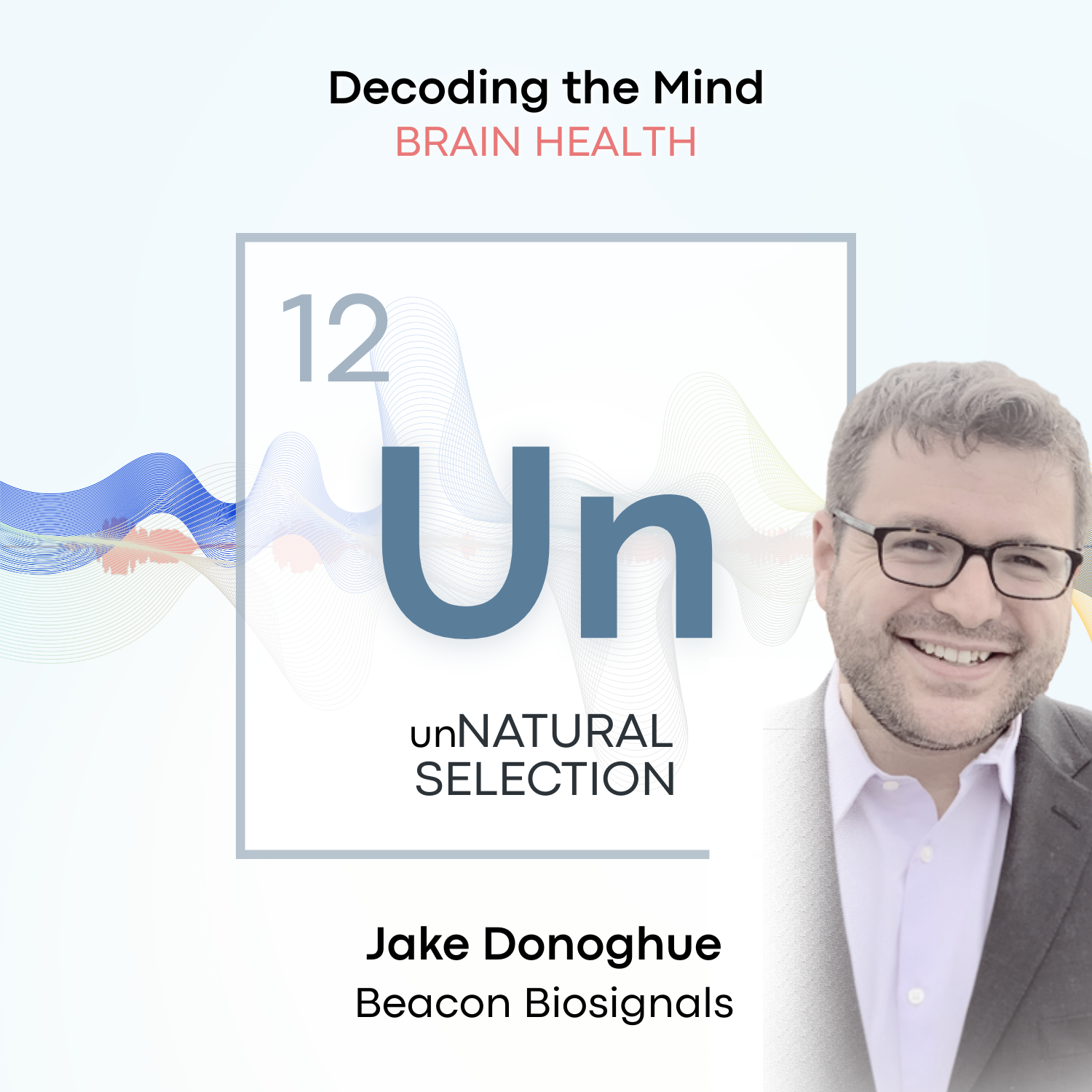
Brain Health: Beacon Biosignals • Jacob Donoghue


Continuous Data Pipelines vs. Point-in-Time Diagnostics
Can Brainwaves Become Biomarkers? In this special episode of unNatural Selection, produced in partnership with Mass General Brigham ahead of the World Medical Innovation Forum, we explore how AI is transforming EEG from a blunt clinical tool into a precision instrument for neuroscience.
We dive into how companies like Beacon Biosignals are decoding brainwaves at scale—advancing drug development, redefining diagnostics, and opening new frontiers in neurological care.
It’s a conversation about data, pattern recognition, and the race to make sense of the brain’s most elusive signals.
-
(Auto-generated by Spotify. Errors may exist.)
Jacob Donahue is the cofounder and CEO of Beacon Biosignals, founded with a mission of decoding sleep to advanced brain health.
1:06
Beacon Biosignals
He leads the company's efforts to transform how neurological, psychiatric, and sleep disorders are diagnosed and treated using AI powered sleep EEG analytics.
Under his leadership, Beacon has built a platform that combines FDA cleared wearable EEG devices with advanced analytics to identify digital neurobiomarkers supporting precision medicine and clinical trials and diagnostics.
1:29
Doctor Donahue received his MD from Harvard Medical School and PhD in neuroscience from MIT.
Whereas research focus on how neuroactive compounds modulate brain network activity, his scientific work spans neurophysiology, neuropharmacology, and machine learning for neuro signal analysis.
1:46
Jake, welcome to a natural selection.
Thanks.
1:49
Speaker 1
For having me, Nick.
1:50
Speaker 2
Just to start and level set, could you please tell us what business you're in and what your role is within that business?
1:57
Speaker 1
Of course, yes, I'm the CEO and Co founder of Beacon Biosignals, AI powered neurotechnology company.
My role as CEO is to help oversee an amazing team of scientists, engineers, commercial folks to be able to help bring quantitative insights into how the brain works and take that into drug development to advance novel therapies for for patients as well as novel diagnostics to help get those patients on the right treatments earlier.
2:22
Speaker 2
And for those that don't live in the world of brain waves and EE GS, can you help us understand what Beacon Biosignals does and how the field of neurodiagnostics fits into the broader healthcare drug development landscape?
2:35
Speaker 1
Absolutely.
So at Beacon we make we have a platform for quantitative neurophysiology assessments based on EEG.
So EEG is electroencephalography which is electrical activity measured from millions of neurons firing action potentials through the scalp.
2:50
And so we have electrode recordings through the wave band, which is our FDA 510K cleared headband, which brings the sleep lab to the home.
And so from that device, we're able to quantitatively measure how the brain, how brain waves activate and deactivate during sleep.
3:06
And we use those insights into sleep to understand brain health.
3:09
Speaker 2
Just to expand upon that a little bit, we hear a lot about digital biomarkers and AI and imaging or genomics, but less about electrophysiology.
3:18
Why has brain data lagged behind?
Why has brain data lagged behind and and what's changed to make now the right moment to build a company like Beacon?
3:26
Speaker 1
That's a great question, Nick.
Well, nothing's changed about the importance of brain function in terms of brain diseases such as depression and Alzheimer's disease, where neural activity really underpins the way that you feel and function and even survive.
There isn't a real why now moment that actually obtaining brain data and brain Physiology data, the way the brain waves emerge from thinking and feeling.
3:49
It's not really been possible until now to do that and acquire that data in a easy to easy to acquire setting at home without putting a huge burden on patients or per trial participants.
And so the tools traditionally require someone coming into the laboratory setting, often requiring A trained technologist to spend an hour or more setting up electrodes that are attached to your scalp with a sticky gel that get in your hair with wires attached to a large heavy amplifier on the other side of the room.
4:18
So these are the old technologies from the 1930s that basically still exist today.
I think the revolution in wearables has allowed the miniaturization of clinical grade diagnostic tools to be able to acquire data, whether that's from the heart and, you know, electrophysiologic monitoring with the from certain companies or from the brain.
4:38
And so Beacon, we've designed and produced the wave band, which is a 510K cleared wearable device that allows you to a person or a patient to be able to put this headband on at home and bring all the power of the sleep lab.
And not just for one night in this ecologically invalid setting, but actually for multiple nights.
4:56
So it's the first time we can study, start studying brain function or longitudinally.
5:01
Speaker 2
That's fascinating.
And you're, you're not just analyzing the data though you're, you're shaping how drug development for neurological and psychiatric conditions is done.
And for most of the audience that don't intuitively see the connection between EEG signals and a therapeutic.
5:19
Can you walk us maybe through what how your work leads to new therapeutics in this space?
5:26
Speaker 1
Absolutely.
Yeah, We model very much off the oncology side of things where you look at companies like Foundation Medicine and Tempest, we're building the evidence base, unlocks the ability to produce precision medicines in the 1st place.
And so Beacon, fundamentally, we believe that data is the key here, that having high quality clinical grade data at large scale on large populations allows us to identify precision brain wave biomarkers that allow us to then develop the stratification mechanisms to better understand the right patients for the right therapies.
5:59
And So what that looks like in practice often is with our clinical trial partners, we are helping support the way they make decisions on whether treatment is even reaching the brain in the 1st place and what dose to give that patient.
And then also critical endpoints in their trials that can help understand, does this treatment also improve symptoms that are very important to those patients, particularly around sleep.
6:19
And so we are often deployed in early phase trials where we need to understand, you know, is, is our brain waves changing in a dose dependent way, in particular to something like REM sleep with increasing doses start to change with more and more higher doses, you know, with certain therapy.
6:35
So these are the types of insights that we can bring to early drug development, to the novel molecules are developed for, you know, a rodent model.
You know, the exquisite nature of the human brain makes it particularly challenging.
So we have now tools to understand how is brain function actually being modulated.
6:51
And then we can actually have a platform that not only can do this in small 10 or 20 or 30 person early phase trials.
These types of technologies that are able to scale at a phase two, phase three magnitude are the types of technologies that allow us to then take those insights to actually patients.
7:07
We're also, you know, at the thousands of patients being able to screen.
We can take the insights from late stage clinical development and understand which patients might respond best to the new therapy.
So.
7:16
Speaker 2
Transformative.
And yet, if I understand this correctly, you're obviously innovating on the product and the features, but it doesn't necessarily require a whole architectural change to the way that clinical trials around brain data are done, right?
7:33
Because what you have is a wearable that a patient can just wear at home.
So it doesn't necessarily require an entire infrastructure change to the entire process.
Or does it?
7:44
Speaker 1
So no, that we fit right in without adding much burden at all to participants or the OR the trial sites or the OR the developers.
The idea here is that patients actually receive the device at home and they're, you know, they're trained and wear it for multiple nights before they start their novel therapy.
That's being developed.
7:59
Often times somewhere in the early or midpoint of that trial for another three to five nights.
And then, and then towards the end of the study to measure how was there a change from baseline to some of their EEG and sleep biomarkers.
And so we we are able to do this in such a way that we can without any impact to the success or likelihood of success of that trial to be able to obtain really high quality data that can make an impact for for those drug developers.
8:23
Speaker 2
Interesting.
So if we think about the way the the different vertices that you could innovate in, there's obviously the product, you know, there's networks, there's brand, there's experience, there's a whole bunch of different things by virtue of you having this product that fits right into the workflow.
8:40
Innovating beyond the product
Are there other areas that you innovate beyond the product that make your offering truly unique, whether it be the experience, whether it be the the networks of business model and so on?
Are there things that were you're pushing the boundaries a little bit more than just the product or are you trying to fit into the current workflow as seamlessly as possible and trying to not to disrupt what's there?
9:05
Speaker 1
Yeah, a few a few answers there.
I think it's table stakes to be continuously innovating on the product so that we have the easiest to use technology for patients so that we can be implemented as many clinical trials as possible.
There really isn't anyone else that's produced an at home 510K cleared medical device equivalent to the sleep lab that brings this level of high quality data and ease of use to patients.
9:26
And so we continue to innovate on that front.
So the patients with Alzheimer's disease, you know, or Parkinson's disease are able to utilize our technologies and so really have the UIUX experience that can fit into some of the most challenging CNS diseases.
9:42
But I think a bigger point here where we're innovating, at least in the neuro space is on the business model we have.
9:49
How Beacon’s business model is transforming the neuroscience space
We look to our our friends over at at Tempest who we think really profoundly changed the way that precision medicines can be developed through their data platform to something that in neuroscience really doesn't exist.
There aren't tools being validated alongside novel therapies and novel diagnostics being developed at the same scale that are interlocked in in the way that happens in oncology.
10:13
And so at Beacon, what we've really done is intentionally designed the machine such that we are a part of the high stakes late stage clinical trials validating where sleep EEG biomarkers matter most, where are they driving billion dollar drug development decisions that impact the life of a person profoundly.
10:30
So we set that bar high and it's a rigorous where that rigorous science can be extracted and validated.
And then having a second business line through clinical diagnostics where we can take those insights and deploy them at scale to patients.
And so with the opportunity to be able to look at Sleep Medicine as a way to access millions of patients with disturbed sleep, we see a really interesting opportunity to take the insights from our clinical trials business to patients at scale.
10:55
Lastly, by being AAI company at our core, the ability to take those data sets that were able to extract at scale and bring them back to our biopharma partners to power the next discovery.
And these are the types of things that are commonplace in oncology that we think will really usher in a new revolution in precision medicine for the brain.
11:14
Speaker 2
In terms of customer engagement, you have two, at least 2 customers, right?
You have the clinicians and then you have the biopharma customers.
Do you have different facing technologies or versions of your system for each one of those?
11:31
Are they clinicians on both sides so they look at the data the same way?
Or do you have to tailor the way that you deliver the product of your system to different clientele?
11:42
Speaker 1
They're tailored to their specific needs.
In our clinical trials, they're looking for data packages aggregated across cohorts of patients receiving treatment or placebo and measuring statistically changes in baseline, you know, in that aggregate.
For a clinician, of course, what matters is that single patient.
11:58
And so that we present those reports for those for those clinicians to be able to efficiently interrogate the neurophysiology and make a diagnosis and understand the right treatment path for those patients.
12:10
Speaker 2
Many neuropsychiatric conditions are diagnosed by symptoms and treated by trial and error.
12:17
What changes for patients, doctors, and drug developers are expected if Beacon is successful?
And Beak, if Beacon's vision plays out, what changes for patients, doctors and drug developers that you anticipate?
12:25
Speaker 1
Absolutely.
As you called out many of these diseases, sleep is a critical feature and we often ask subjectively about this core part of their disease.
And so we think that if we can measure brain function before a treatment is initiated, we might be able to actually predict the right therapy for that patient before and for initiating therapy.
12:46
Not only that.
And you can imagine the psych in the psychiatrist office where traditionally it often might take multiple rounds of trial and error to get the patient on the on the right optimal therapy.
We also envision a world where we can look at sleep EEG biomarkers when you start a new treatment and we can know within a day or two, is this treatment going to work for you in four to six weeks so that that psychiatrist can tell that patient, you know, stick with it.
13:11
We're seeing the drug is affecting your brain.
We know you don't feel better yet, but we know we're having the right pharmacodynamic response or we know that you're not and we can actually double the dose earlier than you might otherwise or change the medication.
So if we view a world which is much highly titrated, much more highly titrated, so the right patients are getting the right dose at the right therapy and with complex, you know, multifactorial, you know, CNS disorders, we think that's going to be really.
13:33
Speaker 2
Critical.
That's incredible.
If we zoom out for for our last question and think about the really big picture, Obviously one way to use your technologies for clinical trials where you're trying to get to the bottom of the the root cause of some disease.
13:50
What is your most optimistic vision for the future of neuroscience?
But if I'm honest, a lot of us have sleep problems, right?
And so if you if we think about over the next 10 or 15 years, what's your most optimistic vision of what understanding brain activity at scale could unlock for human health in general?
14:07
And in the second part of that is, how close are we really to making that feature real?
14:13
Speaker 1
Yeah, that's a wonderful question.
I think we're close.
You know, we're optimistic.
I think building a business model that generates, you know, these neuroscientific discoveries in an Evergreen way is critical to precision medicine for the brain.
And so that and for what Beacon we think is unlocking as we speak is generating the evidence alongside novel precision therapies for the hardest frontier of neurologic and psychiatric diseases.
14:41
And So what that could look like is new paradigms that emerge that don't treat after you start to see symptoms, but sometimes maybe 5-7, ten years before.
An example might be where sleep disturbances precede the onset of symptoms in the disease like Parkinson's disease or what we're seeing in Alzheimer's disease.
15:01
We can validate that further and envision paradigms where every person at the age of 50 starts getting their brain scanned by a few nights of sleep EEG to generate a brain health risk score for certain neurological and psychiatric conditions.
So we feel that this opportunity to proactively monitor brain health offers this this new world that we think we're ushering in.
15:24
Speaker 2
Well, it definitely sounds incredible.
I, I applaud you for the success that you've had and I really want to thank you for your time, Jake, and looking forward to meeting you at the World Medical Innovation Forum.
15:36
Speaker 1
Thanks Nic, pleasure to be here.
