
Athletic Footwear: Reebok


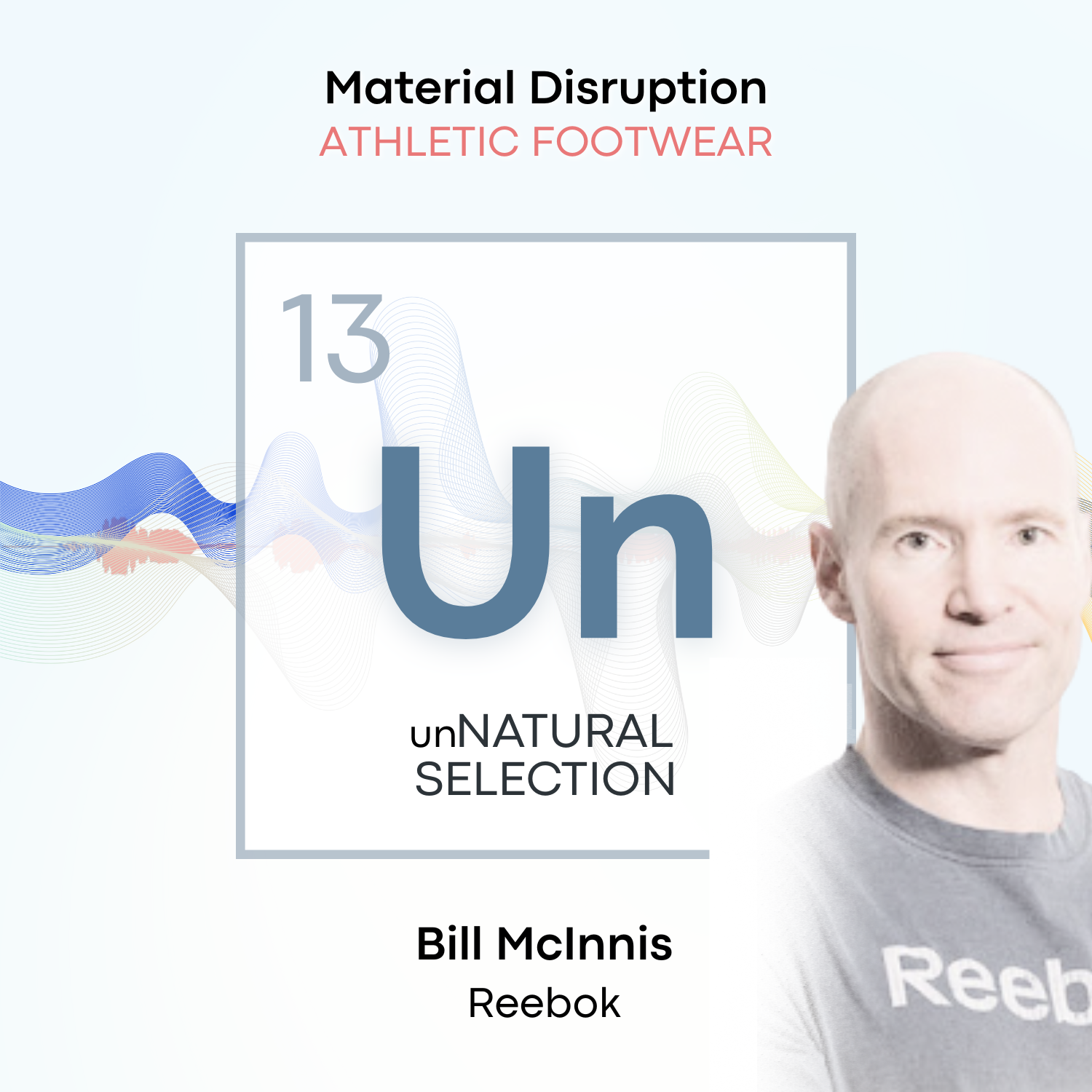
Material Disruption
The Arms Race Beneath Your Feet. The athletic footwear industry is a $100B global battlefield—where innovation isn't optional, it's survival. Trends shift fast, consumer expectations are sky-high, and brands race to outpace each other in performance, design, sustainability, and storytelling.
In this episode of unNatural Selection, we explore what it takes to win in one of the most competitive markets on the planet. Our guest is Bill McInnis, award-winning innovator and former Vice President at Reebok, where he led the creation of game-changing products like EasyTone, ZigTech, and the Liquid Factory.
In a market where culture and biomechanics collide, we explore how evolutionary pressure is driving a new era of footwear—where storytelling, tech, and bold design redefine not just how shoes are made, but what they mean.
If the shoe fits… someone’s already building a better one.
-
(Auto-generated by Spotify. Errors may exist.)
Bill Mcinnis is an award-winning innovator in the footwear industry.
1:04
With a background in Mechanical Engineering from Tufts University and an MBA from the UCLA Anderson School of Management, Bill brings a unique blend of technical expertise, story building and business acumen to his place in footwear.
Bill spent over 2 decades at Reebok where he held various leadership positions including Vice President of Reebok Future and Vice President of Running.
1:24
He led the teams that created Easy Tone, Zigtag, and Realflex, all of which became multi million pair commercial programs.
He spearheaded innovative projects such as the liquid factory and manufacturing process, utilizing robotics and liquid materials to create shoes without traditional molds, and the Cotton and Corn Initiative which focused on producing footwear from plant based materials.
1:46
As VP of Product at Keene, Bill headed up all product design and development and LED the effort to create new, more athletic footwear models for the brand.
Before entering the footwear industry, Bill worked as an Air Force Captain with NASA and satellite launch operations on the United States Space Shuttle program.
2:02
Bill now works as an innovation consultant the footwear and outdoor industries, working with everything from startups to Fortune 500 brands.
Bill is married with two daughters and his hobbies include playing ice hockey, writing, drawing and painting.
Bill, thank you for being.
2:16
Speaker 1
Selection.
Thanks for having me, Nick.
It's great to great to be here.
I enjoyed the podcast.
2:22
Speaker 2
Thank you.
I always start with the same question just to set context and level set.
So, Bill, could you please describe in simple terms what business you're in and what was your role within that business?
2:34
Speaker 1
So I'm basically in the athletic footwear business.
A fancier way of saying sneakers, and I lead innovation teams within that.
That's kind of my sweet spot.
And an innovation team, it's basically comprised of designers, developers, slash engineers, as well as product marketing aspect as well.
2:56
So then the idea is to package that all together and deliver both the the product, which is the obvious output and the accompanying story that goes with it.
That kind of completes the package.
3:08
Speaker 2
From the outside looking in, I don't know anything about the footwear industry, but one of the things that I notice is that innovation happens at lightning speeds, right?
You're, you're putting out new models and new lines of shoes essentially every year.
3:25
And presumably that's also with some market research on top of that as well to understand what the trends are, what your buyers interests are.
There's very little time between identifying where the market is going to putting it into words, to designing, to testing it, to building it and launching it, right.
3:45
The process of concept to launch
And so with new designs again hitting the market year after year, could you walk us through what the process looks like from concept to launch and how you balance the pressures of innovation, market trends and the tight timelines to launch a product that will resonate with millions of people?
4:03
Speaker 1
So great question to begin with, different companies are set up a little differently.
So your bigger companies, your Nike, your Adidas, Reebok back in the day as well.
You have a separate innovation team that's allowed to have a little more time to to your point, it moves really, really quickly.
4:23
There's two main seasons every single year.
You have a spring summer season and a fall winter season.
That's really what the inline group does day in and day out and they have an 18 month calendar essentially from the initial product brief to deliver shoes on the on the shelf at marketplace that they work with.
4:44
The innovation team typically starts a year or two years prior to that 18 month calendar.
And so the idea is to link those two dates up so that you have a, a proven and tested innovation at the beginning of that 18 month cycle.
5:01
Now the reality is that never works.
It's always a lot messier than that.
You're, you're being forced to pull innovation faster than you want or you, you come in midway through the inline cycle and you kind of have to have to kind of make decisions on the fly.
5:17
But relative to other industries, yeah, it moves very, very quickly.
The key if you're going to do anything lasting is it has to work, it has to function, it has to do what you say it's going to do.
And that's why typically you have an innovation team that has a little more time than the regular sort of insurance and outs of business.
5:36
Speaker 2
Interesting And and is there room for pivoting?
5:39
Is there room for pivoting?
So let's say you see or maybe this doesn't happen all that often, but let's say halfway through the cycle you see some amazing new opportunity.
Is there enough wiggle room for you to?
5:52
Speaker 1
Course correct and say like oh we really need to seize on that or then do you just punt that for the next year?
Yes and no.
So you have more than one innovation project going at any given time obviously.
So you have a couple different discrete teams are all working on their own projects.
6:08
As far as pivoting, we have had things where we get the product into testing.
We think it's a it's a cushioning story and it turns out to be an efficiency story instead.
And then everything has to shift and you'll tweak the product to kind of learn more into that that kind of energy efficiency story.
6:26
You'll tweak the story, you'll tweak the aesthetics of the product.
So yeah, again, there's happy accidents.
Reebok basically was was exploded on a happy accident.
So the initial, when you think of a classic Reebok product, you think of that white leather shoe your parents might have had back in the day with a little window box on the side.
6:48
So for their time, they had the softest leather out there and that was a mistake.
So prior to that, sneakers I grew up with when I was a little kid, you had to break in.
Meaning they had the, you know, athletic shoe leather, which was, you know, pretty thick and took some breaking in to get used to.
7:09
There was a factory that Reebok was dealing with when they first got into the aerobics craze and they decided to the kind of cheap Reebok by using a thinner garment grade leather, something that you'd see in a, in a pair of leather gloves or something like that.
7:26
So everybody was outraged on the, and this is before my time.
So everybody was outraged on the Reebok side.
This is ridiculous.
They try to cheap us out and, and then a couple of them came together and said, but you know, my, my daughter really likes these.
They're, she said how they feel great and blah, blah, blah.
7:43
And they kind of around the table realize that, Gee, everybody we gave them to really, really likes them.
Maybe we're on to something here.
And that was really the birth of what everybody knows as the modern Reebok.
The, the roots go back, you know, 100 years or so to England.
7:58
But that's when the brand really, really took off.
And the point of difference was that garment grade leather that that was cheaper than the the regular leather.
8:08
Speaker 2
That's amazing.
I remember those shoes, they had like the ridged ankle component that was like really squishy and soft.
And I remember when it came out, I thought to myself what this is so soft and smooth and bends with your foot as as you play sports and so on.
8:25
And it was very different.
I do remember previous shoes were like baseball mitts.
8:29
Speaker 1
Right.
Yeah.
So it, it was a sea change and basically anytime something dramatic happens in the footwear industry, it's not too long where everybody starts to follow suit.
So everybody in the industry started going with lighter weight, thinner Leathers and, you know, more comfortable at Tryon and all that stuff.
8:48
And it's, it's a pretty close knit incestuous industry.
I know people that have worked at every single company in the industry.
People tend to move from company to company.
It's it's a fun industry and it's it's kind of fun to watch.
9:04
Speaker 2
Yeah.
9:04
How the industry has evolved
And your career has spanned some of the most transformative years in athletic footwear.
From your vantage point, how has the industry evolved technically, commercially, maybe culturally?
And how is that evolution shaped your own approach to innovation?
9:19
Speaker 1
So one of the big evolutions was at the time I first came into Reebok, you know, there were some of the earlier shoes that have been around for a while, but there was nothing called classics or originals.
There were just, these are shoes we've made for a while and people seem to like them.
9:37
Cut to, you know, probably 10-15 years ago.
Everybody seemed to get the idea at the same time that, wait, people kind of like the nostalgia of those shoes.
You know, for Reebok, it's the classic leather and the Club C and, you know, shoes you'd recognize like you just described.
9:55
For Adidas, it's the Stan Smith and things like that.
For Nike, it's the Air Force One and the Cortez.
And so everybody that was around during that time has some of these original products that essentially keep the lights on for everybody in the entire industry.
10:12
Because if you're just spinning colorways of existing styles, you're making money and you're, you know, it's, it's easy.
You're not spending a lot on design and development or extra work.
You're just doing colors and materials and spinning them out.
And that allows you to spend a lot more and the time and money on the innovation side.
10:33
And that's, that's what we've seen over the last several years.
And the the biggest kind of jump recently has been the introduction of these new super phones like P backs from a company called Arkema.
We actually were the first ones to have that at Reebok, but it wasn't the right brand to introduce it to the market.
10:52
We weren't big enough in running at that point.
Nike came around after that and blew us out of the park with a better story using it in a different way.
So that super foam plus carbon fiber plates led to proof points in marathoning and distance running where you could actually show somebody running a better time using this footwear verse that footwear.
11:16
So that's been a huge leap recently.
As far as you know, over the years, there's just been countless new versions of foam, new ways to put it together, new mechanical systems under the foot, new combinations of foam and mechanical systems.
11:33
If you look at a, a brand like on for instance, they've taken foam and molded it into a mechanical shape.
And in doing that it's, it's kind of A2 for one.
So the, the mechanical shape has some aspect and cushioning and energy return and the foam itself does as well.
11:51
So those are kind of the the big shifts recently.
11:55
Speaker 2
You mentioned something in there that the industry is obviously it's a a small universe of players and they all copy from each other.
12:02
How to differentiate when ideas are easy to copy?
Somebody comes up with an idea, they all do that.
So when ideas are so easy to copy, how do you differentiate the brand?
Reebok doesn't have the same feel or presentation as Nike or as Adidas.
They all differentiate as New Balance.
12:18
Like they're all out there kind of.
They all have a different demographic, maybe, maybe a different culture that stands behind it.
So what's the approach then to for for Reebok to compete in those spaces versus just being a coin flip what people get, which is not the case.
12:34
People, from my understanding, there's a lot of brand loyalty from from customers.
They either like the Reeboks or they like the Adidas or they like the Nikes.
I could be wrong, but then how do you differentiate when it's so easy to RIP off ideas?
12:47
Speaker 1
It depends again on size.
So a brand like Nike, a brand like Adidas, and back in the day a brand like Reebok was in every sport and kind of all things to all people.
And if you look at consumers and you look at a traditional running consumer and you look at a traditional basketball consumer, they're different people.
13:07
The running consumer is older and more suburban.
Typically the basketball consumer tends to be younger high school age.
These are the, the, the kids that can't buy enough shoes.
I mean, there's young kids in the target for a lot of these companies is a 17 year old kid who's going to buy a lot of product and they're collecting it as well as wearing it.
13:29
So there's, you know, one pair to wear around, one pair to save in the original box and packaging and trade on kind of the secondary market that's blown up and that's that's really over the last 10-15 years as well that didn't exist prior to all this.
13:44
Speaker 2
Interesting.
When you think about a product, a new product line that you're going to put out there, say that 18 month or two year cycle, what what's the approach to thinking about how design, maybe engineering, storytelling, brand storytelling, So how all these components come together into the final?
14:06
How to think about a new product line
It's not just a product, it's almost like an experience.
It's an identification for that shoe and that demographic that you said this is either for that 35 year old tennis player or it's for that 17 year old basketball player.
From what I see, these shoes come with a personality.
14:22
So it's not just like you, let's throw some colors and throw it out there.
So what's that look like?
It's it's almost like storytelling, right?
14:30
Speaker 1
It absolutely is.
And like, like a lot of packaged good companies, you, you have to have an idea of who that consumer is.
And a lot of times that's that's actually putting it out on a mood board or a PowerPoint presentation.
This is the the center, you know, this is what our consumer looks like.
14:47
This is what they do day-to-day.
We know who they are and where they shop and where they'd be looking for product.
We know what their, you know, probably wearing now or what's in their consideration set and then how are we going to stand out to them within that consideration set.
15:02
So that type of, you know, basic blocking and tackling, consumer packaged good sort of approach does exist in footwear.
It just took a while to get there.
Like when I first walked into Reebok, it was the Wild West days and it was, you know, anybody and everybody from all different backgrounds.
15:23
There was no like go to school and learn how to be a shoe person or go to school and learn about sports marketing or something like that.
It didn't exist.
It was all kind of being made-up at the same time.
And gradually over time, you know, you get your PNG people cycling through and things like that and people start to align on, OK, this is how you build a product timeline.
15:44
This is how you build, you know, a consumer outline.
This is how you build a product brief and this is how you move forward.
But a product brief on the inline side and the product brief on the innovation side can look very different.
Like on the inline side, a lot of times you're just doing iterations of previous models.
16:03
Like, you know, Nikes had some shoes in their line for years and years and years on the running side that they keep updating.
And every year there's a new version of it.
And it's it, you know, gives people something to come back to.
And typically it's going to fit the same, it's going to have a a similar type ride.
16:23
It's going to be at a similar type price point because you know who that consumer is and you go back again and again on the innovation side, you're trying to keep things a little more loose.
So the brief is a little more loose.
So what what I used to hold people to is, is let's align on a one page PowerPoint slide brief with aesthetic information on one side.
16:45
Just bullet points, functional and kind of consumer insight side on the other side and that's it.
Then start from there so that you've got some room to kind of ebb and flow and kind of make those pivots as you talked about earlier.
17:00
Speaker 2
It makes a lot more sense now because I grew up playing tennis and you wear out those tennis shoes pretty quickly.
And I would remember then going to shop, looking for the next version of whatever tennis sneaker that I liked and not knowing the details that go into it.
17:16
It's, you know, it.
Other than the design, the shoes seemed very similar from one year to the other.
But presumably there was some engineering that was not that perceptible to me.
But there was a lot behind the covers that I wasn't really being, I wasn't that aware of.
17:33
Speaker 1
Yeah.
And some of it makes its way all the way through to the consumer where they appreciate it and some of it's in there, but you don't notice it.
And sometimes it goes the other way.
And you know, the inline team can take things out of a shoe in the interest of, of saving some money and making some more margin if they if they don't think a feature is that important.
17:53
Tennis is kind of a unique thing and that you've got wear areas on the shoe, but it's very specific wear areas on each shoe and you've got to kind of figure out, OK, how much rubber can we put on because that's going to be more durable, but then you're adding a lot more weight.
So what's the tradeoff between durability and weight?
18:12
But even the, the fit and feel of a shoe, if, if you grew up kind of preferring 1 brand over another brand, like, oh, I like the way these fit.
That's because the, the last, the kind of plastic foot shape that they build the entire shoe around is different from brand to brand to brand.
18:30
So they all have a kind of, and, and it varies within sport and even within those sports as well, like what the shape of the forefoot is, what the shape of the heel is, what the drop is inside the shoe.
So if your foot happens to more or less resemble the last that they've built that shoe around a little bit better, that shoe is going to fit your foot better.
18:53
So when you get to the elite level and you're, you know, signing the Allen Iverson's of the world and Shaq and people like that who have come back to Reebok late lately, they get a custom shoe built for them.
So they have molds made of their foot.
19:09
They build a last that is specific to their foot so that we know every time we build a shoe for them to perform in, it's the exact shape and size of their foot.
So you can't do that for every consumer out there, obviously, but you can do a best fit and you know, 8 and a half, 9/9 and 1/2 all all the way up.
19:28
That's the example of trying to get to that best foot.
19:33
Speaker 2
As you were talking about all the thinking that goes to the design, I almost, I was thinking about how much I would love to have seen the experiments that didn't work right.
19:41
The Importance of Design Thinking
Because we see the little innovations of, like you mentioned before, the soft leather.
That was an accident, but people loved it.
And all of the other engineer, I remember back when I was a kid, there was a sneaker that had that little pump too.
You would pump it and it would fill with air.
That's us.
That was Reebok, I thought.
19:56
So I didn't want to say it because I was like, oh, maybe I'm wrong, but I remember that being Reebok.
And as a kid I loved that everybody had those because it was just you would pump it.
I don't know if it really helped or anything, but it would fill up and feel tighter.
But for all the ones that actually made it to market, there's got to be kind of like a Willy Wonka factory of things that you guys tried, gels and all kinds of crazy things.
20:15
Obviously, you guys are trying to come up with that next.
Differentiating feature and a lot of them just don't work right.
So that's going to be a pretty interesting and exciting space to kind of like play.
It's almost like a toy store.
20:27
Speaker 1
It is we, we actually had in our conference room what we called our wall of shape and that was where we put things.
And you know, you might have spent a year or two or even three years on it.
And you know what, it never took off.
It never launched.
We couldn't get people excited enough about it and eventually it, it takes its shelf on that wall of shame and it was a bigger wall than I would care to admit.
20:51
And there's, there's plenty of variations of, of the pump that you mentioned on their variations on DMX cushioning that we did over the years.
But the pumps an interesting example because some of the, the most trick engineering we did was, hey, we own the pump.
21:08
That's, that's valuable IP.
We can do a lot of different things with it.
And initially, you know, the idea was taken from a blood pressure cuff basically.
And then you boom, boom, pump that up and it's going to inflate and fill the spaces around your foot and give you essentially a custom fit that kind of gets back to that last shape.
21:28
Like this is going to be a custom fit to your shape, your foot.
It's going to fill in those gaps around it.
So then we started thinking, what else can we do with that?
And one of the ones we came up with was something we called Pump 2.0 where we took that pump ball and instead of on the tongue where you saw it, we put it under your heel inside the shoe.
21:49
So that every time you took a step, you're actually pumping up the shoe around your foot.
So you put the shoe on fairly loose.
You walked around the room and it filled in and, and without laces or anything automatically fit to your foot.
And then we had to, you know, design valves for that that would bleed off at a certain pressure.
22:09
So it wouldn't keep inflating over time.
It would kind of stay comfortable.
And we came up with a, a valve that you would turn and adjust the, the fit the way you liked it so that every time you put on the shoe, it would go back to that.
And we thought, you know, given the time we spent, this is perfect.
22:26
You don't have to pump your shoes 10 times.
You don't have to tie laces.
People are going to love this.
And it was met with a collective yawn like and we had done pre testing, we dragged the shoes out the stores, put them on people.
Everybody that tried them was like wowed by them.
22:44
And then it what it essentially came down to is in the middle of all that, the Reebok brand and the Reebok brand had shifted several times over the years in terms of what they were about.
22:56
The Reebok brand and the footwear industry
The Reebok brand had decided in that instance that they were a hip hop brand.
So we signed Jay-Z, we signed $0.50, we signed all the big sort of leading hip hop people that were out there in that day and we did, you know, classic shoes for them.
23:13
And that was the big push.
That's where all the marketing dollars went.
And when that happens, there was no marketing dollar for this super trick pump shoe that pumped up automatically and it never went anywhere.
So we sold it in, it didn't sell through, retailers weren't interested in buying it again, and boom, there it goes up on the wall of shame.
23:34
Speaker 2
Wow, interesting.
You mentioned Shaq and other athletes at some point and I saw the movie Air, which is fascinating.
The you know, that was my first glimpse into that world.
At some point the shoes the the footwear industry started identifying with famous celebrities, specifically athletes obviously in this space.
23:53
How much of that still resonates in his prevalent in kind of the identity of a shoe and the design that you take towards a certain line of item?
Is that still one of the main strategies today?
24:10
It's kind of like, let's go with a LeBron, let's go with a Michael Jordan, let's go with whoever the next athlete is in a specific sport.
24:17
Speaker 1
Yeah, I think it's it's actually expanded into influencers as well.
So it's, you know, the, the most obvious example is basketball and, and you know, I won't pretend anybody was bigger than Jordan and Nike and what they did.
24:33
And, you know, they're not making movies about the, the stuff we did at Reebok.
They are picking movies about Michael Jordan and air.
So that was kind of the thing that that unleashed everything.
And I, I met, you know, this guy Peter Moore was the designer that had done the, the jumpman logo.
24:52
That's that Michael Jordan logo that's on all his product.
And it was a very different approach in terms of taking an athlete and building the whole platform around him.
We did that with Shaq.
We did that with Allen Iverson.
25:07
We did it to a lesser extent with some of the other people that are out there.
It gives a shoe a cachet certainly.
And particularly if you do something a little bit different, having that that cool factor that that, well, yeah, it looks a little goofy, but Michael Jordan's wearing it that that kind of changes the perception.
25:27
So different is is kind of A2 sided coin.
It can be different, meaning it's odd and funny looking and I'm not interested.
Or it can be different.
Like, you know, people are going to recognize the difference in this shoe when they see me wearing it.
And it's cool because Michael Jordan or Allen Iverson is is wearing it.
25:46
So that that does have a big role in things and you know, having a push for a shoe that's that's, you know, a great functional shoe and basketball, but you don't have an athlete attached.
You know, a kids going to wonder why isn't there an athlete attached?
26:02
Is there is there nobody they can put in this shoe?
Is it is it not right for a basketball?
Whereas if you go over the other side of the house to running, it's all performance focus and you, you run in basically what you see your friends and neighbors and what they tell you to wear at the running shop or try.
26:20
And if you look at Runners World still, what they recommend and things like that.
So it's a, it's a very different model based on the two different consumers.
And then if you get into classics, that's where all the influencers come in, in terms of, you know, what am I wearing for my, my Sunday walk in the park?
26:36
And you know, I'm going to Instagram it and put it out there.
And you know, that's another way to get associated with it.
And we were, we were super early in on, on that.
So we did a, a concept called easy tone.
It was focused against women's.
It was like a, a leg toning story and a bunch of other brands jumped in behind us.
26:57
And back then the, the influencer world was, was less online and more, what were these Hollywood parties?
So you would throw a, a Hollywood party and throwing that party means it's a 6:00 and you rent out a, a mansion or a big house out in LA, Beverly Hills or somewhere like that.
27:19
And you invite a bunch of people.
And it was at the time B&C level celebrities.
And they show up and it's a it's an easy tone Reebok party.
And they get their picture taken holding the shoes and talking about the shoes.
And we actually had all four Kardashians at that party before anybody had heard of anybody except Kim Kardashian, including me.
27:42
I was like, well, who are the others?
And it was like, well, the mother insists that they all be here.
And we kind of saw the ground floor of, you know, brilliant woman Kris Jenner kind of saying, no, this is how it's going to work.
They're all going to be involved.
They're all part of the story.
And Kim's going to be the star.
27:58
But we paid them $10,000 to be at the party.
That was it.
And, you know, at the time, we're like, this is, this is crazy.
This is can't be how things work.
And that helped kick off easy tone in a massive way.
And that was, to me at least, my first exposure with this is what an influencer culture can do to what was a technical story like we had a a technical story underneath that this is how it works, why it works, what it's going to do for you.
28:29
And then she kind of tied it all together.
28:33
Speaker 2
Yeah, it's interesting how much psychology goes into this because my experiences with I mentioned I play tennis and when you're looking for that new racket, there is inevitably the question of well, which racket is the one that Federer uses or which racket is the one that Nadal uses and or sneakers or other gear.
28:54
And I never thought about it much, but I guess in a way as a consumer, it helps you narrow down things, right.
You get and the one perspective, you idolize these people.
So if you're a little kid and you idolize Federer, you're like, well, I'm always going to go for the Federer racket.
29:09
If you're a little bit more advanced, you think to yourself, well, as my game more like Federer or more like Nadal because presumably these pros and their teams have thought a lot about what gear makes sense for their type of game.
And if my game is more like that person's and I'll likely be better off with the equipment like that.
29:26
And so I would imagine that there's similar type of reasoning that happens in consumers for shoes.
Number one is do I love Michael Jordan or do I love LeBron or whoever else?
Is my game maybe more like this person, that person?
And then if the shoe fits, then go with it.
29:45
And like you said before, there's also that cool factor to like I have that Michael Jordan shoe.
So it it's amazing how much there is obviously in the design of the engineering, but equally so on the culture on the psychological component of fitting a person with a shoe.
30:00
Speaker 1
Yeah, and it's it's not just fame, it's to your point, who you aspire to be.
So there's a reason we sold infinitely more Allen Iverson shoes than Shaquille O'Neal shoes.
It's because it's hard for a kid to imagine I'm going to grow up to be 7 one and 300 lbs like Shaquille O'Neal.
30:19
It's pretty rare, but Allen Iverson's barely 6 feet.
I mean, when I stood next to him, I could look at him eye to eye and he's somebody.
You're like, hey, I could, I could be that.
I could be that tall.
I mean, you're not going to be that, but you can aspire to be that.
30:34
And I think it's, it's to your point, there's a psychological, hey, I, I can aspire to be this person.
I I can aspire to play like this person and that has to be there too.
30:46
Speaker 2
When Reebok puts out a line, it's not the only one that it puts out every single year, right?
There's a whole there are parallel lines of products that you put out every single year.
30:57
Speaker 1
Yeah, like I said, there's, there's a whole inline side and that's, that's probably 152 hundred different models and that's getting recycled every year, new versions of them.
You know, not every shoe every, every season, but you're, you're constantly kind of recycling those and then innovation is separate from that.
31:16
Speaker 2
Is there a competition between these internal lines for resources funding attention from executives?
31:24
Speaker 1
Yes, there there's pretty intense competition actually, and we've seen it ebb and flow over the years where, you know, sometimes you feel like you sure we're generating these great ideas and nobody's paying any attention to them.
And so having that that year of whoever happens to be president or CEO at the time and having the confidence from those people as well is incredibly important.
31:49
So I mentioned that shoe easy Tone that eventually we got a big push behind in the party, in the advertising, all that.
31:58
The Reebok Easy Tone
But initially Easy Tone came along at a time when the brand had signed a, a deal, a marketing deal with Cirque du Soleil, right?
The, the Canadian circus.
And you know, there are some of us, myself included, who were like, I don't understand why we're doing this partnership with Cirque du Soleil.
32:17
And we're told, oh, it's, it's so we can get a younger consumer.
And I'm like, I've been to Cirque du Soleil, that's not a younger consumer.
And we went back and forth, but this was the big guy's idea.
So he was going to put the money behind that.
So Easy Tone almost almost ended up on the wall of shame and never, never selling in.
32:37
And the whole reason it got on the shelf in the 1st place was I got pulled in by a sales guy to a lady footlocker meeting at the time, which was not going well when they were being told, you know, you really need to push the Cirque du Soleil and get them sold on Cirque du Soleil.
32:55
So they'll put it all over their store.
And this this buyer, this woman was not having the Cirque du Soleil thing.
The sales guy brings me in like, hey, can you come in and just tell her about this easy tone concept?
And she was blown away.
33:11
And she was like, this is you guys are crazy to be doing the circus nonsense when you're sitting on something like this.
So that took it off there and eventually went to every major retailer and just exploded so that it can be that political, like you're not showing this until blah, blah, blah.
33:30
And it, it's so, yeah, you got to kind of work your way through the weeds and the other important thing.
And, and I think I heard a little when you're talking to the, the gentleman from NASA that it, it's a cell job all the way through from the first brief, you, you know, at some point you're getting with senior management and saying this is what we're working on.
33:51
And at that point you can just kind of tell them the story and what you think it's going to do and how it's going to work and who the consumer is, etcetera.
And then along the way you have, you know, check insurance where you're showing prototypes, you're showing early ideas on how to, to package it, name it, talk about it, what the story is.
34:10
And that storytelling is, is critical to me, I think because it helps you, you kind of build it along the way rather than throw it over the wall at the end.
And to me, that's the worst thing that can happen.
A group works on a product, they figure out the insurance and outs of it.
34:26
And at the end, they throw it over the wall to marketing or advertising.
And they get the shoe and kind of look at what it looks like and take a guess at, you know, this is how we should talk about it.
Things can get disconnected if you're building the story.
It's almost like a a stand up comic working on their material.
34:44
They don't write it down once and go there, that's done.
That's my routine.
They test it out.
What joke works, what doesn't work.
You do the same thing with the story.
Like what resonates with people, what what makes them pay attention, what what seems to put them to sleep.
34:59
And so by the time you get to the end and that final sell in where you've got the senior management, you know what the story is and you know what hits and what doesn't hit.
And you go through that.
And once you get past that, you know, we used to bring Footlocker, Finish Line, foot action into Reebok where we'd show them an innovation room.
35:20
And the innovation room was just a tricked out conference room, you know, blacked out with lights from above and shoes and, and, and glass boxes and things like that.
And would tell him the story of, hey, here's what's coming.
And it had kind of a double effect.
35:36
One was they felt part of what you were working on because you allowed them to give some feedback before they were going to put pen to paper.
And the other thing is that they, you know, felt they were in on something like we'd have them sign a, a non disclosure when they walked in.
35:53
You can't tell any of the other brands what we're working on and blah, blah, blah.
And so by the time it came to put pen to paper, they'd seen that product, they'd heard that story, They felt like they helped build that story and they were like, OK, let's go.
This is, this is what we all talked about.
36:08
So it's a, it was a way to use the innovation room and storytelling as a way to kind of bring that buyer in closer to you because you you're selling all the way up to the, the consumer on the shelf.
And that's, you had talked earlier about, you know, the look of the shoe and, and how it feels.
36:27
And that's critical too.
So once you cement in this is what we're trying to do functionally.
Well, what should the the shoe look like based on who that consumer is and color materials?
Everything goes into that.
What's it feel like when you first put it on your foot in the store?
36:45
That experience should pay back the story and the aesthetic, what it looks like.
And then longer term, when they're up, you know, running on the road or playing on the court, it should continue to deliver on that promise and that story.
And if you connect all of those, you know, that's a win.
37:02
And that's how you get the person coming back for the second pair, the third pair, the fourth pair.
37:08
Speaker 2
It's fascinating.
And as you were sharing that I, I started thinking also you mentioned the NASA chief, Ed Hoffman.
37:16
The importance of a design process
I was also thinking about the Xbox and PlayStation guy when you were talking about sharing the design and prototyping the product with future customers, influencers and so on.
Because as they design their game, they also get people involved in like that design process.
37:31
So by the time the game's out, it's they feel like they almost built it when and you were saying something very similar with a shoe, which is that innovation room you take people in, they experience the whole thing to help give you kind of some guidance and what they like don't like.
So that by the time it comes out, it's it's essentially their shoe.
37:47
Speaker 1
Absolutely.
Yeah, no, it works the same way.
And we, we stopped doing that at a certain point, which, you know, against my protest, but I, I think it was, oh, this is, you know, we're Much Ado about nothing.
They're coming in and I'm like, no, they're coming in and they're buying in and then later they buy in.
38:06
I think that delay is not something everybody picks up on.
I mean, we had, we had a lot of leadership that at Reebok over the years.
And you know when, when you start a project under one leadership regime and then you finish it under a different 1, you know, you can get some, some different feedback on what you're working on.
38:28
Speaker 2
Yeah, it's and so much of A success of a product line seems to fall on the VP or whoever, whatever level champion lives exists for that product line, right?
38:40
The competition within Reebok
Because you were talking about everything from the storytelling, the design, but also the alliances that you have with the CEO or the executive team.
You know, there is the timing, there's storytelling, framing and so on.
38:55
And so there's so much that lies on whoever that champion is for that product line to get it over the fence that we clearly you're one of those people.
You were at that helm of many of those product lines.
So that it sounds like a very fierce competition, almost like a natural selection environment within the organization itself, all these different product lines all vying for that spotlight of who's going to be that product line that the the shoe that's going to be the face of Reebok for that following year.
39:27
Speaker 1
Yeah, so in the in the early days of Reebok, you had one guy and that was Paul Fireman, who really had bought Reebok when it was small and he's the one that exploded it with the with the thin Leathers and things like that and pump and everything.
39:43
And when he kind of put the spotlight on your product, it was like, this is fantastic.
Every resource you ever wanted is there the marketing campaigns around that.
And we had that a couple times.
There was a cushioning system called DMX early in my career in the late 90s.
40:01
We had crashed it.
He loved it.
He loved the feel of it, loved the story of it.
It was moving Air to compete with Nike Air, which was static Air, and our original forecast on that was 10,000 pairs before we got the light shined on it.
40:17
That went up to 2,000,000 pairs because it was like, no, this is the brand story.
We are going to do a massive campaign around it.
Everyone's going to see it.
We did the advertising kind of my predecessor doing what I ended up doing was in the actual ad because he, the pitch was that he, he had this old pickup truck from the 1940's.
40:41
The name was Spencer White.
He had a mustache and glasses.
So it was very distinctive looking.
And the, the pitch was, hey, I made these new shoes.
He's driving out on the Charles River along the Esplanade and saying, hey, I'll, I'll trade you these for those.
And he's just trading everybody's shoes.
40:58
So we did a mock out of that and brought accounts in and, and showed them this, the shoe.
This is what we're going to do about it.
And and you know, we'll get an actor obviously for the for the ad.
And they all went, no, that guy use him, he's telling the story, right.
41:14
And the ability to to tell that story.
The thing just exploded.
And it so again goes from 10,000 pair forecast to 2 million pair forecast really over a month or two just from where's the brand focused and where isn't it focused?
And like I said, that was a cell drop.
41:31
It was, it was getting in front of Paul Fireman and selling him, hey, we had this this other DMX cushioning system and walking that's been very successful.
Here's how we make it performance and this is how it's going to work and etcetera, etcetera.
And when he bought in, everybody bought in.
41:49
When Adidas bought Reebok from Paul Fireman, it was actually the same way.
But really you had to appeal to your own senior management and then the Adidas senior management on top of that.
So if you got them bought in that, that really opened the floodgates in terms of marketing.
42:08
And that's how we launched the, the easy tone shoe, the the Zig tech shoe, real flex, a few others.
So, yeah, it you, you have to figure out who's got the purse strings, who's directing, where the marketing dollars go and, and why and how do you get your piece of it that that you need to get this story out there.
42:29
Speaker 2
And obviously you guys focus well this conversation is on athletic wear.
42:35
The role of athlete data and biomechanics in driving innovation
So to what role does athlete, data, bio, mechanics or in science play in driving innovation today compared to where you when you started?
42:49
Speaker 1
So it's still there.
I mean, all the big companies have a bio mechanics lab right inside the building.
We had the same at at Reebok and you're you're using that data.
That's a it's a pretty well, you know, tread to excuse the analogy area in terms of everybody's got the same machines, you know, treadmills that give you feedback, things like that.
43:16
So everybody was kind of dealing with the same data set.
So you more flip that on its head and use that as a proof point, use it for testing.
So as you're coming up with prototypes, you're using that same equipment to test it as somebody runs on that treadmill or you know, lands on a force plate in a certain direction laterally or straight ahead or in different directions.
43:40
So you're using it more in the test phase.
And then beyond that, the most important piece was we had wear testing where you, you put out 40-50 pairs of prototypes, you put them on reel runners, real basketball players, let them live with the product for 2-3 months, you know, write up an initial review halfway through at the end.
44:02
And that's how you really tease out, OK, what do people like?
What don't they like?
And it can be, you know, goofy things like, hey, the laces are too long.
I, I don't like that and blah, blah, blah, or anything in between.
But from the comments you get back from them, that'll give you a good sense of the, the functional, what's working, what's not working.
44:24
Is this as good as what's out there and the is it as good as what's out there?
Question is hugely important.
Like we used to have some product reviews where it was just, OK, here's the running line, put it all up on a wall.
Let's do an evaluation of the running line.
44:40
Well, that's good internally, but it it really doesn't speak to the real world environment.
And when a when your 17 year old or your 30 year old runner is going to the shoe wall, it's not just Reebok product on that wall, it's Nike product and ASICS product and everybody in between.
44:58
So you really have to test it against competitive product as well.
45:05
Speaker 2
You mentioned before you sometimes you think a product line is going to sell 10,000 units and then it sells 2,000,000.
45:10
Forecasting how much a product line will sell
Do you develop an eye for a product line that you just know, you have a gut instinct that says this one is going to be a hit?
I, I guess there is what I'm getting to is there's an element of forecasting how much you're going to sell.
This is going to sell 10,000 is going to sell a million is going to sell 2 million.
45:26
What are the kind of criteria that go into estimating that amount?
And I'm sure part of it is while we're selling to high school, so there's X number of 17 year olds in the country, but then you also have to penetrate that market.
And So what goes into forecasting how much a given product line is going to sell?
45:43
Speaker 1
So in, in the case of that shoe that went from 10,000 to 2 million, well, they, they took a pretty simple path of well, the last time we did $110 running shoe, which was expensive back then, we did, you know, 810 thousand pairs and you know, why would we feel any differently?
46:02
Reebok can't sell above $90.00 at the time, so that's part of where that came from and you know it was pre, it's not going to have marketing or anything like that.
So we think it's going to be this big.
So you have to weigh that.
There's a couple other things like that wear test thing I talked about.
46:20
One of the things we used to think in the early days of wear testing is you then, you know, you lay out and make graphs of all the feedback and all the ratings.
What do you think about the cushioning?
What do you think about the feel under foot, etcetera.
Arch support, you know, you name it.
46:37
And we used to think that more blue meaning more blue was good, like higher eights, nines and 10 ratings and more blue was was good.
So more blue to light blue meant the shoe was a great shoe and and was going to do well.
46:53
And what we found out was it was actually more when it's on the poles, when you had a lot of dark blue, meaning a lot of nines and 10s, but someones twos and threes.
And that's where you found like people either really, really loved it or really, really didn't like it.
47:09
And that's where you found people that that were passionate about your product as it turned out like a a basic shoe.
Yeah, you'd get a decent amount of blue, but it was because people didn't care about it that much one way or the other.
So that piece did help you sort of 0 in and go like, OK, we're on to something here because people people either love it or hate it.
47:29
And that, that passion is kind of what you're looking for just on the product level.
And then, you know, again, it depends on the, the different category you're working in.
In running, you're, you're basing a lot of it on history and what you've done before.
47:46
And in running, a lot of it's mom and pop running stores where you've got to earn that shelf.
Like they have a motion control shoe and it's from Brooks and they've, they've had that shelf for a long time and you, you really have to do something compelling to knock that shoe off that shelf because they're not adding additional pieces when it comes to something like Footlocker, you need to do something to earn that shelf as well.
48:12
When it came to like Finish Line was a great example of the, the, this guy, Glenn Lyon, who was CEO of Finish Line at the time, actually brought their board of directors to Reebok to show them at the time a brand that gets it.
Because at that time we had a, a wall of easy tone, a wall of Zigtag, a wall of real flex.
48:33
And they're all working and they're all selling.
And he, he put it really simply.
He said, you come to my store and give me a shoe.
You know, I'll, I'll hem and Haw about whether I replace this shoe with your shoe and back and forth.
But that's about as big as it's going to get.
48:49
He said if you come to you with a brand new story, that's how you get like a big slat of wool and multiple colors and story building around it and graphics and, you know, some marketing in store as well.
And that that to me also plays heavily into what your ultimate volume is going to be.
49:08
It's like, all right, if one of these retailers is going to get behind it big and, you know, that's where your consumer goes and it's going to be eye level in front of them and not tuck down the bottom of the wall or someplace like that.
You know, that's how you start to build up those volumes in basketball.
49:24
I've got an athlete associated with it.
Is he somebody that moves the needle or doesn't move the needle?
That's going to make a difference?
So.
Yeah.
And, you know, kids will call a shoe by the athlete.
You know, we had a Ocho Cinco shoe and it happened to be a Zig Tech shoe.
49:41
It was one of the first Zig Tech shoes.
He was one of five athletes associated with it.
But the consumer that was shopping at that Foot Locker type of environment, Chad Ocho Cinco was, was like the bad guy.
So it was the the Ocho Cinco shoot.
49:58
Speaker 2
That's interesting to say.
It's kind of like when a product becomes a verb.
I'm going to Google this, right?
It's going to be one of those moments.
So in the last few minutes that we have just two more questions.
50:08
Where to start a new footwear brand
I guess if you were to design A startup footwear brand today from scratch, where would you begin?
Where, where do you think that there's an opportunity for a new line or a new company in this space?
Or is there 1?
Can you breakthrough the Reeboks and Nikes and Adidas?
50:23
Speaker 1
You, you can now more than you used to be able to do.
I remember years back we used to say, hey, could we start our own brand?
And we're like, well, we don't know how to breakthrough.
We don't know how to get Footlocker and Finish Line.
Like those were the only games in town.
You had to get the retailers on board as direct to consumer kind of exploded.
50:43
It opened a lot more opportunities.
So if, if you look at a brand like Noble, which is a local brand that was 2X Reebok eyes went and started, it was focused on the CrossFit consumer and they, they got a, a good chunk of the business that it's struggling a little right now, but they, they kind of took off like crazy.
51:07
All birds, another example.
So I in short, I think you need to have a, a very specific point of view like this is what we do.
All birds was a good example of that and that we're going to do plant based shoes natural, you know, this is a way to cut down on using plastics and things like that.
51:27
And you saw kind of A, at first, it was kind of a hipster West Coast Silicon Valley person that was wearing all birds that became kind of their default shoe that they were going to walk around in.
And it was kind of a, A badge for people.
I'm a nice person.
51:43
I care about the environment.
And here's the shoe that proves it.
And the way they kept it nice and simple was it It was 1 aesthetic.
All their shoes look the same, so you could recognize them from 2030 feet away.
And it was that same thing we talked about earlier.
51:59
The the brand makes a promise.
The shoe kind of looks like that promise.
The shoe feels like that promise.
And over time, you know, people react to that promise.
So I think anything you start up, you can't be like, OK, we want to build Nike tomorrow and be all things to all people.
52:17
I think, you know that that's, that's really difficult to do.
But to carve out one piece, you know, like cross fitters and that's not as as big a piece as it used to be.
Yeah, you can go after that.
And that's, that's a, provided you do something for that consumer that they know is for them and you're using the terms they use and showing up at the places they show up.
52:41
I, I think it's entirely possible.
I'm, I'm talking to one right now that's that's doing that in a different sport.
52:48
Speaker 2
It's fascinating.
I love the elements of storytelling that you talk about, you know, where you give a promise and you deliver in that promise that it overall becomes an experience for for a consumer.
It's it's so much of that.
It plays into the culture and the psychology of the consumer.
So the final question, Bill, if I could ask you, obviously the, the, the athletic footwear industry is not going anywhere.
53:10
Advice for future innovators
It's only growing and, and becoming more fear.
So if you could give one piece of advice or some advice to future innovators in this field, whether it be for Reebok or Nike, anybody in this field, what kind of advice would you give them as we look at the future of this industry over the next, you know, 5 or 10 years?
53:29
Speaker 1
Well, I, I think #1 it, it helps to be passionate about footwear and sports, particularly if you're on the sports side of things.
You'll just get your lunch eaten if you, if you don't care about that stuff, just because everybody you're competing with is, is living that all, all day and all night.
53:49
And it's, it's passion driven.
It's not have to, it's want to.
And it's, you know, they're typically people who have been following this stuff since grade school and, and middle school and they, they still are passionate about it.
So that's kind of square one, Square 2 is kind of find your niche.
54:06
Like what's, what's your part in this?
What, what do you have to add?
So not everybody's going to be a designer.
That's a, that's a pretty specific skill set and, and ability and a way of seeing things that, you know, some people are good at, some people can develop it, but it's, it's difficult and it's limited and you need some educational background.
54:27
That's, that's typically what I'd recommend if you're going that route.
Marketing, same thing.
That's, that's storytelling.
Storytelling I, I do think is universal.
I prefer the term story building.
Like understand that your story that you first came up with is not written in stone.
54:45
It's going to evolve over time and for me, like I came into the industry out of Business School and nobody's like, hey, put that guy on the innovation side.
I think he's going to be great.
So I started in cross training as like an associate manager.
55:01
I did some time and strategy, which is where you put Business School people.
And then I, I kept kind of tending to, you know, lean over more and more into the innovation side of things and to the point where like when I was first trying to do it, they were kind of, no, we don't need the NBA guy coming over here.
55:19
We, we're fine on our own.
We know what we're doing.
So I kind of had to sell my way into that position and kind of show the value of, of adding some marketing and drawing everything together and adding some story building to that.
But that, that takes time.
55:35
It's not like, you know, anybody rockets to the top from the, from the entry floor.
It's, it's taking your time, having that passion and, but it's a, it's an extremely fun industry, tremendous people and it's tremendous people really at every company you go to because they're all kind of united in love of the same thing.
55:57
They all love sports, they all love athletic footwear.
And it's a, it's, it's kind of unique in that aspect.
I wish I loved finance, but it happened to be footwear.
Sure, it'd be a lot richer.
56:09
Speaker 2
Well, Bill, thank you so much for being a part of this.
This is a This is a field that I know very little about, but I found this conversation to be so insightful.
56:18
Speaker 1
You bet.
Thanks very much for having me, Nic.
