
Policy & Economy: Commonwealth of Massachusetts • Gov. Maura Healey


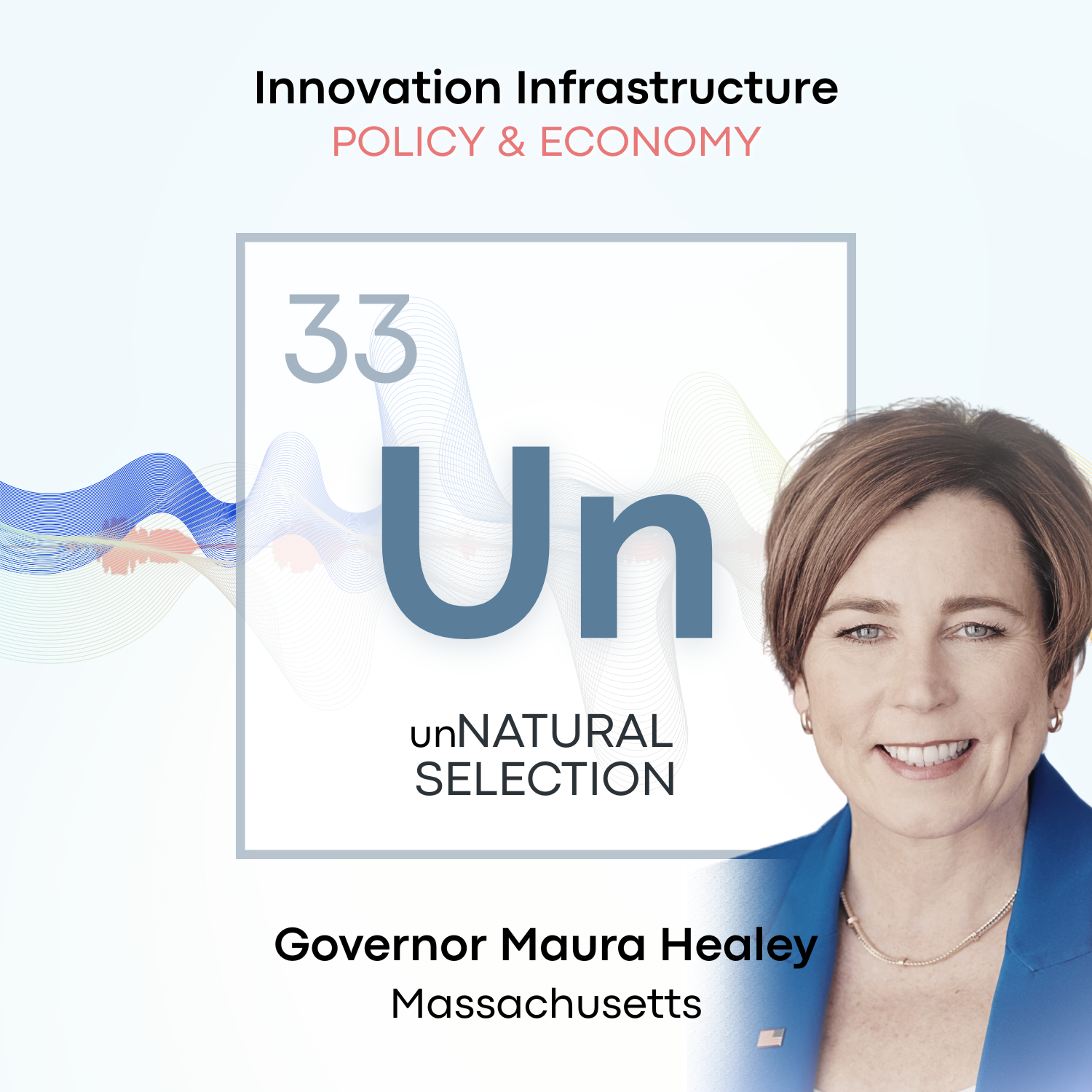
Regional Competitive Advantage: Retaining Capital & Top Talent
The Roots of Democracy Branch Toward Innovation. Governor Maura Healey joins unNatural Selection to discuss how Massachusetts is navigating federal headwinds to remain a global leader in innovation. We explore the state’s partnerships with industry, academia, and communities, the challenges of competition with other states and nations, and the unique role Massachusetts plays as both a modern innovation hub and the birthplace of American democracy.
Governor Healey shares how her administration is stepping in to fill gaps left by federal retrenchment — from weakened public health systems to declining research investment — and why bold investments in education, infrastructure, and policy innovation are critical for keeping Massachusetts competitive. In a time of disruption, she makes the case that states must innovate to evolve and lead.
-
(Auto-generated by Spotify. Errors may exist.)
Maura Healey is the 73rd governor of Massachusetts. In 2022, she became the first woman elected governor in state history and the first openly lesbian governor elected in the country. [2:12] As governor, she has focused on making Massachusetts a global leader in innovation, especially in life sciences, health care, and R&D, while also making the state more affordable and competitive. She was previously the Massachusetts Attorney General, a civil rights lawyer, and a litigation partner, and she captained her basketball team at Harvard and played professionally in Europe.
[2:32] Host: Governor, welcome to unNatural Selection.
Governor Maura Healey: Hey, it's great to be with you, Nic.
Host: Same here. I think we could do a whole episode on your experience and playing professional basketball, but we'll keep it professional for now.
Governor Maura Healey: Okay, all right.
Governor Maura Healey: For the record, I was a point guard.
Host: Okay, I love it.
[2:48] Host: My wife actually plays basketball as well, so I'm sure she's going to have plenty of questions.
Governor Maura Healey: All right.
Host: So, Governor, it's so great to have you here. I always start with the same signature question just to level set with such a diverse audience. It's great to hear in your words what mission drives what you do.
[3:04] Host: So, could you please let us know what need or impact drives your work?
Governor Maura Healey: It's really about delivering for people and delivering for people in Massachusetts. And, you know, I have to say I am a really unlikely politician. Growing up, I never thought I'd run for office. I played professional basketball, I was a civil rights lawyer, and I didn't think I'd be a politician.
Governor Maura Healey: But I ran because I understood the difference that the Attorney General's office could make in the lives of people across our state, and that's the same reason I ran for governor: to deliver for people. And I'm really motivated by that. I love people, I love our state, and I feel really fortunate to lead this incredible Commonwealth.
Host: That's fantastic. I think that leads me to my next question, which is to talk a little bit about the future of the state, especially as it pertains to innovation and life sciences.
Host: As governor, you've made it clear that you want to make Massachusetts a global leader in innovation and specifically in life sciences. What are the key strategies your administration is implementing to maintain and enhance Massachusetts's competitiveness in this sector?
[5:05] Governor Maura Healey: Yeah, Nic, it's really about maintaining our edge and taking the time to ensure that the things that have made us successful—the strong base of our academic institutions, our research hospitals, the incredible talent that we've amassed here in Massachusetts—that we continue to nourish those things. And so for us, it's been about creating the right economic climate and doing that through focusing on a number of things. One is our commitment to a strong life sciences initiative. We just made a billion dollar proposal for ten years of investment in the life sciences and health care innovation.
Governor Maura Healey: That is so critical, not just for the research and the innovation that's going to come out of that, but also the talent pipeline. It's really about continuing to do the thing that Massachusetts has always done: be the first, be the leader. And to do that, you have to invest.
Host: That billion dollar investment is certainly a huge statement. Let's talk a little bit about the talent pipeline.
Host: Given the critical need for a skilled workforce in the life sciences and health tech industries, how is your administration addressing the talent gap, and what role do you see for vocational and technical education in preparing the next generation?
Governor Maura Healey: Yeah, it's a huge issue, Nic, and it's one we talk about a lot, right? Talent is our greatest resource in Massachusetts. But we have to work hard to cultivate that, to develop that. And that means investment in our K-12 public education, it means investment in our community colleges and vocational technical education, and it means investing in our public universities and colleges. And we've done all of that. We've proposed a substantial increase in public education funding. We've rolled out a new program for free community college for those 25 and older who don't have a college degree.
Governor Maura Healey: And that's something we're really excited about because we understand the imperative of ensuring that people are not only staying here but being able to afford to stay here and have access to the kinds of education that will lead to the jobs of the future.
Host: Let's transition slightly to talk about the integration of technology and health care.
Host: How do you view the role of AI and machine learning in Massachusetts's health care and life sciences future, and what steps are you taking to support ethical and responsible adoption of these technologies?
[10:15] Governor Maura Healey: It's a huge opportunity. We're at the very early stages of understanding the impact of AI and machine learning in health care and life sciences. And, you know, we want to be the place where that is done best and done ethically and responsibly. And so, we've formed a task force, an AI task force, to bring together leaders across the industry and across academia and government to think about: what are the implications of AI? And how can we ensure that, as we deploy it, as we use it, we're doing so in a way that is equitable, that is safe, and that ultimately serves the interests of people?
Governor Maura Healey: And so, that's something that we're really focused on. And I think that's another thing that sets Massachusetts apart, is that we understand that the future of this is really about the intersection of technology and humanity, and that we have to do it in a way that really holds those two things together.
Host: That's a great concept, technology and humanity. Let's talk about the unique challenges of Massachusetts.
Host: Affordability is a significant challenge for residents and businesses in Massachusetts. How does your administration plan to balance the state's focus on high-cost innovation with the pressing need to make Massachusetts a more affordable place to live and work?
Governor Maura Healey: You know, Nic, it's critical. The two things go hand in hand. If we are going to continue to be a global leader in innovation and life sciences, we have to address the cost of living. People have to be able to afford to live and work here. And so, my number one priority has been and remains housing. We've put forward a comprehensive package of housing legislation that's going to create the right incentives and also the right funding mechanisms to build more housing, particularly housing that's affordable to the working class.
Governor Maura Healey: We've also invested in child care. We know that child care costs are prohibitive for so many families. And that's a real barrier to workforce participation, especially for women. And so, we've been focused on that. And we're working on making health care more affordable. The cost of health care, as you know, is a big driver of all of this. And so, working with our partners in the health care industry to ensure that we're delivering high-quality care at a price that people can afford.
Host: Let's talk about the broader impact of Massachusetts's health care sector.
Host: Beyond economic growth, what is your administration's vision for the health and well-being of Massachusetts residents, and how do you leverage the state's advanced health care infrastructure to address health disparities?
Governor Maura Healey: Yeah, Nic, health equity is a huge focus for us. We know that in a state that has the best health care in the world, that we still have gaping disparities. And that is simply unacceptable. And so, we're focused on really leveraging our infrastructure to address those gaps. That means investing in community health centers. That means investing in behavioral health, which we know is a crisis across the state.
Governor Maura Healey: And that means focusing on preventative health. How do we get people to a place where they're not just getting sick and going to the hospital, but they're staying healthy and well in their communities? And that's a shift, but it's an important one. And we're doing that by investing in our public health infrastructure and ensuring that we're working with our partners to deliver care where people are, not just where the hospitals are.
Host: You mentioned behavioral health. Could you speak a little bit more about how your administration is addressing the mental health and substance use disorder crisis across Massachusetts?
[15:02] Governor Maura Healey: It's a crisis, Nic. It's a huge issue, and it's one that touches every community. And we know that behavioral health is health. And so, we're treating it that way. We've invested heavily in what we call our "Roadmap for Behavioral Health," which is really about creating a seamless system of care from prevention to treatment to recovery.
Governor Maura Healey: That means investing in the workforce, ensuring that we have enough providers, particularly in underserved communities. It means expanding access to telehealth. It means ensuring that people know where to go to get help. And it means destigmatizing the conversation around mental health. We're trying to lead by example in the state and really encourage people to talk about it and to seek help.
Host: Let's discuss a more controversial topic: regulation.
Host: The balance between fostering innovation and implementing necessary regulation is always delicate. How is your administration approaching regulatory frameworks to support new health technologies and life science products without stifling growth?
Governor Maura Healey: Yeah, Nic, we're trying to be smart about it. We're trying to be nimble about it. We understand that regulation can be a huge barrier to innovation. And so, we're working with our partners in the industry to understand where the pain points are. Where can we streamline the process? Where can we remove unnecessary bureaucratic hurdles?
Governor Maura Healey: But we also understand our role in protecting the public. And so, we're trying to create a regulatory environment that is both pro-innovation and pro-safety. And that's a delicate balance. But it's one that we're committed to. And I think that's where the AI task force comes in, too: to help us think about what are the guardrails that we need to put in place, particularly as these new technologies emerge, so that we're doing it in a way that is ethical and safe.
Host: Let's pivot to talk about climate change and its intersection with health.
Host: Climate change is an existential threat with profound health implications. How is Massachusetts leveraging its life science and health care expertise to address the health-related impacts of climate change, and what role do you see for the private sector in this effort?
[20:10] Governor Maura Healey: You know, Nic, it's a huge issue. We talk about it as a health issue because it is. And we're seeing the impacts now, particularly in our underserved communities, with everything from air quality to extreme heat. And so, we're really focused on this. We're investing in climate resilience, ensuring that our infrastructure is resilient to the impacts of climate change.
Governor Maura Healey: But we're also leveraging our life science expertise to find solutions. We have incredible innovators here who are thinking about everything from novel therapeutics to address environmental exposures to new ways to monitor and track the health impacts of climate change. And that's where the private sector comes in. We need the private sector to be at the table with us, to be innovating with us, to be investing in these solutions.
Host: That sounds like a comprehensive approach. Let's talk about the national and global context.
Host: Massachusetts operates in a national and global landscape where federal policies and international competition are major factors. How does your administration navigate these dynamics to ensure that Massachusetts remains a competitive and attractive location for global life science and health care investment?
Governor Maura Healey: Yeah, Nic, we're constantly thinking about this. We know we're in a global competition for talent, for capital, for investment. And so, we're really focused on ensuring that we are the most attractive place to be. That means being proactive in Washington, ensuring that we're advocating for the federal policies that benefit Massachusetts, particularly around research funding, which is critical to our ecosystem.
Governor Maura Healey: And it means being on the global stage, too. We are traveling, we are engaging, we are telling the Massachusetts story to the world. We want people to know that this is the place to be if you want to innovate, if you want to grow, if you want to be at the forefront of health care and life sciences.
Host: I think that's incredibly well articulated. Let's talk about the future of the state's infrastructure.
Host: In addition to the billion-dollar life sciences initiative, what investments are you prioritizing to upgrade the state's physical and digital infrastructure to support the growth of these high-tech industries?
Governor Maura Healey: Yeah, Nic, it's about making sure that the infrastructure is keeping pace with the innovation. So, we're investing in our transportation infrastructure. We know that congestion is a huge issue. And if people can't get to work, then the innovation stops. So, we're investing in the MBTA, we're investing in regional transit, and we're thinking about new, innovative solutions to transportation.
Governor Maura Healey: And on the digital side, it's about ensuring that we have the best-in-class broadband access for all of our residents and businesses, which is critical to the future of work and the future of innovation. And it's also about our energy infrastructure, ensuring that we have a clean, reliable, and affordable energy supply, which is critical, particularly for our manufacturing sector.
[25:40] Host: Let's discuss one more important aspect of the state's vision.
Host: The life sciences and health care sectors often face periods of intense change, such as the pandemic or economic downturns. How are you building resilience into the state's economy and these core sectors to withstand future disruptions?
Governor Maura Healey: Yeah, Nic, I think that's where the focus on diversification comes in. We want to ensure that our economy is not overly reliant on any one sector. And so, we're investing in other areas, too: clean energy, manufacturing, and our tech sector. But within the life sciences, it's about ensuring that we're supporting the full spectrum of innovation, from early-stage research to manufacturing and commercialization.
Governor Maura Healey: And I think that's where the focus on partnership comes in. We need the public sector, the United States, and the private sector to work together in partnership. Truly, states aren't going to have enough money to make up for what the federal government may be taking away. But if we work smartly, nimbly, if we harness the innovation of the private sector and partner with the private sector, we're just going to be able to do so much more. [27:05]
Governor Maura Healey: And I'm excited about that. I'm excited about the possibilities because I think that the intensity of the times, the urgency of the times is forcing all of us to do things in new and different ways. And, you know, I'm talking to an audience of innovators and folks who understand the entrepreneurial spirit and understand what it means, you know, to be challenged where you're forced and sometimes you fail and you're forced to innovate and leapfrog ahead. [27:32]
Governor Maura Healey: And, you know, that's, that's how I view this moment right now for our state and the opportunity that we have.
Host: Well, Governor, I first of all, I thank you for your service, your leadership, and your vision. This has been an extraordinary conversation and truly a privilege for me to get to know you.
[27:49] Host: And thank you for sharing more of your plans and your thoughts on the future of Massachusetts and what you intend on doing over the next couple of years. With that, again, thank you again for your time and I hope that we can meet in person at the World Medical Innovation Forum. I look forward to that.
