
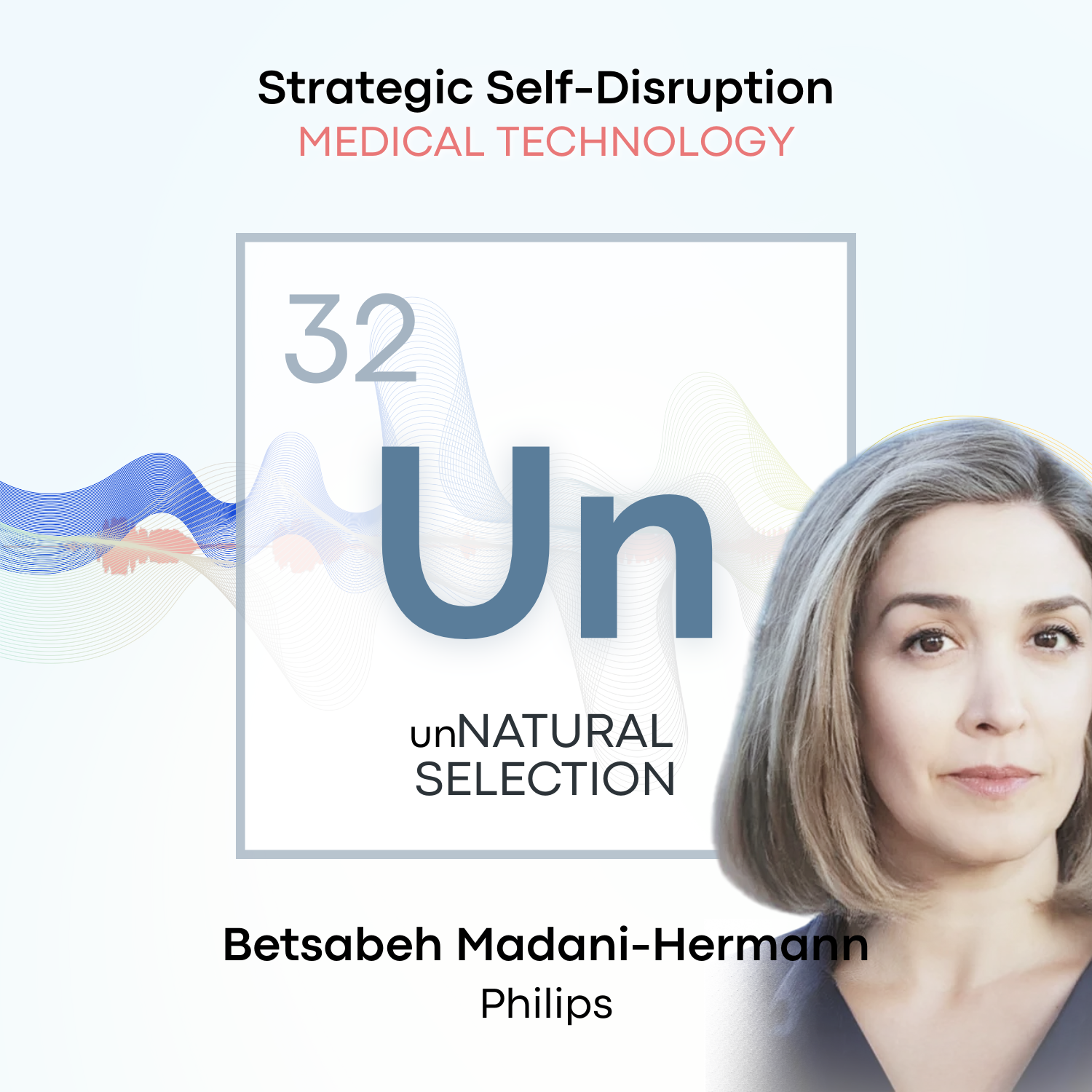
Medical Technology: Philips • Betsabeh Madani-Hermann


Organizational Endurance: Deciphering Internal Signal vs. Noise
Philips’ Journey of Reinvention. Philips has been reinventing itself for more than 134 years — a rare feat in an age when most companies struggle just to survive. In this episode, we explore how a global giant stays competitive and vibrant through continuous innovation. Our conversation dives into the challenges and opportunities of innovating inside a large company with a long history, Philips’ internal accelerator program that empowers employees to turn ideas into initiatives, and the leadership skills required to build a culture of transparency and psychological safety where innovation can truly flourish.
-
(Auto-generated by Spotify. Errors may exist.)
Betsabeh Madani-Hermann is a global innovation leader known for speed of execution and turning bold ideas into market-shifting outcomes. In 2023, she became the first non-Dutch and first female head of Research at Philips in the company's 134-year history, where she leads breakthroughs translating advanced technology into real-world impact. With a background in physics, biochemistry, and engineering, and an MBA from Dartmouth's Tuck School, she brings more than 20 years of experience as an operator, investor, and strategist. Her career spans early-stage startups to $30 billion enterprises across sectors from healthcare and biotech to AI, robotics, and cleantech. Sector agnostic and global, Madani-Hermann thrives in ambiguity, mobilizing cross-disciplinary teams to challenge limits and accelerate transformation. Her leadership lens is systems thinking with a builder's mindset, driving growth, aligning stakeholders, and scaling innovation across industries and geographies.
[2:14] Host: Betsabeh, it's such an honor to have you here. Welcome to unNatural Selection.
Betsabeh Madani-Hermann: Thank you very much, Nic. It's great to be here.
Host: And you know, as we spoke a little bit, our backgrounds are so similar. This is really going to be a fun conversation, and I'm looking forward to kind of hearing your perspectives on innovation when it comes to healthcare and technology.
Betsabeh Madani-Hermann:[2:35] I'm very much looking forward to this. I think we'll be geeking out throughout the conversation.
Host: Absolutely. So to start, I want to talk a little bit about what drives your work. I always start with the same signature question just to level set with such a diverse audience. So in your words, can you please tell us what need or impact drives what you do?
Betsabeh Madani-Hermann:[3:04] Yes, Nic. You know, I've had a career that's, as you mentioned, really spanned early-stage startups to large organizations. And I've always been driven by one thing, which is the question of, how can we bring technology to the market to create an impact, a positive impact on humanity? And I'm not a physician. I'm not an MD, but I've always loved science. I'm a physicist by background, and I have a dream, or I have a desire to see how we can use all the knowledge that we have today, both in science and technology, and the best brains that are out there, to improve people's lives.
Betsabeh Madani-Hermann:[3:43] I think that's the core of what drives me. It's just creating that impact, whether it's an early-stage company or Philips, at a $20 billion global company, and just making sure that every day, we are challenging ourselves, pushing boundaries, and bringing the best we can to society.
Host: That's a fantastic mission, and it's so great to hear you articulate it in such a clear way. So let's talk a little bit about one of the newest challenges that you've undertaken, which is leading research at Philips.
Host:[4:18] As the first non-Dutch and first female head of Research in Philips' 134-year history, what has been your main focus in translating advanced technology into real-world health impact?
Betsabeh Madani-Hermann: Nic, you know, when I started in this role, one of the things that I was told is, "Research at Philips is the crown jewel of the company." And that made me immediately think about, okay, how can we polish this crown jewel to shine as brightly as it can? And really, for me, the focus has been on three things. The first one is, how do we really connect what we do in research to what the business and the market need? And connecting our research to the end-to-end innovation process.
Betsabeh Madani-Hermann:[5:05] The second one is really on focusing on breakthroughs, going beyond incremental improvements, and pushing the boundaries of technology. And you know, Philips is a very strong company. It's a very solid company. The foundation is there, but we need to focus on, "What are the next big things that we are going to deliver to the market?" And that has been a huge focus for me. The third one is about the talent. Attracting the best talent globally and making sure that our teams are diverse. We have scientists from all over the world, with all kinds of backgrounds.
Betsabeh Madani-Hermann:[5:47] It's all about bringing that diversity of thought into the system. It's great to have a new role, and being the first non-Dutch, first female is fantastic, but it's really the impact that you can create with the team that matters.
Host: That's an extraordinary triumvirate of focus. And I think that's what makes for great leadership and a great organization. Let's dig a little deeper into the concept of a breakthrough.
Host:[6:20] What specific areas of advanced technology—such as AI, robotics, or others—are you most excited about for creating those market-shifting outcomes in healthcare?
Betsabeh Madani-Hermann: You know, it's not a secret anymore that AI is transforming every industry, especially healthcare, and Philips has been at the forefront of AI. I mean, we are a leader in imaging, we are a leader in connected care, and AI is embedded in everything we do.
Betsabeh Madani-Hermann:[6:47] And so, that's definitely one area where we focus on, which is to be a leader in the next generation of AI: how AI can really help us to transform how we care for people, both in the hospital and at home. The second area that I'm very excited about is photonics, which is the use of light in diagnostics and therapeutics. It's a big area of focus for us, and we have a deep expertise in that area.
Betsabeh Madani-Hermann:[7:18] And the third one is the new frontier of care, which is really bringing care to the home. The idea of connected care, moving from the hospital to the home, which is a huge shift in the industry. And Philips is very well positioned to be a leader in that space.
Host: That's fascinating. I want to talk a little bit about the shift of care from the hospital to the home.
Host:[7:47] The shift to connected and personalized care is a major trend. How is Philips ensuring the interoperability and security of data across different health systems and devices, especially as care moves more into the home environment?
Betsabeh Madani-Hermann: You know, Nic, interoperability and security, as you mentioned, are critical, especially when we talk about connected care. And Philips has invested a lot in our platform approach. We have a very strong digital backbone that allows us to connect different devices and systems, both in the hospital and at home.
Betsabeh Madani-Hermann:[8:21] And that platform approach allows us to ensure that the data is secure, that it's flowing seamlessly, and that it's only accessible to the authorized users. It's a huge focus for us, and we know that if we don't get this right, the shift to connected care is not going to happen as fast as we would like it to.
Host: That's a great point. Let's turn our attention to the concept of systems thinking, which you mentioned is one of your core leadership lenses.
Host:[8:58] How do you apply a systems thinking approach to align stakeholders and scale innovation across diverse global markets and different business sectors within Philips?
Betsabeh Madani-Hermann:[9:06] You know, systems thinking, for me, is just a way to ensure that we are not optimizing one part of the system at the expense of the other parts. And in a global company like Philips, which operates in 100 countries, you have to ensure that what you're doing in one region is also scalable to the other regions.
Betsabeh Madani-Hermann:[9:30] And so, for us, it's about connecting the dots, really, and making sure that we have a holistic view of the patient journey, from prevention to diagnosis, to treatment, to home care. And that systems thinking allows us to think about, "Okay, where are the bottlenecks? Where are the opportunities for us to create more impact?"
Betsabeh Madani-Hermann:[9:58] And that's what drives our strategy: ensuring that we are optimizing the whole system, not just one part of it. And that's critical in a company like ours, where we have so many different businesses, but they all need to work together to deliver the best outcome for the patient.
[10:13] Host: That makes a lot of sense. So let's talk a little bit about research and development.
Host: R&D often faces pressure to deliver short-term results while also pursuing high-risk, long-term breakthroughs. How do you balance this tension within Philips Research, and what metrics or frameworks do you use to evaluate success?
Betsabeh Madani-Hermann: That's a great question, Nic, because it's a huge tension in R&D. And for us, it's about creating what I call a "portfolio of innovation." It's ensuring that we have a good balance between what we call "horizon one" projects, which are short-term, incremental improvements, and "horizon three" projects, which are long-term, high-risk breakthroughs.
Betsabeh Madani-Hermann: And that portfolio approach allows us to ensure that we are delivering short-term value while also investing in the future. The metrics that we use are not just financial metrics. Of course, financial metrics are important, but we also look at, "What is the impact on the patient? What is the impact on the health system?"
Betsabeh Madani-Hermann:[11:32] And that's where the idea of the "Triple Aim" comes in: improving the patient experience, improving the health of populations, and reducing the cost of care. And those are the frameworks that we use to evaluate success in research.
Host: That's a wonderful way to think about it, using the Triple Aim framework to apply to R&D. Let's talk about the culture of innovation.
Host: You mentioned the importance of attracting and nurturing top global talent. What initiatives is your office undertaking to foster a global, cross-disciplinary, and entrepreneurial culture within Philips Research?
Betsabeh Madani-Hermann: Nic, this is one of my passions. You know, I've had a career that's spanned different countries, different industries, and I really believe that the best ideas come from the intersection of different disciplines.
Betsabeh Madani-Hermann: And so, for us, it's about creating a culture where people feel safe to experiment, where they feel safe to fail, and where they feel encouraged to collaborate across boundaries. We've launched a new program called the "Innovation Incubator," which is really about empowering our scientists to pursue their bold ideas, even if they are high-risk.
Betsabeh Madani-Hermann:[12:58] The idea of this incubator is to provide the resources, the mentorship, and the freedom for our scientists to explore those new frontiers of science and technology. And that's been a huge success.
Host: That's fascinating. The Innovation Incubator. Can you talk a little bit more about how that works? What's the mechanism of that? Is it simply a budget that you give them, or is there a way to guide them through the process?
Betsabeh Madani-Hermann: That's a great question. It's not just a budget, Nic. It's really a structured program where we provide the funding, the mentorship, and the connection to the business. So, we have a small team that manages the incubator, and they work very closely with the scientists to refine their ideas, to test their hypotheses, and to connect them to the right business leaders.
Betsabeh Madani-Hermann:[13:50] The idea is to move from an idea to a proof of concept very quickly. And then, if the proof of concept is successful, we connect them to the business where they can scale that idea. So, it's a very hands-on approach, and it's a way for us to really unleash the entrepreneurial spirit of our scientists.
Host: That is a brilliant way to encourage that kind of innovation within a very large company. I think it's a struggle for a lot of large companies to do that, so I applaud you for that. Let's talk about partnerships, another major aspect of your work.
Host: Given the complexity of modern healthcare challenges, how does Philips Research prioritize and manage external partnerships with academic institutions, startups, and other industry players to accelerate innovation?
[15:10] Betsabeh Madani-Hermann: Nic, partnerships are critical for us. We know that we cannot do it alone. The problems in healthcare are too complex, and the speed of innovation is too fast. And so, for us, it's about being very strategic in where we partner. We focus on areas where we have a clear gap in our internal capabilities or where we see a huge opportunity to accelerate our roadmap.
Betsabeh Madani-Hermann: We have a very strong network of academic partnerships, especially here in Boston, and across the globe. We also partner with early-stage startups through our venture capital arm, and we partner with other industry players where we see a clear win-win. But the key is to be very disciplined in where we partner and to ensure that there is a clear mechanism for transferring the knowledge and the technology into Philips' businesses.
Host: That makes a lot of sense. So, let's talk a little bit about the global aspect of your role.
Host: As you scale innovation across industries and geographies, what are the key regional differences you observe in healthcare needs and technology adoption, and how does your research strategy adapt to these diverse global market demands?
Betsabeh Madani-Hermann: That's a huge challenge, Nic, because, as you mentioned, we operate in so many different geographies, and the healthcare systems are very different. The needs of patients in India are very different from the needs of patients in the US or in Europe.
Betsabeh Madani-Hermann:[16:57] And so, for us, it's about having a global research footprint, making sure that we have researchers on the ground in those key markets. And that allows us to understand the local needs, to co-create solutions with local partners, and to adapt our global solutions to the local context.
Betsabeh Madani-Hermann: The key is to have a centralized research strategy but a decentralized execution model. We want to ensure that the core technologies are developed centrally, but the application and the adaptation of those technologies are done locally. And that's what we call "global-local."
Host: That is a really elegant concept. Global-local. So, let's talk about the intersection of technology, health, and climate.
Host: Sustainability is an increasingly critical consideration. How is Philips Research integrating environmental sustainability goals, such as circular economy principles, into the development of new health technologies and devices?
Betsabeh Madani-Hermann: Nic, sustainability is one of the core values of Philips. We are a company that's been focused on sustainability for a long time. And for us, it's not just a nice-to-have; it's a must-have. And in research, we are focused on two things.
Betsabeh Madani-Hermann:[18:36] The first one is, how do we design our products for circularity? Thinking about the materials, thinking about the end-of-life of the product, and how we can reuse and recycle the components.
Betsabeh Madani-Hermann: The second one is, how can our products help the health system to be more sustainable? For example, by moving care to the home, we are reducing the carbon footprint of the health system. And that's a huge focus for us, and we are embedding those sustainability goals into the design process from day one.
Host: That's a great approach. Let's talk a little bit about the idea of the workforce.
Host: With the rapid pace of technological change, how is Philips Research investing in upskilling and reskilling its workforce to ensure they remain at the cutting edge of AI, machine learning, and other emerging fields?
Betsabeh Madani-Hermann: That's a huge challenge, Nic, because the pace of change is so fast, and the skills that we need today are very different from the skills that we needed five years ago. And so, for us, it's about having a continuous learning mindset.
Betsabeh Madani-Hermann:[20:12] We've launched a number of internal programs and partnerships with universities to ensure that our scientists are constantly upskilling and reskilling. We have a very strong internal academy, and we encourage our scientists to spend time on continuous education. The key is to create a culture where learning is a core part of the job.
Betsabeh Madani-Hermann: And also, as I mentioned before, attracting external talent that can bring in those new skills and capabilities. It's a combination of upskilling internally and attracting external talent.
Host: That is really well articulated. I think the combination of both internal education and external attraction is what drives true innovation and true growth. Let's talk about the regulatory landscape.
Host: The regulatory environment for advanced health technologies, particularly AI and digital health, is rapidly evolving. How is Philips Research proactively engaging with regulators globally to help shape frameworks that foster innovation while ensuring patient safety and efficacy?
Betsabeh Madani-Hermann:[21:28] That's a critical question, Nic, because regulation can be a huge barrier to innovation. And so, for us, it's about being very proactive and engaging with regulators from the beginning. We have a very strong regulatory affairs team that works very closely with the researchers to ensure that we are designing our products for compliance.
Betsabeh Madani-Hermann: We also engage in a number of public-private partnerships where we work with regulators to help them understand the new technologies and to help them shape the new frameworks. It's a very proactive approach, and the idea is to move from a situation where regulation is a blocker to a situation where regulation is an enabler.
Betsabeh Madani-Hermann:[22:23] And that's a huge shift, and it requires a different mindset from both the industry and the regulators.
Host: That's great. Let's talk about the future of medicine, especially in the context of the shift towards personalized medicine.
Host: How does Philips Research envision the future of diagnostics and therapeutics with the continued rise of personalized medicine, and what specific projects are you prioritizing to drive this transformation?
Betsabeh Madani-Hermann: Personalized medicine is the future, Nic. There's no doubt about it. And for us, it's about ensuring that we are providing the tools and the insights to enable that shift. We are focused on three things.
Betsabeh Madani-Hermann:[23:44] The first one is precision diagnosis: how can we use advanced imaging and genomics to provide a much more precise diagnosis for the patient?
Betsabeh Madani-Hermann: The second one is personalized treatment: how can we use AI and data to tailor the treatment to the individual patient, not just to a population of patients? And the third one is connected care: how can we monitor the patient's response to treatment in real-time, in the home environment?
Betsabeh Madani-Hermann:[24:26] Those three things combined are going to enable the shift to personalized medicine, and that's where we are investing a lot of our resources.
Host: That makes sense. Let's talk about what keeps you up at night.
Host: As you look ahead over the next 5 to 10 years, what are the most significant risks or challenges that you believe could disrupt Philips' trajectory in health technology, and how are you preparing the organization to mitigate those?
Betsabeh Madani-Hermann: You know, Nic, what keeps me up at night is the speed of change. I think the pace of innovation is so fast, and the entry barriers are getting lower, so we have to ensure that we are not complacent.
[25:35] Betsabeh Madani-Hermann: The second one is talent. As I mentioned, talent is our greatest asset, and we have to ensure that we are attracting and retaining the best talent globally. It's a huge competition for talent, especially in the AI and digital space.
Betsabeh Madani-Hermann: The third one is the regulatory environment. We have to ensure that regulation is enabling innovation, not blocking it. And we have to be very proactive in engaging with regulators to ensure that we are shaping the future.
Betsabeh Madani-Hermann:[26:14] And the fourth one is the cost of healthcare. We have to ensure that we are delivering high-quality care at an affordable price. That is a huge challenge for the health system, and Philips has a major role to play in that.
Host: I want to talk a little bit more about the cost of healthcare.
Host: Given the global challenge of rising healthcare costs, how is Philips Research focusing its efforts to develop technologies that are not only innovative but also cost-effective and scalable, especially for low- and middle-income countries?
Betsabeh Madani-Hermann: That's a critical question, Nic, because at the end of the day, innovation is only innovation if it's accessible to everyone. And so, for us, it's about thinking about the design of the product from day one. How do we design a product that is cost-effective, that is robust, and that is easy to use in a low-resource setting?
Betsabeh Madani-Hermann:[27:44] The key is to move from a high-cost, high-complexity product to a low-cost, high-value product. And that's a huge shift in the mindset, and it requires a different approach to research and development. We have a number of research programs that are focused on low- and middle-income countries, and we are co-creating solutions with local partners to ensure that they are relevant to the local needs.
Host: That's wonderful. So, let's talk about the next generation of healthcare professionals.
Host: How do you see the role of the healthcare professional evolving with the integration of advanced technologies like AI, and how is Philips Research contributing to their training and adoption of these new tools?
Betsabeh Madani-Hermann: That's a great question, Nic. I think the role of the physician is going to shift from a focus on data gathering and analysis to a focus on clinical decision-making and patient interaction. AI is going to take over a lot of the mundane tasks, and that's going to free up the physician's time to focus on what matters most: the patient.
Betsabeh Madani-Hermann:[29:21] And so, for us, it's about designing our products to be easy to use, to be intuitive, and to be seamlessly integrated into the clinical workflow. We are also partnering with medical schools and universities to ensure that the next generation of physicians are trained on these new tools.
Betsabeh Madani-Hermann: The key is to ensure that AI is augmenting the physician's capabilities, not replacing them.
Host: That's a great distinction to make: augmentation over replacement. I love that. Let's talk about the entrepreneurial journey.
Host: Given your extensive background as an operator, investor, and strategist, what is one piece of advice you would offer to an entrepreneur or founder who is looking to create a market-shifting outcome in the health tech sector today?
[30:46] Betsabeh Madani-Hermann: That's a great question, Nic. And I would say, be bold, but be focused. The health tech sector is huge, and the problems are massive, but you have to be very disciplined in where you focus your energy.
Betsabeh Madani-Hermann: And also, I would say, be patient. Innovation takes time, especially in healthcare, where the regulatory environment is complex, and the adoption is slow. You have to be resilient and you have to be patient.
Betsabeh Madani-Hermann:[31:28] And the third one is, be systems thinkers. Think about the whole ecosystem, not just your product. How is your product going to fit into the existing health system? How is it going to create value for the patient, for the physician, and for the payer? That systems thinking approach is critical for success in health tech.
Host: That's very solid advice. I want to talk a little bit about the role of the chief research officer.
Host: As Chief Research Officer, what is your personal vision for the long-term legacy of Philips Research under your leadership, and what impact do you hope to leave on global health and the broader innovation landscape?
Betsabeh Madani-Hermann: My personal vision for Philips Research, Nic, is to make it the most impactful research organization in health technology globally. I want us to be the place where the next big breakthroughs are happening, where the best talent wants to come and work, and where we are creating a real impact on global health.
Betsabeh Madani-Hermann:[32:56] And for me, the impact on global health is the most important thing. I want us to be a company that is known for delivering high-quality, affordable care to everyone, everywhere.
Betsabeh Madani-Hermann: I think that's the core of Philips' mission: to improve the lives of 2.5 billion people a year by 2030. And research has a major role to play in that.
Host: That's a wonderful vision. I think that the goal of 2.5 billion people is an extraordinary one. Let's talk about the intersection of the payer.
Host: You mentioned the payer in the previous answer. How do you see the payer landscape evolving in response to the rapid advancements in health technology, and how is Philips Research working to demonstrate the value and cost-effectiveness of new technologies to secure broader adoption and reimbursement?
Betsabeh Madani-Hermann: You know, Nic, the payer landscape is shifting from a focus on volume to a focus on value. And that's a huge opportunity for us. We have to ensure that our products are not just innovative but also cost-effective and are demonstrating a clear return on investment for the payer.
[34:14] Betsabeh Madani-Hermann: We are investing a lot in health economics and outcomes research to provide the evidence that our products are creating value for the health system. And that's a critical piece of the puzzle. It's not enough to have a great technology; you have to prove that it's actually reducing the cost of care and improving the health of populations.
Betsabeh Madani-Hermann:[34:34] And that's also growing, and individuals are becoming more and more educated and taking care of their own health. But it is not something we work with. It's just part of that ecosystem that I usually look for: "Who's going to be a disruptor?"
Host: I love that.
Host: Well, with all that, Betsabeh, it really has been a privilege getting to know you and hearing about the work that you're doing. [34:52] I'm sorry that we went over, but you dropped a bomb on me with this incubator. I just couldn't stop asking questions. Thank you so much for your time. I applaud you and the work that you're doing and an extraordinary career, and I look forward to seeing where you go from here and how you lead Philips into the future. [35:10] But with that, thank you again, and I look forward to meeting you hopefully in person next week at the World Medical Innovation Forum.
Betsabeh Madani-Hermann: I look forward to meeting you in person, and thank you for having me on the podcast.
