
Community Health: Kraft Center • Elsie Taveras


Environmental Determinants: Designing Systems Beyond Genetics
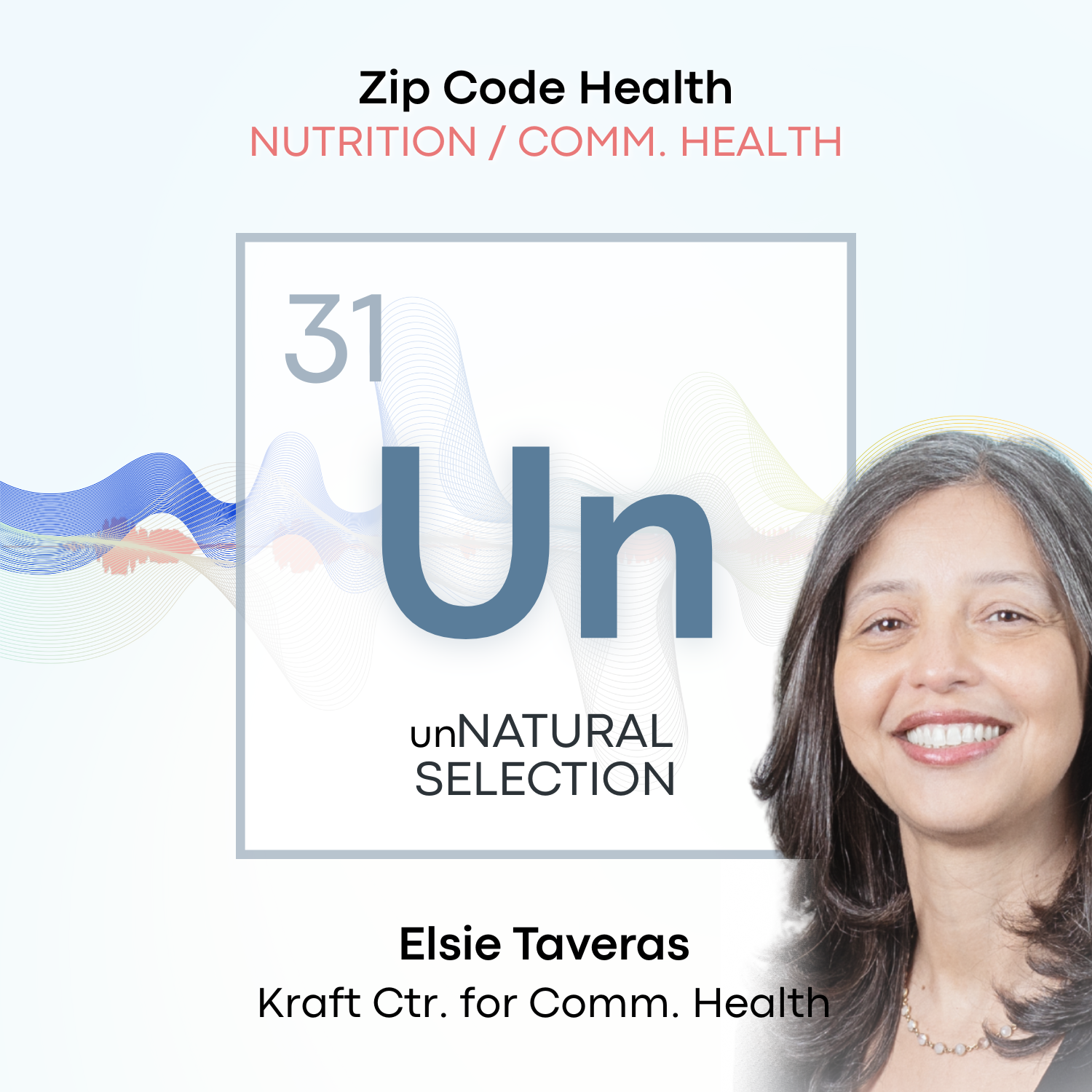
Innovation, Nutrition, and Building Resilient Communities. Childhood obesity is one of today’s most pressing health challenges, but the story is far more complex than “eat less, move more.” In this episode, Dr. Elsie Taveras discusses the latest research on childhood nutrition and obesity, the myths that have shaped what we eat, and how her team at the Kraft Center for Community Health is helping bring healthcare innovations to communities — moving solutions from early adopters to the late majority. A conversation at the intersection of science, strategy, and community health.
-
(Auto-generated by Spotify. Errors may exist.)
Elsie Taveras, MD, MPH, is the inaugural Chief Community Health and Equity Officer at Mass General Brigham and executive director of the Craft Center for Community Health at Massachusetts General Hospital. She leads system-wide strategies to improve Health Equity and the health of the community served by Mass General Brigham. She's a pediatrician at Mass General, the Conrad Taft Professor of Pediatrics and Nutrition at Harvard Medical School, and professor in the Department of Nutrition at Harvard T.H. Chan School of Public Health. Dr. Taveras is a leading expert in community Health Equity, childhood obesity, maternal child health, and health disparities. Her research and community health leadership have influenced the developmen1t of national programs to improve health outcomes and eliminate inequities for socially at-risk populations. Sh2e's a recipient of the Public Health Leadership and Medicine Award from the Massachusetts Association of Public Health for her work improving health and healthcare and community-based settings. Dr. Taveras received her Bachelor of Science and Medical degree from New York University and completed her internship, residency, and chief residency at the Boston Combined Residency Program and Pediatrics at Boston Medical Center and Boston Children's Hospital. She holds an MPH from the Harvard T.H. Chan School of Public Health.
[2:17] Host: Elsie, welcome to unNatural Selection.
Elsie Taveras: Thank you, Nic. It's a pleasure to be here. I'm really looking forward to this conversation.
Host: Absolutely. So, I always start with a signature question just to level set for our diverse audience and to hear in your words what mission or impact drives what you do. So, can you please share with us what need or impact drives your work?
Elsie Taveras: That's a great question. You know, Nic, I've always been driven by the opportunity to really improve the lives of children and families, especially those who are most vulnerable. I'm a pediatrician by training, and I've seen firsthand the impact of health disparities on children's development, their well-being, and their future. And so, for me, the driving force is really that deep commitment to Health Equity. It's about ensuring that every child, regardless of their zip code, their background, or their social circumstances, has the opportunity to thrive and reach their full potential. That's what motivates me every single day.
Host: That's a powerful mission. And speaking of which, you're the inaugural Chief Community Health and Equity Officer at Mass General Brigham. That's a huge undertaking. Could you elaborate on what your main focus is in leading system-wide strategies to improve health equity and the health of the community?
[5:00] Elsie Taveras: The focus is on implementing a comprehensive, system-wide strategy that addresses the root causes of health inequities. This includes three main pillars: Community Investment, Clinical Redesign, and Workforce Equity. For Community Investment, we're leveraging our resources to support community-based organizations that are tackling issues like housing, food insecurity, and economic mobility. These are the social determinants of health that account for a significant portion of a person's health outcomes. Second, Clinical Redesign is about integrating community health principles into our clinical care, ensuring that we're screening for social needs and connecting patients to resources. For example, implementing a universal screening tool for food insecurity in our primary care practices. Third, Workforce Equity is about diversifying our healthcare workforce and creating an inclusive environment for our employees and the communities we serve. It's an all-encompassing, holistic approach.
Host: That is an incredible framework. I want to dig deeper into the concept of Community Investment. How do you measure the return on investment for initiatives focused on the social determinants of health? And what are some examples of successful programs you've implemented?
Elsie Taveras: Measurement is crucial for accountability and for scaling what works. We use a balanced scorecard approach. This includes traditional health metrics, like changes in disease rates (e.g., childhood obesity or asthma), but also community-centric metrics. For instance, we track improvements in housing stability, access to nutritious food, and employment rates in the communities we serve. One successful program is our Food is Medicine initiative, where we partner with local food banks and farmers to provide medically-tailored groceries and nutrition education to patients with chronic conditions like diabetes or hypertension. We've seen clinical improvements, like better blood sugar control, and a reduction in hospital readmissions for these patients, which ultimately translates into healthcare cost savings. It's a long-term play, but the data is compelling.
Host: That is fascinating. The idea of "Food is Medicine" is gaining so much traction. Switching gears a little to your background in childhood obesity, which is a major public health challenge. How does a systems-thinking approach, which you apply to community health, inform your strategies for tackling this complex issue?
[10:00] Elsie Taveras: Childhood obesity is a perfect example of a challenge that requires systems thinking. You can't just focus on the child; you have to look at the entire ecosystem. This includes the family, the school environment, the neighborhood, and broader public policy. Our strategy is multi-level. At the individual level, we focus on clinical interventions and family counseling. At the community level, we partner with schools to improve their nutrition and physical activity standards. We also work with city planners on policies that promote active transport, like safe walking and biking paths. Most importantly, we've developed innovative tools, like an AI-driven predictive model that identifies children at highest risk for developing obesity, allowing us to deploy early, targeted interventions. It's about moving from treating the problem to preventing it by addressing all the forces that shape a child's health trajectory.
Host: That integration of AI into public health is a fantastic example of innovation. Let's talk about the digital divide. As you push for more connected and data-driven community health, how are you ensuring that these technologies don't inadvertently widen the existing inequities for socially at-risk populations?
Elsie Taveras: That is a critical concern, and we are hyper-aware of the risk of exacerbating the digital divide. Our approach is to ensure that digital tools are not the only solution, but an enabler of the solution. We call it a High-Tech, High-Touch model. For any digital health tool we implement, we pair it with a human component—a community health worker, a patient navigator, or a bilingual health coach. For example, when we roll out a new patient portal, we have community health workers in local libraries or community centers helping families sign up and learn how to use it. Furthermore, we prioritize mobile-first and low-bandwidth solutions, recognizing that many families rely solely on smartphones and limited data plans. We also invest in providing access, such as distributing tablets and hotspots to families that lack reliable internet at home. Equity must be baked into the design process from the start.
[15:00] Host: That makes perfect sense—High-Tech, High-Touch. I want to pivot to the issue of health disparities in maternal and child health, another area of your expertise. Given the alarming rates of maternal morbidity and mortality, particularly for women of color, what specific initiatives is your office driving to address these systemic issues?
Elsie Taveras: The disparities in maternal health are truly a public health crisis, rooted in centuries of structural racism and bias within the healthcare system. Our strategy is multi-pronged, focusing on Clinical Excellence, Community Doula Programs, and Anti-Racism Training. Clinically, we are implementing standardized protocols across all our birthing hospitals to manage obstetric emergencies, which is shown to reduce mortality. The Community Doula Program is a major focus: we are funding and partnering with community-based organizations to provide doulas and culturally concordant care to expectant mothers in marginalized communities. Doulas provide essential emotional support, education, and advocacy, and their presence is associated with better birth outcomes. Finally, we require mandatory, recurring Anti-Racism and Implicit Bias training for all clinical and non-clinical staff involved in maternal care to ensure respectful and equitable treatment for every patient.
Host: That work is incredibly vital. Let's talk about the challenge of scaling. Mass General Brigham is a large, complex system. How do you move innovative but localized programs from a successful pilot phase to system-wide implementation across dozens of hospitals and hundreds of practices?
Elsie Taveras: Scaling innovation in a complex system requires a clear governance structure and a shared commitment. We use a framework called The Craft Center for Community Health Model. First, we secure Executive Sponsorship—it must be a system priority. Second, we establish a Learning Collaborative, bringing together staff from across all sites—urban, suburban, and rural—to share best practices and troubleshoot implementation challenges. Third, we ensure Data Transparency. We publish site-specific health equity data so that every hospital and practice can see their progress and hold themselves accountable. It creates a healthy competition for improvement. The key is to standardize the core components of the intervention while allowing for local adaptation, or what we call "fidelity with flexibility." This ensures the program meets the specific needs of each community while maintaining the integrity of the evidence-based model.
[20:00] Host: That's a great balance, "fidelity with flexibility." Given your role, I imagine you engage with a lot of policymakers. How is your research and data informing public health policy at the state and national levels?
Elsie Taveras: Our research is designed to be highly translatable and policy-relevant. We conduct Implementation Science research, which focuses on identifying the most effective ways to translate evidence-based interventions into public health policy. For example, our work on neighborhood-level risk factors for childhood obesity was instrumental in informing local zoning policies to limit the density of fast-food restaurants near schools. Nationally, we actively participate in advisory committees and task forces, using our system-level data—which is unparalleled in its scope—to demonstrate the impact of social determinants on health and advocate for federal funding in those areas, such as expanding the reach of the Supplemental Nutrition Assistance Program (SNAP) to include incentives for fruits and vegetables. We aim to be the bridge between clinical evidence and effective public policy.
Host: It sounds like you're creating a truly virtuous cycle. Looking ahead, what emerging public health or technology trends are you most excited about, and which ones do you think hold the greatest promise for further accelerating health equity?
Elsie Taveras: I am most excited about the potential of Generative AI and Precision Public Health. Generative AI, specifically, for its ability to rapidly analyze vast amounts of social, environmental, and clinical data to predict local public health crises—like heat waves or disease outbreaks—with unprecedented accuracy. This allows us to deploy resources proactively, rather than reactively. Precision Public Health is the idea of tailoring public health interventions to specific, small populations based on their unique risk profiles, rather than one-size-fits-all programs. For example, identifying a specific block in a city with a high prevalence of asthma and customizing air quality and housing interventions for just those residents. It’s about being incredibly precise and efficient with our efforts. I am hopeful about these trends. There is a lot of room to put into practice things we already know work. There's a lot of innovation coming down the pipeline. There are medications, there are new treatments, therapies, and applications. We have no choice but to be hopeful and to really tackle head-on some of the most pressing challenges and community health challenges with innovation.
[23:28] Host: Well, Elsie, I applaud you for the incredible work that you're doing. I'm honored to have you here, and it was a real pleasure getting to know you. I'm also looking forward to meeting you in person, hopefully at the World Medical Innovation Forum next week. We're really excited about the World Medical Innovation Forum. We'll be announcing the inaugural Craft Prize for excellence in innovation and community health. And to your point, the prize was born from our Craft Center's mission to really tackle some of the most pressing issues impacting community health. And we will be recognizing a transformative organization that is doing just that. So I'm excited for the forum and I'm excited to announce the winner of the Craft Prize, and really looking forward to the forum.
Elsie Taveras: Hope to see you there then.
