
Platform Biotech: Mammoth Biosciences • Trevor Martin


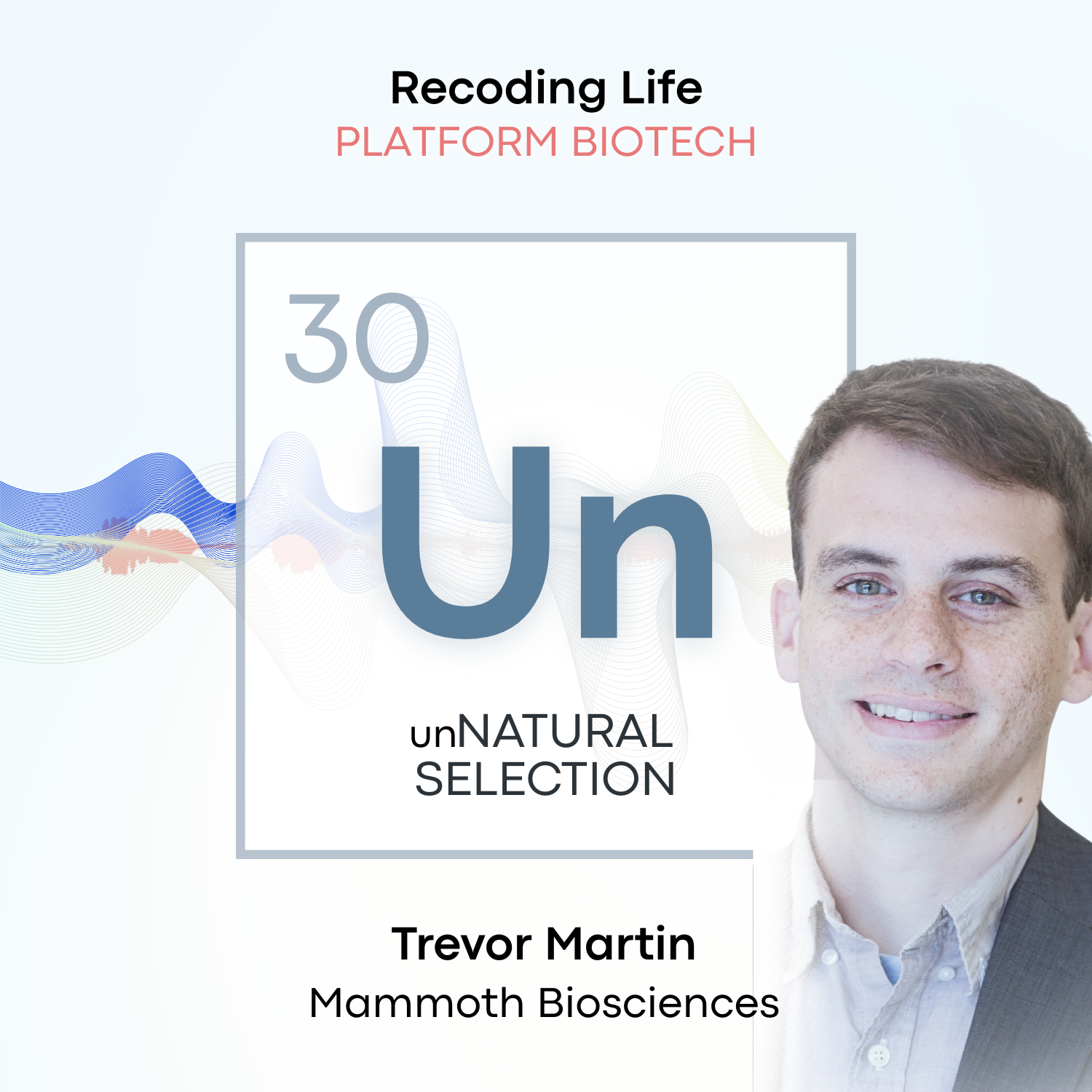
Recoding Life
How CRISPR and AI Free Us from Inherited Destiny. Trevor Martin, CEO of Mammoth Biosciences, joins us to discuss how biology, AI, and engineering are converging to create a biotechnology operating system — a platform of reusable components that can be rapidly deployed to tackle new conditions.
We explore the groundbreaking story of baby K.J., the first newborn to receive a personalized CRISPR therapy for a rare disease, and look ahead to a future where genome editing moves beyond rare disorders to common diseases like heart disease. At its core, this vision points to a profound shift: a world where humanity is no longer bound by inherited genetics, but empowered to lead healthy lives that were once unimaginable.
-
(Auto-generated by Spotify. Errors may exist.)
Doctor Trevor Martin is the Co-founder and CEO of Mammoth Biosciences, a biotechnology company based in the San Francisco Bay Area that is harnessing the diversity of nature to power the next generation of curative CRISPR therapies for genetic diseases as well as improving human health and well-being. (1:31) Through its AI-enabled discovery and development of novel CRISPR systems, including from Co-founder and Nobel Prize winner Jennifer Doudna's lab, Mammoth is enabling the full potential of its platform to read and write the code of life. (1:51) His scientific work has been featured in outlets including FiveThirtyEight and The Atlantic. He is the featured healthcare honoree on the Forbes 30 Under 30 list, is on Fortune's 40 Under 40 list, and is an EY Entrepreneur of the Year 2021.
Host: Trevor, welcome to unNatural Selection.
Trevor Martin: Yeah, thanks for having me.
Host: To level set and just give everybody listening some context around what motivates you, could you please tell us what need or impact drives your work? (2:16)
Trevor Martin: Yeah, I think that Mammoth is part of two revolutions in biology that are very exciting. The first one is more on the research side, and that's this idea of biology becoming more like engineering. And instead of being this kind of like adventure into the dark jungle and trying to build a drug by kind of feeling around in the dark, how can we build reproducible systems that don't just build one drug but can build hundreds of drugs where it gets easier every time you do it. The other revolution is in therapeutics, where we're moving from just addressing symptoms to trying to find the root cause, which in many cases is the human genome, and trying to fix that and cure it. So both of those, I think, are very big challenges and things we're very excited to be tackling. (2:58)
Host: That is an incredible articulation. It's fascinating. I want to dig deeper into the concept of reading the code of life, which is a signature aspect of Mammoth Biosciences' technology. Could you elaborate on what exactly that entails and how it's transformative for diagnostics and disease detection? (3:22)
Trevor Martin: Yeah, so I think this is where we have to appreciate the diversity of nature. CRISPR is a system that was derived from nature, originally from bacteria, and it's essentially a mechanism that the bacteria use to defend themselves from viruses. The way that it does that is it has a guide that can search and find a specific sequence of DNA, and then it'll cut that DNA, destroying the virus. When that gets translated to a human genetic disease therapy, what we're doing is we're finding a gene that's causing some kind of disease and we're cutting it in order to fix that. (4:00)
Trevor Martin: But what we realized when we were looking across all the different kinds of CRISPR systems is that there's a lot of them, and some of them have this beautiful property where they can not only find and cut DNA, but they can, when they find a specific sequence of DNA, they can release a signal, so they don't cut the target, but they'll cut reporters and basically put out this signal. And so that allows us to, in a very rapid, inexpensive, and easy way, be able to read the code of life in a very similar way to how a home pregnancy test reads a signal. You can basically have these CRISPR systems, and we can design them to detect any sequence of DNA or RNA. And so you can basically reprogram these systems. (4:44)
(5:00) Trevor Martin: And so you can detect, for example, a COVID-19 virus in 30 minutes, or you can detect a cancer biomarker in 30 minutes, or you can detect a rare disease in a very rapid way. And so I think this is a revolution in diagnostics where for the first time, we can be able to do very high-performance, very high-sensitivity diagnostic testing in a very rapid, distributed way. (5:10)
Host: Yeah, that's an incredible vision. It's interesting how you brought up the analogy of a home pregnancy test. That's a great way to put it in context. (5:20)
Host: So, switching gears a little bit, Mammoth Biosciences is very much a biotech company with a strong emphasis on AI and machine learning for novel CRISPR discovery. How does AI supercharge your ability to write the code of life for gene editing? (5:40)
Trevor Martin: Yeah, so this is where it comes to the diversity of nature. It turns out that there are millions and millions of different CRISPR systems, each with unique properties, and they're out there in nature. And it turns out that we need to find them and be able to characterize them in a rapid way. And this is where AI comes in. So we can use AI to basically be able to ingest all this information from the world, look at millions and millions of genomes, and be able to find new CRISPR systems. (6:13)
Trevor Martin: The original CRISPR system was a very blunt instrument. We want a variety of CRISPR systems. Some of them need to be very small so we can deliver them more effectively. Some of them need to have different properties that can edit different kinds of sequences and things like that. So this is where AI can accelerate the discovery process. And not only the discovery process, but also the development process, where we can try and understand which of these new CRISPR systems will be the best for a particular genetic disease. We can actually model that with AI. (6:50)
Trevor Martin: And then the other part that's very exciting is that we can also use AI to think about how to deliver these systems. If you have a car, you need to drive it somewhere. We have CRISPR, we need to deliver it to the right place in the genome, and we need to deliver it to the right place in the body. And this is where AI can come in to help us engineer the delivery systems so that we can have better tropism, so that we can have better on-target editing and things like that. (7:24)
Host: Yeah, that's incredible. So you're actually using a computational model to predict and select the optimal CRISPR system for a given therapeutic target. (7:40)
Trevor Martin: That's exactly right. And I think that's how biology is shifting in a big way from a kind of discovery, where you're just kind of searching around and hoping, to being an engineering discipline, where you can actually model and predict what's going to happen. (7:58)
(10:00) Host: That's a huge shift. And it seems like this is accelerating the timelines for drug development in ways that were previously unimaginable. I want to talk about one of the biggest hurdles for CRISPR therapeutics, which is delivery. As you mentioned, how do you get the gene editing machinery to the right cells in the human body safely and effectively? What are the most promising avenues you're exploring for that? (10:37)
Trevor Martin: Yeah, this is a huge, huge question in the field, and I think the answer is multiplexing the solutions. There are a few different answers for how we can deliver CRISPR. The first one is viral delivery, specifically AAV. This is the workhorse of gene therapy. And there's a lot of things that are very attractive about AAV. It's safe, and there's a lot of clinical experience. It's already been approved for certain therapies. (11:08)
Trevor Martin: But the challenge with AAV is that it's small, and so it can only carry a small payload. And a lot of the CRISPR systems are too big for AAV. So this is where our strategy of finding small, novel CRISPR systems is key, where we're finding these systems that are small enough to be put into AAV. (11:30)
Trevor Martin: The second major avenue is non-viral delivery, which is essentially lipid nanoparticles (LNPs). This is what was used in the COVID-19 vaccines. And I think that is a very exciting and promising avenue because it's very scalable, it's very inexpensive, and you can actually deliver a larger payload, including mRNA, for example. The challenge with LNPs right now is that they're really only good at delivering to the liver. (12:05)
Trevor Martin: And so this is where the AI comes in, where we're actually engineering the LNPs so that they can target other organs, like the muscle, the brain, or the eye, which is a very important area for genetic disease. So, I think it's a combination of viral and non-viral delivery, and the AI is the key differentiator in optimizing both of those. (12:35)
(15:00) Host: That is incredible. The idea of engineering LNPs for tissue-specific delivery fundamentally changes the game. It moves it beyond just the liver. (15:15)
Host: I want to pivot a little bit to the broader implications of gene editing. The public conversation around CRISPR can sometimes be fraught with ethical concerns, especially concerning germline editing. As a leader in this field, how do you navigate these ethical waters, and what responsibility does Mammoth Biosciences feel in setting the standard for responsible innovation? (15:48)
Trevor Martin: That's a very important question. The field of gene editing has to be thoughtful about how we proceed. For us at Mammoth, we are firmly committed to somatic cell editing—editing the cells of the body, not the germline—the sperm and egg. We believe that germline editing is a line we should not cross. (16:20)
Trevor Martin: We've also been very proactive in engaging with the public and with policymakers to ensure that there is a thoughtful, open discussion about the technology. Jennifer Doudna, our co-founder, has been a leading voice for responsible innovation and has written extensively on the topic. We've also established an internal ethics board and an external advisory board to guide our decisions. (16:48)
Trevor Martin: Our focus is purely on therapeutic use—curing disease in living patients. This is where we believe the most immediate and profound impact can be made, and where the ethical path is clear. It's about healing, not human enhancement. (17:15)
Host: That commitment to somatic cell editing and establishing a clear ethical framework is crucial for public trust. (17:29)
(20:00) Host: We're seeing a lot of acceleration in rare disease therapies. Can you share a specific example of how your platform's ability to discover novel CRISPR systems is unlocking a previously intractable rare genetic disease? (20:20)
Trevor Martin: Yeah, absolutely. One of the diseases we are focused on is an ultra-rare, severe, and often fatal neuromuscular disease. The challenge with this disease is that it requires a very large gene to be edited, and the original CRISPR systems were just too large to be packaged into an AAV vector for delivery. (20:50)
Trevor Martin: Using our AI-powered discovery platform, we were able to find a novel, ultra-small CRISPR system—significantly smaller than the original Cas9—that can be effectively packaged into AAV. This was a game-changer. It essentially unlocked the ability to create a therapeutic for a disease where, previously, the delivery limitation made it intractable. This highlights how the diversity of nature, when harnessed with AI, can solve what seemed like fundamental engineering problems. (21:28)
Host: That's a fantastic real-world example of how scale and AI enable novel solutions. (21:40)
Host: Finally, Trevor, as you look five to ten years out, what is the grand, audacious vision for Mammoth Biosciences and for the field of curative gene editing as a whole? (21:58)
Trevor Martin: The grand vision, I think, is twofold. On the diagnostics side, it's a world where a CRISPR-powered diagnostic is as common and as ubiquitous as a home pregnancy test, allowing people to detect anything from infectious disease to cancer to changes in the microbiome, all from the comfort of their home. That will transform healthcare. (22:30)
Trevor Martin: On the therapeutic side, which is where the bulk of our work is, the vision is truly a world without monogenic genetic disease. These are diseases caused by a single gene mutation, like Sickle Cell Anemia or Cystic Fibrosis. We have line of sight to curing all of those. And then the next step is how do we start tackling diseases that require more complex editing, like editing multiple parts of the genome? (23:05)
(25:00) Trevor Martin: And kind of going into like maybe multifaceted diseases where multiple genes are causing something and doing multiplex editing and stuff like that. (26:06) But I think it's really exciting that we can, with a straight face, I think genuinely say in 20 or 30 years, no one should suffer from a monogenic genetic disease, period, right? And that would transform the lives of millions. Even if we're talking about rare disease, the adage is very true that if you look across all the rare disease, rare disease is not rare. (26:26)
Trevor Martin: We almost all know someone that has some kind of rare disease. And so I think that we truly do have line of sight to that. And I think more generally, it creates this world where for the first time we can actually say that, you know, your genetics is not your destiny, right? Like you really, you know, no matter what luck of the draw you got when you were born, you don't have to suffer from that for the rest of your life. (26:52) And I think that very much could be, you know, a major triumph of human engineering.
Host: Yeah, it's an extraordinary vision, Trevor. Congratulations on such wild success so far and thank you for your time. You've been very generous with us. This has been a very insightful conversation for me. (27:11) I very much enjoyed it. And I look forward to meeting you in person at the World Medical Innovation Forum next week.
Trevor Martin: Yeah, thanks for having me and looking forward to the forum.
