
Pharmaceuticals: Sanofi • Michael Quigley


R&D Capital Efficiency as an Operational Imperative
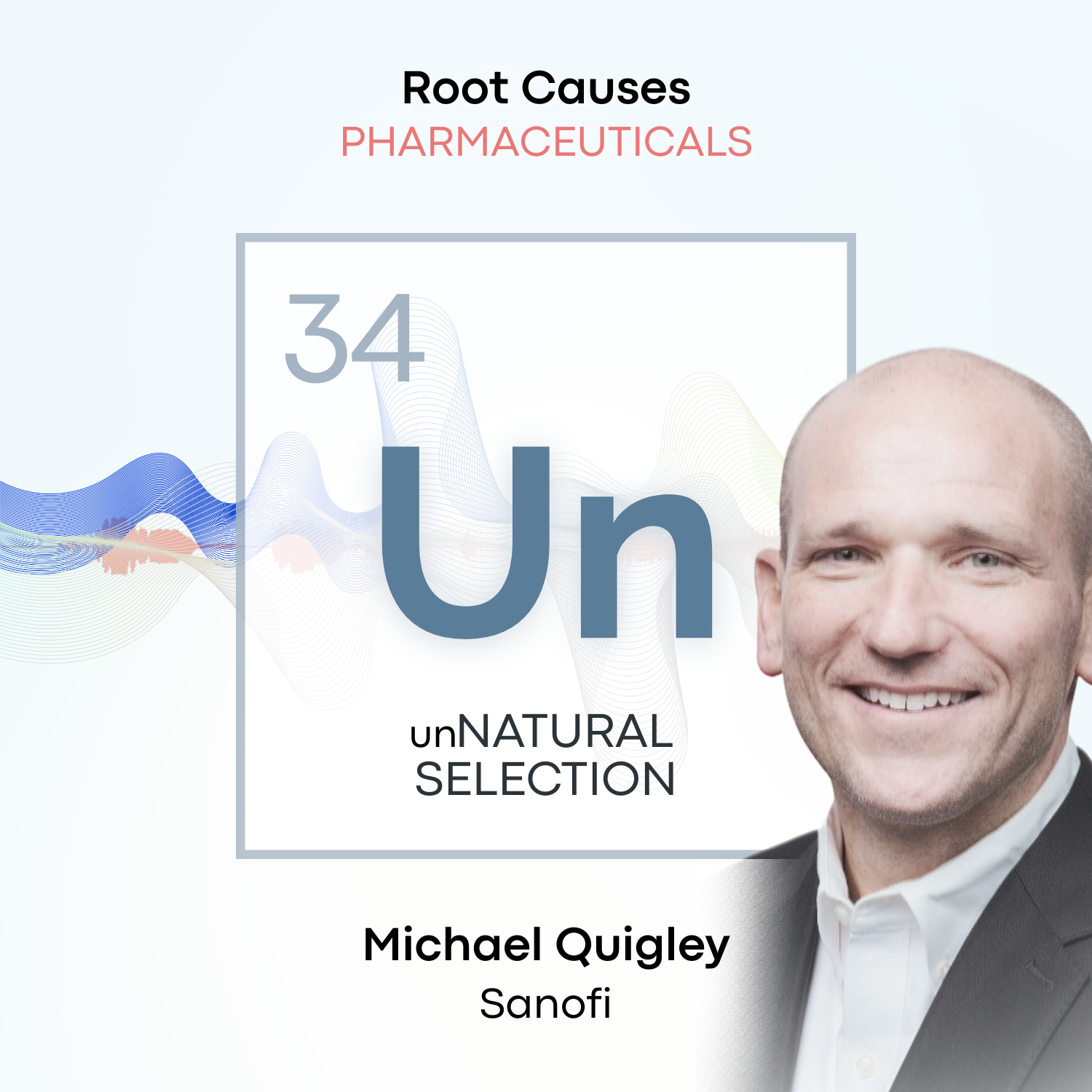
Inside Sanofi’s Arsenal of Innovation. Recorded LIVE at the World Medical Innovation Forum and produced in partnership with MassGeneral Brigham, this episode of unNatural Selection features Nic in conversation with Michael Quigley, Chief Scientific Officer and Global Head of Research at Sanofi.
Together, they explore Sanofi’s competitive edge in a rapidly changing pharmaceutical landscape, the company’s perspective on global demographic shifts, and the transformative potential of modern technologies like AI, genomics, and CRISPR. Michael also shares how Sanofi is willing to disrupt itself when saving lives is on the line—and what these bold choices could mean for the future of human health.
-
(Auto-generated by Spotify. Errors may exist.)
Michael Quigley, PhD, is currently the Chief Scientific Officer and Global Head of Research at Sanofi with responsibility for Sanofi's main therapeutic research areas of immunology and inflammation, oncology, including immuno-oncology, neurology, and rare diseases, with a mandate to innovate and accelerate first- and best-in-class medicines from discovery to clinical translation. Michael Quigley received his PhD in immunology at Duke University and completed his postdoctoral studies at the Dana-Farber Cancer Institute, Department of Pediatric Oncology.
[1:35] Host: Michael, welcome to unNatural Selection.
Michael Quigley: Thanks, Nic. Really great to be here.
Host: I'm really looking forward to having this conversation, but before we get started, I always start with a signature question just to level set and give the audience a sense of what drives the work that you do.
[1:56] Host: So, could you please let us know what need or impact drives your work?
Michael Quigley: Yeah, Nic, I think it's a great sort of founding question. And for me, you know, at the end of the day, the goal of what I do within Sanofi research is to really drive the increased output and efficiency of the research organization to deliver medicines to patients with unmet need.
[2:17] Michael Quigley: Part of the reason I joined Sanofi at a really interesting time in the company is to rethink how you do that with the scale that pharma affords. But, given my background—we didn't touch on it much—I've seen biotech, venture, and pharma through my career trajectory. And really, it's about delivering those medicines. If we're not delivering medicines, then the job's not done.
[2:46] Michael Quigley: And I think there are two parts that drive me. One is a little bit of the intellectual curiosity that comes from a scientific background: How do we sort of apply the most innovative technologies to solve these really hard scientific problems in drug discovery?
[3:04] Michael Quigley: The second is really the impact on patients, right? I mean, the whole idea of what we're doing is in the service of patients that have unmet need, that, you know, have chronic debilitating diseases or severe diseases.
[3:19] Michael Quigley: And so, in the absence of delivering to patients, then we're not doing our jobs. And so, for me, it's the combination of the intellectual curiosity and the sort of patient focus that really drive the work that I do.
Host: That's incredibly well articulated. So, let's talk a little bit about that patient focus.
[3:42] Host: In your view, what is the role of large pharmaceutical companies like Sanofi, and how does your role as a Chief Scientific Officer shape that responsibility for bringing innovative and effective treatments to patients globally?
[3:55] Michael Quigley: Yeah, it's a great question, Nic. I mean, I think that the role of pharma is unique in the ecosystem. I think there are certain things that pharma can do that others can't. And one of those is the scale to invest in areas that are high-risk but have the potential for high-reward, particularly as we think about sort of novel targets and novel modalities in the field.
[4:21] Michael Quigley: I think that the second is to really have the end-to-end view of drug discovery and development. You know, we're very good at identifying what the core drivers of a disease are, how do you discover a molecule to impact that disease, and then ultimately, how do you translate that to the clinic and to global markets, right?
[4:43] Michael Quigley: And I think that that end-to-end view, where we're really responsible for all of it, and we leverage an ecosystem of partnerships to help us, is what I think makes pharma unique. And certainly, as a CSO, part of my role is to set the vision for what the future of Sanofi research looks like.
[5:05] Michael Quigley: How do we really create that engine that allows us to deliver both today, but importantly, tomorrow? And I think, Nic, what's most exciting is that we're really moving from a situation where we're impacting sort of the symptoms of disease to getting to the core drivers.
[5:24] Michael Quigley: And I think that's where really the opportunity is to sort of drive durable disease modification, potentially even cures, in diseases that were thought of as untreatable previously.
Host: The durable disease modification is a really critical concept there. Let's dive a little deeper into that.
[5:45] Host: How has the integration of AI and machine learning fundamentally changed the drug discovery process at Sanofi, and how is it helping you to achieve that durable disease modification?
[6:00] Michael Quigley: Yeah, I think it's a huge opportunity. I think that, you know, AI and machine learning, if you think about it from a sort of discovery perspective, we are generating an immense amount of data, right? I mean, we are really focusing on how do we integrate data sets that are typically very disconnected within sort of a research environment.
[6:22] Michael Quigley: So, everything from genomics to sort of transcriptomics and proteomics, and really using AI and ML to find those needles in the haystack—to find those nodes that are really critical to driving disease, that we wouldn't have identified just purely by sort of human decision-making or by traditional drug discovery approaches.
[6:47] Michael Quigley: And I think that's a huge part of what we're doing within research today is figuring out how do we leverage those data sets and how do we build the sort of technical infrastructure to allow us to do that on an increasingly rapid pace.
[7:05] Michael Quigley: And I think the second part, which is equally important, is how do we leverage AI and ML to do things that have always been hard to do in drug discovery, which is to really think about drug-like properties, safety, and toxicology earlier in the process.
[7:23] Michael Quigley: So, to go from a place where we generate, you know, hundreds of thousands of molecules in the hope that maybe one of them will be a drug, to really applying AI and ML to prioritize those that have the greatest chance to be a drug. So, to increase the speed, to increase the probability of success.
[7:43] Michael Quigley: And I think that's where we're seeing the opportunity today within research.
Host: I think that's a fascinating answer. So, you touched on it a little bit, but let's go a little deeper.
[7:59] Host: Given the increasingly complex and specialized nature of R&D, what role does external innovation play in Sanofi's overall research strategy, and how do you decide which partners to collaborate with?
[8:13] Michael Quigley: External innovation, Nic, is a huge part of what we do. I mean, I think in many ways, we've thought about our research organization as being at the center of a larger ecosystem of innovation. And so, we're not going to be the best in the world at every technology. And so, we need to leverage partners that are doing novel things.
[8:36] Michael Quigley: And I think that's where we've put a huge emphasis, both on academic collaborations, but increasingly on biotech and venture, and sort of early-stage innovation to sort of bring those into the Sanofi fold to help drive that.
[8:53] Michael Quigley: And I think, how we think about prioritizing those, first, it has to be science-led. Right? It has to be based on an area where we think there's a huge scientific opportunity to deliver a medicine to patients that have a great unmet need.
[9:11] Michael Quigley: And then, I think the second part is, it has to be aligned with our research areas. We really focus on the four therapeutic areas that we talked about, right? Immunology, oncology, neuro, and rare disease.
[9:24] Michael Quigley: And so, we're very disciplined about finding partners that are doing something complementary or enabling to those areas. But it has to be done at a pace where we can bring those innovative technologies in quickly, to help sort of accelerate the research process within Sanofi.
[10:00] Host: That makes perfect sense. Let's shift a little bit to the culture of innovation.
[10:04] Host: As a leader of a global research organization, how do you foster a culture of risk-taking and continuous learning, which is essential for breakthroughs in drug discovery, and especially in an organization as large as Sanofi?
[10:19] Michael Quigley: That is probably the most important thing we're trying to do in the organization. And I think there are a few key aspects to it. First is to really create a culture where we are asking the right questions, where we're being disciplined about the problems we want to solve, and really putting a patient focus on all of that.
[10:44] Michael Quigley: And I think that really allows scientists to feel empowered to fail fast, right? I mean, in drug discovery, you are going to fail much more than you succeed. And if you don't create a culture where scientists are willing to try novel things and ultimately fail quickly, then you're never going to get to the breakthroughs that you need.
[11:07] Michael Quigley: And I think the second part is transparency around the decision-making. Right? If you're transparent about what you're trying to achieve, and ultimately why you're choosing to either move forward with a program or ultimately stop a program, then I think you bring people along on that journey.
[11:27] Michael Quigley: And then the third, which I think is most important, Nic, is to really focus on the empowerment and the sort of individual ownership of the research programs. We're trying to shift the organization from a place where it's a sort of command-and-control organization to one that's a more matrixed and collaborative organization.
[11:51] Michael Quigley: And so, really empowering teams to own their outcomes, and to own the delivery of the medicines, really creates a sense of empowerment that allows people to be more creative and to ultimately deliver those medicines in a more rapid fashion.
Host: The idea of failing fast and having transparency around the why, in addition to the what, in terms of that decision-making process, I think is an incredible lesson for any organization, whether you're in life sciences or elsewhere.
[12:28] Host: Let's talk about clinical translation for a moment. What are the most significant bottlenecks in translating early-stage scientific discoveries into viable clinical candidates, and how is Sanofi specifically working to overcome these?
[12:44] Michael Quigley: Yeah, I think, Nic, there are two main bottlenecks. The first is really the translational science and the patient selection, right? How do you sort of understand that the biological hypothesis that you've discovered, that you're going to use to treat a disease, actually translates to the human, and how do you do that at a pace that is increasingly rapid?
[13:10] Michael Quigley: And I think that's where we're leveraging AI and ML, and sort of human disease biology models to increasingly do that earlier in the process, to really validate the core hypothesis and the node that we want to hit, that it translates to humans.
[13:30] Michael Quigley: And the second part of that is really the patient selection, right? I mean, how do we think about moving from a general approach where we're treating all patients with a given disease, to really identifying those subsets of patients that are most likely to respond to a particular medicine?
[13:49] Michael Quigley: And I think that sort of precision medicine, or precision health, as we're increasingly thinking about it, is a huge opportunity, but it's a huge bottleneck in terms of how you select the right patients, how do you execute those trials to show that the medicine is working.
[14:10] Michael Quigley: And then the second big bottleneck, Nic, is the chemistry itself, right? How do you develop a drug-like molecule that is both safe, that has the right pharmacology, that can ultimately translate to the clinic? And that's where, again, we're leveraging AI and ML to sort of increase the efficiency and the speed of the chemistry organization.
[15:00] Host: That's a great segue to a question about the next frontier in drug development.
[15:06] Host: Given the advances in genomic medicine and cell and gene therapies, what do you see as the next frontier in drug development, and how is Sanofi positioning itself to lead in these areas?
[15:20] Michael Quigley: Yeah, I think the next frontier is really, it's a revolution in modalities, Nic. I mean, I think we're really thinking about moving from a situation where we're very focused on sort of large molecules and small molecules, to a broader spectrum of different ways to impact human disease.
[15:43] Michael Quigley: And so, everything from sort of new protein modalities, like multi-specific antibodies, to cell therapy, to gene therapy, and then ultimately, what we think of as genetic medicine. Right? How do we apply the best of what we're learning about RNA and DNA to sort of address diseases that were previously untreatable?
[16:11] Michael Quigley: And I think Sanofi is positioning itself in a unique way in this. We're really investing in all of these different modality platforms to ensure that we have the broadest spectrum of approaches to solve any given scientific problem.
[16:32] Michael Quigley: And so, we're thinking about things like in-house capability for the manufacturing of genetic medicines and cell therapies to sort of really own that end-to-end view. We're leveraging partners that are really great at in vivo gene therapy, and ultimately, how do we sort of apply those to the core therapeutic areas that we talked about.
[16:55] Michael Quigley: So, I think it's a very exciting time. I think the spectrum of modalities, and the ability to sort of apply those to the core drivers of disease, is what's most exciting about where we are today.
Host: That's really exciting. So, let's talk about the workforce of the future.
[17:17] Host: With the accelerating pace of scientific discovery and the integration of AI, what new skills are most critical for the next generation of researchers and scientists at Sanofi, and how are you preparing your current workforce for this shift?
[17:34] Michael Quigley: Yeah, it's a great question. I think that, you know, the traditional sort of bench scientist, in the absence of a strong computational skill, is increasingly going to be a real challenge for us in the future.
[17:53] Michael Quigley: So, we need people that are both excellent at the bench, but can also work with large, complex data sets. They need to be increasingly fluent in the language of computation, AI, and ML, and how those apply to their respective research areas.
[18:14] Michael Quigley: And then, I think the second part, Nic, is the ability to work in a matrixed organization, right? I mean, we are really shifting to a model where it's no longer just a single person at the bench doing an experiment, but it's a multi-disciplinary team with biologists, chemists, computational scientists, all working together in a much more fluid way.
[18:39] Michael Quigley: So, the ability to work within that collaborative environment, I think, is a huge shift for us. And how we're preparing our workforce for this is, we've invested heavily in internal training and sort of upskilling of our current scientists to ensure that they are fluent in the language of computation.
[19:03] Michael Quigley: But we're also hiring externally, right? We are bringing in the best of sort of computational biology and data science to sort of ensure that we have the right talent pool for the future.
[20:00] Host: That makes perfect sense. Let's shift gears slightly to talk about global health challenges.
[20:04] Host: Beyond your core therapeutic areas, what role does Sanofi play in addressing broader global health challenges, such as pandemic preparedness, and equitable access to medicines?
[20:18] Michael Quigley: Yeah, I mean, I think that's a huge focus for us. I mean, I think, particularly around pandemic preparedness, Sanofi is unique in that we have a large vaccines business, which, you know, is really focused on delivering to global markets, and really trying to ensure that we are preparing for the next pandemic.
[20:41] Michael Quigley: And part of that is the sort of development of novel platforms that allow us to generate medicines at a rapid pace. And I think the second part is really around equitable access.
[20:56] Michael Quigley: And how do we think about our medicines not just in the developed world, but in the developing world? And how do we ensure that we are taking an equitable approach to both pricing and delivery of those medicines?
[21:10] Michael Quigley: And I think that's where, as a large pharma company, we have a unique responsibility to sort of ensure that we are bringing medicines to all patients that need them.
Host: That's a great answer. So, let's talk about the sort of core drivers of disease again.
[21:32] Host: In the next five to ten years, what are the most exciting breakthroughs that you anticipate will fundamentally change how we treat some of the chronic diseases you focus on, specifically immunology and neurodegeneration?
[21:49] Michael Quigley: Yeah, I think that's where really the rubber is meeting the road, Nic. I mean, I think we're really focused on moving from a situation where in many situations we're impacting the symptoms of disease, and we're shifting to sort of understanding what the core nodes are that might be drivers, sort of the apex aspects of driving disease pathophysiology.
[22:20] Michael Quigley: And we and others in this field are starting to adopt precision approaches that might deplete a certain subset of cells that are driving disease, and, you know, potential curative or at least certainly long-term treatment-free remission in many of these diseases where that wasn't thought of previously as we think about just treating those symptoms and the underlying causes.
[22:50] Michael Quigley: And we're seeing that not just within immunology, but more broadly as we think about sort of core nodes in rare blood diseases.
[23:11] Michael Quigley: And ultimately, what we hope will translate into areas like neurodegeneration where really combination approaches at these nodes really think have the potential to drive to sort of durable disease modification in diseases today that don't have much available for patients.
[23:35] Host: That's fantastic. Well, this has been a pleasure. Great to meet you here in person at the Well Medical Innovation Forum. I wish you the best of luck on your upcoming panel in the next 20 minutes or so. Thank you again for being with us, for your generosity with your time, and I hope that we can have this conversation again in the future.
[23:52] Michael Quigley: I really appreciate it, Nic. It's been great.
