
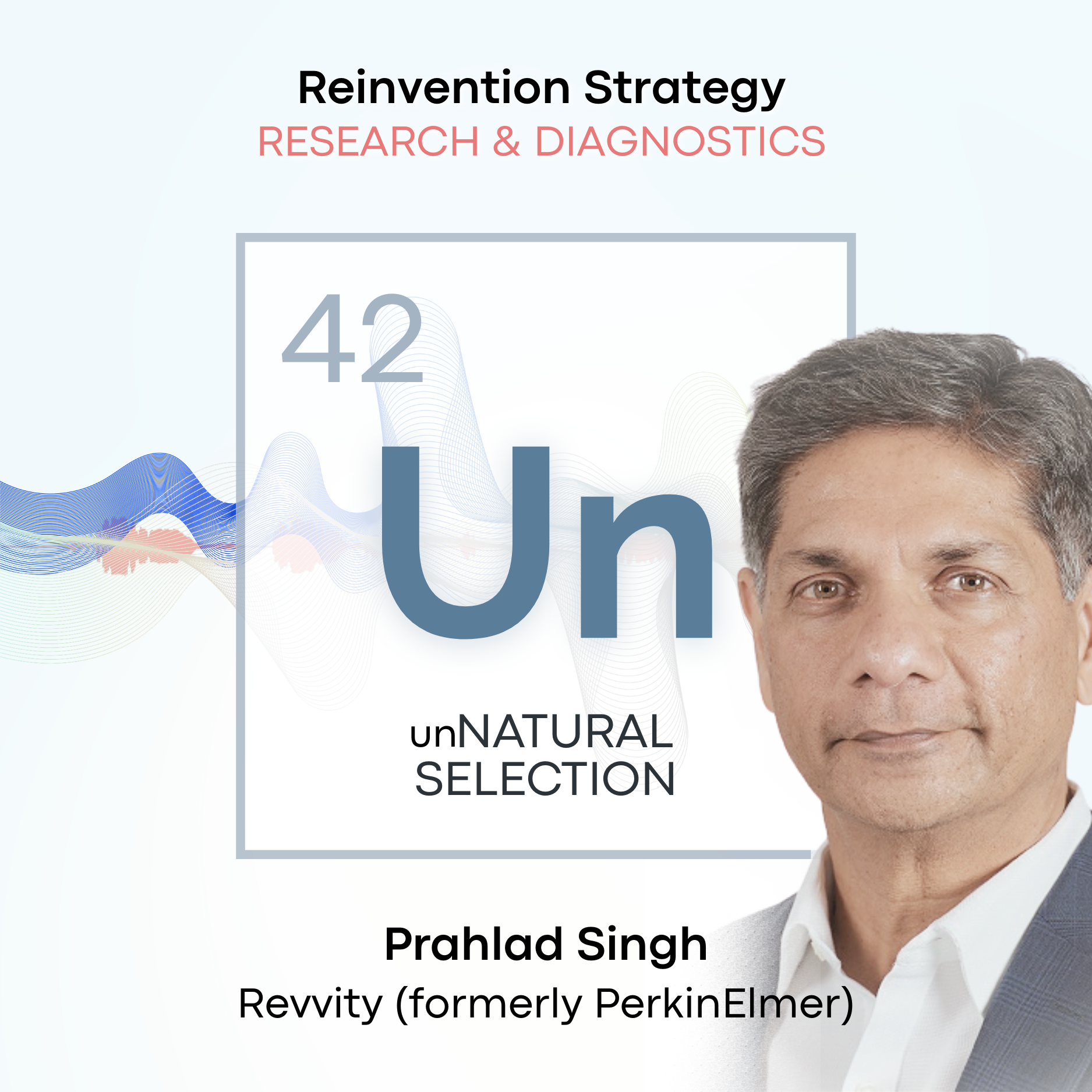
Research & Diagnostics: Revvity • Prahlad Singh


Strategic Divestment: Shedding Legacy Assets to Rebuild Growth
Revvity's Data Strategy for the Future of Life Sciences. The life sciences and diagnostics industry is evolving faster than ever. We sit down with Prahlad Singh, CEO of Revvity, to discuss this dramatic shift.
Prahlad explains the vision behind Revvity's major rebranding (formerly PerkinElmer), moving from a tools provider to a high-value, end-to-end solutions partner. The focus? Agility, innovation, and data. We explore how their Signals Platform is the new "crown jewel" that addresses the immense complexity in fields like genomics, multi-omics, and precision medicine. Learn why advanced data analytics is no longer optional—it's essential for navigating the future of science.
Tune in to understand how Revvity is anticipating client needs and driving the next generation of scientific breakthroughs.
-
(Auto-generated by Spotify. Errors may exist.)
Doctor Prahlad Singh is president and CEO of Revity. With more than 25 years of leadership experience working for global healthcare companies, Prahlad is professionally and personally motivated by the opportunity to make a positive impact on the world. Under his leadership, Revity's 11,000 employees deliver best-in-class solutions and service to a diverse range of organizations, advancing science that expands human health and improves lives worldwide.
Before his current role, Prahlad served as President and CEO of Perkin Elmer prior to it rebranding to Revity, a position he was appointed to in 2019. During his time in this role, Prahlad led the company through a period of significant transformation, stewarding the organization through the COVID-19 pandemic and overseeing its dramatic portfolio evolution.
He was also at the helm when the company completed the divestiture of its Applied Food and Enterprise Services businesses to New Mountain Capital, which resulted in the creation of Revity. Prior to joining Perkin Elmer in 2014, Prahlad was general manager of GE Healthcare's women's health business. He has also held senior executive-level roles in strategy, business development, and mergers and acquisitions at both GE Healthcare and Philips Healthcare. Born and raised in India, Prahlad holds a bachelor's degree in chemistry from the University of Bombay. He moved to the United States to continue his academic career at the University of Missouri, Columbia, where he earned a Ph.D. in chemistry. Prahlad also holds an MBA from Northeastern University's D'Amore-McKim School of Business. Prahlad currently serves on the board of directors of Ethanol Corporation and the Analytical Life Science and Diagnostic Association (ALDA). Additionally, he is a member of the Massachusetts General Hospital Presidents Council and an honoree of The Ascent Foundation's 2023 A List Awards, recognizing outstanding Pan-Asian leaders.
Host Prahlad, it's such a pleasure to have you here. Thank you for being on unNatural Selection.
Prahlad Singh Glad to be here, Nic. You and I obviously go back a long way. But for the sake of the audience, I'll be asking a few historical questions that I may have some context to.
Host But to get started, I always start with the same signature question to give a chance to level set and set the foundation for people listening. Could you please let us know what need or impact drives your work?
Prahlad Singh I mean, I think the way I think of it is there are two primary drivers, Nic, that motivate me. One is to see science come to life on the lab bench, directly impacting the health and well-being of people, whether it's through the development of new therapies or through screening and diagnosis of diseases and disorders. But that really is a primary motivator. But on a personal level, the opportunity to motivate others and see them succeed and really grow, both professionally and personally, through their journey at Revity is a big motivating factor as well.
[05:00]
Host That's excellent. And for the listeners unfamiliar with Revity's core business, could you describe the company's scale and scope today and how it has evolved under your leadership?
Prahlad Singh Revity today is approximately $2.8 billion in revenue and about 11,000 employees and globally pretty well dispersed and direct in more than 150 countries. You know, in terms of the journey of the portfolio transformation that the company has gone through, at least over the past seven years, it's pretty remarkable. And just to give you a few data points to illustrate what the company's gone through, it's not just evolved, but it's pretty much completely transformed. You know, only 30% of the company's revenue today was part of the company seven to eight years ago. We did 12 acquisitions in two years. During the COVID period, we divested a third of the company, changed the name, changed its culture and focus over that period of time. So primarily what we have focused on is transforming the business to pivot into areas of high market growth, to areas which are much more durable and sustainable in markets where we have more leading positions, and ones that are less cyclical but higher margin. That sort of that has been the North Star through which we've been guiding the company's transformation. Even if you look at what is happening in the world today from a technological advancement perspective, you know, at that time, Perkin Elmer really needed to transform itself into something that was new and different and repositioned the business for the future. Our focus was to be able to quickly react to the changing market conditions, the changing scientific priorities that were in front of us, and ones that our customers were uncovering at the same time, you know, whether it's through automation, machine learning, AI, but ones that can have a profound impact on human life. And exactly that is what our intention was when we started putting Revity together. And maybe give you a couple of tidbits around that. You know, just look at the changing regulatory and economic environment, the technology, you know, from a technology perspective, the shift that was going on, you know, our focus was how could we transition the company so rather than be a vendor, it was more of a partner in how we work with them side by side in these scientific discoveries as the times were changing. You know, and as a result of this, I think we've now uniquely positioned the company compared to our peers in a sense that we now have a portfolio together in life sciences and diagnostics. And you know, and I think strategically our crown jewel is the software franchise, which you know well, that is now a backbone to so much of the scientific discovery work that our customers are doing.
Host Yeah, incredible. I mean, what I don't want to gloss over is the scope of the rebranding. And so what I'm going to read is a little bit of the history there for people that may not be familiar, and then we can unpack it a little bit more. But for nearly 80 years, the name Perkin Elmer was synonymous with a vast array of scientific tools, diagnostics, and services across multiple sectors, including food safety, environmental monitoring, and healthcare.
[10:00]
Host However, in 2023, under your leadership, Prahlad, the company executed a profound strategic transformation. It divested its environmental businesses, and the remaining highly focused entity, comprising life sciences and diagnostics portfolio, was relaunched as Revity, which is a name combining "Revolutionize" and "Vita," the Latin word for life. This is a deliberate strategic pivot to create a specialized end-to-end solutions provider positioned to lead the convergence of pharma, diagnostics, and data in the age of precision medicine. And so with that, I just, I think it's tremendous, and you rarely hear about such all-encompassing rebrands, right? So if we take a step back, and it was covered also in a Harvard Business School case study as well because of the scope of this transformation, again, of this change, going from an 80-year-old brand that people knew to Revity, there was a tremendous amount of obviously strategy and thinking behind this. As you described, you're really positioning yourself for the future. I'm sure that there were all kinds of challenges, though, and obstacles and people questioning whether this was the right thing to do. Can you tell us a bit about just the kind of logistics and actual implementation of this transformation? What kind of forces did you feel as you were moving towards this?
Prahlad Singh Well, I think the day and age that we live in today, you see what happens when you do a brand change. You know, there are enough examples out in the media over the past few weeks as to what happens when you try to change your logo or a brand name of a company. You know, and here we were taking an 80-year-old established brand name, you know, in the analytical space and saying, "No, I mean, you know, this aligns very well with what Perkin Elmer is today and was over the past eight years, but it doesn't really align with where do we want to take the company." No, I think, you know, look, obviously there were sleepless nights because you are jumping into the unknown essentially, right, from a place, from a place of comfort. And that never is one that lacks excitement or uncertainty or self-doubt. But what we did not doubt at all is what the intent was, you know, and Revity was in our mind a symbol of change because we were really changing the focus of the company, the end markets that you are going to play in, the portfolio transformation that was coming together. And it did require a change in mindset, in name, and an identity. And that was the primary driver because if you're going to go from more of an instrument, analytical, food, and services company to one where you're partnering in scientific discoveries, providing the software, providing the reagents, providing the tools and capabilities to customers to be able to unravel rapid discoveries, not just in small molecule space, but in biologicals, in cell therapy, you needed to come out with a new identity. And that was the primary driving.
Host I mean, I commend you. I respect that so much because I've interviewed Steven Sasson, the man who discovered the portable digital camera at Kodak, the former CEO of Blockbuster, James Keys. And so you hear these stories about companies being disrupted and not having the ability to cope with that institutional inertia enough to be able to change themselves before it's too late. And yet it's not an easy and trivial thing to do. It takes an enormous amount of courage and foresight to think about what it takes to disrupt yourself and reinvent yourself. And not just reinvent like a product line or a department. What you've done is you said the name Perkin Elmer worked well for us for the past 80 years, and it's working well right now, but where we anticipate the needs of the company going, those needs don't align with the original history. And so what we're going to do is we're going to disrupt ourselves and redefine ourselves in a very intentional way that aligns with what that vision is. And for the sake of people listening, this is not again something that is just done flippantly. It takes an enormous amount of planning and work, and again, bravery to be able to do that and go through the motion. And so from my understanding, this was something that was a year-long transformation. Now that the change has been implemented, how has the outcome in terms of customer perception, internal alignment, or market valuation matched the original vision of how you intended for this to unfold?
[15:00]
Prahlad Singh I think it's a journey, and it's still a journey. And for two or three reasons, I would point out: one, it takes time for customers to get used to something new, you know. And I think that I would say probably in the second half of 2024 and in the first half of 2025, we've started seeing that transition happen, wherein you go to a customer and then the former company's name comes out first, and then say, "Oh, no, but wait, you guys are not Perkin Elmer anymore." So, you know, that, that's a journey. And I think it will take time. It will continue to take time, just like any new adoption of anything new does. The second aspect, in the same way, is, as I said, 30% of only 30% of the revenue was there seven years ago. So everything that is the other 70% is through acquisitions, and we've acquired 12 companies, and two of them I'll specifically point out that have strong brand entities of their own: BioLegend on the life sciences side and Euroimmun on the diagnostic side. So you know, you've also become a house of brands that you are trying to now adapt into what Revity will look like. That's an internal journey, an internal transition that takes place. The thing that probably has not gone to our expectation, and we need to continue to work on that, is the end market. You know, our expectation was the end markets would grow in the 4% to 6% range. Unfortunately, the end markets over the past two and a half, three years have either been flat or slightly negative. So while we have had differentiated growth, meaning we've grown a couple of 100 BPS better than the market growth, in order to show the true power of the portfolio, we need to start seeing the pharma-biotech market, the life sciences industry, get back to what is more of a normal market growth in the 4% to 6% range. And that is when the true essence of what the power of the portfolio is, we'll be able to demonstrate to our customers, our employees, and more importantly, our shareholders.
Host And you mentioned a couple things earlier about the crown jewels of the focus now being around data and digital services, and then you also mentioned that part of the rebranding was to position yourself less as a tools provider and more as a partner to your clients, right? And your clients are vast. I mean, it's from labs, research, pharmaceuticals, biotech, healthcare. If we think about how these fields have been almost converging in a way, you know, the boundaries are a little bit blurry, right? So traditional data companies are now doing more in the healthcare space. Life sciences and diagnostic companies are more in software. Now you're seeing maybe a little bit more of companies like Verily and Microsoft Biotech. You're doing some of that, and especially you become more of a partner. Those boundaries are a little bit more blurry. Can you tell us a little bit more about how Revity is positioning itself relative to all of these blurring lines? I know that part of it is being a partner, but how does that make you feel where now you're seeing a lot of overlap with, say, for example, traditionally data-intensive companies like Microsoft? Do you see them more as competition, as partners, as symbiotic? How do you see these things morphing and these divisions blurring nowadays?
Prahlad Singh Yeah, so Nic, let me break it down into a few pieces because there was a lot packed into that. First, let's talk about the Signals platform. And that's where, as you pointed out, our Signals franchise is one that becomes the fundamental center around how drug discovery will, or with AI, will take place. And this is where some of the companies that you name, we view them more as partners rather than as competitors because, honestly, we are a software... you can look at us both. We are a software company with the right life sciences tool that enhances the development of the right software, or we are a life sciences company that can be supplemented with the software that becomes the nucleus of drug discovery. So that's where I think we strongly believe we are uniquely positioned.
Host Yeah, I totally agree. And in full transparency, I was a part of Perkin Elmer back in the day, at this point, eight or nine years ago, and the advent of the Signals platform was everything that you just mentioned, right? Perkin Elmer sits in this unique position of providing the tools and services that generate that data. You know, for the listeners, I'll embarrass you by saying that, you know, it's pretty well known that I think you were one of the deep architects and the one who named what Signals, the platform, is called today. So I think you should definitely take pride in that, and especially where the company and the business has taken it from where it was a decade ago to where it is now.
Prahlad Singh I think, Nic, the beauty of Signals is today, you know, it plays an important role in helping scientists, as you said, organize, capture, and make sense of the data that comes out of their experiment. You know, you could say that we are deeply embedded in what the wet science is today. There are hands-on work happening at the bench. But now what's more exciting is how molecular design is evolving with AI and machine learning, increasingly moving the first steps of discovery out of the lab and into the computer. That is where Signals has got a fundamental advantage in terms of how it can help design, develop, and be the hub around how drug discovery will take place.
[20:00]
Host It's not that long ago that, you know, you would have the tool that would generate the data, and then you would take that data, and you would go off and do all the processing and analysis, you know, separately. And that data was largely confined to you as the creator of that data. Now, a lot of the work is just, you know, at the time, was done through Excel spreadsheets, right? That was the most advanced tool that you had to be able to kind of manipulate and find patterns in that data, and that was it. Now, you know, the idea is that you have the end-to-end platform where the data is generated, analyzed, archived, and then, you know, put into the model for the next step of the experiment. And I think that end-to-end workflow approach is the right one, because the problem isn't the data, the problem is what you do with the data. How do you integrate it? How do you create something useful that then becomes the next experiment to run? Like, you have the camera, but then you don't know what to do with the camera. And so then you don't generate the picture, you don't process it. It just becomes a brick. But now the idea is that you have the whole workflow. You have the camera, you have the processor, you have the printer, you have the frame, you have the whole thing. And I think that's the approach you're taking, which I think is very clever. You know, you're looking at the solution, not the product, and that's the key distinction. In the example of the camera that I had with Steven Sasson, I was using the camera that he invented as a proxy for the whole workflow. So you actually have your solution. If you want the camera, you can give that to them as well. But what we're trying to do is be a value-added partner to you to solve an actual problem, then just to give you point solutions. Exactly. You're not providing disparate products as a vendor, but really the whole workflow.
Prahlad Singh I mean, with Signals, think of it this way, right? It is today the hub in the lab. You know, as you look at the new paradigm of what we call AI-augmented discovery, tens of thousands of scientists today already spend a majority of their day on the Signals platform. Wow. So, you know, it's the environment where they plan experiments, collect results, and visualize outcomes. It's the natural place to integrate predictive models without requiring scientists to be computational experts. So the AI will run in the background, crunching all of this data, finding the patterns, and telling the scientist, "Okay, this compound is not likely to be a good compound," or "This compound needs to go this route," and all of that.
Host So that then we can bring in the magic sauce which we humans have, which is finding some of these patterns and trying to direct the course of discovery to say, "Okay, with all of this knowledge, how do we now discover new drugs?" And so I can see the need for something like this become just ever more necessary and critical as time progresses. And the way we think about this is always through a human lens. You know, with the advent of AI, there's always the question of what is the role of the human, what is the role of AI. And I think the key is to understand that they're both going to play a critical role. AI will do all the heavy lifting, all the processing, finding the patterns that our minds just can't find and process, and then presenting that to the human for the ultimate judgment. And I think that's the distinction. It's not a replacement, it's a co-working relationship, if you will, where AI does all the number crunching and the human does all the big-picture thinking, right?
[25:00]
Prahlad Singh That's right. And so it's a great relationship because AI is great at doing the repetitive work, giving you the information and saying, "Okay, now you need to do all the thinking," and not be just a cog in the wheel of doing the experiments, but really thinking, "Okay, what is the next experiment I need to do? What is the experiment that I need to run to be able to find the answer?" And so that's where I think the real partnership is. And it's also true in the diagnostic side of the business as well, where we are the number one or number two player in the world in almost every market that we play in, whether it's through our newborn screening or our autoimmune franchises. And in the same, you know, if you recall the user group meetings that we used to have on the Signals side of the business, you know, two or three times a year where our user groups define and sort of decide what our NPI pipeline looks like on the Signals side of the business. So to be able to provide the right outcome, those are the execution, those are the, I would say, drivers that we need to continue to focus on and execute on. Obviously, we are able to do that a whole lot better in a market environment which is...
Host So now let's think a little bit about what the culture shift has been like. I mean, obviously, you know, in the corporate world, culture is a big word that gets thrown around, but it is one of those things that, you know, I always say that culture is what you do when the CEO is not in the room. You know, that's what, that's what defines the culture. And if we think about that, you're transitioning from a very tools-centric, hardware-centric company that has been around for 80 years to a very modern, AI-first, software-first company. And so the employees have to, you know, follow along. And so there's a huge employee component here as well. How do you drive that culture? How do you drive the shift in the mentality from a very heavy, tools-centric company to a very agile, software-centric company? How do you drive that change, especially across 11,000 employees around the world?
Prahlad Singh It's an interesting question, Nic, because I think that for me, culture is what gives you the highest probability of success. That is what I define culture as. And for that, what we needed to do is take the best of the old culture, what made Perkin Elmer successful for 80 years, and blend it with the new culture, which is more agile, more modern, more software, more AI. You know, we call it our four-pronged approach where we, you know, we always say that we, you know, we are one team, we embrace the unknown, we are a catalyst for change, and we make a difference. And this has to be driven from the top all the way down. The one-team concept is so important because, as I said, we've had 12 acquisitions, and all of these acquisitions came from very different cultures. You know, some were more of a software house, some were more of a tool house, some were more of a reagent house. And so bringing all of this together under one umbrella, that is where the one-team concept really came to the fore. Embrace the unknown, catalyst for change. As you said, we've had a huge portfolio shift. It's a huge disruption for us as well. And so you need to be able to embrace that change and be a catalyst for change, and then make a difference, which is always, you know, the most fulfilling part. And so, as I said, if you were to humanize the two, that's part of what it has changed. The average age of the employee base has gone down by eight years. You know, it's a totally different work and employee group today than what it was. And for that, we needed to change the space, the colors, the brand, how we operate, how our operating mechanism, everything needed to change. You know, take the good and evolve to something different that needed to change with what the new company was going to look like was what our focus was.
[30:00]
Host It's a huge thing to do, but I commend you for that because it's the right thing to do. If you want to transform the company, you can't just transform the product line; you have to transform the company and the culture. And, you know, there's been so much that you've accomplished already. If we think about newborn screening, that's one of the few, like, very obvious, very clear impact things that you can point to and say, "We, as a company, saved so many babies' lives." And, you know, that, that's one of the very few things that you can point to and say, "Okay, that was definitely us." But now let's talk a little bit about the future of what's happening. And you mentioned newborn screening. That's, that's a beautiful thing. But what is the future of that? Because newborn screening, the next step is genomics, right? Genomics is becoming cheaper, faster, more available. And so if we think about what a next-generation newborn screening looks like, it's not just, you know, blood samples and metabolic disorders, which are obviously very important, but it's a little bit more of a prophylactic, not prophylactic, but a little bit more of a predictive kind of a model where, you know, you can screen, you can detect, and then you can intervene. And that intervention can be anything from lifestyle changes, to diet changes, to therapeutics, to gene-editing, and so on. And I know that Revity has a full workflow from diagnostics to therapeutics. Can you talk a little bit about what that next generation looks like in that field?
Prahlad Singh I think, Nic, you broke it down beautifully. I think that's exactly what the next generation is. It's not just about newborn screening, but it's about life-course diagnostics. And so newborn screening is the first life-course diagnostic that you go through. And then you go through the next life-course diagnostic, which is to detect diseases that might come along with age and all of that, whether it's through autoimmune diseases or other diseases that you can see. And then you come to the therapeutics part, where, you know, you detect the disease, and then you have to come up with the right therapeutic to be able to address that. And you are right in saying that we have a full workflow because the way we look at it is, you know, you have to detect the disease, then you have to come up with the right therapeutic for that, then you have to have the right diagnostics that need to go with these therapeutics, and then you eventually detect the impact of post-therapeutic and continue to monitor. So it's a full workflow from discovery, all the way to diagnostics, and then monitoring the therapeutic itself. And I think that's where the future is, where all of these things are going to come together. And you mentioned the cost of genomic sequencing going down. You know, there was that well-known case earlier this year with baby K.J., where they found that metabolic disease, and using CRISPR technologies, they effectively cured him from that disease. Now, relatively speaking, we're not that far away from that becoming a reality, right? It's an end-of-one right now, and it's incredibly complicated and very expensive, but so was genomic sequencing 20 years ago. So now we can envision almost the future where babies are screened, things are detected, and we intervene before they become a real thing, potentially monitoring, or from monitoring all the way to curing babies right at the point of care. And I see Revity being positioned exquisitely for that entire workflow, as you mentioned a second ago. Yeah, I mean, you know, we are fortunate enough to say that, you know, and I know you've heard me say that, you know, if you come into work in the morning and we leave the day and we don't screw up, we've saved 75 newborns. Yeah, I mean, you...
[35:00]
Host Well, and that is incredible. And that's, you know, if we think about what the future is, it's really the combination of a bunch of technologies that have come together to really, you know, not just, not just in the healthcare space, but everywhere, right? And I think what you've done with Revity is you've taken the existing expertise in, you know, the wet lab, the diagnostics, the tools, and you've married it to the data side of the business. And I think that's the key. That's the distinction between a company that does one thing and a company that does the whole workflow. But now let's think a little bit about what is your, what is your kind of a full impact that you can see. And this is going to be a hard one because you're still very much making change, and you've accomplished so much already. But if you can somehow envision some point in the future, 5-10 years, whatever is relevant, where over the course of your tenure leading this company or others, that you can look back and reflect on what you've accomplished and think about a best-case scenario, what that looks like that made you feel that you've achieved the full impact of what you were capable of. What accomplishments or changes in the industry would make you the proudest and give you the deepest sense of fulfillment when you look back?
Prahlad Singh Yeah, I think that I would break it down into three buckets. You know, and if you've gone through the rigors of science as a postgraduate, you just start taking any problem and solve it into, or any challenge, and then break it down into smaller challenges and address them as such. You know, the way I look at it, number one is from the impact that you can have on the planet. I firmly believe that we are really uniquely positioned with what we can do in terms of, you know, improving human health, improving the planet, and especially in the diagnostics side, detecting and helping to diagnose new diseases and disorders. So the impact that we can have on human health is one that we are most passionate about. You know, the second, given the portfolio transformation that we have gone through, again, to provide a differentiated financial profile that is highly beneficial to our shareholders is one that our focus is on, and part, but more importantly, is our employees. My true legacy, I hope, will be when our employees feel the proudest about the work that they have done and the impact that they have had on this planet. You know, that's what will be the most fulfilling, that you take pride in what you are able, what you have accomplished, and the path that you've sort of set for our future growth in terms of how we put Revity in a place that it will continue to have an impact on people's lives.
Host Well, Prahlad, I, for one, having worked with you, take immense pride in the part that I played in helping Revity become what it is right now, at least in the Signals platform. It was a privilege working with you. I very much enjoyed our years overlapping together at Perkin Elmer way back in the day. And it really has been such an honor having you here on the podcast. So thank you so much for your generosity and for your thoughts, and I look forward to continuing this conversation. Thank you, and thank you again for being on the show.
Prahlad Singh Thank you for having me. It was a pleasure to talk to you.
