
Professional Rugby: New England Free Jacks • Alexander Magleby


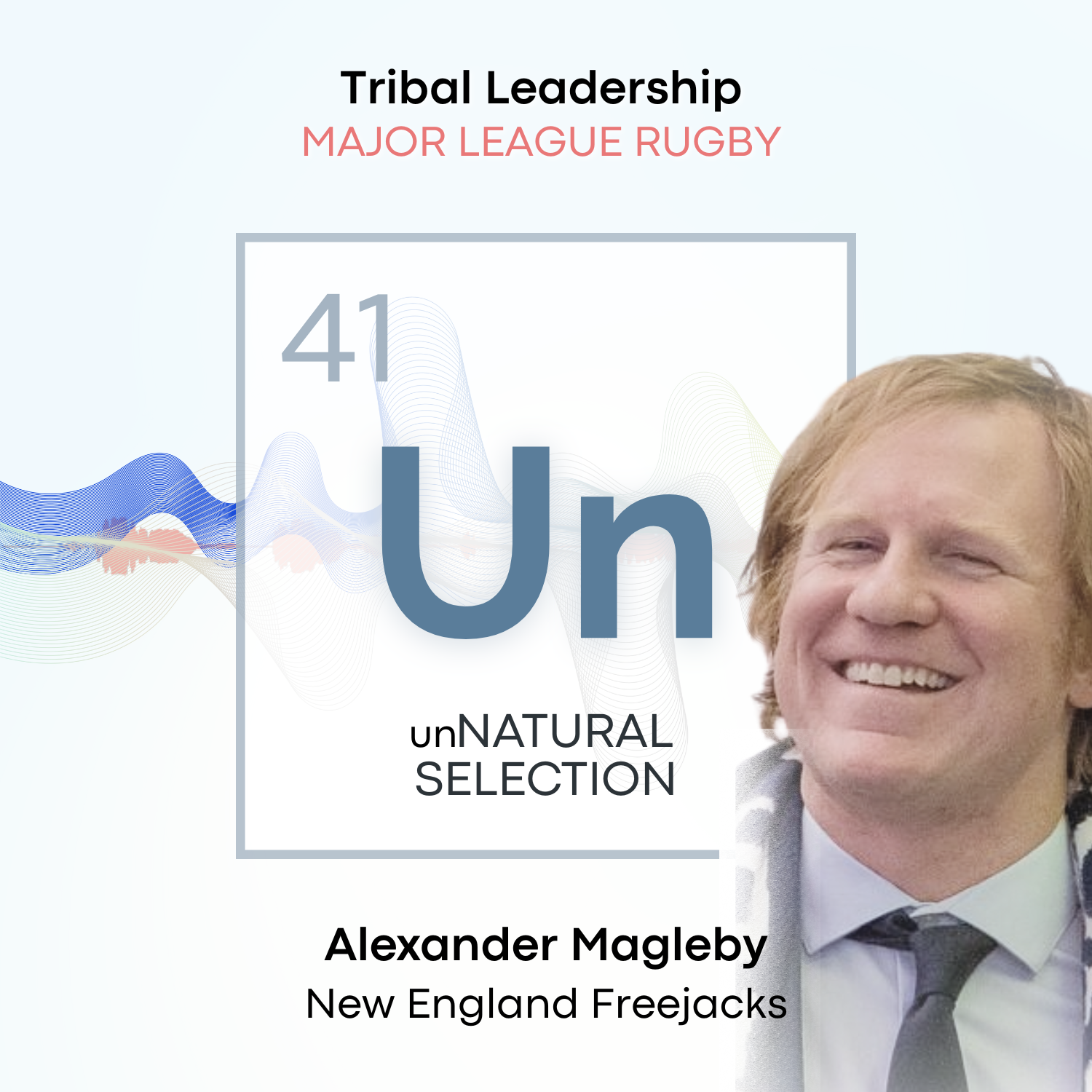
Cult-Like Belonging as a Sustainable Competitive Moat
How Culture Creates Champions. What does it take to build a winning team—and a lasting community—around a sport still growing its roots in the U.S.? In this episode, Alex Magleby, Co-Founder and Executive Chairman of the New England Free Jacks, shares insights that go far beyond the field.
Alex walks us through Rugby’s rich history, from its earliest origins to its ongoing evolution, and reveals how the Free Jacks are redefining what it means to compete. Their philosophy begins with Rugby itself, then culture, and only then the mechanics of skills and strategy—an approach more like building a special forces unit than a traditional sports team.
This is a conversation about leadership, culture, and innovation—less a sports analysis and more a masterclass in how to forge resilience, belonging, and excellence in any competitive environment.
-
(Auto-generated by Spotify. Errors may exist.)
Alex Magleby is a pivotal figure in American rugby and a true leader in sports entertainment. Alex Magleby is the Co-founder and Executive Chairman of the New England Free Jacks, who clinched back-to-back Major League Rugby Championships in 2023 and 2024. Before this, he served as CEO of Heritage Sports Ventures. His rugby journey is extensive. He represented the U.S. as both a Sevens and Fifteens player, captaining teams at every level, including his three-time national champion high school team, Highland Rugby, Dartmouth College, where he led the team to three Ivy Rugby titles, and the U.S. National Sevens team to a Rugby World Cup.
As a coach, Alex Magleby led Dartmouth to eight Ivy League Championships and consecutive Collegiate Rugby Championship titles in 2011 and 2012. He was inducted into the CRC Hall of Fame as its first coach. Later, as head coach of the USA Men's National Sevens team, he guided them to their best-ever finish in the World Rugby Sevens Series.
Beyond coaching, Alex Magleby served as a General Manager for All USA Rugby High Performance, leading both the men's and women's teams to the 2016 Rio Olympics and achieving unprecedented successes, including the first-ever win against a Tier 1 country for the men's Eagles Fifteens.
He is also deeply involved in the rugby community, serving on various nonprofit boards including Imagine Rugby and the Free Jacks Foundation. Alex Magleby's vision and dedication continue to shape the future of rugby in the U.S.
Host: Alex, it is such a privilege to have you here. Thank Thank you for being on unNatural Selection.
Alex Magleby: Great to be here, Nic. Thanks for having me.
Host: To get started, I always start with the same signature question, just to level set and give people insight into why you do what you do. So, could you please let us know, Alex, what need or impact drives your work?
Alex Magleby: Well, rugby is just fun, first of all. I always keep trying to escape, and it keeps pulling me back. So that is just the gravitational force, the magnet, and everything that goes with it. It's just super inclusive and fun, and that always continues to bring me back. But we set out with the Free Jacks, you know, in 2018 when we kind of came up with the concept. We really believe that rugby is a great medium by which you can build better communities. Whether you're a kid participating, you know, the rules are the same, whether you're a girl or boy. There's a lot of trust that has to go into playing the game. You know, it's a physical game, but you're playing the opposition. There are no helmets, there are no things like that. Significantly fewer injuries than, say, American football, but nonetheless, still a contact sport. And there's just a certain amount of trust that you have to have in the process of that. And that's why I think you also see in rugby post-game, you break bread together with the opposition. There's the camaraderie piece, and it's just a sport that really brings people together. There's a certain tribalism that exists for each team. But you and I will be sitting down watching a game together, and you may have the opposition jersey on, and we're still buying each other a drink. And there's a code of ethics that kind of goes along with the game. And that's perhaps because of the nature of the sport on the field that goes off of it as well and bleeds into how the crowd exists and feels. And we just set out to say that, you know what, we can actually build better communities with this sport. And that's what we've done. We work really hard every day doing as we build up. We're hosting the 2031 Men's Rugby World Cup, the third largest sporting event in the world, in '31 in the United States, and then the Women's World Cup in '33. So it's kind of the beginning to the end kind of process of this company.
[05:00]
Host: That's incredible. Congratulations on hosting those huge events. You, in that introduction, said so many things that I want to unpack in this conversation, everything from the camaraderie that you talked about. I'm more familiar with soccer, and I see the level of chaos. Obviously, it brings people together, but around the world it also has some negative history on the way that both things happen on the field, but then also off the field with spectators and fans. And so I'm really curious to know how the camaraderie builds. It almost seems like rugby, you leave everything on the field and don't take it home with you, which is actually really compelling to hear about. In the spirit of that, can you tell us a little bit more about the current status and growth of rugby in the U.S. and how it compares to rugby internationally?
Alex Magleby: Yeah, so rugby is the world's contact game, right? And forever it prided itself on the Corinthian values of amateurism. Rugby union only went professional globally in 1995. For the vast majority of its long history, it was an amateur game. You played in school, you played in the military, whatever the case, play for your local club that also may have owned the local pub. Just a very community-centric kind of a game. And then it went global in '95. And its growth has skyrocketed since it went professional in '95, both at the club level. The international game has always been very strong, but those are now professional athletes, men and women. We're just wrapping up the Women's Rugby World Cup right now in England—record-setting crowds. The final is this weekend, it's Canada versus England, and just some awesome, awesome spectacle that's happening around the game, which is very cool. And then you've seen that in the United States happen for a long time as well. You know, when I played in high school in the '90s, we would go to a national championship every year. We had a great team. A bunch of the players I played high school rugby with went to the NFL. So some surreal athletes, and we played football in the fall, and basketball, wrestled, or skied in the winter. And then we all played rugby in the spring. That was kind of an anomaly at the time, mid-'90s in the United States. And now you see that has really changed with the change in the scholastic model. So when I was looking for colleges, going there to play rugby wasn't really a mindset. And now that has changed both for girls and for boys, where you can go to a university setting. You can play in the Ivy's, you can play at big public schools, you can play at small private schools, you can play in the military academies. They are either quasi-varsity or varsity programs where you have professional coaching, great facilities, and, most importantly, really great education in the classroom and on the field. And that's been a big, big shift in the game in the United States over the last 20 years. And that's really started to accelerate the last 10 years. And so you've seen that really change as the scholastic model starts to build out. You see just the nature by which parents are approaching the game now for their 12-year-old versus the ice hockey or other sports that they do, right? It's becoming a much bigger part of the American sports tradition rapidly.
[10:00]
Host: It feels it. I never played, but I at this point know a lot of people that are rabid fans. You and I share some of those friends. So it's interesting because you've seen this sport almost grow up before your eyes, right? I mean, I actually did not know that it became professional just in 1995. It feels like rugby has been around forever, which it has, but I didn't know that only for the last 30 years or so has it actually been a professional sport. So it's interesting that you've seen it grow from kind of like an amateur sport and now evolving into what it is. How has it shaped the course of this sport? We talked a little bit about obviously everything that wraps up the sport: the social aspects and being inclusive to all genders, and kind of the halo that lives around the sport. How has the sport itself evolved since it went public?
Alex Magleby: Great question. So the 1995 Rugby World Cup—they call it the Nelson Mandela World Cup, you know, Invictus, the book, the movie—that World Cup was the last amateur World Cup. But what had been happening in the subsequent years before that? A lot of those athletes, they may be attorneys or carpenters by day, and then they go to training with their club at night. They would train with their club two nights a week, and then on the weekends they'd play for their club. And then they had a little mini regional provincial season, and then they'd go play for their country where they played for their country. They'd show up to practice on a Wednesday, and then they'd play a game on a Saturday, and they're an international Test match in front of 80,000 people. But then what started happening, so those athletes could train longer in the late '80s, early '90s, they were starting to get money under the table from the clubs. And so you are less likely to be a carpenter all day, and maybe half a day you are a carpenter, right? So those changes are going to happen. And so by the '95 World Cup, that's when the world of rugby clocked and said, "Wait a minute, let's just put this on open and put it on the table and actually put professional structures in place where we have agents and contracts and players associations and professionalized coaching and professionalized medical and all of those things." And so for the first 10 years, it was really the Wild West as you now had professional coaches doing this, you know, 90-plus hours a week and trying to figure out how to iterate and iterate and take advantage of the rules and, you know, players not training full time. And so the game really started to change rapidly. And so you've seen that it's gone through these various shifts over the last 20-plus years where the coaches get really good at the attack, and then the defense adjusts, and then a few years later, nobody's scoring because the defenses are so good, and then the attack coaches readjust. And it's cool to see. And then the rules of the game have... I think World Rugby's done a great job reassessing the rules as it progresses: one, to make player safety at the forefront and even integrating technology as much as possible to make that the case; and two, to make the game as entertaining as it possibly can, as a spectacle and as a participatory sport. And I think they're doing a really good job kind of chasing that down. But there's been a massive acceleration, you know, since '95. And the game just looks completely different. The game that I even played is now in a lot of ways totally different than the game that exists today.
[15:00]
Host: Interesting. Since it became a professional sport, has the U.S. been as involved as other countries? I know it's huge in countries like New Zealand and in places in Europe. Has it been growing more popular in the U.S., or was it popular from the very beginning in the U.S.? And the reason why I'm asking that question is because the U.S. is playing catch-up in other sports like soccer, right? And hopefully, at some point, it'll become competitive at that level. How does the U.S. compare when it comes to international competition?
Alex Magleby: Yeah. So it's been fits and starts, right? So the U.S., USA Rugby, the national governing body, was established in '75. And by the '80s, some of those teams were actually being really competitive on an international scale because really good American athletes who came from a professionalized, say, American football infrastructure were crossing over to rugby—great athletes who are basically professionalized playing. It's amateurs who've been playing rugby their whole life, but just a physical specimen difference. And the U.S. was catching up. But then once the game went professional globally, it did not yet go professional in the United States. So most universities in the '80s and '90s had a club rugby program, very amateur, great opportunity for self-organization. But also, probably in some people would have seen those as just another fraternity or sorority on campus, like kind of a big party atmosphere. That was kind of the middle. So you had a gap of about 15 or 20 years where the global game went professional, and the U.S. game continued to be a collegiate club sport. And that was really the tipping point where the rest of the world just went into a higher, higher tier, and the U.S. game was just not the professionalized part. And that's why Major League Rugby, which is our professional league, only started in 2018. We are a new league. We have 11 teams. We're trying to grow this market. And so we are now starting to catch up because we've got the scholastic piece, the collegiate piece, the professional piece. And you're seeing now the U.S. National team start to accelerate, but we're still playing catch-up. We're still paying catch-up to the global game. So when you look at an international competition, let's say a Test match where it's the U.S. versus an Ireland or a France or a New Zealand, we're not quite there yet. We're playing great games, but we're not playing with the same results that you're seeing in other sports like basketball. We're not, you know, we're not the greatest at this game yet. We will get there. But it takes time.
[20:00]
Host: You've built such an incredible, inclusive culture around this sport. You talked a little bit about that in the beginning of our conversation. What are the most important values you try to instill, not just in your team, but also in the community of fans and spectators?
Alex Magleby: Well, you just hit on it. It's that inclusive word. You know, the Free Jacks, we say we play Free Jack style. We're relentless, and we're inclusive. That's who we are. The relentless part is what we're doing on the field, the inclusive part is what we're trying to do with our community. And so we've been very, very deliberate about that. We work really hard every single day to try to do those things. And I think that is the really cool thing. And it's become a third space for most of our fans. And most of our fans weren't rugby people before, right? And so, in some ways, it's that it's the... the missing kind of connective tissue that you're seeing in society and in other sports and the tribalism of other sports that is not quite the same. And you know, we work really hard to try to do that, and the community has responded in kind. It's been great.
Host: That's amazing. I'm going to steal the term, "third space," and I'm going to start using that. I love that concept. So that obviously means the team and the players need to embody those characteristics, which, on the field, that's not what you're seeing, right? But then off the field, you expect them to be role models in the community. How do you think about that when you're thinking about your team?
Alex Magleby: That's absolutely spot on. We have a mantra: we're building a team that's building a club that's building a community. We don't focus on the outcome, the win/loss. If we do the three things in the correct order, that will take care of itself. And it has. We've had really, really good success in the short time. And that's because we've really focused on the values of the team. The right people need to be a part of our team that have the right mentality, that enjoy the sport and that it's both on the player side and the coach's side. So you really started a huge macro level saying let's create this experience, let's create the culture, then let's think about the right team and the right players, and then we'll take it from there. And it's been the secret sauce. It's been great.
[25:00]
Host: It sounds like it. That's fantastic. So as you've seen, obviously the sport evolve and the U.S. now playing catch-up. And then you yourself building this incredible culture. How do you manage your business? Is it a focus on the fan base? Is it a focus on the players, or is it a focus on the experience?
Alex Magleby: It's a focus on all three. And it's really the intersection of the players and the fans. So we try to find moments where those two intersect as much as possible. Post-game... and there's a reason why the athletes, when they're done, they turn around, and they acknowledge the fan base for their effort as well. Our locker room is open to fans when they come into the stadium. So they can literally walk through the locker room, and they can see the players' names. And they get to have a connection to the athlete, the human, that's behind the shield. And I think that's really, really important. So it's that intersection of the fan and the player. And then we work really hard to make sure that the actual spectacle is as good as it possibly can be. And we use the metrics of our fan happiness. And so we use a net promoter score kind of a concept. We're trying to make sure that we're keeping that above a certain level. And we're really focusing on the fan experience in its entirety, right? It's not just the 80 minutes of game play. It's the four hours that the fan is spending in our environment. So that's the parking, that's the food, that's the beer line, that's the post-game experience. It's every one of those things. So we focus on that entire experience. And that's what we've done for the last seven years, and it's been really successful.
Host: That's amazing. As you're starting to get the signals you're starting to pick up with that, how are, are you seeing any opportunities for you to kind of steer the ship in the direction it's going or maybe you pivot? Are you seeing opportunities for new innovation and how you're growing Free Jacks from where it is today to where you want to take over the next five years, say?
Alex Magleby: Yeah, I think evolution in general, it's... it's really important that we're always trying to listen. In 2018, when we started, we thought we were going to be a sports and music entertainment company. So we bought a music venue, and we thought we're going to put a rugby game on, and then, you know, Modest Mouse will play after, or whatever the case. And that was a moment where we pivoted to try to do something else. And we did everything we possibly could to learn for two years. And then we actually pivoted back and said, you know what, actually, that's not really shaping behaviors where people are like, I'm going to go to the stadium to see Modest Mouse, but now I'm going to go to see the Free Jacks play. It... you know, we weren't really doing what we set out to do for my audience behavior, you know, education, point of view, and everything else. That was a pivot back. And I think that shows some real strengths of the company to be able to kind of try to do those things which are crazy and hard, but then also be like, you know what, that's not for us right now. So we try to be adaptable. We try to listen to the fans. And we try to really execute on the things that we are hearing from our fans.
[30:00]
Host: That's actually a really interesting pivot. And I love the fact that you decided to go back to what you do best. Now, speaking of innovation, it seems like rugby, since its inception, has had a constant pace of evolution. Can you talk a little bit about the history of the sport, and how much has it changed over the centuries it's been around?
Alex Magleby: Yeah, so in 1823, there's a legend of William Webb Ellis who picked up the football and ran with it at Rugby School in England. So that was the moment where the split happened between soccer and rugby. So you have old version of soccer, of which old rugby came from. And then the United States, you know, in the 1870s on a lot of the college campuses, particularly in New England and the Northeast, you would have teams that were, you know, Rugby Football Association. And so if you were at Dartmouth, you'd play the rules of Dartmouth. If you were at Amherst, you'd play their rules depending on where you went. And sometimes that would be 11 people on a field, sometimes that would be 15. Sometimes it was a bigger, it was much more of a... it was a running game, but it was also a pushing and shoving game. And so you saw that in the 1870s in the United States, and that evolved with the advent of the forward pass. The forward pass came in 1906, and that was the creation of American football. So American football is a spin-off of rugby, not soccer. And so that was the moment where American rugby essentially died in 1906, when American football was born. And rugby continued to be played mostly in the Pacific Northwest. And there was a moment where Stanford and Cal had only 11 players playing rugby, and they were still trying to figure out how to do it. And then they decided to stop playing the 'American' version of football, which was what was born in 1906, and they went to what they call 'rugby'. And they went to the 'American' version of football because a lot of college campuses were dropping the game due to player safety, right? So there were some players dying, and they were trying to figure out how to make this game safe. And the forward pass was a safety measure. And that created American football. So Stanford and Cal went to rugby, and they were playing the international game, and they actually did really well. They won the Olympics. So they did really well on the international stage. But then they went back to American football in the late '20s. And then so you saw that in like the '50s, and then the game started to continue to evolve in the United States in its own, in its own way.
[35:00]
Host: Yeah, it sounds like it's been a tremendous journey for the last 200 years or so where it's been under a constant pace of innovation and change. I was going to, my question was going to be, how do you balance tradition in the sport with... innovation and the evolution of the game? Because it has such a long and rich history.
Alex Magleby: I think, like anything, you have to keep challenging the system. And World Rugby has done a great job of that. There's a rule that's in place now that's called the 50/22 kick. It's essentially designed to open up the field. So the players on the field have to decide, am I going to cover the field with more players, so the defense is stronger, but then I'm giving up attack opportunities, or am I going to put more players in the attack, which is giving up defensive opportunities? And so that constantly makes the athletes on the field have to adapt. And that's what's cool about rugby. There's very few stoppages. And the communication of the athletes on the field, they have to decide in real-time what the next play is going to be.
Host: Are there any major evolutionary leaps that you see a certain player like, "Wow, this changes everything"?
Alex Magleby: So, yeah, so there is one in particular, but just in general with the game, there's 15 players on the field, and for the 15th player to score, the other 14 had to do their job, basically, right? So forever, and to its own kind of marketing demise, it's rugby's... the team's the star. It's not one person. You see a bit of that in ice hockey, but ice hockey you score, right? You can get a getaway and Gretzky because statistically speaking, you know, you're just that person is so much better than everybody else. I would say in the history of rugby, modern rugby, there's been one person who's been so game-changing that everybody would recognize that person even if... they're not a rugby fan. And that's the All Blacks fly-half, named Dan Carter. He was the first athlete who was so good at every aspect of the game. And he was the first athlete that basically could change his game during the 80 minutes. So he could be the attack coach for the first 10 minutes, and then he could be the defense coach for the next 10 minutes. And he could do everything. And he changed the game.
[40:00]
Host: He changed the game. So that's super interesting. So now as you think, and obviously the Free Jacks have won as well. So now as you're thinking about 2025, 2026, how do you think about the team itself to be as competitive as possible? What, what's the thinking that you go into as an executive director about the players, the structure of the strategy, the training to make them into elite players and to take all of this?
Alex Magleby: We're just trying to focus on our three values. I'm trying to find the athletes that embody that. We are trying to find the right talent for the right team for the right culture. And we think if we do that, we don't have to be perfect at everything. I think that we just try to be really good at the things that we can do, and then we're going to compete as hard as we possibly can. We're trying to win, but you can only win 20% of the time, so 80% of the time you are losing. And so how do you keep pushing that envelope? I think, like everything else in life, it's a game of percentages, and you're trying to maximize the outcome. But I think if we do, if we do that and keep bringing it back to what we're about and why we're doing it, really good things will continue to happen.
Host: It sounds a little bit like you're building a special forces unit when I, I've read about the Navy Seals, for example, and you would think they... weapon. And then you read about their recruitment process, and it's actually all psychological and emotional, the things that make for a strong teammate, somebody who's reliable, somebody who's trustworthy. And they build a cohesion across the group first. And then the secondary part is like, let's train this person to be lethal. But it doesn't start with that. And...
Alex Magleby: Absolutely. You know, the U.S. National team that went to the Rio Olympics in 2016. We didn't recruit on talent. We recruited on behavior. And we took the athletes that we thought were going to be really good teammates, that were going to push each other, and that were going to be relentlessly inclusive in how they did that. And we thought that was the right formula for success. And it was. That was a good run.
[45:00]
Host: That's amazing. I'm going to shift gears a little bit, Alex. So, my question to you is, is there anything that keeps you up at night about the future of the sport, either in the U.S. or internationally?
Alex Magleby: Not really, because I think we're really focused on the values of the game. There is a phrase that exists that's in sports entertainment and business in general, it's "no margin, no mission." And I would say that probably most people in sports entertainment and most leagues would say that. And so that works as long as people are willing to say at some point we'll have got to the point that we have that platform that is monetizable and sustainable or the asset valuation is appreciated so much more than the negative carry, almost like a biotech company. And so that is definitely a concern when you're starting any new league, because if we're not financially viable, we can't do the work we're doing. And so we're really focused on that, but I think that's solvable. I'm not worried about that. I think that we're going to get there.
Host: That's great. What is the one core difference that you think exists between rugby and other American sports?
Alex Magleby: You know, I just think it's the fact that the communication on the field between the athletes, they have 10 seconds in between a whistle to reset and decide on what the next plan of attack or defense is going to be. There's 15 players on your field, there's a referee, 15 players that you're playing against in that 10 seconds. You have to get consensus about what you're going to do moving forward and what you're going to improve on from what just happened. There's no coach involved. That's it. The players on the field have to learn how to make change happen rapidly. So you cannot be rah-rah. It can't be, let's just go, guys. It... you know, that doesn't really work, because you're losing. You're giving up ground. You're giving up yards. It has to be an informed, concise, direct communication that you can then move on from. And that's what makes for a really good rugby team. And I think that's why you see great leaders come out of the game. They know how to communicate in a very succinct and direct way.
[50:00]
Host: Wow. And that's all on the field. That's amazing. I have one last question for you, Alex. What is the greatest lesson that rugby has taught you, as a coach, as a player, as an executive, in life?
Alex Magleby: You know, I think it comes back to the camaraderie piece. That you can play against somebody for 80 minutes... and you leave it all on the field. And you hit each other as hard as you can. And it's a very physical game. And then we after we shower up, and we go, and we sit down, and we have a meal together. We learn about each other's culture. We may even share a beer. And that is awesome. And society does not have enough of that. That doesn't exist really in most situations anymore. In sports, in sports entertainment, in youth sports, it is, you are the enemy. There's no learning from each other. And I just think that rugby has taught so many people a different way. And if we can share that with more people, that is a positive for society.
Host: Alex, that's incredible. I'm hooked. I'm definitely coming to your game. It sounds like so much fun to be a spectator, but it actually sounds like something that I would want to just kind of be involved with. And so I, I definitely will, will, will come to visit. And it's been extraordinary talking to you. This has been insightful in so many ways. It's not the interview I was expecting. This has become more of a life lesson than it has become learning about a sport. But I commend you a tremendous success and good luck in the coming season with that. It's been a true privilege getting to know you. Thank you so much for being on unNatural Selection.
Alex Magleby: Nic, it's been great, fantastic. I'm happy to share, and love the work you're doing on your podcast. And there's something we always say when we finish things up with the Free Jacks, it's, it's, let's ride.
