Extractive Metallurgy: Sadoway Labs • Matt Humbert


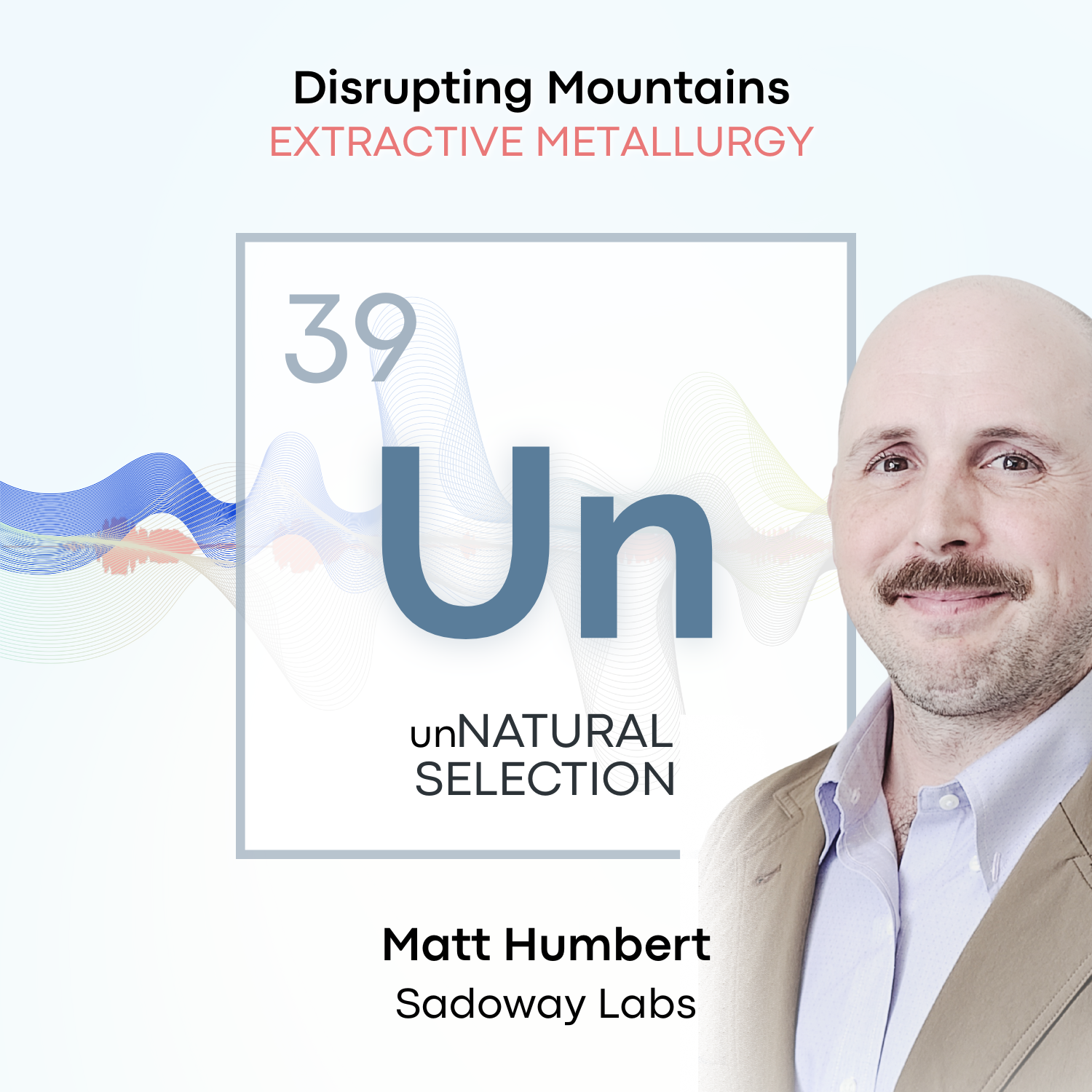
Disrupting Mountains
From Caves to Skyscrapers. The modern world runs on an invisible foundation—precious metals, rare earths, and fossil fuels that power everything from smartphones to clean energy. But behind the shine lies a darker reality. In this episode, Dr. Matthew Humbert, a globally seasoned materials scientist, joins us to unpack the high-stakes world of resource extraction—where innovation is slow, margins are razor-thin, and the consequences are often borne by the most vulnerable. From blood diamonds to oil fields, from Dutch disease to national security, we explore how geopolitical tension, economic dependency, and community exploitation are all part of the true cost of what powers progress.
-
(Auto-generated by Spotify. Errors may exist.)
Matthew Humbert is a globally experienced material scientist and engineer with a career spanning advanced metallurgy, electrochemistry, and manufacturing innovation. An MIT-trained mechanical engineer, he began in the oil fields of Alaska before returning to MIT as a lecturer and researcher in material science. He helped to launch Boston Metal, where he pioneered industrial-scale metallurgic reactors. His international work includes collaborations with CSIRO and Monash University in Australia and a Ph.D. from Swinburne, focused on electrochemical metal reduction in material modeling. He now serves as senior staff scientist at the Setaway Labs Foundation, driving innovation at the frontier of material science.
Host: Matt, welcome to unNatural Selection.
Matt Humbert: Thanks for having me, Nic. Great to be here.
Host: I always start with the same question simply to give listeners context, and also people love hearing directly in your words. Could you please explain to us what need or impact drives your work?
Matt Humbert: Sure. Yeah. So my expertise is focused on converting mined minerals into metals. So the miners dig up the rocks, which are minerals, and then they crush them and sort them and try and do some processing on the mine site, and then they send it to a plant where those minerals and ore get converted into metals. Traditionally, for most metals, that's done by burning the ore with coal. Mostly what we'll talk about today is iron, the iron industry, because that's the most accessible, and it makes up about 95% of all the metals produced or more. And then aluminum is the second biggest by way, or volume, whatever you want to call it. And aluminum also uses a fair amount of coal in their process, but also the introduction of electricity. And what I do is try and develop technologies that use that electrical energy that is taken from the aluminum industry and is inspired by the aluminum industry and extend that into other metal production fields, like iron. And that's what Boston Metal is trying to do. So I think, yeah, for me personally, it's a, it's a moral endeavor trying to get away from coal. Iron and aluminum generate about 10% of the global $\text{CO}_2$ emissions every year. Trying to keep that coal in the ground, I think, is really important to mitigate the climate risks as well as environmental impacts of coal mining. And I think, you know, where the intersection of our abilities and society's needs are is where we want to be. And I feel like I'm right at that nexus. So over my career, that's what I've been focused on—the kind of different aspects of that, both the process modeling as well as reactor design and development, and then some industrial starting towards industrialization and commercialization.
[05:00]
Host: Metals power nearly every part of modern life, from energy to technology to defense. How do you think about the strategic importance of metals from an innovation and national security standpoint?
Matt Humbert: Yeah, most of the innovation in the United States and in the Western world is focused on emissions reductions. So iron is a pretty easy one, where the primary emission there is carbon dioxide, which goes to the atmosphere, and that's not great. Other metals, like rare earth metals, they have other emission streams there. They have a more complicated process to go from the ore to the metal. Usually that involves things like hydrofluoric acid, sulfuric acid, and usually in pretty high quantity. So for every ton of, say, neodymium for magnets that gets made, about four tons of acid gets produced. That needs to be processed and neutralized. And those aren't big markets in terms of millions of tons per year. The neodymium market is in the hundreds of thousands of tons, so quite a bit smaller than steel, but that’s still 100,000 tons of acid that needs to get handled along with all the other byproducts there.
Matt Humbert: So a lot of metals, iron being an exception—iron we take as supplements in our multivitamins—but many metals are quite toxic to humans. Things like chromium, right? Hexavalent chromium was, you know, where we live in Massachusetts, a big issue from the tanning industry about 100 years ago or even less. Other metals like lead, used in gasoline, that's quite toxic and damages the neurological development of children.
[10:00]
Matt Humbert: So we want to try, and when we mine minerals—when minerals are mined from the ground—they usually contain not just the elements we're looking for, not just iron, right, maybe or not just aluminum or not just silicon. It has a whole spectrum of other elements in the minerals, and sometimes those for important minerals like zinc, silver—those things—those trace elements can include lead, cadmium, other things that are toxic: arsenic. And during the processing, where they were safe and stored in the ground, below ground, when we dig that up, they kind of end up everywhere. So in the United States, we're trying to keep those elements controlled and contained, and that's where a lot of innovation is tried to be found. But this is a challenge; technically, it's difficult to try and find new processing pathways. These processing pathways, metals have been used for a long time. The Bronze Age was a few thousand years ago, the Iron Age 1,000 years ago. So we've got a long history of developing this pipeline of production. So new chemistries are hard. It's a hard, difficult industry to break into. And then usually when we do find new chemistries, they end up being a little bit more to a lot more expensive to implement. And that's why a lot of the metallurgical industry has been offshored. We get a lot of our critical minerals from China. We do a fair amount of production here in the United States, but the Western world has definitely shifted a lot of its resourcing and sourcing of materials and mineral metals to other countries, to developing countries.
Host: Interesting. So it sounds like a big part of the innovation here in the U.S. is around kind of the environmental impact, whereas maybe in different regions they might be trying to innovate more in the chemistry or the automation. Is that a fair assessment? Because obviously, you can speak to the U.S., but are different countries and different segments of the world innovating on different frontiers, or is environmental impact generally of high interest across the world?
Matt Humbert: It's generally of high interest. A lot of countries are trying to kind of grow and adopt technologies that we've had in the United States that allow for efficiency upgrades like automation, things like that.
[15:00]
Matt Humbert: So I have some figures here which are pretty interesting. So the largest steelworks in the United States, the Gary Works in Indiana, in 1972 employed 30,000 people, made 6.8 million tons of iron. And in 2023, they made 8.2 million tons and only employed 2,200 people. So their productivity went up and their employment went way down, got cut by, like, a factor of 10, while their productivity went up by, well, let's say 20%.
Host: So that's automation. That's 100% automation.
Matt Humbert: That's exactly right. Yeah, these big facilities, these facilities span multiple acres and, you know, automated rail cars, automated robots to do the cranes and lifting and...
Matt Humbert: Yeah, so the shift in labor for that period is quite high, and that's a lot of what countries that are developing their internal metallurgy are focused on—adopting the technologies that allow for lower cost of production. Here in the United States, we're trying to focus on, you know, how do we make iron without any $\text{CO}_2$ emissions? That's what Boston Metal is trying to do. And there's some interesting challenges there. Usually, it comes down to a business case. How much does it cost? The steel industry, iron is a commodity. It sells for about $\$400$ a ton, maybe a bit more, maybe a bit less. And that price is pretty stable over time. And any additional cost in the process is really going to be a competitive disadvantage. And the margins are quite low, so it's a race to the bottom in terms of cost. So new technologies have to be either lower in cost or at least competitive in cost with the existing technologies to be adopted. And a few things are happening now where, you know, we're starting to get carbon taxes that are increasing the price of coal, and that's making the competitive cost easier to meet.
[20:00]
Matt Humbert: So in the United States, we don't have a direct carbon tax, but we have incentives for clean energy production. So that's helping to kind of spur development here. But those are kind of the two frontiers: automation and efficiency in the developing countries, and here in the Western world, it's mostly about how do we reduce the environmental impact.
Host: That's really interesting. When I think about the supply chain, which is something that you're an expert on, I think about the energy required to make the metals, but I also think about the materials needed to make the metals. And I'm really curious to know what you think about the supply chain of these materials and how geopolitics are impacting that. You mentioned that a lot of it is being outsourced to China and developing countries. What is your take on that? And what are the implications of a lot of these materials being outsourced?
Matt Humbert: It’s a huge problem. You know, we don't think about it too much because it's underground or it's faraway, but the supply chain for metals is quite concentrated in certain regions. For example, about 80% of the world's iron is made in China, and China is not a big miner of iron ore. Iron ore is mostly mined in Australia and Brazil, and it's sent to China, where it's processed into steel. And then steel is used to make everything from cars to buildings to bridges. So we're kind of reliant on that supply chain. We're also seeing a lot of our critical minerals, like rare earth metals, being mined and processed in China. And that's a huge national security risk. We need those metals for a lot of our high-tech applications, like defense systems, electric vehicles, and renewable energy. So if we don't have control over that supply chain, we're in a vulnerable position. So the US government is now trying to incentivize domestic mining and processing of these critical minerals. But as I mentioned earlier, it's a difficult industry to break into because the profit margins are low, and the environmental regulations are high. So it's a challenge to get those domestic supply chains established.
Host: And what about the cost of that transition? You mentioned that iron is a commodity and it's about $\$400$ a ton, and any additional cost is a competitive disadvantage. What's your outlook on the cost of the transition to clean energy metal production? Is it something that's feasible in the short term, or is it going to take a long time?
[25:00]
Matt Humbert: I think it's feasible, but it's going to take a lot of effort and investment. The capital costs for new steel mills are enormous. The cost of a new, clean energy steel mill can be in the billions of dollars. And so, you need a long-term commitment from governments and investors to make that happen. But the good news is that the operating costs for some of these new technologies, like the one Boston Metal is developing, can be competitive with the existing technologies. So once you get past the initial capital investment, the running costs are comparable. And that's where the competition is going to be in the long term. If we can get the operating costs down, then the market will naturally shift towards the cleaner technologies. Right now, it's about getting over that capital hurdle.
Host: That's great. Let's shift gears a little bit and talk about your background. You're an MIT-trained engineer, and you have a Ph.D. from Swinburne. You've been involved in a lot of cutting-edge research. Can you tell us a little bit about what got you interested in this field?
Matt Humbert: Yeah, so my background is in mechanical engineering, but I specialized in materials science and engineering. I was always fascinated by how things are made, how you take raw materials and turn them into useful products. And when I was at MIT, I got interested in the iron and steel industry because it's such a fundamental industry, and it has such a huge environmental footprint. So I started working on projects related to clean steel production. And that's where I got involved with the technology that Boston Metal is now commercializing. It's an electrochemical process that uses electricity instead of coal to make iron. And it's a game-changer because it eliminates $\text{CO}_2$ emissions from the process.
Host: That's incredible. And how did you transition from academia and research to the industrial side of things?
Matt Humbert: It was a natural progression. When you're doing research, you're always thinking about how to take your discovery out of the lab and into the real world. And with the Boston Metal technology, we had a clear path to commercialization. So I helped to launch the company and build the initial industrial-scale reactors. It was a huge learning experience, going from a small lab experiment to a multi-ton-per-day industrial process.
[30:00]
Matt Humbert: It was a lot of trial and error, a lot of hard work, but it was also incredibly rewarding to see the technology come to life.
Host: I can only imagine. And now you're a senior staff scientist at the Setaway Labs Foundation, driving innovation at the frontier of material science. What are you working on now?
Matt Humbert: Yeah, at Setaway Labs, I'm focused on what I call "materials for extreme environments." So, we're looking at things like next-generation battery materials, new alloys for aerospace and defense, and materials for fusion energy. It's all about pushing the boundaries of what's possible with materials. I'm also still involved in the clean metals space, looking at new ways to process and recycle critical minerals. It’s a very exciting time to be in materials science, because there's so much innovation happening right now.
Host: That's absolutely fascinating. Let's dive a little bit into the technical challenges of scaling up these new metal production technologies. What are some of the unexpected hurdles that you've faced?
Matt Humbert: The biggest one is what I call "the million-ton problem." When you're in the lab, you're working with grams or kilograms of material, and everything works perfectly. But when you try to scale that up to a million tons per year, which is what a typical steel mill produces, you run into all sorts of unexpected problems. The physics and chemistry of the process change at that scale. For example, the heat management is completely different. In the lab, you can easily control the temperature, but in an industrial reactor, you have to deal with massive amounts of heat being generated, and you need to find a way to manage that.
Host: I can imagine the thermodynamic implications of that. You know, you're not just dealing with the chemistry, but now you're dealing with the massive heat transfer and scale of the process.
[35:00]
Matt Humbert: Exactly. And another big one is the supply chain for the raw materials. In the lab, you can buy high-purity chemicals, but at the industrial scale, you have to deal with real-world ores and minerals, which are impure and vary in composition. And you need to design your process to handle that variability. The components are also a big challenge. We're talking about very high temperatures and very corrosive environments. Finding materials that can withstand that for years of operation is a constant struggle. We need new materials for the reactors themselves.
Host: That's a great point. And also, you mentioned earlier that cost is a huge factor. I can imagine that when you scale up, the cost of raw materials can also become a limiting factor. Do you see that as a challenge for some of these new technologies?
Matt Humbert: Absolutely. We call that "input cost sensitivity." When you're developing a new process, you might use a fancy chemical that works great in the lab. But when you look at the price of that chemical at the million-ton scale, it might cost more than the final product you're making. So you have to be very careful about your choice of raw materials. You have to use cheap, abundant, and easily available materials. We also have to think about the market for the byproducts. In a clean process, you're not making $\text{CO}_2$, but you're still making some other byproducts. And you need to find a market for those byproducts, or else they become a waste disposal cost. So it's all part of the economic puzzle.
Host: That's a great point. And that brings me to a question about the economics of scale. I remember reading something in the past about how the price of a certain material, when you go to scale, actually ends up influencing the price of the material itself. Is that something that you've seen in your work?
[40:00]
Matt Humbert: Yes, that's a fascinating phenomenon. It's the law of supply and demand at the industrial scale. If you're going to need a million tons of a chemical that is currently only produced in the thousands of tons, you can't just take the current price and multiply it by a million. You are fundamentally changing the demand curve for that reagent, and the price will go up because there's not enough supply. You are impacting the demand curve of some of your reagents when you try and go to scale. Yeah, so that's how things you can be like, "Oh, actually, you know, when I want to buy, you know, half the state of Rhode Island's dirt," they're going to charge me for it more than if I was just there to get a dump truck full of sand.
Host: Yeah, I mean, your own activities influencing the market.
Matt Humbert: Exactly, yeah. Yeah, wow, that's incredible. I mean, this has been such an eye-opening conversation that, you know, I think the work that you're doing and trying to innovate in this space, and especially the focus on making things more environmentally responsible and more efficient, is is admirable. I really look forward to seeing where this industry goes because obviously it's something that impacts all of us across the entire planet. So with that, Matt, it's been a pleasure to have you here. Thank you so much for sharing your insight and your experience and for sharing this with the rest of the audience here on unNatural Selection.
Matt Humbert: Thanks for having me, Nic.
