


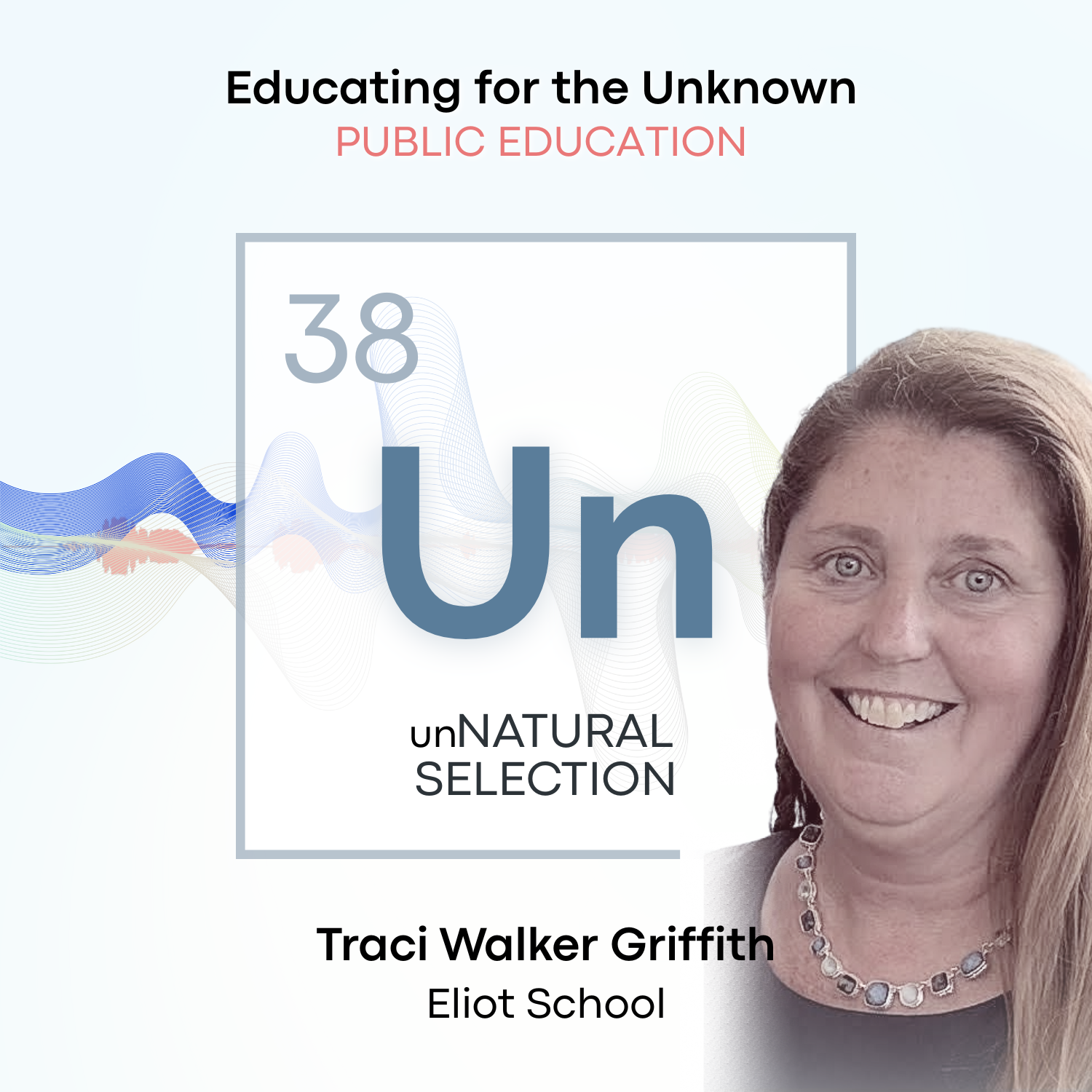
Execution Velocity: Driving Culture Change Ahead of Policy
Shaping America’s Next Leaders. The Eliot School in Boston, founded in 1713, is one of the oldest public schools in the United States and counts Paul Revere and Samuel Adams among its early students. Today, it has transformed from an underperforming school into one of the most desirable in Massachusetts — a journey that reflects both resilience and vision.
In this conversation, Principal Traci Walker shares insights into the school’s history, its unique status as an “innovation school,” and the leadership required to guide such a transformation. We explore the importance of teaching children not just facts, but how to learn, adapt, and thrive in a rapidly evolving world — especially as artificial intelligence reshapes the very foundations of education.
Because society itself is evolving, our educators must stay ahead of the curve — directing our children’s evolution so they can be prepared for increasingly unpredictable horizons, where adaptability and leadership will define the future.
-
(Auto-generated by Spotify. Errors may exist.)
Traci Walker Griffith, Executive Director of the Elliott K through 8 Innovation School in Boston, is a visionary leader with over 33 years of experience in education. A forward-thinking leader, Traci is committed to integrating innovative technologies, including artificial intelligence, to reshape the future of education. As an advocate for progress and equity, Traci is deeply committed to the idea that the future of learning lies in blending traditional educational practices with cutting-edge advancements. Her approach incorporates AI tools to enhance personalized learning, providing every student with tailored experiences that meet their individual needs. In doing so, she not only fosters academic excellence but also ensures that students are prepared to navigate an increasingly digital world. Traci's belief in the transformative power of education goes beyond just academics. She envisions a learning environment that develops the whole child socially, emotionally, and creatively, equipping students with the skills to thrive in a rapidly evolving world. Through her leadership, the Elliott School continues to embrace innovative models that use AI to streamline educational processes, engage students in meaningful ways, and cultivate creativity, critical thinking, and problem-solving skills. Her work is grounded in the conviction that the future of education is one where music, the arts, and technology converge to create a dynamic, inclusive, and transformative learning experience for every student. Traci's work is shaping a vibrant learning environment that empowers students to think boldly, creatively, and collaboratively, ensuring they are ready to face the challenges and opportunities of tomorrow's world. Traci holds advanced degrees in education and resides in Charlestown, Massachusetts. Her children, Joey and Elizabeth, are proud alumni of the Elliott School, a testament to her commitment to fostering a community where every child's potential is unlocked.
Host: Traci, welcome to unNatural Selection.
Traci Walker Griffith: Thank free having me, Nic. So glad to be here.
Host: It's so great to have you here. And just as a brief disclosure, my children both go to the Elliott School as well. So I'm clearly biased in this, and it's such an honor to have you here. And it's just extraordinary to know you. So I'm really looking forward to this conversation.
Traci Walker Griffith: As well. Me too.
Host: So to get started, I just my signature question that really gives you the opportunity to give us context and to level set for the listeners because you can't assume that people listening have any context of your work. What inspires your, or even what the Elliott is for that matter? What need or impact drives your work?
Traci Walker Griffith: It's a really great question. Often times people are always asking me, "Like, what actually makes you so happy to go to work?" I'm always happy. It's the faces of the children, it's the families that are super excited: "My kid got into the Elliott." I think most importantly, what drives me every day is that every child across the country should have a rigorous learning experience and a joyful learning experience, and that they should not be competing with one another. Joy and rigor are essential partners in what the future of learning could look like. And I'm also excited and driven by the possibility of public education. Every day I come to work and think about how I can get better, how we can get better.
[05:00]
Traci Walker Griffith: And I think that has shifted from when I started in 2007, and we were on the closure list, to now three buildings later and over 800 kids, that it's always driving me to think about what can we do in service of children to be better.
Host: Yeah, that's incredible. You mentioned obviously public education there. So just to unpack that a little bit, what are some of the biggest misconceptions about public education that you wish more people understood, especially in the context of innovation?
Traci Walker Griffith: That's another great question. I think the biggest misconception is that public education can't innovate. That's a huge myth that I'm committed to debunking. I think public education is actually the engine of innovation. It's where you have the most diverse group of students, the most diverse group of families, and the most diverse group of educators. And that is the perfect storm for innovation. You have a huge need, and you have a huge drive to meet that need. I think the second misconception is that public education is about mediocrity. It's not. It's about excellence. It's about equitable excellence. And I think that when people think about private schools, they think about all of the amazing things that are happening, but often times we don't think about the public education setting. And there are incredible things happening in public schools. And I think that's why the Elliott has been successful. Because we've been very committed to telling our story, to sharing what's working, and to sharing our innovation model.
Host: And when you speak about the innovation model, what does that actually look like?
[10:00]
Traci Walker Griffith: So when I think about the innovation model, I think about three components. The first is personalized learning. We are committed to using AI and other technologies to meet the needs of every single child. I think that often times we talk about differentiated instruction, but in a classroom of 30 kids, that's really hard to do. So if we can leverage AI to provide personalized learning paths for every child, that's a game-changer. The second is social-emotional learning. We're committed to teaching the whole child. We're committed to teaching them how to be good citizens, how to be collaborative, how to be creative, how to think critically. And I think that's a huge part of the innovation model. The third is arts integration. We're committed to integrating music, art, and technology into every single classroom. And I think that's what sets us apart. We don't see music and art as extracurriculars. We see them as essential partners in learning. So those are the three pillars of our innovation model: personalized learning, social-emotional learning, and arts integration.
Host: That's incredible. And to dive into the first one, personalized learning. You mentioned AI. What does that actually look like in the classroom? And what are the ethical considerations that you have to take into account when you're introducing AI into an elementary and middle school setting?
Traci Walker Griffith: That is the question of the moment, Nic. The ethical considerations are paramount. We're talking about children. So, number one, we're not using any AI that is a large language model that takes in and uses our children's data. Everything that we're using is closed-loop. So the AI is only learning from the data that's being generated within the platform. That's a huge ethical consideration. The second is that we're teaching the children how to be critical consumers of AI. We're teaching them that AI is a tool, not a replacement for their own thinking. And we're teaching them how to use it responsibly.
[15:00]
Traci Walker Griffith: So in the classroom, personalized learning looks like a child on a tablet or a computer doing a math program that's adapting to their needs. If they're struggling with a concept, the AI is giving them more problems on that concept. If they've mastered it, it's moving them on to the next one. It's also about a child writing an essay, and the AI is giving them feedback on their grammar and their sentence structure, but it's not writing the essay for them. It's helping them to become a better writer. It's about that partnership between the human teacher, the human child, and the AI tool.
Host: And the second pillar, social-emotional learning. I think that's one of the most important things that schools are teaching right now. I'm curious to know how you're using technology to enhance that social-emotional learning?
Traci Walker Griffith: It's counterintuitive, right? Technology and social-emotional learning. You think they're on opposite sides of the spectrum. But we're using technology in a few different ways. One is we're using virtual reality to teach empathy. So students can put on a VR headset and experience what it's like to be in someone else's shoes. We've done a unit where they experience what it's like to be a refugee, to be an immigrant, to be someone who's different from them. And that is a powerful tool for teaching empathy. The second is we're using technology to help students regulate their emotions. We have a sensory room where students can go when they're feeling overwhelmed, and we have a lot of technology in that room—interactive projections, sound machines—to help them calm down and regulate their emotions. The third is we're using technology for communication and collaboration. So we have a platform where students can communicate with each other, they can collaborate on projects, and they can give each other feedback. And that's a huge part of social-emotional learning—how to work with others, how to communicate effectively.
Host: That's absolutely fascinating. I would've never thought about VR for empathy. I think that's a game-changer.
[20:00]
Host: And the third pillar, arts integration. Tell us more about that. Why is music and art so critical to your innovation model?
Traci Walker Griffith: I think that for a long time, the arts have been seen as secondary. You know, if we have enough funding, we'll have art and music. We see them as primary. The arts are about creativity, critical thinking, and problem-solving. And those are the skills that our students need to thrive in the 21st century. When a child is learning an instrument, they're not just learning notes; they're learning discipline, they're learning perseverance, they're learning how to collaborate with others in an orchestra. When a child is doing a visual arts project, they're learning how to think creatively, how to problem-solve, how to express themselves. And we're integrating technology into that. So we have students using AI to compose music, we have students using virtual reality to create art installations. It's all about blending the traditional arts with cutting-edge technology to create a dynamic learning experience. And I think that's what makes the Elliott so vibrant.
Host: That is a stunning model. I mean, thinking about the confluence of music, art, and technology. I can't think of a better way to prepare children for the world that's coming at them. And speaking of the world that's coming at them, what do you think is the biggest challenge that schools will face in the next five to ten years?
Traci Walker Griffith: I think the biggest challenge is inequality and equity. I think that AI has the potential to widen the gap between the haves and the have-nots. If only affluent schools have access to the best AI tools, and only affluent families can afford to teach their children how to use them, then we're going to have a huge problem. So I think the biggest challenge is ensuring that every child, regardless of their socioeconomic status, has access to the best technology and the best instruction. The second challenge is the speed of change. Technology is evolving so quickly that it's hard for schools to keep up. So we have to be nimble, we have to be flexible, and we have to be committed to continuous learning.
[25:00]
Traci Walker Griffith: We have to be committed to ensuring that our educators are constantly being trained on the latest technologies and the latest pedagogical practices.
Host: That's a great point. And what about the role of the teacher? In a world where AI is playing a bigger role in personalized learning, what is the teacher's role now?
Traci Walker Griffith: The teacher's role is more important than ever. I think that AI can take over the mundane tasks, the grading, the differentiated practice, but the teacher's role is to be the motivator, the mentor, and the master storyteller. The teacher is the one who inspires the child, who connects with the child, who creates that human connection that AI can never replace. The teacher's role is to facilitate collaboration, to foster critical thinking, and to teach the whole child. So, if anything, AI is elevating the teacher's role, allowing them to focus on the things that only a human can do.
Host: That's an extraordinary way to put it. And when I think about the skills that students need to succeed in the future, what are the top three skills that you think are most critical?
Traci Walker Griffith: I think the first is critical thinking. In a world full of information and misinformation, students need to be able to discern what's true and what's not. They need to be able to analyze, evaluate, and synthesize information. The second is creativity. AI can automate a lot of things, but it can't be creative in the human sense. So, students need to be able to think outside the box, to generate original ideas, and to solve problems in new ways. The third is collaboration. The world is becoming more interconnected, and students need to be able to work effectively with people from different backgrounds and different cultures. They need to be able to communicate, to negotiate, and to compromise. So, critical thinking, creativity, and collaboration. Those are the three C's of the future.
[30:00]
Host: Those are incredible. And I think that goes back to the three pillars of the innovation model: personalized learning for critical thinking, arts integration for creativity, and social-emotional learning for collaboration. I think that's a beautiful symmetry.
Traci Walker Griffith: Absolutely. It's all connected. The innovation model is a holistic approach to education.
Host: And to switch gears a little bit, what is your take on the importance of community involvement in the success of the Elliott School?
Traci Walker Griffith: It's everything. The Elliott School is a community school. We're committed to serving not just the children, but the entire community. Our families are our partners. They're not just consumers of education; they're co-creators. So we have a very active parent-teacher association, we have a lot of community partnerships, and we're committed to being a resource for the community. We open our doors for community events, we host adult education classes, and we're committed to being a hub for the community. I think that's what sets us apart from a lot of other schools. It's that deep commitment to community involvement.
Host: And you mentioned the speed of change earlier, particularly with AI. What advice would you give to other school leaders who are trying to navigate this rapidly evolving landscape?
Traci Walker Griffith: I would give them three pieces of advice. The first is, don't be afraid. AI is a tool, not a monster. It's something that we can harness to enhance learning. The second is, start small. You don't have to overhaul your entire curriculum overnight. Start with one classroom, one teacher, one subject, and see what works. And the third is, focus on equity. Make sure that whatever you're doing, you're doing it for all children, not just a select few.
[35:00]
Traci Walker Griffith: If you focus on equity and you start small, you can navigate this rapidly evolving landscape.
Host: That's great advice. And you mentioned the importance of training educators. What are some of the key things that you're focusing on when you're training your teachers on AI?
Traci Walker Griffith: We're focusing on two things. The first is pedagogical shift. We're training our teachers to move from being the sage on the stage to the guide on the side. AI can deliver content, but the teacher needs to be the facilitator of learning. The second is ethical use. We're training our teachers on how to use AI responsibly and how to teach their students to be critical consumers of AI. We want our teachers to be the moral compass in the classroom, teaching students how to use this powerful tool for good. And that's a constant, ongoing training process.
Host: I think that's such a beautiful idea, the moral compass. I think that's an extraordinary metaphor. And finally, you know, Traci, what is your ultimate vision for the future of education?
Traci Walker Griffith: My ultimate vision is a future where every child has a rigorous and joyful learning experience, and where education is a transformative and inclusive experience. I envision a future where music, art, and technology converge to create a dynamic learning environment, and where every child is prepared to be a critical thinker, a creative problem-solver, and a collaborative citizen. I envision a future where public education is the engine of innovation, and where every child's potential is unlocked. That's my ultimate vision.
Host: That is a spectacular vision. I, for one, am so grateful for all the work that you're doing and the incredible impact that you're having on the lives of children. I think that the Elliott School is a model for the rest of the country, and I hope that other school leaders are listening and learning from your example.
[40:00]
Host: So with that, Traci, it's been an honor and a privilege to have you here on unNatural Selection. Thank you so much for your time and your insights.
Traci Walker Griffith: Thank you, Nic. It's been a pleasure.
