
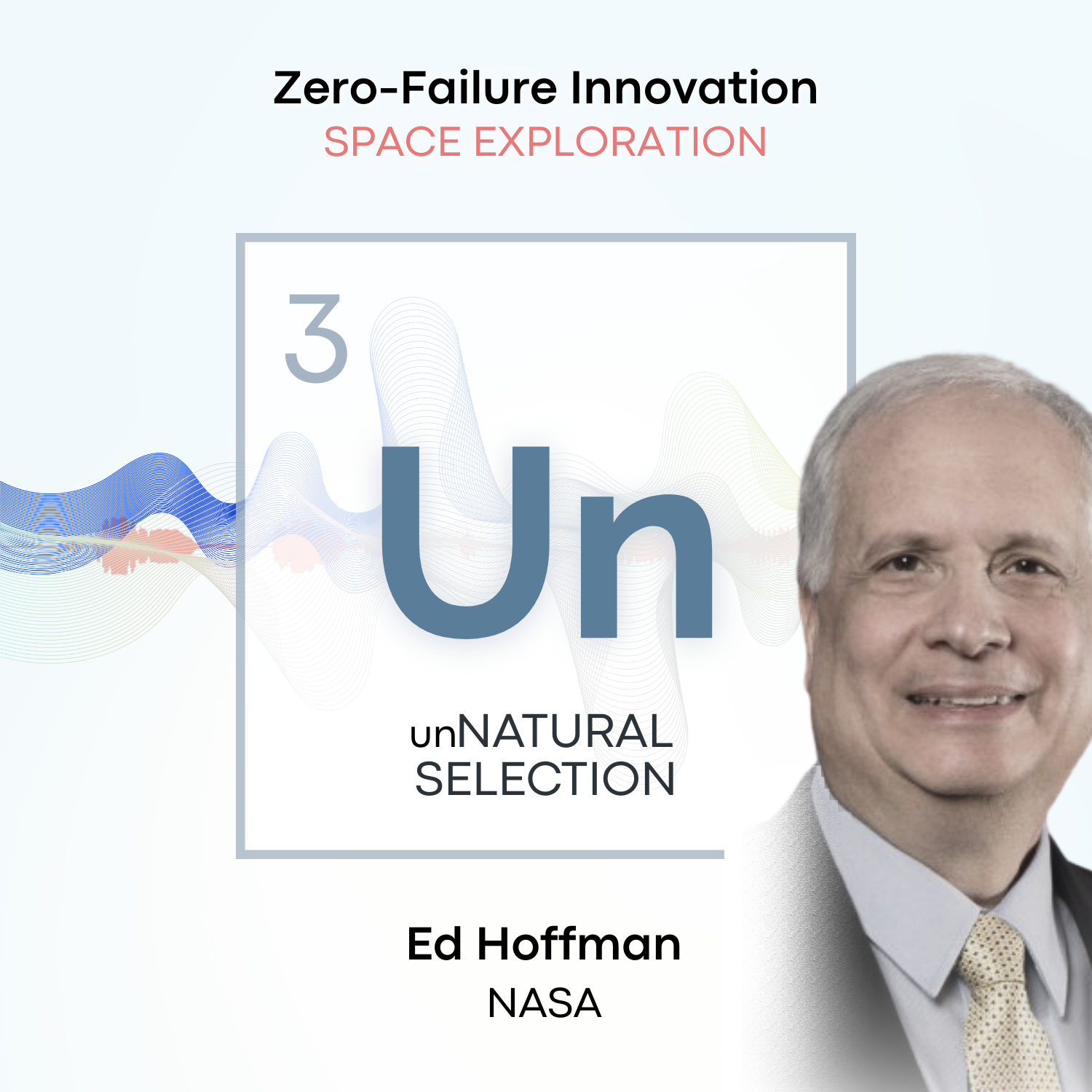
Space Exploration: NASA • Ed Hoffman


Psychological Safety & Risk Mitigation in High-Stakes Environments
Innovating at the Edge of the Unknown. What does it take to lead innovation when the risks are deadly and the stakes are cosmic? In this episode, I speak with Dr. Ed Hoffman, NASA’s first Chief Knowledge Officer, about how one of the world’s most visionary organizations manages knowledge, leadership, and learning when even the smallest misstep can be catastrophic. We explore how NASA pushes the boundaries of possibility, what it means to innovate in high-risk, high-reward environments, and how the agency's approach to discovery continues to shape the future of humanity. When NASA innovates, the world pays attention, and every new discovery shapes everything that we know about existence.
-
(Auto-generated by Spotify. Errors may exist.)
I am super excited to have Doctor Ed Hoffman with us today.
Doctor Ed Hoffman is the CEO of Knowledge Strategies, which is engaged in research, education and consulting services in support of organizational performance.
Doctor Hoffman is currently professor at the Columbia University School of Professional Studies where he reached certain researches and leads a course entitled Navigating the Future of Work.
1:31
His research indicates that intangibles of ideas, conversation, gratitude, and collaboration are critical for organizational growth.
He serves as the Strategic advisor for the Project Management Institute with a focus on supporting organizations around knowledge, learning and leadership for teams.
1:49
He retired from a wonderful journey with NASA.
A senior executive at NASA, he was the first NASA Chief Knowledge Officer and founder of the NASA Academy for Program, Project and Engineering Leadership.
Following the Columbia Space Shuttle failure, he led a small team that designed the NASA Strategic Management and Governance approach.
2:09
He received the NASA Outstanding Leadership Medal in 2010.
He has co-authored an upcoming book, The Smart Mission, NASA's Lessons for Management, Managing Knowledge, People and Projects by the MIT Press.
He is currently researching and designing A curriculum sequence on future of work for Columbia University.
2:29
Ed, it's a pleasure to have you here.
Thank you for being here.
2:32
Speaker 1
Yeah, it's great to see you again.
It's been been a while that we've been talking.
So I look forward to the conversation.
2:38
Speaker 2
Yeah.
And, and just for a little context, you know, as you and I were talking about before, you know, we met about nine years ago, 2016 at a conference.
You were at the time chief knowledge officer for NASA.
And, and I just remember, you know, there are a few moments in, in the lifetime where your eyes just open up and you just realize there's a whole world outside that you weren't Privy to before.
3:01
And when you started sharing with me the, the, the conferences, an innovation conference, and you started sharing with me, like the, the, the innovation that happens at NASA, which is me coming from a computer science background, also from stem cells, innovation and iteration happens either a course of like minutes and hours or maybe days and, and years if you're in biotech, but not in the course of decades where you're have to kind of envision what the future might look like in 1020, thirty
3:32
years and consider all the possible scenarios that might impact your, your mission.
And, and so, you know, as we talked about that, that conversation has been in my mind ever since and I've been meaning to unpack more of that.
And so it's a, it's really a pleasure to have you here.
3:48
Speaker 1
No, I, I remember the conference specifically, that was just one of the last before I was getting ready to, to leave NASA and, but I enjoyed that one very much.
I think innovation is really one of the, the core challenges and opportunities in the world today and particularly around science, around engineering, around technology.
4:11
How to cope with hyper-innovation
And so I, I remember that fondly and I, I look, I've enjoyed some of the podcasts and the writings that you've done.
I've been following up on you SO.
4:22
Speaker 2
Yeah.
Thank you so much.
Yeah.
And it's really, you know, the reason why I started this podcast in the 1st place was because it, I do believe that for a while now we've been in a state of hyper innovation.
If you think about just kind of like how long it took for electricity to be absorbed by society or the telephone, the television, you know, it took decades.
4:42
And there are certain elements of, you know, computers, personal computers, the Internet, cloud computing all the way now projecting towards the GPU's and AI, which has made it so that even being in the field, I feel like I can't breathe without being bombarded by new innovations.
5:05
It's not happening yearly anymore.
It's happening like on a week by week basis to the point that it's impossible to guess where we're going to be in six months.
And so from that perspective, innovation is such a hot topic because a big part of it is corporations.
Just how do you cope with it?
5:20
How do you position yourself to be able to deal with it?
Absorb what's right, engage with the things that maybe aren't ready yet for prime time, but stay relevant and competitive in a field where almost anything goes.
5:33
Speaker 1
Yeah.
5:34
Speaker 2
And and so from that perspective, I think with your background, can you tell me what in simple terms what business was NASA in and what was your role within that business?
5:48
What is NASA and what is its mission?
Yeah.
So NASA in the industry, it's in the aerospace industry.
And really what it targets is it uses science, it uses engineering and it uses typically the management of, of projects to be able to explore, explore the universe, explore the world, to be able to understand what's going on in terms of science, the environment, certainly climate, the ability to design and develop spacecraft and the ability for humans eventually to go to other planets and to, to live on those planets.
6:23
So basically NASA's about, I would say the, the science, the engineering, the technology and the management of exploring, understanding the technologies needed for how we live on Earth and how we move into other planets, understand the universe, including Earth as a whole.
6:44
So it's the science, it's the engineering, it's the technology and how we as humans make the best use of it.
6:51
Speaker 2
We we have learned so much if through astrophotography and the Hubble deep, you know, the Hubble Space Telescope and now the James Webb Space Telescope.
And so has that mission that NASA has had, has it evolved over time as we learn more about the universe, or was it kind of very crystallized early on?
7:13
Speaker 1
No, I mean, it's you use the example of James Webb, which is a more recent one, the Hubble Space Telescope, which was, you know, there earlier in my career.
These, these have changed science, they've dramatically changed the economy of what we understand about the planets, the stars, where we came from.
7:34
There are people who argue, my wife being one of them, that the telescope projects are the most spectacular part of what NASA does the, the robotic missions because they're using technologies, very complex technologies that are able to look at other planets, look at other stars.
7:55
The the studies in terms of is there life other places always sparks fascination.
And so it it's literally a changes.
You talked about this at the start.
Technology changes now so fast, and because of the science and the engineering, it's only going to continue in that kind of a pattern.
8:14
But the telescopes, human exploration, the work that NASA does, and really all of these kinds of organizations change the nature of the world 'cause they they elevate to new levels that we're jumping off of.
Yeah.
8:28
Speaker 2
Yeah, it's interesting.
Hard to tell what what comes first.
You know, in, in a way, society evolves and therefore we create these technologies that allow us to appear deeper and deeper into space.
But then, you know, as we peer deeper and deeper into space, that also accelerates our own consciousness and our awareness of what's out there and how we fit into that space.
8:46
The the world that NASA is in has been something that's been, like I said, on my mind since we first met, because I can't fathom what innovation strategy means to an organization that's thinking decades into the future.
9:02
The importance of innovation strategy for NASA
Yeah, I think, well, I think what NASA does well when it captures the attention of people, I'm a believer.
So my my focus on NASA was really, if you want to call it 1 area learning and development, which was huge.
And I know from your career you start doing one thing, you end up in others projects take you in different directions.
9:21
But basically I'm a learning and development guy.
How do you learn, How do you develop?
How do you work in a team and, and how do you build that kind of capacity to do really complex things?
I think organizations, Nick, come down to really 2 broad things, which encapsulates everything.
9:39
One is knowledge and knowledge is a know how.
Knowledge is the smarts.
Knowledge is the experience that people have, but it's also the data.
It's the digital now, it's the AI, it's the technology come coming together with collective people to be smart.
9:57
But in addition to that, it's the relationships and a keyword there is trust.
So as we do things, as we develop new technologies and with the work you've done, Julian, that the question is, we know you can do that, but do we want you to do that?
10:14
Is that good for humanity?
Do we trust you?
One of my I I never liked the favorite book or favorite movie at all time, but I reread Frankenstein recently and I love everything about it's written brilliantly.
10:31
It's exciting.
It's got the the kind of far sci-fi epics, but it's basically a human story about curiosity that gets out of control, leading to incredible knowledge before we know how to handle it.
10:47
And so but but I think organizations clearly nowadays are about these two things.
How do we deal with knowledge?
How do we target it?
How do we get better?
We have to, and how do we rely on people, the human element, the ethics, the conversations, the design aspects to make it work effectively.
11:07
So my emphasis on the future of work and really what I wrote about in the SMART mission in terms of my time at NASA, is when you have the human element, people who are making decisions and communicating and engaging, and they're extending technology and knowledge, it keeps moving forward.
11:26
And if you get 1 without the other, that's when we're into trouble.
11:30
Speaker 2
I I can only imagine how complex it must be to choose which projects to go after.
11:35
NASA’s Decision Paralysis
At NASA.
You're in the spotlight.
You're not a startup where you can do things in stealth mode.
So when you choose a project, you got to think of all those things you just said, the ethics, the humanity, you know, the technology, technological challenges, the politics in some cases as well, right?
11:51
And I'm sure many other things.
You also have to consider that the NASA opera operates in environments where failure can be catastrophic.
Like bugs just don't do so well in that world.
12:07
And yet innovation requires risk taking inherently, you know, like you're learning something new.
If you're not doing something in a space that's unknown, you're not really innovating.
And so I just curious to know how the agency balanced the need for reliability with the imperative to innovate in context of all these other variables.
12:26
So we talked about like, you're also in the spotlight and their budgets and their politics and all those things that it almost feels like having a decision paralysis must be so easy in that space.
12:39
Speaker 1
Yeah, I, I think that there's so much that goes into this, as you know, But I think one of the things I learned that's really important is having healthy tensions.
And so a typical NASA mission you're going to have, science usually drives everything.
12:57
We're trying to understand whether you want to have people living on Mars or if you want to develop a new, you know, climate, you know, safe kind of technical green technologies, whatever.
Science is really driving it.
And then you have the engineering, and engineering is building it, designing it, developing it safely, and then you have the management.
13:20
And so there's always a natural tension.
The scientists always, first of all, scientists in general don't like time.
They don't like being told you have to figure the same because science takes time and they typically they know what they're shooting for, which often is larger than the budget that's available.
13:38
And then they have to often rely on the engineers who are building.
And engineers love to build.
They love to design.
So you often get the notion of engineers who are looking to design the highest quality, something that really works.
13:55
You have management that's always panicky about schedule and cost because that's what you have.
And I think the best teams I saw they, they knew how to argue, they knew how to disagree because no one agree.
Smart people don't agree to things.
14:10
If if I'm ever in a room and everyone's quietly agreeing, then either people don't care or some or people are afraid to talk.
So you have to have that tension where the management in general is setting.
This is what we're willing to pay for to do this project, and the science is indicating this is what we can learn from this, and this is kind of how we're going to approach it and test it and communicate it to the world.
14:40
And the engineering is usually driving this is the quality dynamics of what we need, and we need more.
And if it works right with the right people, there's always trade-offs, but you have that healthy tension leading to a product, a program that leads to success, where you have an entity going too much in One Direction.
15:01
If it's too driven by budget tiers and financial people, then you cut costs, usually at the at the loss to the to the design.
You get things maybe that are low cost, but they don't really do what you want.
If you have uncontrolled engineering, then you may get something that's great, but you can't afford it over time.
15:22
So I'm a believer that people, I used to say, now give me 10 people at NASA randomly and you could do anything for good or for evil.
So you, you want to be going with the the right target.
But I, I think that's it.
The other part of the question, I often wondered, NASA is part of the government.
15:42
The importance of risk taking
Government organizations are risk averse.
They're supposed to be risk averse.
They don't like taking chances.
But what I found at NASA, and I think this is true, a lot of organizations and government, 90% of the budget goes to industry and the industry are large organizations.
16:02
In my day there were the Boeing's, the Lockheed's Baes and you know, Rummins and all these kind of organizations.
But you also have small entrepreneurial start-ups.
SpaceX at one point was a start up and they proposed something from he was seen as a crazy guy at the time, you know, Elon Musk.
16:23
And he got a very small, I forget the small, it was very small amount for what he was looking to do.
And I remember someone saying, what's he going to do with that?
What he's going to do is the start up, he's going to demonstrate a concept and if he does it well, he'll get more money.
16:39
And now he's got one of the largest, you know, organizations in aerospace.
So NASA innovates also through not only the healthy tension, but also through being able to throw in industry.
And if you use that smart, you can, you can test, you can iterate, you can experiment, and you know, you can balance the risk in a way that works well for everyone.
17:03
So that's what I saw at NASA.
17:06
Speaker 2
So one of the things that I did at Perkin Elmer was start in innovation lab and and focus on really kind of like the digital transformation of Perkin Armor, which is at the time an 85 or so year old company that was an accumulation of a bunch of devices and tools that they had accumulated.
17:25
And, and so the idea was like, how do you transform an organization like that into kind of forward-looking digital?
And one of the things that I set out to do was I just kind of like looked at the playbook, which is you look way back at Skunk Works and Lockheed Martin, which you mentioned.
17:40
And they're, you know, obviously when you look at the list that they came up with and what worked for them, a lot of those are government specific.
But you know, you can kind of cherry pick from there and be like, OK, there are some things around, you know, the culture, the environment, the psychological safety, the, you know, the mission orientation, the and, and so many different factors that go into creating a safe environment for ideation and, and, and putting mechanisms in place so that you can address the needs of the people that are doing this thinking whether you're aligning their thinking.
18:13
So you go through progressions of saying, OK, right now we're just going to think white hat.
All our answers are, you know, all proposals or answers are yes and no, no's and butts.
Eventually we'll get to black cat, which will be all nose and butts.
But we're going to go through a progression, right?
18:28
And that allows people to align their thinking.
It allows people to put ideas out there without the fear of getting rejected right off the bat because initial ideas are are fragile and usually imperfect.
And it's very easy to kill them right from the very beginning because you're always going to find faults for them.
18:45
And so it just really kind of you establish these mechanisms to create an environment where people can feel like they can, you can bring the best out of them in a, in a, in a structured format.
Did the teams operate like that at NASA?
19:00
How NASA buffered its innovation labs from politics and bureaucracy
You know, were they like kind of innovation labs in and of themselves?
How do you buffer them from all the stuff that's happening around people like the politics, right, the bureaucs, you know, how do you, how do you buffer them from that so they can do their best?
19:13
Speaker 1
One of the things that I think worked, it's different.
I, I spent the large part of my career in Washington at the headquarters office, You know, where you're around the budget and you're around the strategy, you're around the political environment.
But I also spent part of my career at the, the centre level.
19:32
I spent time at Goddard Space Flight Centre, I spent time at what's now the Glenn Research Centre.
Centres are different and to a large extent, I think centres deliberately protect their, their talent, their people to do the engineering, to do the science, to fight for what they need and to not be distracted by the noise of the politics.
19:53
So if you're in Washington, you're going to deal with what you were mentioning and you really need to be effective and, and, and good at that.
If you're working a mission, if you're working a project, you probably are, for the most part, you have a certain amount of protection to do the work you need to do.
20:13
So, you know, there's a little bit, you know about that.
And I think it comes down to a few things.
In any kind of product or project, one of the most important things is who, who are, you know, they call it stakeholder.
But again, I call this management.
And I would always say when I'm assigned to a mission, a learning development, who does this matter to?
20:33
I would say, who's my sponsor?
Who's got the money?
Who's going to determine whether it's successful or whether I failed?
And in certain times, if I could not find that leader, that person who, who was driving something that I thought I was kind of swimming with a dead shark.
20:50
Because there's a lot of times, you know, in government where people start something, but I'm not really sure how it got started.
No one really owns it or cares about it.
And you want to avoid those.
But if you find something that really matters, then you have that sponsor who's getting you the resources and you know how you can do.
21:07
I'll give you an example.
So I was set up to be to create what's now the NASA Academy program, project engineering leadership, basically learning development for the individuals and teams working NASA missions.
21:23
That was shortly after the Challenger space shuttle disaster started up about 1991.
And so I was working at that.
And then towards the end of my career, the last big start up was 2010, I was asked to be NASA's chief knowledge officer to create more of a focus on knowledge.
21:44
It's similar, but now it's extended to the larger organization level and different strategies around knowledge.
I didn't really know where the request was coming from.
I knew there was a report from Congress that it does every year and every agency end of 2009.
22:02
These things are like 300 pages and usually they have things in there that you have to respond to.
And it was shown to me, and it was a report, not a page.
NASA needs to do a better job of managing its knowledge, sharing its knowledge, getting its knowledge out there.
And he knew exactly kind of generally what they were talking about.
22:20
And then I was asked to basically create this team in this office.
And I didn't know, were we doing this because of this one page?
Which means there's really not sponsorship for it.
It's something that ends up in a report.
22:35
And after a year, people are going to lose interest.
And I've seen many, usually innovative things.
If they're going to die, they die within the 1st 12 to 18 months.
I always saw.
So I, I asked for a meeting with the, the leadership of NASA.
I met with Chris Scalise, who is associate administrator at the time and met with the deputy.
22:55
I met with the administrator and basically said, why are we doing this?
And with Chris?
And particularly says, you don't think it's a good idea.
This has been your life, Said it doesn't matter if I think it's a good, this is my world.
But why does Congress, why doesn't, why do you care?
I mean, you're engineers, you're interested in these other things.
23:13
And I was basically looking to see beyond that report when people don't pay attention to that, is there really a client, if you will?
And I heard Chris and I heard Charlie Baldwin is the administrator, and I heard Mike Restavis, the chief engineer.
23:32
And they made wonderful arguments for why this was so important.
And I knew that if we did it right, we would be successful.
I knew this mattered.
And I asked to get Mike was the chief engineer at the time to come down to meet with the new teams.
23:50
I knew everyone would be skeptical.
This is the kind of thing people don't like to to do in project engineering based organizations.
And I said, just come down and talk 1520 minutes of what about why this is vital to NASA.
He did a beautiful job and people embraced it.
24:08
So I think the work that you were involved in the human genome, I think people are probably really excited about it.
They're but you have to still fight, I'm sure, you know, for things.
I think in the missions, the products, the innovations, the activities, a good idea isn't enough.
24:25
How to get the right people to support your innovation
There has to be people who will support it and fight you reasonably to make it happen.
And if there is complacency, complacency is the thing always to look for.
It's it's the vampire in the house that will kill anything.
24:41
Complacency means that when a problem happens and problems will always happen, you're on your own and you die.
So that's the thing that I would say in terms of innovations, Nick, that I think is important.
It comes back to the knowledge and the relationships part.
24:59
The knowledge is do we have the people, Do we have the technology to be successful in this?
And if we do, do we have the relationships that will support us through the challenges, the resources we need and when things do not go as planned.
25:16
And if you don't have both of those, it's going to be really, really difficult.
And so I always look for for those kinds of two things.
So I have smart, solid people place like NASA, places you work.
The answer is usually going to be yes, because you have it internally or you have it in industry or you have it in universities.
25:34
But the other one, which is often more hidden and dangerous, is do I have the relationships to make this mission successful?
And you got to watch that and you have to manage that really closely.
There are things I asked for deliberately to make sure I had that and that I would have the support for this innovation.
25:51
Speaker 2
Yeah, So many questions pop up to my head with everything you just said.
And presumably there was a form of knowledge management that each one of these centers.
And so I guess if I, if I say back to you what I heard you're what what Congress and, and leadership and NASA wanted you to do was establish a system for cross pollination across these different centers so that they would learn together, unite the knowledge in one place and all kind of like benefit from that, you know, together.
26:25
And so, yeah, I mean, you know, something like that.
It's, it's, it's not even about the technology, right?
It is all about it by it's about people.
It's everything about like you said, who do you have available to you talking to people, understanding requirements.
What does it mean to solve that problem?
26:41
Who's going to use it?
How are they going to use it?
How are they going to how are they going to consume that information?
So it's, it's fascinating to see that as recently you said this was what, like 2010?
26:58
Speaker 1
That's right.
That was the starting point of it, yeah.
27:00
Speaker 2
Interesting that as recently as that, that was 15 years ago, right?
That NASA was saying like, OK, we need to stop working in silos.
27:09
Speaker 1
Maybe the biggest challenge for organizations today is, and it's part of our knowledge economy, is that organizations really are blessed, really, really smart, talented people.
27:22
The Challenges of Knowledge Economy
You know, in, in all these organizations, we tend to end up within our communities, right?
AI people end up with AI people learning people learn with, you know, you know, engineer different kinds of engineers.
27:37
And so we work and we go to parties when we like and we trust each other.
Now we have to work with a 90% of the people who are part of different talented areas.
And in, you know, 40 years ago, if I had trouble working with, you know, legal, I had time to work it, it wasn't a big deal.
28:01
Nowadays, things happened so fast that the head of the, that AI initiative has to be aware of the legal implication, which has to know about the procurement contract in, in, in, you know, movies, which has to understand what are the partnering situations, What kind of talent and learning do we all these are coming together and we're used to working with our own tribes.
28:25
And so we have the knowledge there, but we don't always build the, the teams.
I saw in a lot of your background that's around team capability team, of course, that's so important.
One of the things I learned at NASA earlier in my career, I, I kind of used to believe that if you had 50 people on the team and they were the smartest people and they're the most passionate and most credible what they're doing, if you throw them together, things will go well.
29:01
And then I learned it doesn't work that way sometimes.
You know, people may be smart about their stuff, but they don't like each other or they don't.
All these factors.
So that how we learn to work together, how we do what we're doing right now.
How do you have conversations so we can understand what we have and how we can get close to what we're doing for is so important and for thousands of years, you know, we could do that over years we didn't have.
29:31
Nowadays things have changed so quickly.
We're talking now for whatever pre that's on.
Once we get on something new has happened again.
And so that to me is maybe the biggest challenge of organizations and societies.
It's we can find expertise for everything and brilliant people, passionate people, smart people.
29:53
How do we collaborate towards a common mission towards the common end?
And that's more difficult because we, we don't know in many cases how to communicate to each other.
And one of the things I, I believe is that the thing that scares people more than anything else, more even than public speaking or deaf, is other people.
30:15
Speaker 2
Yeah.
You know, sometimes you throw really smart people into a room and things don't go necessarily as planned.
You know, you think all these people are just going to be motivated by being around smart people and they're all going to get together and, and get along.
And it's, that's part of establishing culture, that's part of people management.
30:31
It's part of, again, as we said, creating a safe space.
It's also part of just getting rid of toxic people.
Some, some people you just can't change.
And when they are toxic, they can actually spoil the entire lot.
And so you've got to understand and, and that's one of the things where you just don't know when is the right time to get rid of this person.
30:48
You try to work with them as much as you possibly can.
And at some point you're like, this is just not working out and you have to get rid of them for the sake of the rest of the team.
And when you do that, it's amazing how then the team just kind of like becomes better.
It almost heals very quickly because by the time it gets to you, this person is toxic.
31:06
Those people have been dealing with this for a long time and and they're probably wondering why is this person doing this and why are they still here?
31:13
Speaker 1
Why are they getting away with it while I'm working so hard and trying to?
Yeah, I know.
You're absolutely right.
You know, one of the things NASA's a very good place.
I think a lot of projects are good at stories.
And when you think of a project, there's a destination.
31:29
And I think with the most important, you know, projects, product, activities, we create stories that motivate us to move forward.
So you're a part of the human Genome Project.
I don't know that much about it, but it turns me on.
I have a story in my head of how cool that would be and how cool you are because you're part of it.
31:49
And anything that I could do to be a part of it, I would want to be there.
And so successful projects and missions, they come from having a story that we get together.
This is more important than any of us individually.
32:05
They're about tapping into knowledge that we have or that we have to find.
They're the ability to innovate by learning.
Because if you keep doing things the same way, you, you, you can't get to where you need to go.
So all of these are the factors to me that lead to this notion of a smart, smart mission.
32:25
And I think when you're lead, when you're part of it, project a product, a program that excites people, it's a major fuel accelerant to be able to get it to work.
32:36
Speaker 2
Oh yeah.
I mean, you know, it's one of the posts that I wrote was on leadership storytelling and, and shaping your narrative.
And, and it's so, you know, I lived it through startups because in, in a startup, you don't have a lot, you have an idea that's unproven, untested.
32:52
And, and all you really have is that idea and the story around it and how it'll make the world a better place.
And you need to be able to shape it in such a way that people will reflect.
They will somehow embrace that idea.
33:10
It'll become a part of them to the point that they'll want to work with you to make it happen.
They'll want to fund you.
They'll want to open doors for you.
And it's all based on this idea, the notion that you're the one that can deliver on that.
And so you have to shape that story in such a way that's inspiring, it gets people.
33:25
And that's part of just leadership, right?
I mean, leadership is inspiring people to want to do the things that you're leading them to, not telling them to do it.
And, and, and at the same time, that story's got to have components for all the stakeholders because they're not all thinking the same thing and they don't all have the same incentives and so on.
33:42
So you've got to shape it and, and it's not perfect at first, but you shape it over time and then you realize like, oh, it's missing a key element for this very important stakeholder.
I need to add that to the story.
That's right.
And, and, and so, yeah, I, I agree with you.
33:57
I think at the end of the day, the greatest things that society can accomplish are things that are shaped by a very inspiring story that moves people to want to move mountains to make it happen.
34:07
Speaker 1
Yeah, I mean that's one of the things that, you know, do the navigate in the future of work for the clown.
I love that all the things I teach and I think because basically it's a story, I mean like love to have you actually talk to the students.
But one of the questions I'd ask you is what are the stories for where we're going that you're that excites you most.
34:27
That to me is fascinating with all the things that you've done.
What are the you know, there's so many things out there that are exciting, that exploration about science, about new technologies, about AI, about how long do humans live?
And they just get a sense from you as to, Hey, this is these are the things that not a real cool, but they're achievable.
34:48
And how to go about that?
34:49
How to keep up with the pace of disruption
That to me is the story of who we are on that that I sign up for so.
34:56
Speaker 2
How do you keep up with the pace of disruption that's happening today, right?
I mean, when you and I spoke about this almost 10 years ago, you mentioned things that blew my mind, right?
Things like when NASA innovates, you've got to think about in terms of decades, not only the components of whatever you're doing.
35:13
So if you think about the Voyager spacecrafts that we're launched in the 70s that are still functioning today, they're an interstellar space sending signals back, we're course correcting, sending them signals.
You've got to think about everything from the technology you're using.
Is it still going to be relevant in 20-30, forty years?
35:29
You've got to think about how you manage to course correct with a device that it could take 12 hours or more for the signal just to get there and for it to get back to us to know if the signal even got there in the 1st place.
You know, all the way through just all the possible things that could go wrong and including is this the right time to do this?
35:50
Because if we wait another five years, we may invent new technology that'll get us there cheaper and faster.
And so at some point, you just have to pull the trigger and be like, we're doing this.
And so if you could just share a little bit about the thinking behind all of those factors.
36:04
The 6 principles of a smart mission
And obviously we can't cover them all, but just it's just, it's flabbergasting for me thinking about it from the outside.
36:10
Speaker 1
Yeah.
I mean, so I to to do it it quick, I think I look to about 6 principles that I learned at NASA and this is kind of this notion of the smart mission.
I'll give an example, but one is knowledge.
36:27
You have to stay smart.
Knowledge is dynamic.
So if you're brilliant today and you stop caring, but you'll fall behind.
So in addition to knowledge, you need to have a learning.
You need to be comfortable with failure.
Things aren't working.
You need to put aside your ego in in terms of learning from others.
36:45
You need to have a culture that I think embraces.
Smart people are annoying because they they tell us things we don't want to hear.
And the world is annoying because it keeps changing.
The world that I grew up with is different today.
The music is different, the technologies are different.
37:02
So having a culture of adaptability becomes important.
Team, I mentioned is vital.
37:09
How to define a team
Everything is done now in a team.
And how do we define the notion of team?
Or is it just our discipline or just the team we work with?
Is it the people who are part of the larger organization who are supporting this?
37:24
Do we include our clients and politicians who see themselves as part of it becomes a very important factor, collaboration that cuts across these boundaries and silos.
How do we collaborate?
Do we collaborate truly with openness, open source, open Komona, if you will, or do we hold certain things back?
37:43
And then I think that story, that sense of story becomes important.
37:48
A team at NASA
I'll give you, I'll try to make it a quick story.
In studying, preparing to write the book, the SMART mission, NASA's lessons for managing knowledge, people and projects.
One of the examples we came across that I thought was cool was a A-Team very small team based out of the NASA jet Propulsive Laboratory.
38:12
And it was March of 2020 at the onset of COVID and for different reasons, the leadership came up with the notion of, look, we have world class engineers here.
We have our citizens and friends dying in hospitals because of a shortage of ventilators.
38:32
We should be able to develop a prototype for a ventilator that can be built at any hospital with low cost off the shelf technology.
That was the goal.
So they got approval for that.
It was going to be a very fast, it was supposed to be 60 days or a very short turn around mission.
38:51
If you look at what had to happen, it was interesting.
They had really smart engineers, but they didn't have health technologists.
They didn't have medical ventilator experts.
They didn't have people who knew the nature of a virus or COVID.
39:07
So they had to develop knowledge by going outside.
They went to Huntington Hospital to speak to the head of pulmonology in terms of what he knew about the cases, the causes.
They met with nurses, they met with patients, they talked to technicians in the ventilator business.
39:27
They pulled together expertise based on that that good engineers could leverage.
They had a principle on that team trying to get it right, which was be comfortable being ignorant until we are not.
39:43
We will be comfortable being ignorant until.
I never heard that.
NASA is a proud organization.
You know, people don't like to be interesting.
So I'd ask her, what's this all about?
It's just, you know, NASA, we can be arrogant and we couldn't afford arrogance on the time.
39:59
We needed to learn from others.
So he said, look, let's be honest, we don't know about a lot of the things here.
Let's be honest when we don't know something.
Let's invite people in.
Let's listen to them.
Let's learn from them.
So they created a norm of learning and putting aside where the genius is, they focused heavily on the team.
40:20
It was a small team.
It was one of the first projects that had to work at a distance because you remember during the COVID working from how do you do that?
How do you build trust?
And they did different things.
They started to practice when they were on Teams or Zoom or whatever they used of keeping their cameras on so that we can see each other.
40:41
It's not the same as being that they did that.
One of the other things they did is they at NASA, you'll select characteristics that you want for your team and they had a variety of, they wanted innovative people and all that.
But two things that they had listed that were interesting.
40:58
One is they wanted forceful project team members and they wanted kind, KIND project team members.
So forceful is easy on a project.
And I think it's probably due for people in projects and science tend to be forceful.
41:13
The kind.
What was that about?
And what they said is, look, we're doing a fast turn around, two months.
We don't have time for drama.
But we need to be totally honest that if I'm doing something that doesn't make sense, we want Nick to basically said, hey, Ed, I see what she's doing, but I don't think this will work.
41:30
But we wanted it done in a way that was supporting the team.
So we wanted forceful people and kind people.
We want the relationship to matter.
I talk about the importance of story.
How do you build this trust in the sense of collaboration?
The start of each meeting, they would read their mission statement.
41:50
And I don't have the exact words here, but it's basically we are developing prototypes for off the shelf low cost ventilators so that any hospital can use that to develop ventilators to basically help their citizens and people deal with deal with COVID.
42:11
And they would read at the start of each of their meetings and it would remind you why you're working hard while you're fighting, while you're working long hours.
The story becomes part of this.
We're here doing something.
So let's get over the individual differences and, and let's make it work.
42:26
And then they had what I wrote about it.
It's called global collaborate.
I don't mean international, but collaboration is often tough.
It's not with their own team, but as we work with people from different parts of the community, of the pharma community, Right.
42:41
As an example, a key part of ventilators is the regulatory aspect.
They brought in two regulatory experts, one from the UK, one from not Sinai in the US, who are part of the team immediately.
Now normally project people do not like regulatory people because they tell you what you can't do.
43:03
And I've sometimes heard the notes, we won't tell them about it.
So the you know how that goes, but they have the regulatory people immediately so they can say this will work, This will definitely not work.
And when they they finish this in 37 days and it was passed at that 37th day by I think the regulatory reviewers, probably because they were part of this process.
43:28
So you know, the, the smart mission comes from having knowledgeable people inside, but also outside.
You have a team that is committed to the truth and working hard, but also to taking care of each other.
43:45
You have the the acknowledgement that we have to adapt, we have to change.
Knowledge is dynamic.
The end of today, something's changing would continue moving forward.
We can't get complacent globally collaborating across the different communities.
44:01
So we're getting the best out of things, having a culture that embraces learning and is comfortable with failures and iterates and we take on the challenges and we keep going.
It's like, what are the we keep going no matter what spiders we're dealing with, we keep committed and supporting each other and, and this notion of the story, what we're doing matters.
44:22
And if we get to the point where we don't think it matters, we got to really talk about that.
And I think that to me is the note.
That's the world we're in right now.
It wasn't like that 34 years old because you had time, you can change your minds.
Things didn't change that that nowadays the technologies, the relationships, the politics, the dynamics, the Geo, all these things change.
44:45
So you have to rely on the people, knowledge, learning, culture, team story and collaborating across these lines.
That's to me what what I spend my time focused on.
44:57
Speaker 2
Yeah, I know.
It's interesting.
It almost sounds like this story deserves almost like a Lockheed Martin Skunkworks version 2 point O You know the experience, right?
I mean, it sounds like what you guys succeeded in, what, 32 days?
You said 37 days.
Yeah.
I mean, you know, when you're approaching it with smart people that tend to rub each other, you have to create the environment, the culture, the story, the mission, all of it needs to align.
45:22
You've got to create relatively emotionally intelligent people that are kind to each other while at the same time respectfully challenging each other to become better.
And all of that in in a way that you're taking these people into a place where now, yes, you're very smart, but you're going to be ignorant for a very long time before you figure this out.
45:41
Speaker 1
The best teams, they argue they, they, they were, they got that out there on the table, but they supported each other, you know, at the end of the day to start the next day to keep moving forward.
So again, I think at the very high level, the big challenges of the day are assembling, creating, sharing the knowledge, the expertise that we get from people and technology, and doing in a way that the relationships help us work effectively and ethically, you know, so that we do cool things.
46:12
Speaker 2
This has been fascinating for me.
Like I said, this has been insight that I've been waiting 10 years to get and ask you these questions and and I could go on forever.
I mean, it's just I'm fascinated by it.
I've been a a massive fan of just space exploration and the work that NASA has been doing when I, I can't help it, but when I talk to people about true innovation, to me, NASA is the first word, the first, you know, organization that comes to mind.
46:41
It's just the ability that they that the organization has had to explore the universe and give us a better sense of ourselves and open our eyes to what's around us, what's beyond the stars and how we fit into the cosmos.
46:58
I think it's just one of the most extraordinary accomplishments of humankind.
And it's humbling.
It's terrifying, but I wouldn't have it any other way.
And so, you know, I thank you for all the work that you did at NASA and for the extraordinary work that so many other scientists before and today are doing there.
47:19
And honestly, when I look at the news everyday, I'm always hoping there's going to be a new release, news post or a photograph coming from NASA that's going to shed a little bit more insight into what are places in the cosmos.
So with all that, I guess just one final question, if I could ask you for future space exploration experts and potential people that want to work in space exploration, astrophotography, NASA, just given where we are today, where technology is today, what advice would you give to somebody who say in high school or college thinking like, you know what?
47:57
Advice for future space exploration experts
Ed sounds like a really, really smart and cool guy.
I would love to work with more people like that.
How do I end up in NASA?
What do I study?
What do I do?
Where is this field going?
48:07
Speaker 1
Yeah, so I think there's a lot of entry.
I I get that question a lot.
It's opened a lot of, you know, not only high school, but elementary school.
They, they get so excited.
You know, one of the things I say, obviously, you know, study you're in school, find out what you enjoy.
48:23
Take the time to understand what you're good at, what interests you, study it, do well in it.
And then as you think about next stage is look for the relationships you're going to go to college.
Look for a school with a professor or two that has connections to NASA and look to get internships to get in there.
48:42
But if you want it, you'll get it.
Is is truthfully is my view and it it it's, it's getting to that point where you have that kind of clarity.
So many different steps, but that's what I'd recommend.
48:54
Speaker 2
Thank you so much, Ed.
This has been a conversation for me personally.
It's been 10 years in the making.
49:00
Speaker 1
Thank you very much, Nick.
I look forward to seeing you and thanks for staying connected.
This has been a lot of fun.
