


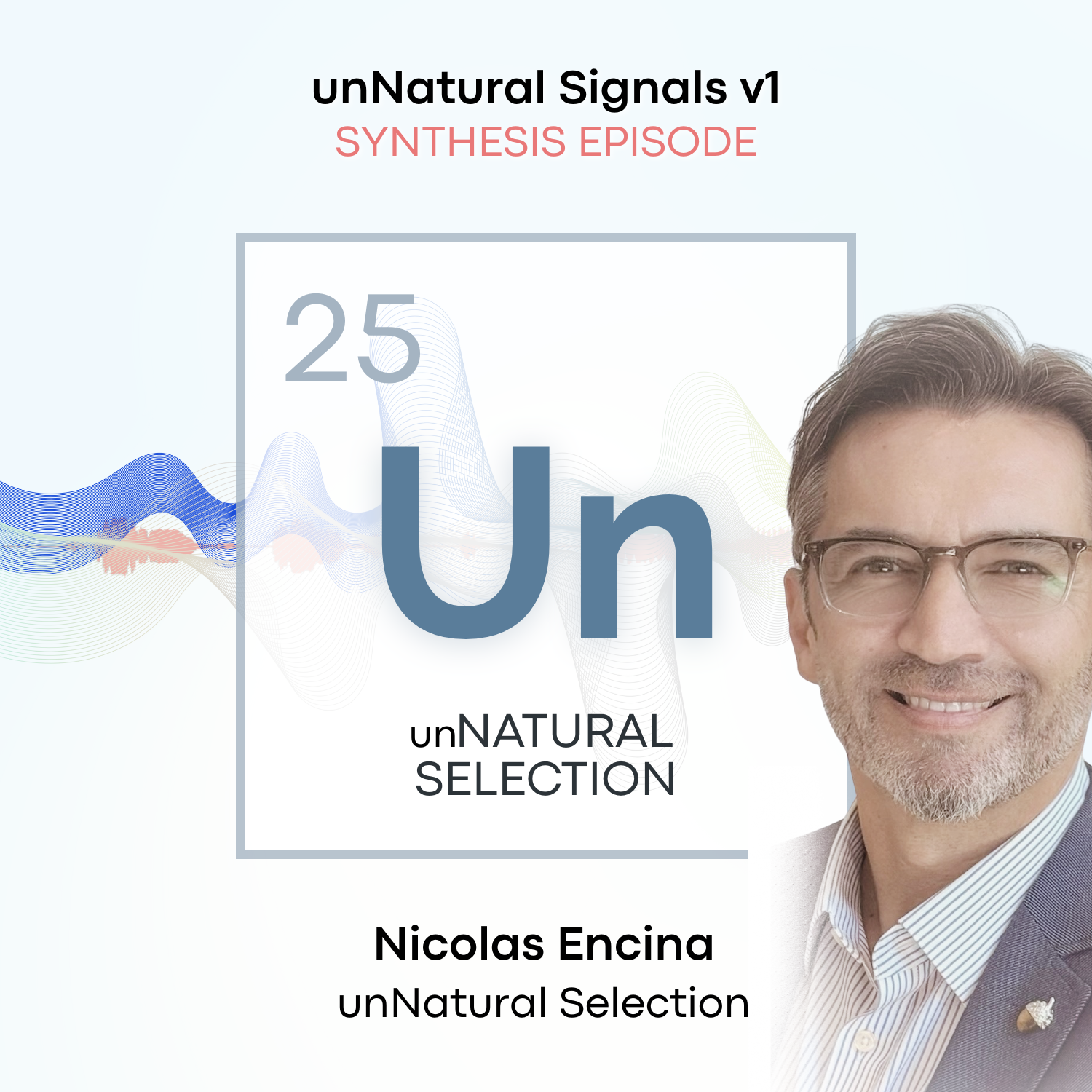
Macro Signals & Structural Shifts Across Legacy Industries
Emergent Patterns. In this special 25th episode, host Nic Encina steps out of the interviewer’s seat to reflect on the origin, evolution, and future of unNatural Selection. What began as a curiosity about how innovation mirrors natural selection has grown into a living archive of how people and ideas adapt, survive, and thrive under pressure.
Drawing insights from 24 episodes across sectors—from genomics and biotech to performance arts and public health—this retrospective explores recurring themes like adaptability, resilience, behavioral change, and the surprising power of emotion and storytelling. Nic unpacks what pioneers across industries are teaching us about competition, leadership, and evolution in real time.
If you're new to the show, this is the perfect place to start. If you’ve been along for the ride, this is a moment to take stock—and look ahead.
-
(Auto-generated by Spotify. Errors may exist.)
Hello everybody, my name is Nic Encina and welcome to the special 25th episode of unNatural Selection.
For the last 24 episodes, we've had the privilege of speaking with some of the most innovative minds across a breathtaking range of fields.
2:51
We've delved into what it takes to create, compete, and lead in a world that is changing faster than ever.
And now, with the significant milestone, we're pausing to reflect not just on the incredible insights our guests have shared, but in the very origin story of this podcast and how our thinking has evolved along the way.
3:07
This episode is different, though.
It's an opportunity to synthesize all of the lessons we've learned and to share with you what we believe are the core principles that connect innovation to the conceptual framework of evolution.
We'll be breaking down the key themes we've identified across all of our conversations, from the power of compelling narrative to the importance of resilience.
3:26
But more than anything, this episode is a chance to hear from you.
We want to hear your feedback on what has resonated, what hasn't, and how we can continue to evolve this podcast to create better value.
Your input is the selection pressure, if you will, that helps us optimize our show and the things that we focus on.
3:44
So let's take a moment to look back at where we've been and with your help, chart a course for where we go from here.
3:52
The Podcast's Genesis: From Idea to Unnatural Selection
All right, let's take it back to the origin.
Can you tell us why did unnatural selection start in the first place?
3:59
Speaker 2
It's all kind of started over lunch with a friend in December of 2024, someone I really respect, former CEO of LexisNexis.
We were talking about career stuff, life and just catching up.
It'd been a few years since I saw him.
At one point he said you should really write about your experiences, and I kind of laughed.
4:19
I thought a book.
Nah.
It didn't feel like me.
The idea of sitting alone, chipping away at a manuscript for months or years on end, it just didn't fit, and it was kind of antithetical to the way that I've worked in any other area of my life.
4:34
Everything that I've ever done, whether it's launching a company, building a new program, starting something from scratch, it's always been quick, iterative, startup style.
Try something, get feedback, adjust, repeat, iterate, learn experiments, succeed, fail.
4:50
I've never been 1 to vanish into my own head and come out the other side with something polished and final.
Now, I know a lot of people do write books that way with great success, but for me, that process felt kind of antithetical again to how I create.
5:06
I need feedback loops and I need momentum.
So a book was out, but the idea of writing stuck with me.
Not in the traditional sense, but as a way to explore ideas more publicly.
At first I resisted even that.
Writing A blog just felt self-serving, self promotional, maybe even a little performative.
5:27
And I've never been someone who's super comfortable putting myself out there and that way.
But the more that I thought about it, the more that it started to feel less about me and more about making space for exploration in something that I care deeply about, which is creation, creativity, innovation.
5:46
That's the stuff that really drives me.
I've learned one thing over the years about myself, that it's if I'm not building a new program organization that my brain naturally is working in a new piece of software or tool or even writing music.
6:01
I just get energy out of making and creating things that people find value in.
At the time, I was also going through some personal challenges, some heavy reflection, figuring out a few things on my own, and honestly, diving into this project helped me.
6:17
They gave me something to focus on, something constructive to do with my time.
And looking back, the early days of unnatural selection kind of feel like a blur.
But I think that's how it is.
When something just pulls at you, it pulls you in.
It started as an experiment and it's been evolving ever since.
6:38
Speaker 3
Part 1, the podcast origin story.
6:42
Speaker 1
You know.
6:43
Speaker 2
At the risk of oversharing, the idea behind the podcast actually started in the bathroom.
6:49
Speaker 3
Ha ha, wait.
Seriously.
6:51
Speaker 2
One day I noticed that our toilet paper had these little squiggly perforated edges instead of the usual straight lines that almost never work as planned.
And for some reason, that detail really stuck with me.
I thought, huh, toilet paper companies innovate.
And then immediately afterwards I thought, well, duh, of course they innovate.
7:07
There's not just a single toilet paper company.
They have to compete for market dominance and and they have to evolve to survive.
Even in that space, innovation matters.
And that tiny weird moment sparked a much bigger question in my mind, which was if toilet paper companies are innovating, then what else is?
7:26
Obviously all other fields.
It's not just the ones that I'm familiar with.
Every industry is locked in competition and is forced to adapt.
And if they are, then more importantly, what can we learn from that?
7:42
And when you look at it from that perspective, for me, everything became an opportunity for an episode because just looking around the room, I see furniture, I see television sets, I see laptop computers, I see refrigerators.
8:00
If I go outside, there is there is automobiles, helicopters, there are companies fighting for landscaping.
Everywhere that you look, there are fields, factories, companies and people that are all trying to do their best at competing with others in their similar space and trying to innovate and think of ways to differentiate themselves so that they can be chosen by the limited number of potential clients and customers.
8:32
And so when I started thinking about it from that perspective, the idea just became that much more exciting because I've spent most of my life in science, tech and healthcare.
But suddenly I found myself fascinated by other arenas, the ones that didn't know anything about.
8:48
And when I see how all of that mapped back to the bigger patterns, especially to evolution, natural selection, competitive pressure, adaptation.
And that's where the name Unnatural Selection comes from.
Because we're not just talking about their winning forces in the wild.
We're talking about this new era where we're living in, where humans are consciously shaping our own future.
9:08
We're engineering evolution, designing our own next steps.
It's natural selection, sure, but with human override.
An intentional twist.
A little unnatural.
So the idea was what if we explored innovation not as a shiny Polish thing, but as a response to pressure, a survival as mess?
9:28
What if we drew connections across totally different fields, from biotech to opera, from tennis to aerospace, and look for the deeper patterns underneath?
That's the spirit of a natural selection.
And honestly, I think it's kind of like that old show Dirty Jobs that show with my Grow.
9:45
Except instead of exploring dirty work, we're exploring The Dirty side of innovation, the stuff that's raw, unglamorous, and often hard earned.
And from the very beginning, I knew I needed to move fast.
I knew that my inclination was to stay private and not share more of myself.
10:03
And I absolutely needed to.
And so I really realized that the biggest risk to not doing this was me second guessing myself and realizing that I didn't want any part of it.
So I did the opposite.
I pushed through it.
I had, I didn't know how to record a podcast.
10:19
I had no idea how to edit design, graphics, distributed, any of that.
But I figured I'll learn or I won't.
And if it flops, that's OK, At least I gave it a shot.
So with regards to the launch itself, the first 3 episodes were intentional.
10:35
I wanted them to represent different dimensions of what innovation actually feels like in the world.
Episode one, for example, with Stephen Sasson, he was the guy who invented the digital camera at Kodak in 1975.
Yeah, at Kodak.
This is a company that practically owned photography at the time, but they couldn't see past film and consumables, even though Steven had invented the future.
10:58
The company just they couldn't get out of their own way.
It's a textbook case of the innervator's dilemma, corporate inertia and all the forces that keep good ideas from seeing the lot of day.
And looking back, it's easy to say, Oh well, they should have done this or they should have done that.
11:13
But in that moment it wasn't so clear.
There was no digital ecosystem.
There is no Internet, no one was asking for a toaster sized camera.
But now Kodak's gone from 100,000 employees to just a few thousand, and I read recently that they might shut down operations entirely.
11:30
It makes you wonder though, what other companies are right at that Cliff and facing these major tectonic shifts?
Perhaps they can learn something from Kodak.
Episode 2 was a bit of a left turn.
It was on Krav Maga, a hand to hand combat discipline using special forces, and honestly, I included it to keep things grounded, to keep things real.
11:52
I didn't want us to get too precious about innovation.
I didn't want us to wield it with a capital I.
Because at its core, innovation is survival.
It's adaptation.
And there's no better reminder of that than martial arts and the rawness of human survival.
The stakes are high.
12:07
It's not about theory, it's about what works in real time under pressure.
Styles evolve, they blend, and I think that kind of evolution is just as relevant to business and design as it is on the mat.
That's wild.
In episode 3, NASA, because I couldn't not do NASA.
12:23
I mean, when you want to talk about long range innovation, you don't get more ambitious than launching spacecrafts into interstellar space.
Voyager was launched in the 70s using 60s technology and it's still out there, still sending data, still being guided from Earth.
12:39
That kind of planning, thinking not just in years but in generations, is just awe inspiring.
It's human creativity at its most extreme.
So those were the opening moves, the dark side of innovation with Kodak, a shot across the bow, the raw survival instinct of Krav Maga and mixed martial arts, and the heights of human achievement with NASA.
13:02
After that, I started branching out.
Biomedical engineering, tennis, sneakers, opera, anything where people are creating under pressure, adapting and trying to outlast the competition.
Because at the end of the day, Unnatural Selection isn't just a podcast, it's becoming an archive of how innovation actually happens.
13:21
Not in theory, not in the boardroom slide decks, but in practice and people's work in their decisions, in the trade-offs, the failures, the small wins that no one sees.
And hopefully, in listening to all these different stories, we start to spot the patterns, the kind that helps us evolve not just our technologies, but the way that we think about creation itself.
13:42
Key Themes: Adaptability, Emotion, and Behavioral Shifts
Part 2.
Key themes uncovered.
13:45
Speaker 2
We.
13:46
Speaker 1
Began this journey 24.
13:47
Speaker 2
Episodes ago with a simple question What drives innovation and competition in a world of constant change?
13:54
Speaker 1
We've heard from pioneers across.
13:55
Speaker 2
Diverse fields from.
13:57
Speaker 1
Healthcare and aerospace to gaming.
14:00
Speaker 2
And tennis?
What's become clear is that innovation is neither a linear path nor A1 size fits all.
The conceptual framework that best explains what we've seen, heard, and learned is evolution.
14:11
Speaker 1
And the following.
14:13
Speaker 2
Are a few notable takeaways from the 1st 24 episodes.
14:19
Speaker 3
The survival of the adaptable.
14:20
Speaker 2
You have a team that is committed to the truth and working hard, but also to taking care of each other.
You have the the.
14:30
Speaker 1
Acknowledgement that we have to adapt, we have to change.
14:33
Speaker 2
Knowledge is dynamic in nature.
Species don't survive simply by being the biggest and the strongest, by being the most adaptable.
The same holds true for companies and ideas.
14:43
Speaker 1
Kodak's story.
14:44
Speaker 2
Isn't just about a company failing to invent, it's about a company that was too specialized to survive in a changing environment.
It's a classic case of the innovator's dilemma where corporate inertia.
14:54
Speaker 1
Stood in the way of.
14:55
Speaker 2
Adaptability, in contrast, he gets from Mass General Brigham.
14:58
Speaker 1
Show us how a large.
15:00
Speaker 2
Organism, like a very large health system, can intentionally evolve by making strategic changes to survive.
This means that, unlike natural selection, innovation is often a conscious act.
15:14
Speaker 3
The power of a symmetry and cross pollination, you know.
15:17
Speaker 1
Maybe I'm not going to square up and fight a boxer the way a boxer wants to fight me.
15:22
Speaker 2
The competition we witnessed isn't just a head on clash.
The most successful guest didn't win by being bigger or having more resources.
They won by changing the rules of the game.
Denise Chapman Weston.
She used playology, play and empathy as strategic assets to win over a market dominated by performance.
15:40
The leaders of the Human Genome Project at NASA, they didn't just succeed with technology.
They use a compelling narrative or a shared genetic code to align diverse teams and win the battle for trust and talent through storytelling.
This reminds us that in both nature and business, mimicry, camouflage and asymmetric strategies can be more powerful than brute strength.
16:02
Speaker 3
What about cross pollination?
Do you see ideas or strategies jumping from 1 field to another in unexpected ways?
16:11
Speaker 1
Unapologetically multidisciplinary.
Almost everybody in the lab is themselves cross.
16:17
Speaker 3
Trained in more than one.
16:18
Speaker 1
Field.
I think it's hard to build a multidisciplinary team with only disciplinarians.
Breakthroughs.
16:24
Speaker 2
Often happen at the intersection of disciplines like genetic recombination.
New ideas are formed where diverse disciplinarians come together.
We saw this in the evolution of health policy, play design and bioengineering, where success grew at the seams between fields.
16:41
This cross pollination of ideas is a superpower, A deliberate form of evolutionary novelty that unlocks new possibilities.
16:50
Speaker 3
The journey and the role of emotion.
16:52
Speaker 1
Some of the things about technology that are removing these important indicate emotional and physical indicators of knowing.
17:00
Speaker 2
Somebody's listening to you.
17:01
Speaker 1
Heard you, observes you.
17:04
Speaker 2
Got to see.
17:04
Speaker 1
Who you really were.
17:06
Speaker 2
Rick Mackey and Meredith Hansen taught us a profound lesson.
Durability comes from a passion for the.
17:12
Speaker 1
Process, not the prize.
17:15
Speaker 2
The organisms that persist across conditions aren't optimized for one single victory.
They're built for ongoing adaptation.
In a world of hyper innovation, the love of the game and the joy of continuous improvement is what keeps a company or an individual relevant.
17:30
Crucially, we've learned that unlike the.
17:32
Speaker 1
Cold Statistical.
17:33
Speaker 2
Process of natural selection Human innovation is deeply emotional.
The transcripts revealed that creating a safe emotional psychological space is essential for high risk ideas to flourish.
We've also seen the critical importance of resilience and overcoming failure.
17:49
Rick Mackey taught us to forget the previous point but to learn from it, while Robert Langer and others demonstrated that persistence through rejection and setbacks is a core leadership skill.
18:01
Speaker 3
Innovation as a behavioral shift.
18:03
Speaker 1
So I was unprepared and I hadn't really thought about displacing 100 year old business.
I had thought about.
I thought about a new way of doing.
18:13
Speaker 3
Something.
18:14
Speaker 1
That that seemed really cool and modern.
18:17
Speaker 2
Perhaps the most unique insight from this podcast is that innovation isn't just about inventing a new product or service.
It's often about behavioral design.
It's about nudging systems, changing habits, and altering stakeholder incentives.
We saw this in healthcare, with guests focused on changing doctor and patient behavior, and in gaming, where the goal was to change how children learn and play.
18:38
These evolution ready systems built on trust and narrative clarity are more resilient and adaptable than those simply optimized for one moment in time.
As we look into the future, we will continue to explore this connection between innovation and evolution.
We've learned that leadership is less about being a hero CEO and more about being an ecosystem architect.
18:59
We've seen how culture serves as an internal selection pressure, defining what ideas live, spread, or die.
The ultimate lesson from our journey is that innovation, like evolution, is a story of adaptation, resilience, and the power of a great story to change the world.
19:16
Winning Strategies: Redefining the Game and Leveraging Narrative
There's a lot to unpack here.
Really interesting patterns emerging.
When you look at the role of competition across these examples, what stands out?
Any consistent takeaways?
19:28
Speaker 1
You know, after.
19:28
Speaker 2
Speaking with so many guests across so many wildly different fields, from biotech to theme parks to tennis.
19:34
Speaker 1
Some clear.
19:35
Speaker 2
Patterns have started to emerge, and they're not always what you'd expect.
19:40
Speaker 3
Love the game, not just the trophy.
19:42
Speaker 2
And the number one thing that I try to get everybody to do is to be the best competitor they can be, OK?
That should be the number one goal of any coach, mentor or parent.
If you're all about the competition, you don't check out as much.
20:00
The people who go the distance aren't just chasing trophies.
They love the game.
You hear this over and over again.
Rick Mackie and tennis, Meredith Hansen and Opera both talked.
20:10
Speaker 1
About how?
20:10
Speaker 2
Real durability comes from loving the process, not just the outcomes.
It's not about that single big win.
It's about showing up consistently, evolving constantly, and staying in a game because you want to, not because you need to prove something.
And if you think about it, if you love the competition and the process and the game itself, then your motivation is endless because there's going to be no shortage of competition.
20:36
So if you use that as a way to motivate you towards continual improvements, that's a winning recipes for long lasting success.
And that mirror is something we see in biology too.
Organisms that last across shifting conditions.
They're not designed for one perfect moment.
20:52
They're built for ongoing adaptation.
They survive because they flex.
20:58
Speaker 3
Adaptability beats scale.
The nimble and responsive often outlast the big and slow.
21:03
Speaker 2
A Symphony.
21:04
Speaker 3
Or an opera company.
21:05
Speaker 2
Is is engaging singers who are not?
21:07
Speaker 3
From that area they actually will encourage and allow us to come out a day or two before rehearsal start.
21:14
Speaker 1
To get used to the.
21:15
Speaker 2
Altitude, because it really does.
21:17
Speaker 1
Have an impact on and.
21:18
Speaker 2
People are are often surprised how much of an impact.
21:22
Speaker 1
It does have.
21:23
Speaker 2
Some of the most successful guests I've had, especially those in healthcare and biotech, they didn't succeed by being the biggest, they succeeded by moving quickly.
They adapted before anyone else even realized the terrain had changed, and evolution supports this idea.
In volatile environments, generalists, the ones with range, often outcompete the specialists.
21:42
It's about having the capacity to pivot when everything else is shifting under your feet.
21:49
Speaker 3
Change the rules, win the game.
Redefining value and reframing categories as a strategy for dominance.
21:55
Speaker 2
Cybersecurity, it's not really something about just bits and bytes cybersecurity, but it actually really is about where where threats are going to converge, whether they're sort of Internet based threats, cyber threats, if you want physical threats.
But it's not just about playing the game well.
22:10
The most innovative guests, they didn't just compete, they redefined the game entirely.
They change what value even means.
Some reframe performances play.
Others shifted the focus from treatment to total well-being.
Some created entirely new categories that the old players didn't even recognize until it was too late.
22:29
In this principle, compete by redefining the game is something we see clearly in martial arts too.
Whether you're looking at Brazilian Jiu Jitsu or Krav Maga, a core idea is that it's foolish to try to out compete a powerful opponent at their own game.
You don't try to outbox a pro boxer in the ring.
22:45
It's a losing strategy.
Instead, you shift the playing field, use kicks, submissions, ground techniques, whatever changes the dynamics and gives you an edge or at least a fighting chance.
You change the terms of the engagement.
It's the same in business, tech, policy everywhere.
The real innovators don't just fight harder, they fight smarter by redefining the arena.
23:04
And again, evolution has a lesson here.
Speciation often happens when a new niche opens up.
The winners aren't always the strongest.
They're the ones who step into spaces no one else is paying attention to.
23:18
Speaker 3
Play as a competitive strategy.
Curiosity, joy and creativity as underused innovation levers.
23:24
Speaker 1
The feeling of walking.
23:25
Speaker 3
Into a restaurant.
23:27
Speaker 1
Is the same feeling that I had.
23:29
Speaker 3
When I walked into my grandmother's house.
23:32
Speaker 2
Now, one of the most surprising insights for me has been around curiosity and play.
Denise Weston in Playology was a great example of this.
She treats joy as a design principle, not as an afterthought, but as a core strategic driver.
And it works.
There's something deeply powerful and seeing play not just as fun, but as fuel for innovation.
23:54
Speaker 3
Shape the ecosystem, don't just compete in it.
Elite innovators alter the conditions of competition itself.
24:00
Speaker 1
There's nothing like being on the ground here, you know, being on the team and then walking, you know, world class institution one after another.
And I I think it doesn't exist like that anywhere else in the globe.
And it might not exist like that at any other time.
24:17
The top performers.
24:18
Speaker 2
Aren't just competing within an environment, they're shaping it.
They're creating new categories, influencing stakeholder behavior, and even reshaping cultural norms.
They aren't just surviving the game, they're rewriting the rules and changing what winning looks like.
24:35
Speaker 3
Asymmetry as an edge.
Unorthodox strategies outperform brute force.
24:40
Speaker 2
How with the skill sets I have which are still.
24:42
Speaker 1
Quite limited.
I mean, I'm not a molecular biologist or politician or anything, but how can I take?
24:47
Speaker 2
The skills that I have.
24:50
Speaker 1
With their limitations and.
24:53
Speaker 3
Who I.
24:53
Speaker 1
AM and and have the biggest positive impact on the world.
That's kind of the guide that I've.
24:58
Speaker 2
Tried to use people like Denise Weston, David Roux and others.
They're not just using better tech or bigger budgets, they're competing with strategies that feel almost unfair in the best way.
Empathy, the light, hyperlocal, trust.
It's like a nature where mimicry, camouflage, and unorthodox defenses let weaker organisms thrive despite not being the strongest or the fastest.
25:23
Speaker 3
The power of Narrative Warfare Stories don't just sell, they align, adapt, and win hearts.
25:28
Speaker 2
Narrative and and stories and building worlds and and and delivering it to people in a way that.
25:34
Speaker 3
They can consume.
25:35
Speaker 2
I think that's the really valuable piece of it, understanding how people consume content and you know what makes them excited about something.
But it may be the most powerful lover I've seen across all these categories is narrative.
25:50
Because competition isn't just about better features or faster delivery.
It's a battle of stories, And the ones who win aren't always the loudest or the flashiest.
They're the ones who connect emotionally, who inspire action, who get people to believe.
Simon Cynic said it best And start with why.
26:08
People don't buy what you do, they buy why you do it.
And the most successful leaders and innovators on this show, they lead with why They frame their mission in a way that attracts talent, trust, and attention to make people feel something.
It reminds me of another powerful insight from Switch, the book by Chip and Dan Heath.
26:26
If you want real, lasting change, whether it's in a person, a company, or an industry, you can't just appeal to logic.
You can't just clear the path or explain the strategy.
You have to move the heart.
That's what creates alignment.
That's what creates momentum that lasts.
26:42
And when you zoom out, that's not just the business insight, it's evolutionary.
Our shared stories, our ability to believe in collective purpose, to coordinate our own meaning.
That's what made humans so uniquely adaptive.
That's our edge.
So whether we're talking about nature or business or just navigating life, it turns out it's not always the biggest or the boldest.
27:03
That when it's the ones who adapt, who create, who connect, who tell the most compelling story about the future and who then invite us into it.
27:13
Speaker 3
The competition stories really hit hard.
So much strategy, survival, even reinvention.
It's intense, but it's also inspiring.
So stepping back, when you look across everything we've heard about innovation and competition, what can listeners take away to become stronger, more adaptive leaders themselves?
27:34
Speaker 2
When we asked world class innovators what leadership looks like, we didn't hear about org charts or command and control.
We heard about storytelling, resilience, culture, trust.
Over and over again, guests described leadership not as giving orders, but as shaping the narrative at Hoffman from NASA.
27:52
But at best, stories align people that make sense of chaos.
27:55
Speaker 1
They're how leaders hold.
27:56
Speaker 2
Vision and values, but storytelling alone is enough.
Change also takes heart.
That's what resilience is about.
Rick Macci taught emotional toughness, Robert Langer shared how he turned rejection into a huge nanotechnology industry and hospital leaders in crisis showed how staying calm and adaptive is a life saving skill.
28:18
Culture came up a lot too.
Not as fluff, but as infrastructure.
It sets the rules of evolution inside the organization.
What survives, spreads or gets snuffed out in biology, genes, Dr. Evolution and companies.
Culture does.
And leadership isn't just internal anymore.
28:35
Today's pioneers are shaping ecosystems, coalitions, partnerships, platforms.
They're not just managing teams or engineering the environment around them.
One of the most underrated themes?
Trust.
Especially in high stakes settings, leaders create psychological safety so people can take risks, explore and speak up.
28:53
Because survival, just like in nature, is often A-Team sport.
So that's what leadership looks like in evolutionary terms.
It's not just about being in charge.
It's about creating the conditions where ideas, people and systems can adapt and thrive.
That's leadership through the lens of a natural selection.
29:12
Listener Feedback and the Podcast's Evolving Identity
Part 3.
The journey so far.
29:15
Speaker 1
From a blank slate to a multi industry encyclopedia.
Again, the aim was to identify how people and organizations adapt, survive and evolve.
And one of the metaphors that obviously the whole podcast is a metaphor.
29:34
But metaphors within metaphors, if you will.
Each guest is almost a genetic trait in an innovation ecosystem.
They become the driving force, they become the mutations, they become the responses to selective pressures.
29:54
And each episode has become almost a mutation worth studying, right?
Some mutation succeeds, some don't.
And, and I think we've seen that already in the 1st 24 episodes that we've covered.
30:06
Speaker 3
Totally.
30:08
Speaker 1
I think if, if I reflect back on, on the journey so far, it's been very rewarding.
I mean, it's been, I've learned so much in doing this and I look forward to every single interview and, and there are so many more to come.
I mean, there are many that are recorded already with, they just haven't been released.
30:24
But I've also received a lot of extraordinary feedback from people that I I know and love and from people that I didn't know.
And, and I want to share some of that right now because it's, it's shaping how I think about this podcast.
Again, I started with just a general idea, if I could throw it out there, see where it goes.
30:42
And, and so some of the feedback so far is that some people would like me to be more involved, to involve myself more in the conversations.
You know, when I first started again with my general kind of inclination to not make it about myself, I saw myself more as a passive listener asking questions.
31:07
Speaker 2
Getting out of the way.
31:08
Speaker 1
And focus on the guest.
But some people have actually told me that they look forward to hearing me chime in more and they look forward to kind of my insights and my comments as we have these conversations that actually surprised me.
I actually genuinely did not consider that because I thought, I mean, I'm interviewing extraordinary people.
31:29
I'm interviewing some of the most influential people of our time and some of the most, some of the most decorated and revered scientists and technologists and artists.
And I thought like, well, that's who we want to hear about.
31:46
That's what we want to learn about.
It's really not about me, but I have gotten some feedback saying that it'd be nice to hear more from me.
So it's something to consider.
32:01
And honestly, this special episode, this summary episode, the episode 25 is an attempt to get out of my own comfort zone and explore a new approach to see how it goes.
So, so this episode actually is me listening to that and, and learning from it.
32:20
And it has also urged me to reflect on the discussion so far and to tease out what trends and learnings I'm hearing from across industries, as evidenced by the previous section where we talked about some of these takeaways and some of these learnings that we've covered that we've exposed so far through these conversations.
32:38
Now, I'm still debating whether I conduct these overarching summary episodes once a month or so, or if I end each episode maybe with a quick summary.
But I'm thinking that overarching episodes are better because it allows us to reflect on cross disciplined learnings, which is what this podcast is all about in the first place.
32:54
Speaker 3
That makes sense.
32:55
Speaker 1
And I guess I'll wait to hear some feedback on this episode before deciding because I think that people will be able to absorb this and noodle on it, and then perhaps give some feedback on whether they like this or if they prefer a summary at the end of episodes.
33:12
Again, my inclination is to do more of an overarching one because I really like teasing out threads that come out in conversations across industries.
I find those to be interesting.
33:28
I find those to be pleasantly surprising.
And and then I also find them to be kind of reinforcing in a way, because if they exist across disciplines, then we're probably on to something more than, say, a particular theory that one particular person or one particular discipline has.
33:51
So I'm inclined to doing these overarching episodes maybe once a month, maybe once every couple of months, but we'll decide after more feedback.
Another piece of advice that I've gotten is to maybe respectfully challenge guests more and become more of a litmus test for true innovation.
34:16
Meaning that I should I should push on guests more and I should strive to be kind.
Not nice, but kind and I should push.
34:27
Speaker 2
Harder to get at the.
34:29
Speaker 1
Essence of true innovation strategy and practice, particularly when guests start misrepresenting effectively Brownian motion for true innovation and evolution by design.
I think that in some cases, and particularly from what I've seen, the more senior people get CE OS and so on, sometimes they lose the sight of what innovation is and, and maybe I should challenge them more on that.
35:04
So that's one piece of advice that I've gotten and something that I take to heart.
Obviously it's something I have to be sensitive about.
I don't want to become so contentious that I scare people away.
But I think there is something to be said for again, back to the whole concept behind the MMA episode, keeping it real.
35:25
Speaker 3
Part 4 What's next?
35:27
Charting the Course: Future Guests and Show's Vision
Where is the show headed?
As I mentioned, there are things I'm thinking about.
I think that there are lessons learned from previous episodes.
I mentioned that there are a bunch of episodes already recorded that we haven't released everything from the CEO of Blockbuster to mineral extraction to neurotechnology to public education and and many other fields.
35:52
In fact, actually, I, I welcome you guys to send feedback and let me know what fields you would consider to be interesting to explore.
I mean, I, I would love to interview somebody from Formula One or NASCAR, maybe rugby, maybe.
36:09
I don't know.
There's so many fields out there.
You know, you can think about automobiles, right?
It would be interesting to learn about from BMW or from Ferrari on what innovation means to them and how they approach it.
Yeah.
36:24
So if you have ideas on on disciplines, on areas and fields and also specifically people that would be interesting to hear from.
I'm always looking for again, experts.
I, I try not to focus so much on startups because I guess fundamentally, you know, I've been in startups enough that to know that startups, their success is not proven yet, right.
36:48
So it's like trying to learn about innovation or how to do it right from a startup is putting the, the cart before the horse because we just don't know yet.
And so, I mean, I wouldn't be opposed to a startup.
If the founder is a multiple success founder of startups where he or she knows what they're talking about, that's a different story.
37:12
But the idea of just going after startups doesn't really appeal to me because I, I want this to be again, an encyclopedia and an archive of learnings.
And I think that startups are still learning, so there's less to reflect out there.
So to me, it's really about world renowned experts in different disciplines and what we can glean from their experiences.
37:33
Interestingly, also by virtue of my career in biotech and life sciences and healthcare and so on, I'm naturally drawn to health and science, but I honestly personally find field entirely foreign to me to be the most curious and rewarding.
37:50
And so I'll continue interviewing people across biotech and pharma and so on.
But because there is a lot of work being done there and it's fascinating what is happening today as we are seeing this crossover from technology to biology and life sciences and what that means for human health in in the future of humanity.
38:12
But, but I, I really do find areas outside of healthcare in life sciences to be really rewarding.
So what does success look like for this podcast?
Again, I launched it without much of an inkling of what I wanted to do with it.
38:28
It was mostly get it out there and see where it goes, see where it resonates, what hits, what connects, what doesn't.
But I want to continue creating this archive of real world innovation across industries.
I want to continue distilling learnings that shed light on human creativity and the essence of what enables humanity to begin shaping its own evolutionary destiny.
38:49
I want to ask questions about what are we doing right?
What are we doing wrong?
How can we take these learnings and become better at it?
Can we reframe how we think about and discuss innovation everywhere from the corporate boardroom to the tennis court to healthcare or even in space and and how do we take these learnings from different industries and apply them towards the development and furtherment of the human condition and in our own society?
39:20
A Heartfelt Thank You and Final Thoughts
That's really powerful.
39:21
Speaker 1
Again, I invite the audience, I invite you guys to suggest guests and themes because I think that for as much as I'm looking around, but thanks to interview, I am sure that the collective knowledge of people will bring about a much richer experience.
39:40
So to close, I want to express my profound gratitude first and foremost to my guests.
I've had the privilege of interviewing some of the greatest minds of our time and in some cases, some of the greatest minds in human history.
They didn't have to do this and their generosity humbles me and I'm incredibly grateful for their time and their support.
40:04
As we've launched this experiment, I want to thank family and friends that have been incredibly supportive for my wife who supports me daily, to my daughter that encourages me, to my son that pretends to run his own podcast, little 3 1/2 year old, and to my brother who created the music score for Unnatural Selection, and all the way to my.
40:25
Father and closest friends who are my most devoted listeners, thank you guys so much.
Your feedback and your support means the world to me.
And I also want to thank anybody who's listening to this right now.
I'm certain that you have other things that you could be doing, but you are choosing to log in here and listen to me ramble on about my experience so far.
40:47
It's not clear where unnatural selection will go, but if I see that it's resonating with people and you're getting value out of this journey, then we will keep this experiment going to where it takes us together.
Thank you.
