
Pediatric Gene Therapy: Mass General


Proactive Prevention
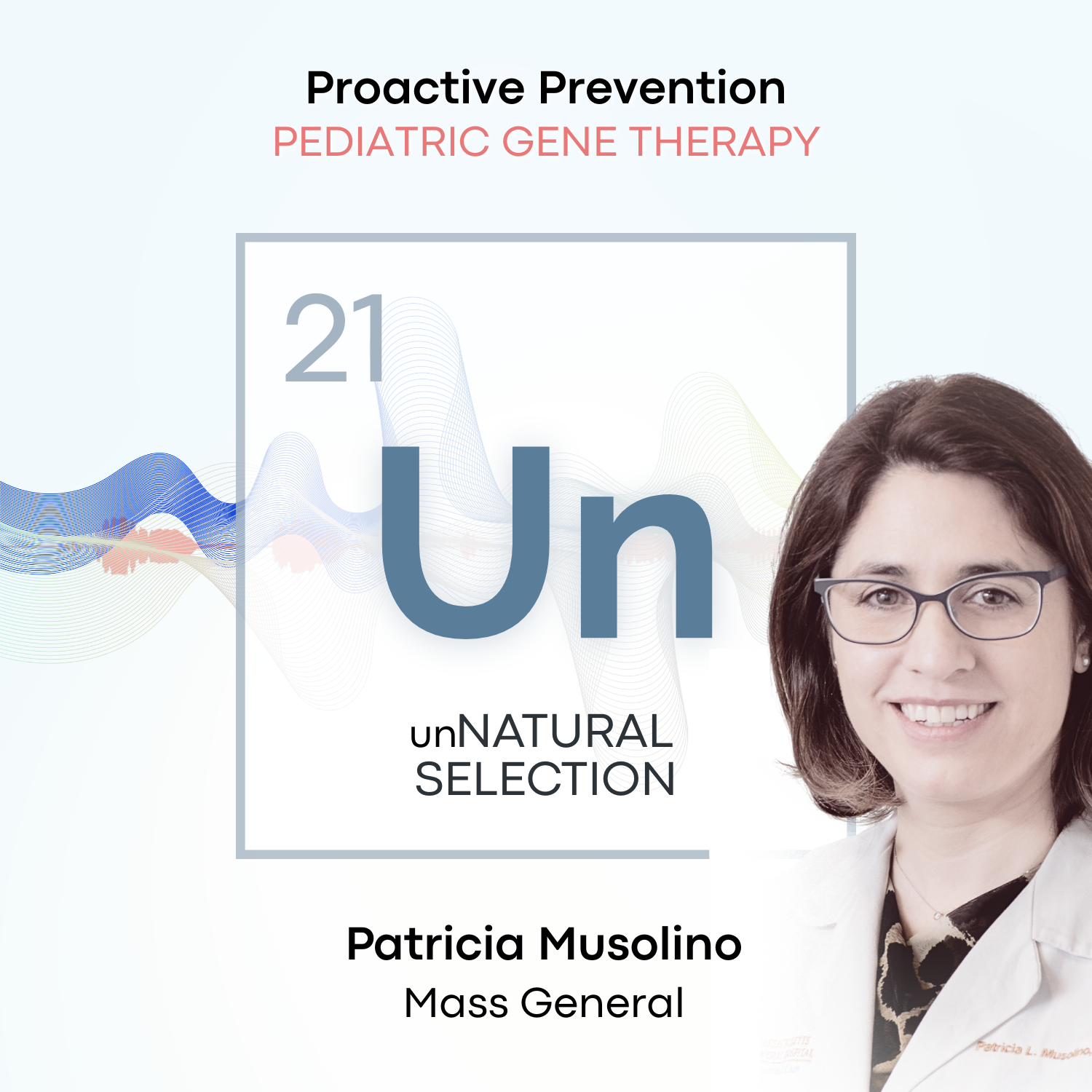
Gene Editing Under Pressure. Dr. Patricia Musolino of Mass General Brigham is pioneering gene editing approaches to treat Multisystem Smooth Muscle Dysfunction Syndrome (MSMDS)—a rare but devastating condition that causes stroke, heart attacks, and severe disability in children. In this episode, we explore how cutting-edge science is rewriting the prognosis for some of the sickest kids, and what it takes to translate genetic insight into real-world therapies under intense pressure.
-
(Auto-generated by Spotify. Errors may exist.)
Doctor Mussolino is a critical care and vascular neurologist with expertise in gene therapy for white matter and cerebrovascular disorders.
She's the director of the MGB Gene Therapy for Genetic Vascular Disease team and director of the Pediatric Stroke and Cerebrovascular Program at Massachusetts General Hospital.
1:22
Doctor Mussolino's clinical and research expertise revolves around the translation of discoveries in Human Genetics to clinical application and white matter and cerebrovascular disorders.
Working hand to hand with clinicians, scientists, patients, and advocacy groups, Doctor Mussolino has developed an international network of resources to accelerate development of targeted therapies and maximize the life potential of children and young adults affected by vascular disorders.
1:50
Doctor Mussolino is the recipient of several awards from the NIH, the Hearse and Child Neurology Foundation MGH Executive Committee on Research in the prestigious national 2017 Herbert Party's Clinical Research Excellence Award from the National Clinical Research Forum for the first gene therapy trial in a cerebral demyelinating disorder of childhood.
2:13
Addressing Urgent Unmet Needs in Vascular Disease
Patricia, welcome to a natural selection.
2:16
Speaker 1
Thank you so much, Nick for giving me the opportunity to to be here.
2:20
Speaker 2
Now it's it's my pleasure.
And as we were talking about it beforehand, really excited by this because our worlds overlap so much, right?
So I leave the International consortium in newborn sequencing.
So there is that connection there.
And then also from your bio, you have the award for the demyelinating disorder of childhood, which you said is adreno leukodystrophy.
2:41
And in my background goes back to the original Lorenzo story.
You haven't been a caregiver for Lorenzo Dona himself?
2:48
Speaker 1
Wow, the world is smaller than we think.
2:52
Speaker 2
Isn't it?
I know, yeah.
Not to mention you're from Argentina and I'm from Chile, so, you know, funny meeting here in Boston.
3:00
Speaker 1
Yeah, even smaller, but it's, it's, it's so great to to hear also the efforts that are being speared by your group and in the newborn sequencing, newborn screening by genomics.
We really are at that age in humanity that we need to to learn what is feasible and what does it mean when we find something altered in your genomics and what do we do with that in care in life.
3:24
So I I'm a pleasure to meet you and, and have this opportunity to exchange about these great ideas and innovations that we are trying to develop.
3:33
Speaker 2
Yeah, I 2nd that.
I think it's going to be interesting when we, we can potentially dive into that about even from the early days of the human genome project, the vision was always to bring genetic screening to newborns, right?
Because if you're going to use it for screening, if you can use it for prevention, the best places at the beginning of life, not when you're already sick or 50 years old or so on.
3:54
And and it's come full circle now, you know, as we've first, it was applied obviously in specialty care, you know, oncology and rare diseases.
And as we go further downstream now to the screening world and we're getting back to healthy infants, when you identify a condition like MSMDS that you work on or others, what does that mean for care?
4:14
What does that mean for accessibility?
What does that mean for coverage?
There's so many questions still being worked on, but it's very interesting to see that within our lifetime we've come almost full circles of that.
4:25
Speaker 1
Yeah, and I, I echo the urgency here.
We need to get this going and run and and write in that we do have the position to really go deep into the genome and find and understand regulators and genes and modifiers that will maybe 'cause disease.
4:43
But also we do have the knowledge that there are certain ones that we are severe, that they're penetram, that they're going to cause disease like a mutation in the after 2 gene that causes mother systemics muscle disorder.
And and what it comes full circle, and I think the urgency is even higher, is that now we have the technology to do precision therapeutics, meaning I can see what your variant is that is causative of this disease that will take quality of life, will take your abilities to develop to your fullest potential and intervene as hopefully, as you say in the window that is a still a preventive one for a lot of things up there, potentially able to develop or without treatment that you're going to be
5:30
losing.
And in this case for us is, is the vascular system and it affects the brain and the heart and the aura.
And those are the main causes of disease still in the world.
So another plaque here to why do we care about these conditions that are so severe and affect children and and they don't seem to be like so common.
5:54
It's because there really are the places where we can innovate.
The urgent unmet need is so high that we can afford the risk of bringing new therapeutics and in the aim of helping them unlock therapeutics for vascular disease, still the number one cause of death and disability in the world.
6:15
So we have thousands of clinical trials, multiple drugs, and everybody knows what you're supposed to be doing.
Exercise and sleep well, eat nice, take your blood pressure medications, control your cholesterol.
There's a variety of things that you can do and many other drugs that are great developments in humanity to extend life, to make it better.
6:37
But it's still we are not able to heal vessels that are disease and we are not able to prevent them from getting sick.
And that's what causes myocardial infarction, heart attacks and strokes, which continue to be the first leading cause of death and disability.
So being able to understand for the non monogenic, not the Mendelian inherited disorders, the mechanisms requires these deep dive into your omics, your genomics, your proteomics, lipidomics and also unlocks those places where the biology is much more understood.
7:13
Because we also know that variants in that area cause severe forms of the disease that are inherited and runs in families like MSNDS.
So we have this opportunity and we have this responsibility, I think of really translating to 1st in human studies these technologies that we are able now to implement and also incredible fast times of development.
7:37
Speaker 2
Yeah, no, that's I, I totally agree with all that.
7:40
Healing Brain Injury: The Core Motivation
So you know, if we take a step back, I always start with the same question.
You kind of answered it already, but just so for the listeners to get a very concrete picture from you in your words of why your work matters, can you please tell us what impact or need drives your work?
7:56
Speaker 1
Yeah, I would say it's, it's the the patient that I see in the hospital is, is what really keeps the torch and and also like the focus and anything that we need to be doing.
And I am an intensivist, A neurointensivist and I see patients when they're very sick and they have had brain injury from different reasons, particularly specialize in patients that have suffered from vascular disease or hemorrhages in the brain, stroke ischemic in the brain or vascular malformations like AB, M's or aneurysms.
8:28
And I do pediatric care and adult care and I direct the group that also sees the genetics and the non genetic vascular disorders for Pediatrics here at at the hospital.
And the need that is clearly identified is we really have very few ways to heal the brain once you have brain injury.
8:49
We do everything we can to rehabilitate and maximize the ability to adapt to the injury that the brain has mostly in children.
And I strong believer of that.
We also do research in these aspects of rehabilitation and recovery.
But what is heartbreaking is to see someone that was a few days before celebrating some event in their family, the birth of a child.
9:13
Now I'm talking a young adult and losing the ability to speak, move independently and be dependent on others for probably the rest of their lives.
So that is the driver.
The driver is these patients in the most productive time of their life, of these children that are resilient, developing, thriving and then have to face an event like a stroke that takes away not just for them, but for their siblings, for their parents, an enormous amount of quality of life because of the care they need to seek and also because of the abilities that they have to adapt to live with that they have lost.
9:53
And again is just as I said, this is not a a disease of a few, even though the one that we are developing, the specific therapeutics are more rare.
And because they're so severe, they're causing strokes in infants and in children less than six years of age.
10:12
So before you go to school, your children start having not one, but recurring strokes.
So the need is urgent, but they really are the prototypical vascular disease.
And again, to go back to the pyramid, the pyramid is still the same with all the drugs that we have, with all the technologies we have developed, with the incredible intervention that we can do in the hospital in the acute care like stents and catheters and retrieval and clot lysing medications, we're still facing the truth that is vascular disease.
10:45
It's the number one cause of disability and death.
Every every 20 seconds there is a myocardial infraction in the world like it's, it's, it's daunting to think about it.
And what is so clear of cardiovascular disease, of neurovascular disease, more than 80% is vascular disease.
11:04
The vessel that brings the blood supply to the brain, to the heart, to the kidney is the one that is affected.
And the wall becomes incompetent and it ruptures, or it becomes thicker and thicker and it narrows the blood flow to the point that it occludes it and doesn't let the oxygen and the nutrients get to the organs.
11:25
And then you see organ failure like you see strokes, you see the cart infarcts and also see kidney disease.
So the big picture is to treat these diseases that are so severe, we need the tools and we need to develop them.
They do not currently exist like good vector platform we call it the way that you deliver something to the very specific part of the human body.
11:49
Those to get into the vessels have been very difficult to develop and it's nature is very smart.
If you wear things, if things were getting into your vessels easily, you will be having something called vasculitis and that will be terrible.
Every time you have a cold, a virus can get access to this system, it will be very devastating.
12:08
So the body has mechanisms to keep things away from it and at the same time it has limited the ability that we have to concentrate the drugs that could make differences and the mechanism we have known for decades that caused the vascular disease inside of in the vessel wall.
12:23
So that's basically the reason.
Like there is an opportunity here to transform the tools we have to treat the most common disease in the world by focusing on those with the most severe, prototypical forms of this disease, which are these inherited genetic disorders.
12:43
Speaker 2
Yeah.
12:43
Correcting Genetic Defects for Life-Saving Outcomes
I mean, Speaking of which, most of our conversation is going to be around your work with MSNDS.
So for listeners not familiar with what MSNDS is, could you please describe the condition, what causes it and and what the typical outcomes are so people understand like what it is it that you're trying to address?
13:02
Speaker 1
Yeah.
So this this condition is is caused by one single variant, one letter in the beginning that is changed in this gene called aptitude.
It codes for a protein that makes the muscle in the vessel wall and the muscle in the gut, in the bladder, in the eye, in the lungs, in the airway contract so be able to do its job.
13:23
It's a muscle.
So it does also contract.
It is not your muscle in your arms, your legs, it's not your heart muscle either.
That is the muscle that is called smooth muscle.
And this, this, this function of the smooth muscle and the lack of contractility alters the vasculature.
13:41
And for example, if you can squeeze your vessels, your blood pressure is low and that's what these kids suffer.
And when your blood pressure cannot correspond to your level of activity, you can't move that much.
So they have intolerance to exercise and activities.
And, and these patients are worn with the condition.
13:59
Some of them have been diagnosed in utero because the bladder doesn't contract.
The bladder is all fulls muscle and it just accumulates urine and they're diagnosed with big bladders in the intra like obstructic ultrasounds.
And then at the moment of birth there is a muscle that is very easy to see, smooth muscle.
14:17
If you think about smooth muscle, just shine a light in your eyes.
The black area of the eye narrows.
That's called a pupil when you shine a light.
And that's because smooth muscle can constrict contract that little sphincter, which is the pupillary muscle.
14:33
And these kids don't have the ability to contract that sphincter.
So they are born with dilated fixed pupils that don't react to light.
So it's an easy diagnosis that could be part of the screening that we do in every single newborn, which is shining a light in the eyes to see if they have cataracts.
14:49
Well, we add the check, that's the pupil constrict.
You could have right there the first screening to say there might be something in this patient.
This is muscle is also affecting the vasculature.
And at birth there is a communication between the two vessels that come out of the heart, the pulmonary artery and the aorta.
15:08
And that is supposed to close right after you're being born when you start breathing because the oxygenation now goes through your lungs and not your mom's placenta or your placenta.
And in this communication not closing, there is chanting of blood.
So these kids develop low oxygen levels and respiratory distress, and they cannot feed very well as babies.
15:30
And with those two, you can diagnose them because there is almost that combination figs.
Dilated pupils and large PDAs, patent ductus arteriosus, or pulmonary windows are a giveaway.
There's almost no other gene that causes this syndrome.
15:45
And then as they develop, the vasculopathy is characterized by this low blood pressure that impairs their level of activity, constantly puts them at risk of stroke.
But there are moments that they are supposed to increase the blood pressure to put blood flow to the head, like when you're standing up very rapidly or you're being exercising a lot, you need to increase your blood pressure inside the head to maintain the blood flow to the brain.
16:08
They can do that and they run the risk of suffering strokes.
And as they age, the vessels in the brain start to narrow and they narrow as soon as three years of age and that's when they have higher risk of stroke.
With any common thing that happens to a child, diarrhea and not drinking because I'm entertaining playing with my friends and any dehydration lowers it even further.
16:32
These blood flow and it can put them at risk of a stroke and then into the second negative life.
After there are 10 years of age, the largest vessels in the body, the aorta and the other vessels that go to the arms and the neck start to dilate and they rupture.
16:48
And aortic thoracic aneurysm is is another familial condition which the aptitude has many others that can be causing this in older patients.
But this particular variant, the arginine 179 is a most severe form and it does it in early childhood and before 20.
17:07
Most of these patients have to have heart open surgery to replace their aorta because it will get to the point that is too risky and it could dissect.
Dissect is a tear in the vessel wall and that can kill them because it's such a big vessel with such a high pressure that you can lose a lot of blood in this section.
17:27
So we what what changes when we do a diagnosis?
This was part of your question.
When we diagnose them early on, knowing that this muscle is not doing the contraction.
What we do change is the way that we manage them in the day-to-day for any of their needs on a standard of care.
17:45
You need to get a scan and you're a child.
Usually you require some sedation, some anesthesia.
These patients can stroke when you put them under anesthesia because everybody's blood pressure and heart rate goes down when you put them under anesthesia.
But we also have drugs that can maintain your blood pressure and your heart rate when you are under anesthesia.
18:04
So these minimal changes, using the knowledge that we have about the human Physiology and the standard of care, excellence care that you can do multisciplinarily, can change and prevent a lot of these life changing events for these kids.
And we're talking about stroke, a kid that was able to walk, losing the ability to walk, talk or like go to school and at some point.
18:28
So it's a it's dramatic what we can do without even disease modifying therapies.
Still, we're not able to fully prevent these strokes.
And we watch the delay of occurrence, I think more than the eradication of their occurrence, just because the vessels continue to suffer the disease and they progress over time.
18:48
Speaker 2
So does that really lead into the insight to why you're doing the gene editing work that you're doing?
So for starters, you mentioned something there that MSNDS is caused by a single mutation.
So it being monogenic probably makes it easier for this type of therapy to begin with.
19:04
But then also, like you said, it's, you know, by monitoring and doing the current standard of care, you're just delaying the inevitable.
What you're trying to do is seeing if you can prevent it altogether.
19:18
Speaker 1
Exactly.
And is is exactly the motivation and again that the tools at the bench are ready.
So we have the ability to modify the gene DNA, the RNA, and even at the protein level with exquisite tools that did not exist not even seven years ago.
19:37
So we are in an era where you're able to modify your DNA or control the expression of those proteins that may not be beneficial.
And in this case, you have one of the two copies of the gene that is altered, the other one is not.
And if you only had that one, you will be doing OK without probably any disease.
19:56
There are people walking around that don't have a copy of this gene and they are controlled.
They are in the genome as control patients.
So we know that if we can.
Modify, either normalize and make it normal control sequence, the one that is mutated or if we can decrease the amount that that particular gene is producing and let the other one do the job, we could potentially restore the function of these smooth muscle cells in the body and have them present altogether these terrible life threatening events, the strokes, the aortic dissections.
20:32
And there's also a lot of quality of life.
When your gut doesn't move well, you have a lot of symptoms that are uncomfortable when your lungs don't do the development right, you are very susceptible to having severe pulmonary complications.
Some of these kids spend half of the year, if not entire years inside the hospital because of complications of their disease.
20:55
So the amount of, of, of things that can be really modified by going at the root cause.
And, and that's the thing when we have in gene therapy, while you're trying to tackle mechanisms in other diseases where there is not no gene at the root.
21:10
In gene therapy, we have the one thing we know is what causes the disease.
And if we can make that normal, we will have an opportunity to see when in the disease making this gene back to normal can prevent, halt or reverse the changes that have occurred that cause the symptoms of the disease.
21:31
So this is a perfect example of prototypical smooth muscle cell dysfunction in the vasculature and elsewhere in the body.
But we're focused on the vasculature because that's the most life threatening of all their symptoms.
And with CRISPR has adenine base editors, which is perfect for this particular type of mutation, we're able to correct that single letter back to what it should be and enable the gene to produce the RNA to produce the protein to have the function that is supposed to have in the cells.
22:03
Speaker 2
Yeah, you and I talked about we have a lot in common.
I was a part of human genome project way back in the day, which is dating me for sure.
And now I'm president of the International Consortium in Newborn Sequencing.
And so it's interesting and, and fascinating to see the full cycle come through from early discovery of what the human DNA look like.
22:24
But even back then, people had a vision, which was like, eventually we are going to use this at the newborn stage to try to identify risk before they happen, potentially at the very least monitor, if not intervene and maybe even cure.
And now you're coming at the tail end, which is like that curing phase, which is like, OK, now we know enough information, we actually go in there, we can edit people's DNA and prevent these diseases from happening altogether.
22:49
And to see all of that and, and one lifetime and not even a lifetime.
It's not like I saw it when I was 2 and then I'm seeing it when I'm 90.
It was within our professional career that this is all happening.
And so, you know, when I think about one of the the case that brought this to people's attention societally was the KJ case at CHOP and Penn, which exposed the world to the idea that a fatal childhood disease could not just be treated, but potentially cure through personalized gene editing.
23:20
Even before symptoms emerged.
That one story seemed to compress decades of aspiration into a single moment.
And so how does your work expand that narrative, and what new possibilities does it unlock for the future of early disease preventing interventions in children?
23:37
Accelerating Gene Therapy: Platform for Future Treatments
I, I would say that has been inspiring, but more than inspiring is this is one thing we cannot do without human data.
We need to be putting these drugs with all these beauties that we have to do to make it safely into patients to know what we can or not do.
23:58
And, and in that case, the enzyme that is used to do the correction, the genome editing, it's from Doctor Klein Stiver, which is our NGV who has engineered specifically for that child to tackle and produce the least amount of off targets that you can have and effectively very potently edit that variant and make the kid had a possibility of decreasing their ammonia and hopefully developing as he's doing.
24:24
We we just feel it warms the heart just to see A-Team that cross coast is Fiora Urnov with the Institute is Kiran Xenura in Penn with the neonatology team and the metabolic team caring for these kids for so many times for this crisis.
24:41
These kids are in critical care and coming with the group that has helped with the engineering of the of the enzyme itself and in record time.
And I think that is what we're trying to do here.
And I've had multiple conversations also with theater and and others in the field in there is an opportunity here that the what it used to be the manufacturing of a drug can take for gene therapy somewhere in between like year, year and a half, maybe two years.
25:13
And sometimes you have to troubleshoot it and maybe longer even after you have everything that shows is worth putting into a clinical trial.
And particular, in particular with genome editing, the ability to create this drug and have a compounded drug in six months is what I think is, is so unthinkable.
25:34
And we used to think, oh, to create the strategy to test all the enzymes that Ben had to test for this particular kid used to be a process of six months to nine months.
To do that alone, he has compressed these timelines.
We generate the cell lines in one week, two weeks.
25:50
We are testing the strategy in another two weeks like you went from six months to two weeks that and that's to just select one candidate and then creating the mouse model of this kids disease that happened at Jackson's in record amount of time, like less than three months.
26:05
They got a mouse if they can and they're testing enzymes and they're they're going for it and and they have an excellent biomarker.
So now think about I, I think about Kiran and, and they're working on this liver targeting and that's LMPS, so lipid nanoparticles that can deliver these RNA with the enzyme that fix your DNA having tested in humans in adults in their clinical trials that to lower cholesterol to fix transteratine so or or hemoglobinopathies.
26:37
So this it was a prime ready vehicle to put them somewhere it needs to go in this particular type of diseases, the metabolic liver based diseases of childhood.
And wow, we do have to do this and there is almost a compelling must of offering the possibility of a treatment of this kind.
27:00
And mostly when we learn that is safe and we don't know the safety yet, no many, many years have to encompass to safety on genomic therapies.
But we, we at least know that the tolerance and the alternative outcome so much worse that what we are seeing as a safety profile absolutely justifies doing this.
27:19
So what we are doing is working in something that has been a little bit harder than targeting the liver and nobody has done yet with the genomic therapy which is delivering the enzyme to vessel wall.
And I mentioned these briefly, they're not easy to target.
27:35
So we spent a few years developing with the help of of a group of industry and support from Angel investor and NIH funding across multiple labs on developing these vectors that allow us to target the nanoparticles the to the vessels.
27:52
And we also done it with AAV viral vector that is the most used in human gene therapy right now.
The SMA children are a very good example.
More than 7000 patients have been treated with AAV and doing great.
Beyond the sad news that we also learn as we learn what can be done and not in older patients.
28:11
But when we're talking about precision medicine on newborn screening, I think the opportunity is undisputable that the safety profile of these drugs seems to be very, very good and it justifies trying to fix the root cause of their disease.
So our task was develop how to get there.
28:29
So we did a viral vector and a nanoparticle to be able to target vessels inside of so where they are and modified genetic disorders in there.
And we have two programs.
One we add the gene and the other one we do genome editing and MSNDS is the one where we correct the gene with the CRISPR cast.
28:47
And in this one, what we are now able to do is to put not chasm SMDS with this particular variant, but other variants because you only modify minimally that enzyme to recognize the other side in the gene.
And you are able now to treat not just 1012 patients per year with this very severe disease, but they remember the patients that I said have also active 2 variants that cause aortic dissections in their 20s and 30s.
29:16
So we can treat them also.
And this is what it expands is when we have the ability to say we treat genetic vasculopathies with an editing approach.
If we are able to provide the FDA with the safety package, the off target that moving the enzyme around in your genome could have and those off targets are tolerable, meaning they're not going to cause a severe disorder or an impairment.
29:47
Then we are opening what Kieran likes to call Umbrella, others call platform.
I hear what we call it, but it's not the end of 1 when we do the whole effort to develop the therapy, which is an incredible effort also in resources.
30:04
But that effort is also used almost automatically because we did the work the right way and put the safety profile up front in front of the regulators to be able to treat the next variance by just changing minimal things on the formula.
30:20
When you think is like, is that ever been done in drugs?
Isn't it a drug supposed to be a drug?
Now?
We do it all the time.
We do it with vaccines.
You get a flu vaccine and you get the new variants on the flu.
You're modifying what is inside that drug that got approved once with their clinical trial.
30:36
And the safety over decades and efficacy of these drugs just tells us we can do that.
It's being done in the field of cancer where you customize the therapy that got approved for each patient.
There is no one therapy that is the same to the next patient.
30:52
So we are already there and we have learned from human studies that this is safe enough.
And now we have the tools to really go at the single letter in the DNA and put it back into where it should and allow the body of a child to develop with the normal function of that gene.
31:10
And I get very excited about this because I.
31:12
Speaker 2
Love it.
31:13
Speaker 1
We are committed to these kids.
I I think most of these families have direct contact with me almost every day was caring for a kid with these conditions is quite complex and humbling.
What these parents go through.
31:28
Some of them resuscitating their own children multiple times before getting EMS can get to them when they're having complications of the disease.
Having to plan for things that you never want to think when you have child, a newborn in your arms.
31:45
And we all know from the allergy therapies we have developed that have now newborn screening, how disrupting it is to get a diagnosis when you're looking at your child and it looks healthy.
And it's just that, you know, I'd be having a very severe condition later on in life or without any treatment, it will start losing that ability to, to, to grow and develop.
32:09
So it's not it's not difficult to keep going.
32:15
Speaker 2
Oh yeah, no, absolutely.
You know, the consortium that I run, we have many patients, families, patient advocacy groups and so on.
And you, you can sense in their voice, in your interactions, the urgency that many of these families have because, you know, some treatment, therapeutic discovery can stand in the way of their child leading a normal life or a, a very different outcome.
32:39
And so there's, there's definitely an urgency for these things.
And it sounds like from the work that you guys are doing, you're already thinking about maybe how to industrialize this because like you said, you've gone from six months for doing a certain thing to two weeks to five days.
And you're thinking about how to build this in a platform like structure where you can now address multiple diseases.
32:59
And, you know, I have a little bit of background the science, so I understand some extent to how complicated and how complex all this work is.
But it sounds like there is a path towards doing this at scale.
And the reason why I asked for this is because, you know, you know, as well as everybody getting this in the hands at population levels where it's accessible to people, it means that it it obviously as new medicines and new therapeutics come out, they're always super expensive because there's enormous amount of R&D that goes into this, right?
33:29
So it's not like, you know, if it costs hundreds of millions or billions of dollars to get a therapeutic out or more, you know, the companies that do this obviously need to recoup some of those costs and losses in the upfront work.
But eventually if this is going to diffuse across society, it has to be something that's accessible, you know, at a state level, at a country level, global level.
33:51
And it sounds like you guys are already taking the steps to make this into a platform like system that actually has scale in mind from the very beginning.
34:00
Speaker 1
Yeah, I absolutely.
And and the answer is yes.
And we have we have genome editing, we have gene addition and RNA therapeutics, siRNA therapeutics all focus on vascular, vascular disease.
And what have we platform our like the platform is we have ways to get there now because we didn't, we developed those tools that can concentrate whatever you want to deliver into those cells.
34:27
We have tools in the way that we manipulate these what gets expressed like we call it promoters to off target things that we don't want to have to deal with.
If the disease is not in the liver, I don't want the liver to see the therapeutic because I don't want the side effects that the therapeutic can have.
34:45
And in terms of platform, this ability to testing humans these these vectors and say, yes, we are able to modify the biology at the vessel level of such a severe condition unlocks the possibility of going down in OK, we need it for this disease.
35:03
What does it what need what is needed to do with the next ones?
And I will say two things about genome editing.
Genome editing has the possibility because the enzyme with some restrictions could be the exact same to tackle multiple mutations in multiple genes that cause the same syndrome that cause the sacs same disease, aortic dilatation, Moya Moya disease, if I can test them adequately.
35:27
And this is the work that I would say is platform and is getting shrinkage in time because also a lot of help from AI.
You can engineer millions of enzymes specific to certain characteristics that you want using AI.
Doctor Glenn Stiver has pioneered that published recently also on how he has these million different enzymes in the freezer just ready to go for what?
35:52
What do we need to put?
OK.
This one is the one and we already engineer them.
So that is shrinking the testing side.
So kind of like lead optimization we call it.
Not like we're trying to find which one is the lead that can take.
We have been putting a lot of effort on the translatability.
36:09
So a lot of things can work in the mouth.
We've known this for the existence of therapeutic development, but they don't in human, OK.
And it's sometimes even they work or they seem to be getting to where they should in the non human primate, which are things that we're trying to avoid the use of and they do not work in human.
36:27
So.
And I, I want to say one of the things that we have taken very seriously is developing being a research hospital.
A we do have the patients and we have tissue from patients.
When when a patient has vascular disease and their vessels are being removed because they're don't flow any longer, we are able to test our drugs and our platform in a live ex vivo tissue from patients, tissue from the brain, tissue from the kidney, tissue from the liver.
36:56
We are simulating, we call it a bioreactor.
We're simulating the perfusion that happens in the body and testing and putting these tools at Test for translatability to humans.
And if we think this is adequate is recapitulating what we see in the smaller models.
37:12
We're also taking a much more high throughput organized and Vaseline, a dish.
We are able to create some of these things in the dish, not all of it.
A human is a human, but we are able to accelerate the testing platform into a much more high throughput.
37:29
And what happens at at the therapeutic level in vivo is that once you've shown you can do this and truly in an alive Organism, modify the biology in a relevant way significantly to change vascular disease.
And with this genome editing, we normalize the brain vasculature, the kidney vasculature, the lung development, the aortic diameters, we're able to really reach these cells that smooth muscle across the body.
37:56
And there are other groups that have replicated our work and they have shown and even gone a step further developing these promoters to make it more specific to vessels only.
And we're working with them, Doctor Olson, in Texas, to really try to optimize and do the best that we can.
38:14
And then the question for anyone thinking about like, Oh well, it is still you need to do all of this for each disease.
Well, the regulatory frame is opening up.
The FDA is working to really catch up with what is Precision Therapeutics right now, what is happening in patients.
38:32
And of once to really put a regulatory frame that allows you to get this umbrella indications, a label that says this is a drug to correct genes in aortic vascular disease.
And then you have to provide all the data to say that can be done, AB is safe, but you're doing it once and the clinical trial could be in the most severe form to start because that shortens also the duration of your trial because these patients have a disease that progresses more rapidly.
39:00
I don't have to wait five years for the aorta to daily, in my view, dilating quickly in six months and 12 months.
So I can see the effects of the drug much faster and then treat the next patient without having to do a clinical trial and without having to do another run or R&D.
And also in the cost developing some of these tools where the expertise to pivot it is the highest, which is the academic environment.
39:23
And we do work hand to hand with industry to do this informed from the way that you have to be ready to exit to to have someone focus on this and developing all the way through that development.
Academia has reduced the cost to less than half.
What a regular proof of concept that you can include in what we call an interaction with the FDA that is previous to an Ind.
39:46
When they allow you or not to put the drug in a patient to really be in half of the time and sometimes even half or more than half of the cost.
And what I would say you do that you cannot do in a biotech bench.
Is when something is not looking the way we want it or we see a finding that says, oh, by the way, we should be looking into doing this with that because we didn't know we could get this.
40:10
We pivot in weeks.
We got the best scientist institutions.
And I'm not talking about MGV, we're talking about a network as your group.
It's an international network of scientists that have dedicated a lot of the expertise on developing the enzymes on understanding biology of the human disease in vasculature in this most muscle geneticist and all that Villa can pivot on a next iteration of that lead like in four weeks and we're testing in new mice the next one.
40:43
You can deviate this way when you are in biotech and you have one or two scientists that that do everything from end to end because you cannot tap on these networks of 2040 people behind helping design, develop, conceptualize the next iteration of that technology.
41:02
So I think the cost can be reduced.
The number of patients that can be treated with a single RND run is much larger than we thought was the case for genomic therapies.
And in the other side on gene addition and the classic gene therapy that we know the most in humans because the biology of the vasculature is conserved, there is pretty much 5 pathways that are causative of all vascular disease and you will be using the same trans gene to modify the biology of the genetic and a non genetic disorder.
41:36
And we have one in particular which is a calcified address sclerotic accelerated disease of ectopic calcium deposition caused by the loss of EMPP one or ABC 6 gene that we treat with a gene addition.
We've been able to rescue the mouse model and we are interacting with the FDA on this program as well.
41:56
And this drug is what Dearlation right now.
A lot of patients with end stage renal disease need to stop very aggressive forms of calcific vascular disease that end up taking their entire life in sometimes less than 12 months.
42:12
It's called calcium.
So these patients are ready to receive something and and we have almost like the decision to be made of like we're going to treat the babies, that's how we develop it.
But could we even do under the same Ind the treatment of the patients with this lethal condition because there is no alternative and we do have a good rationale and we're doing the the work to prove that we can make an effect in these patients as well.
42:40
So the way that we're thinking about precision therapeutics, I call it precision therapeutics because gene therapy doesn't, I don't know, it's difficult to put genomic genome editing, gene therapy, gene addition and then you RNA, what about the RNA therapeutics?
42:57
Are they also gene therapies?
So I just got a precision therapeutics because what we're doing is going at the root cause or the highest part of our functioning in our cells DNARNA and try to modify biology to really hopefully help patients.
43:14
Speaker 2
Yeah, it's, it's incredible.
43:15
Revolutionizing Healthcare: Access and Affordability Challenges
I mean, it's not only the the mission behind it, the, the science, which is incredibly complex, but the fact that you're all working so feverishly to try to address this, not only to show that it can work, but already thinking ahead about how it can affect and impact people's lives.
43:32
I know that a lot of people that I work with, especially in the newborn screening world, are going to be super excited about this.
And so if I can ask you, Patricia, one singular question that I've been meaning to ask you for somebody so involved in this field from from your vantage point at the intersection of neurology, genetics, therapy, development, how do you see this progression shaping the future of care?
43:57
Speaker 1
I, I think we're going to be seeing that and it's happening in neurology.
So we, we went from seeing patients trying to get a diagnosis and we spend a lot of time trying to get to what is it causing the disease of the patient to now having the ability to access genetic diagnosis in like less than two weeks.
44:19
We send a test, we get the results like this used to take six months, one year, sometimes three years to get the, the test that was not even clinically available.
So what is being happening in urology and, and I think a good testament of this is the, the development of oligo nucleotides anti sense oligonucleotide ASO.
44:38
We currently have right now at NGV several programs with the only patient with that variant that with working with N Lauren, with working with Timothy you and with working with other industry partners like Ionis, we're able to develop a therapy and how is it transforming.
44:58
And I, we have these conversations even in, in, in a weekly base with insurance companies.
It's like, hey, we have this disease, it's progressive.
It's going to take a lot of healthcare to take care of this patient infrastructure, people, resources.
45:17
And we have the possibility of developing a therapy that we think is quite targeted that is safe.
Asos have have an incredible safety profile that is very benign that is relatively cheap to develop and fast and we can do it if you allow us to continue supporting the care of these patients while we inject this drug in the patient and learn from them.
45:39
So right now we are in this intersection with where the the payers are opting for allowing us with the incredible authorization from the FDA and IMD and everything to treat patients in a kind of mixed model.
45:56
The mixed model is you continue to provide the care and it's and it's not in a clinical trial paid by the clinical trial isn't the best interest to try to modify the disease trajectory for anyone society which is the pairs the patient to begin with.
46:12
The most important thing is like this goes and trickles down in into society.
And at the same time, this enables the possibility of like almost in real time, you do the diagnosis, you do the development.
And these are not necessarily sometimes six months like we had in the baby, but sometimes it takes one year, sometimes it's two years, five years, depends on what it takes to develop their targeted therapy.
46:35
But the timelines are shortening exponentially month by month.
So I will emphasize that if we do not think about the model, not right now, 10 years ago, we should have been thinking about the fun.
This is happening is revolutionizing the field of neuroscience and neurology.
46:53
And they're much more larger programs than mine at the department like ALS and Parkinson's, Enhantington's disease, which have at the moment platform trials of personalized precision therapeutics where you have 617 people trials running at any point plus the end of ones that are being developed for their own.
47:15
So is revolutionizing care to the point that hospitals have to be ready.
And this is not ready infrastructure.
I need a room to put the patients that too.
But this is we have to train the physicians, we have to train the world on how to use these drugs that have their own profile of things to watch and things to do.
47:38
And how do you also manage a disease that you may change the course and now it becomes a different disease, hopefully becomes a cure and you don't see the disease.
But most of the time we ameliorate the disease.
And then what you knew about the disease is no longer applicable.
47:53
So developing and training these generations of of providers and it's just just doctors.
It's like the nurses, the technicians, the therapists.
We'd really have to think about how this is happening and any the technology is pushing us almost from from behind.
48:14
And the patients of course are ready and asking for this.
We have patients from all over the planet in all kinds of socio economical needs, all ages, teaming up with us to develop a therapy for them and their families or them and their disease.
48:31
And some of them are teaming up with us so we can develop therapies for someone else's disease.
And I want to put a gratitude call to to the people that just see the impact of what we're doing and they come to support us as a team because they they see the mission is so worth it that even if they don't have a person in them, in their families or themselves affected by the condition, they are supporting us to continue forward.
48:59
So I think this, the revolution is already here.
We have to think about a lot of ethical challenges, and access is one of the biggest ones is, as always, anything in healthcare.
It's not just precision therapeutics or new therapies.
49:19
Your level of understanding, your ability to communicate, your ability to take time off from your job, which is not a given to a lot of people even in the United States of America, limits your ability to really access care.
49:35
And, and those are much bigger barriers.
And I imagine you're interviewing people and doing revolution for this, for these aspects of, of life.
But we have the commitment to make the development as affordable as possible.
49:52
So when we develop these therapies, they're affordable.
They're not $100 million to develop.
They are much less than that.
And therefore they can be manufactured in a much more affordable way.
And we also have the commitment of doing this for the world.
And this is something that I witnessed multiple times when we do clinical trials for for diseases and many, many times, mostly for rare, we welcome the the enrollment and the screening to patients from all over the world because they are now concentrated in one town.
50:22
And these patients participate in the clinical trials.
And if the clinical trial shows that the drug can be beneficial, they have benefited from the drug, they go back to their their countries.
We establish care and at the same time train people to be able to manage them after the therapies.
50:38
But then their entire family societies, once the drug is approved and commercialized, it usually for reasons that are not evil, for reasons that are very real and practical, can only be implemented in very specific places where the healthcare system supports the cost of those drugs being given.
50:59
And that usually tends to be a few countries only.
And then the rest of the world either has to have the resources to pay and move to these countries to get it or not be able to access them, even having been participants of the revolution that allow this to exist.
51:19
So I think we have to reformulate.
How do we do manufacturing that is safe and affordable and how countries work together upfront on coming to common regulatory pathways?
So it's also affordable to get approvals to give the drug not just in one country or one country at the time, but to be able to enable it for a much larger network so more people can really access and other reasonable cost.
51:49
Speaker 2
Yeah.
And do it at scale.
Yeah, it's, you know, there's obviously the, the science is super complex.
Getting it to a place where you can industrialize the science is also very challenging.
And then like you mentioned, there's also the the downstream implementation challenges of preparing clinicians, health systems, patients, families, entire nation states policy influencing policy.
52:15
So there are so many different challenges that need to be crossing.
It's done.
I mean, we see it done in different areas and pharmaceuticals and other places in healthcare, but it's not a it's not a cakewalk.
It's not straightforward.
I actually Co founded a precision population health program at Harvard that does a lot of this like implementation science work for genomics and precision medicine as well.
52:35
So I understand a lot of these downstream implementation challenges, but the work that you're doing is phenomenal.
Obviously the cause is incredible.
And I, I speak with people daily that would love to see this in real world implementation settings because they're real families and and children out there that are in desperate need of solutions like this.
52:57
So with all that, Patricia, I applaud you for the work that you're doing and for such a tremendous career that you've had so far with such profound potential for impact when this technology and the science actually gets out into the hands of clinicians and in real patients.
53:14
Congratulations on the work.
Thank you so much for your time and for being with us in the natural selection.
And I look forward to continuing this conversation at the World Medical Innovation Forum later on this year.
53:25
Speaker 1
Thank you, Nick, and the the admiration is mutual.
I do hope that you get us to the point where we can diagnose babies.
We dearly need that and we're ready to implement it.
And, and I look forward to continuing the conversation as well and welcoming everybody to the World Medical Innovation Forum to learn about the exciting progress that is being done and the efforts to to make life better and allow people to to accomplish their fullest potential and be happy.
