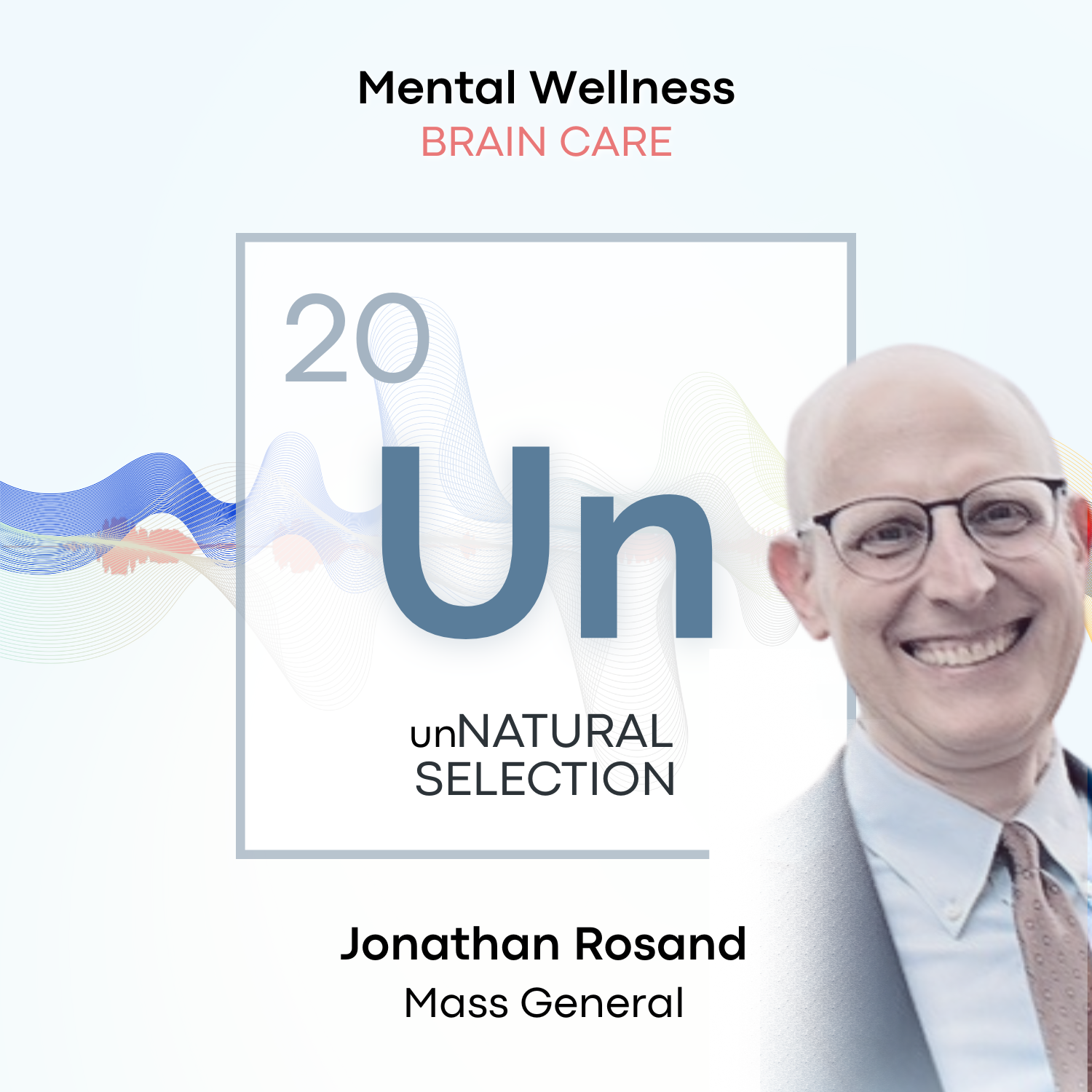
Brain Care: McCance Center • Jonathan Rosand


Translating Complex Analytics into Actionable Behavior Change
What if we could prevent up to 40% of dementia cases, 60% of strokes, and 35% of depression—before they even start? In this episode, Dr. Jonathan Rosand, a neurologist and co-founder of the McCance Center for Brain Health at Mass General Brigham, joins us to discuss the McCance Brain Care Score—a powerful new tool designed to measure and improve lifelong brain health.
We explore the science behind brain disease prevention, the challenges of translating risk into action when mechanisms remain uncertain, and why brain care must become a global movement. From digital health to social change, this conversation dives into the urgent need to shift from reactive treatment to proactive brain resilience—and what it will take to get there.
-
(Auto-generated by Spotify. Errors may exist.)
Jonathan Rose and MDMSC is a physician scientist at Massachusetts General Hospital, professor of neurology at Harvard Medical School, and Associate member of the Broad Institute.
A global leader in brain health innovation, he has spent over 2 decades advancing how we prevent and treat brain disease like stroke, dementia and depression.
1:27
Doctor Roseanne pioneer the use of genetics, imaging and big data and stroke research, founding the International Stroke Genetics Consortium in the Cerebral Vascular Disease Knowledge Portal.
He also built Mass Generals Neurocritical Care Division into a world leader and Co founded the McCann's Center for Brain Health to promote lifelong brain resilience.
1:49
In 2023, he launched a Global Brain Care Coalition, GB CCA public private effort to reduce brain disease worldwide by 30% by 2050.
Central to this mission is the Brain Care Score, a tool driving innovation and personalized prevention, digital health and AI.
2:05
Doctor Roseanne's work is reshaping our society's value and invest in brain health, offering bold, data-driven solutions with global impact.
Jonathan, please welcome to Unnatural Selection.
2:18
Speaker 1
It's a pleasure to be here.
Thanks very much for inviting me.
2:22
Speaker 2
I always start with the same level setting question, Jonathan, just to give some context to the listeners.
So, in your words, what need or impact drives your work and how do you view your role in addressing it?
2:34
Speaker 1
Our work now is focused entirely on solving one clearly defined problem, and that is that roughly 45% of all dementias, 75% or more of all strokes, 35% or more of all depression can be attributed to risk factors that we can modify ourselves.
2:56
And yet there is no systematic approach to taking advantage of this knowledge.
And so we have an opportunity to prevent brain disease, the most common and debilitating of them, but we don't have the tools to do it.
3:13
So we embarked on developing those tools.
And our vision is that in order to enable individuals to make choices every day, to modify their risk factors, individuals must have the knowledge and the resources to make those choices.
3:34
And that's what led to the development of the Brain Care Score.
3:38
Speaker 2
For listeners that may not be familiar with your field, how would you describe the McCann's Brain Care score and the broader vision behind the Global Brain Care Coalition?
3:48
The McCann’s Brain Care Score
Well, let me take a step back and sort of start with kind of the origins of our thinking.
So I'm a neurointensivist and as a neurointensivist, I take care of the worst of the worst head injuries, bad bleeding in the brain, bad strokes, spinal cord injury.
4:10
And my colleagues and I made an observation early on among those people who recovered from these injuries as well as their partners, caregivers, spouses, and that is that there were very high rates of depression, anxiety and post traumatic stress at three and six months.
4:31
And these were in people who hadn't had any history of these conditions prior to they're being admitted to the ICU.
So on the basis of that observation, we decided to try a primary prevention approach in the ICU.
4:48
We partnered with a team of psychologists who developed simple skills and educational tools, mindfulness tools, trained patients and their caregivers in these, the use of these tools.
5:06
And what we found was this intervention early on, no medicines involved had a profound had profoundly reduced the risk of developing these mental health conditions.
So it was then that I began to think, well, maybe we could take this approach and start to tackle a really large scale opportunity, in this case dementia and stroke and depression.
5:34
And so with, on the basis of that initial experience, we began to work with patients and families and practitioners to try and understand why it is that despite the fact that we have decades of epidemiological data firmly linking a range of risk factors, modifiable risk factors to risk of these conditions.
6:01
Why is it that we haven't been able to convert that knowledge into action, convert that knowledge into resources that each of us can use every day to actually take the steps we need to take to reduce our risk of these conditions.
In fact, if you look at just hypertension, which is a risk factor over the last two decades, rates, rates of hypertension control have actually gotten worse, not better.
6:28
And that's true for quite a few of the other risk factors for dementia, stroke and depression.
So what one of the things that we learned in talking with patients, families and practitioners was that everybody was used to having information handed to them, but there was no way to understand directly from the information that individuals received what they should do tomorrow or when they went home.
7:01
So that led us to developing a score so that each step that one took would raise your score and reduce your risk, theoretically.
And what we learned importantly, was that health is a term that is very confusing to all involved.
7:25
So when we would talk about brain health with patients, we would be repeatedly questioned along lines of, well, you told me that my husband had a stroke.
And when when someone has a stroke, part of their brain dies.
So how can his brain ever be healthy again?
7:42
Or I understand what you're saying about a healthy brain, doc, but does that mean that my son, who has schizophrenia will never be able to have a healthy brain?
So we learned quickly that discussing health immediately raised all sorts of uncomfortable questions and in general, risked exacerbating the stigma that is associated with brain disease.
8:08
And so over time, listening to patients, what became clear is that patients were asking, what can I do to take good care of my brain so I don't end up like my brother with dementia or my mother?
And so that's how we began to frame all of this from the perspective of care.
8:28
And that, I think is the key innovation is that this score takes decades of knowledge and distills it into simple steps that anyone can take to take better care of themselves.
It puts the agency, it puts the decision making into the hands of the individual.
8:48
And that's how we got started.
And then there's lots of exciting stuff that's happened since.
But I think that's the kernel and that is the tool that we've used to scale.
And we're thrilled that it's being embraced in lots of communities around the world and in fact, is currently being embraced as part of the new Medicare Guide opportunities to deliver primary prevention to the family members of individuals with dementia.
9:21
So lots, lots of opportunities built on this simple model of conferring agency on individuals in response to their curiosity for something they can they can do, some control they can have over their future.
9:35
Speaker 2
That's amazing.
So the, the, this scoring tool, it's more than just a risk stratification tool.
It also guides the user on how to optimize your score.
It's not a, it's not a static score.
It's actually something you can modulate depending on your behavior.
9:52
And the, the numbers that you gave are, are staggering.
I mean, you know, over you said it's possible to prevent over 35% of depression and a significant percentage of dementia and strokes.
10:04
What makes the Brain Care Score possible and what’s standing in the way of achieving it?
What makes those levels of prevention achievable and and what's standing in the way of getting there?
10:11
Speaker 1
Well, the Brain Care score includes 12 robustly confirmed risk factors that you can modify.
But as we all know, behavior change is hard.
10:27
So even treating hypertension, which for most of us who have hypertension involves taking one or two medicines, maybe 3, even that, which would be a simple act by most estimates, is hard for people to do regularly either.
10:46
We have all sorts of feelings about taking medicines.
For some of us, any medicine we take is a reminder that we are somehow sick.
And so we want to put off the medicine and give ourselves the sense that we don't need it.
11:02
When of course, if we want to reduce our risk of developing these conditions, we we do need it.
So what what the score does is it allows you to choose where to start.
And that's what we found to be really embraced by the patients with whom we've worked because you, you don't have to do what somebody else tells to you.
11:28
You're given a choice and you can take the first step.
So an example that I often cite, because it happens so often in my office, patient will come in and say, doc, I don't want to talk about losing weight.
I know I have to lose weight.
11:43
You don't need to tell me.
Well, it turns out that your BMI, you know, optimizing your BMI, is a component of the brain care score, but it's one of 12.
So you know what?
We never talk about it.
But the great news is, you know, once you move one lever on the score, the others will move as well.
12:03
So all they have to do is choose to start somewhere else.
And if they do want to work directly on their BMI, they can, but they needn't.
And they can still substantially reduce their risk of dementia, stroke, and depression.
The other thing I'll add, yes, we've done a whole range of validation studies where we've looked, we've reconstructed the score in these large cohorts of people who've been studied in Europe and the US.
12:30
And what we find consistently is not only does a higher score correlate with lower risk of dementia, stroke and depression, it also correlates with a lower risk of heart disease, lung cancer, breast cancer, colorectal cancer.
12:47
So we actually see this project now as a refashioning of how primary prevention could work, bring it directly to the hands of the consumer, that is you and me.
It doesn't have to be in the doctor's office.
13:06
And it gives people a road map and what we like to say, you know, I'm a neurologist, so obviously the brain is very important to me.
But if all of primary care from adolescents onward consisted of just getting your brain care score optimized, Can you imagine how different the world would look for all of us?
13:25
So very, very simple.
And scaling it now is our next goal.
13:32
Speaker 2
Yeah, I love it.
It's kind of like a combination of an incentive system, gamification and empowering users.
You, you mentioned there, you know, it's, it consists of about 12 different risk factors that you try to optimize for, but then the user can kind of pick their own journey, right?
13:48
It's like, yeah, you're not prescriptive.
Like you need to start with weight, pick one of the 12, and then they all kind of work together, which makes sense because I've noticed in myself with my, my diet tends to follow my exercise patterns.
If I drop out of doing exercise, my diet goes downhill.
14:04
And vice versa.
If I'm really getting into exercising, I tend to watch what I eat a little bit more out of those 12.
And you mentioned hypertension, so clearly that's one of the important ones.
They're not likely all equally as important to the overall formula, right?
Are there some that you're like looking for to modulate more than others?
14:22
Speaker 1
Well, that's a question we get all the time.
Doc, what's the one thing I should change?
I mean, of all these 12, and what I say is the most important thing is that you raise your score.
So however you can raise it, raise it.
14:39
What we've learned from our research is that it really doesn't always.
There isn't a reliable component that everybody has to focus on to get the biggest bang.
It really means if you raise your score of five points, no matter how you get it up, you get a large impact on your risk.
15:00
Now, if I put on my epidemiologist hat, I think if we were able to cure the world of hypertension, that would be a huge, a huge thing.
So I'm, I'm partial to hypertension, but you know, we're talking about engaging ourselves in a lifelong journey.
15:22
So we wanna make it as easy as possible for each of us to stay engaged.
And we're gonna, each of us have to figure that out for ourselves.
The message here is that we're doing the hard work of giving you the best science.
15:37
We're always updating things.
We've got a new paper coming out that's gonna update the brain care score, but we're not here to sell you anything.
We're not here to advertise anything.
Our goal is to take all that's been learned over decades and translate it into bite sized chunks for everybody to make their own.
16:00
Speaker 2
Yeah.
And you know, you're talking about obviously prevention, and there's no better place to start with prevention than early on.
16:09
Early detection and prevention
Do you find that a lot of times people come to you when they're already starting to see symptoms, by which point it might be not too late, but the effects of the preventative measures are going to be as profound as you know versus starting at 30 or 20?
16:25
Speaker 1
Well, here's the.
Here's the piece of information that's really changed the way I think about this.
We've actually done surveys of adults, you know, web-based surveys of American adults, average age 45.
16:42
And when we asked them, do you or your intimate partner have close personal experience with dementia, stroke, more than 75% answer yes.
If you add in depression, that answer goes up to nearly 100%.
17:00
These conditions are really affecting.
They affect the people who care about the person who's affected.
To watch somebody with one of these conditions is to watch their dignity, be, you know, impaired, lost.
17:19
It is to have a sense of helplessness.
You, you love this person, and there's nothing you can do to alleviate their suffering or restore their dignity.
And So what we've learned is that once you expose people to the experience, remind them what that experience was like, and then you say, hey, but did you know that dementia, stroke and depression can be prevented?
17:44
The light bulb goes off and it's so reassuring.
It opens up an opportunity that many of us just didn't really think existed.
That's the engagement piece that we think is going to be part of this scaling of this program and crucial to the to its success.
18:06
In other words, dementia, stroke and depression are part of the universal human experience.
Let's leverage that to prevent it.
Now, as we think about scaling, I can also offer you some of the observations that any parent I think in in the US would would have already been exposed to.
18:31
You know, kids as they're growing up, they start to think about brains, their brains, whether it's an elementary school.
And you start to, you know, you see neurodevelopmental differences among your classmates and your friends.
You get into slightly older grades.
18:48
ADHD.
Everybody's talking about ADHD, and then mental health takes over as a preoccupation in adolescence.
And if you look at college newspapers, the ads are overwhelmingly for things like ADHD coaching and therapy, mental health interventions, stress management.
19:12
So our brains are really part of our daily lives.
So we think that by engaging in that aspect of our of each generation's experience, that's a way in.
Now we have to prove it, but that's our approach.
19:30
Speaker 2
It's fascinating.
And, you know, one of the main forms of dementia that society's been focused on for the last few years is Alzheimer's.
19:42
How the scoring tool has worked with Alzheimer’s disease
And they're, you know, it's still debatable what the underlying mechanisms are.
You know, I don't think anybody really knows.
And so how has this scoring tool and mechanism worked with diseases like that, where it's unclear exactly what the mechanisms of action are, but they clearly aligned with a lot of the risk factors that you're already working with?
20:03
Speaker 1
Well, one of the things I think we, the the biomedical community has learned, and this is, you know, it's because of the billions of dollars of taxpayer investment in the NIH over the last 50 years, is that the body just isn't that complicated.
20:20
And so while we don't understand the specific mechanisms that lead to a condition like Alzheimer's with sufficient, you know, precision so that we can tweak, start to tweak things and reverse it effectively or although we're getting there or or prevent it in a, you know, a, a very, very simple way.
20:43
What we are learning is that can many of these chronic diseases of aging share a lot of common biological pathways, inflammation, vascular disease.
And so that's where we think the sort of common paths are focusing and all of the risk factors that you modify through the Brain Care score all end up reducing inflammation.
21:10
They are cardiovascular risk factors as well.
So they improve your cerebral, vascular and cardiovascular health.
So it's probably a combination of all of that.
And then exercise has so many benefits.
It was just a really interesting article on on some of the molecular changes triggered by exercise that seem to be associated with reduction and neurodegenerative disease and animal model.
21:35
So it's just that I just think the body isn't that complicated.
At least it's not too complicated for us to to care for it.
21:44
Speaker 2
OK, you know it.
Last two questions.
You've been so generous with your time.
You mentioned changing behavior can be hard at the health system level.
It's also difficult to change behavior from your traditional reactive form of care, which is, you know, let's act on this, especially brain related conditions when symptoms appear to a proactive and preventive form, which fundamentally our our health system as a whole doesn't really operate in a way that encourages that.
22:22
How to make preventive care a part of healthcare
So how do you see this system becoming a part of care in the US or abroad?
Are you finding that going direct to consumers is one way, or do you have to change the way that help providers think about prevention?
22:37
Speaker 1
There's a lot to unpack there.
Let me give you a couple of examples.
I think fundamentally prevention has to be direct to consumer because it's all about what's happening every day outside of the doctor's office and the doctor's not following you around, you know, remind you so.
22:58
So I think we have to accept that prevention is a direct to consumer compact.
It's a direct to consumer opportunity.
That having been said, there are lots of ways the healthcare system can incentivize it.
23:15
And there are some really innovative changes being made in some of the ways in which Medicare reimburses that are providing opportunities for the brain care score to be scaled and offered as part of, for example, the, the guide program, the recently revised Medicare Guide program.
23:37
And we're thrilled to be working with a bunch of partners in that space.
And part of the way in which that care and the brain care score is being delivered in that program is through independent pharmacies.
So physicians don't even get involved until, you know, later on in the stage of engaging the consumer.
23:56
So that's one.
The other is though, it, it goes back to my experience in genetics.
Just just like you, we we know you know what what our vision for precision medicine has been since we began to start understanding the entirety of the human genome.
24:16
Well, prevention has to be thought of as precision in the same way, because each of us not only carries A relatively unique genome, we also carry a relatively unique set of experiences that we've lived through in environmental exposures.
24:31
And so any effective prevention has to be tailorable to the individual and the brain care score.
Therefore, it's not going to be the same in every community, it's not going to be the same for every generation, but the concept and the values of the brain care score will be the same.
24:49
And so we're doing a lot of work with collaborators around the world, and that's what the Global Brain Care Coalition is about, figuring out what the needs are, the different populations we'd like to work with, having them tell us how they think the brain care score will work, and then we test it out.
25:06
So that's how we envision scaling.
And of course, fundamental to any effectiveness is demonstrating that outcomes change.
So we have assembled what we're calling a learning healthcare system without walls, and at the center of that is going to be counting cases.
25:25
We have to really improve the the precision with which we're measuring ultimately diagnosis of dementia, stroke and depression around the world.
And that's that'll be the subject for another podcast.
Well.
25:36
Speaker 2
That's amazing and and I do believe you know those the application and use will be different from place to place.
I really enjoy looking at the fields are exploring prevention through the lens of multiple determinants.
It's not just, you know, your genetics and your clinical, but your environmental, your socioeconomics, your behavior, all those things play into your outcomes.
25:58
So to finish off looking ahead, what's 1 insider lesson you've gained that could reshape how we protect brain health across a lifespan?
26:06
What’s one insider lesson you’ve gained that could reshape how we protect brain health across a lifespan?
What do our listeners need to understand about where brain care is headed next?
26:10
Speaker 1
Well, one of the components of the Brain Care score, actually 3/3 of the components are social emotional, one of which is meaning in life, the other is social connectedness, and the other is stress reduction.
26:26
And one of the things that we've learned is how important that social emotional piece is to human health.
And our patients who use the Brain Care Score come back to us consistently to report that sharing the Brain Care Score with others gives them enormous satisfaction.
26:49
So what is prevention going to look like?
I think it's going to be a social project.
I think it's going to be one that involves the building of connections in communities.
I, I liken it to, you know, we learned that when there's a pandemic, as we recently lived through, everybody has a job to do.
27:13
For some of us, it was checking in on elderly relatives who were quarantined or who were, you know, isolated in a nursing home.
For others, it was homeschooling our children.
For others, that we were essential workers, but nobody will tell you that their live was their lives were not altered in some way, that they hadn't picked up some sort of a new job.
27:32
Well, the pandemic of dementia, stroke and depression dwarfs in terms of impact the pandemic that we just lived through of COVID.
So when I talk about taking action this way with patients, you can imagine how energizing it is when they realize, oh, there's a pandemic.
27:51
This is what I can do to help myself, and I can share this with my family and friends.
So imagine if each of us took that step, social contagion as it were, we would lick the pandemic.
28:05
Speaker 2
I, I for one, definitely know people that are afraid of dementia that runs in their family.
They're taking precautions right now and I I'll definitely be passing this on to them.
Jonathan, congratulations on tremendous work and, and just such a stellar career so far.
28:22
Of everything that you've done.
It was a pleasure speaking with you and unpacking some of that today.
Thank you for being an unnatural selection and I look forward to meeting you at the World Medical Innovation Forum later on this year.
28:34
Speaker 1
Thanks, Nick.
It was a pleasure to chat with you and it's great to meet you and I'm I'm looking forward to continue the conversation.
