
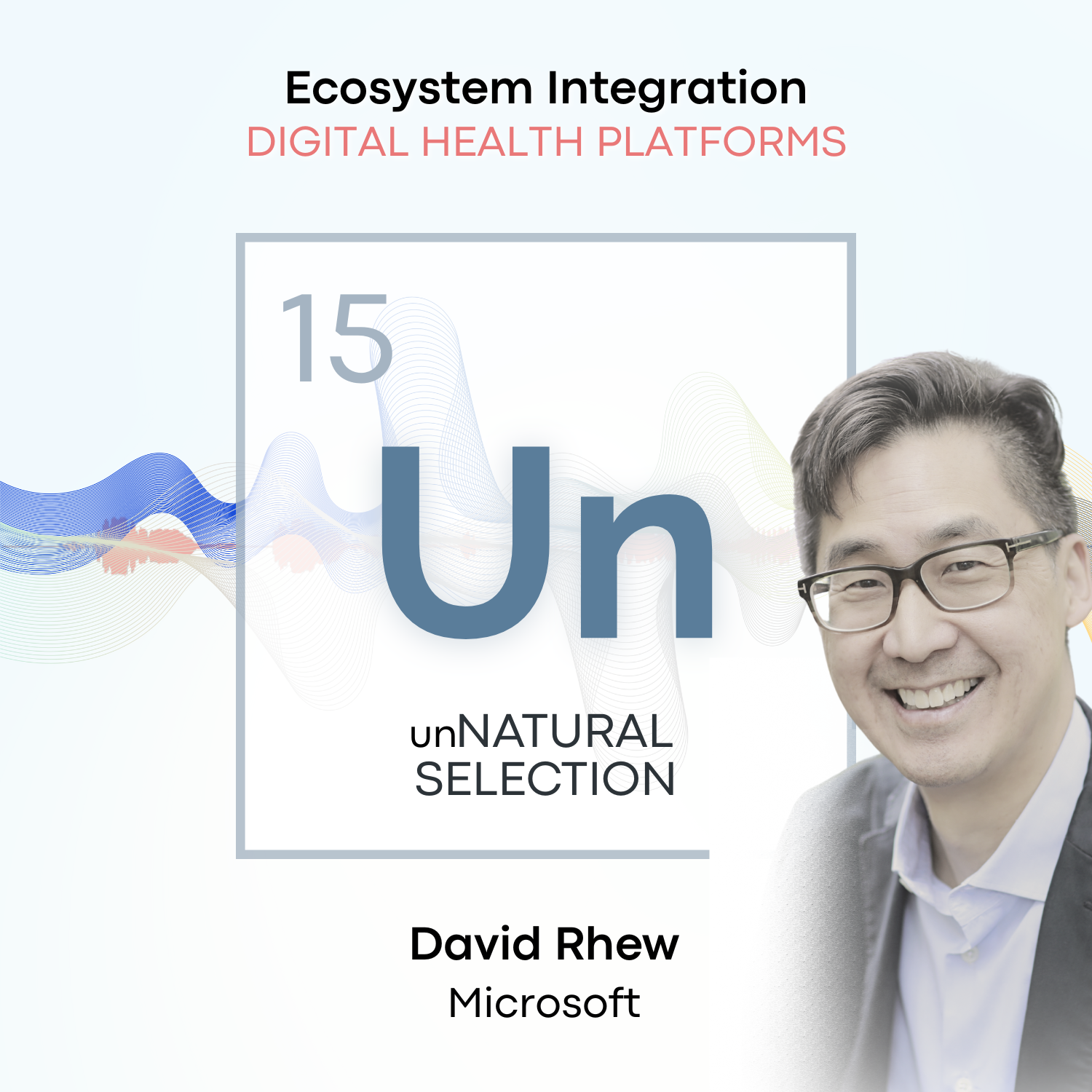
Digital Health Platforms: Microsoft • David Rhew


Platform Playbooks: Scaling Integration Over Point Innovations
Microsoft’s Approach to Healthcare Innovation. In this episode of unNatural Selection, we sit down with Dr. David Rhew, Global Chief Medical Officer at Microsoft, to explore the cutting-edge innovations shaping the future of healthcare.
From leading pandemic response efforts to guiding Microsoft’s transformative healthcare strategy, Dr. Rhew shares insights on how AI, cloud technology, and evidence-based solutions are revolutionizing care delivery on a global scale. He discusses the challenges of navigating diverse healthcare systems, the critical role of trust in tech adoption, and Microsoft’s bold vision for the next decade of health — one that promises to radically improve health outcomes and redefine how we think about patient care and well-being.
-
(Auto-generated by Spotify. Errors may exist.)
David is Microsoft's Global Chief medical innovation officer, VP of Healthcare.
He has served as Microsoft's International coordinator for the Pandemic Response, working with AWHO to develop their World Health Data Hub, CDC to stand up their vaccine data lake, and U.S. states to roll out COVID-19 vaccines.
1:40
His adjunct professor at Stanford University holds six US technology patents that enable authoring, mapping and integration of clinical decision support into electronic health records and has been recognized as one of the 50 most influential clinician executives by Modern Healthcare.
Doctor Wu received his Bachelor of Science degrees in computer science and cellular molecular biology from University of Michigan.
2:01
He received his MD degree from Northwestern University and completed internal medicine residency at Cedars Sinai Medical Center.
He completed fellowships and health services research at Cedars Sinai and infectious diseases at UCLA.
He served the CMO for Samsung and Zynx Health and SATA National Quality Forums executive CSAC board.
2:22
He's chair emeritus for Consumer Technology Associations Health Technology Board and currently serves as ADVA Meds Digital Health Board, the governing committee for an SCC, the the Medical Device Advisor Group for FDACMS and NIH, and the board of directors for Cedars Sinai Medical Center.
2:41
David, welcome to a natural selection.
2:43
Speaker 1
Thank you, Nick.
I'm excited to be here.
2:46
Speaker 2
Congratulations on everything you've accomplished.
I was there.
There's no way I was going to read that bio in one breath.
2:53
Speaker 1
Yeah, or you can go really fast, right?
2:58
Speaker 2
Just to to level set and for the sake of the listeners who who may not know and and would always appreciate hearing it in your own words, I start with the same level setting question.
3:07
What drives Microsoft’s work and how do you view your role in addressing it?
So, if you will, what need or impact drives Microsoft's work, and how do you view your role in addressing it?
3:14
Speaker 1
Yeah, it's really interesting because I would say when Microsoft first started, it was about the technology.
The the mission was put a computer on every desktop and in many ways we looked it through the technology lens.
But much of that has changed over the past decade where we're starting to realize that that the technology can be a great enabler and to enable things means that we can accomplish things that we could never have envisioned before.
3:40
And that transformed our entire business.
So now our mission is about empowerment, empowering every individual, every organization around the world to be able to do more, to be able to think boldly about things that were previously difficult or impossible and see if technology can help us.
3:57
And so my role is a bit of that translator ambassador for how this technology is applied in the healthcare space, working with healthcare organizations, whether they be providers, payers, pharmaceutical companies, medtech, you know, a variety of other groups that are thinking about these major problems that they have, but understanding that technology could be a great enabler.
4:19
But how can I do it?
And so I I really work to try to figure out how we can bridge that gap.
4:24
Speaker 2
That's exciting.
So as Chief medical officer, your purview is really looking at how Microsoft delivers this technology to enable healthcare.
4:32
Speaker 1
Yeah, it's the researchers, it's the clinicians, it's the organizations that are managing the data and managing the individuals lives.
And ultimately it's about the patient.
How do we actually help improve the lives of the patients, improve access to care, find ways that we can improve the quality and the safety of the care, and as well as improve the experience for both the patients as well as the providers?
4:57
Speaker 2
And Microsoft is a massive organization, and you cover not only hospitals and universities, but entire nation states.
5:07
How clinical insights influence product development and partnerships at Microsoft
How do you ensure that clinical insight meaningfully influence the strategy, product development, even partnerships at that scale?
5:16
Speaker 1
Well, we often times, you know, think small or think big, but start small.
So many of the things will often times be piloted and tested in certain environments to make sure that this is actually working.
A lot of it has to do with workflow, you know, making sure that these technologies can be embedded into a clinical workflow and ultimately can lead to a good experience.
5:38
And then from there we think about how can we scale it, how can we bring it to different environments and how can we allow that to be something that is useful at multiple different levels.
And say there are many organizations that have a lot of resources that can take advantage of these, but there's also organizations that don't have as many resources.
5:56
And this is where technology can be a great equalizer.
It can help us bring a lot of the benefits that often times only go to the those that have the technologies and the resources to now everyone and anywhere around the world.
6:11
Speaker 2
Yeah.
And what you mentioned Microsoft as a technology enabler, how does Microsoft view its position in healthcare generally?
6:23
Microsoft’s position in healthcare
Is it more of an infrastructure provider?
I think you mentioned like an enabler.
Is it a platform for transformation?
All of the above?
6:33
Speaker 1
I think mostly it is about the platform, you know, trying to understand how can we build a platform starting with, we'll say data security is a foundation understanding how can we protect the data?
How can we ensure that the data is used properly within certain environments that meet certain standards, whether they be regional standards or country specific standards.
6:56
And then also building on top of that a capacity that allows us to be able to build the infrastructure to support large computations, large amount of data storage.
But from there, it really gets into the healthcare components of the data itself.
7:11
Understanding how data can be made or interoperable, leveraging standards like FIRE or HL7, OMOP, understanding then how the data sets themselves can be used as sources of information for AI to be tested upon.
And then building on that with multiple different types of AI capabilities.
7:31
And I think what we we've then realized is that one other element is how do we orchestrate all of that in a way that is seamless, enables computer human interactions to be done synchronously, asynchronously.
All of those are things that Microsoft spends a lot of time thinking about the technologies and how they can be deployed.
7:50
Now one could say, well, why don't you go the whole way and just kind of build all the products that need to be done?
Well, that's really where we stop.
Our goal is empower an entire ecosystem of clients and partners so that they can solve the problems, they can leverage these technologies and not have to deal with a lot of the things that we view as infrastructure.
8:09
Our goal is to make them more successful, more efficient and ultimately able to deliver on more innovation.
8:18
Speaker 2
You know, it's funny because you, you kind of read my mind.
And when you say, why do people say, don't you, why don't you just go all the way and build these products?
Because I was thinking like a Microsoft EHR would be amazing.
But to your point, you're enabling these partners to build on top of the infrastructure that Microsoft is building.
8:35
Speaker 1
Absolutely.
And you know, one of the things that we realize is that every industry is starting to look at not only the technology infrastructure, but how AI will transform the experiences.
And so as part of that, you know, we're starting to think about, OK, well, what is that next generation of AI we started with, you know, I'll call it more predictive type of AI.
8:56
Generative AI became an extremely powerful mechanism for us to be able to have conversations and learn more about how technology or AI can help us on our complex tasks.
But we're now starting to move into the world of agentic AI, where things will become much more automated.
9:12
And that's such an exciting time because we're able to improve not only the efficiencies, but deliver on things that in the past only an individual could do, but now we can do this at scale.
9:25
Speaker 2
You said something earlier also that really resonated because obviously have known about Microsoft for a very long time and even work with it in certain cases.
9:33
Microsoft’s Enterprise Strategy
And I've always been impressed that number one, Microsoft is very much an enterprise play.
I mean, you do sell straight to consumers, but you have a whole division that identifies with the enterprise.
And the way that I've always from the outside looked at Microsoft's innovation is Microsoft doesn't necessarily have to be the first mover in something.
9:53
It could be a very quick follower, but everything you do is aligned and almost developed in partnership with your clients.
Like you're embedded in there.
You understand their workflow, their needs, their challenges, and then when you actually roll something out, it usually fits right into that workflow.
10:11
Speaker 1
Yeah, you're absolutely right.
And that is one of the things that I feel Microsoft has truly embraced the fact that the technology is an incredible component of how we can solve problems.
But it does have to be used by individuals that are using particular systems that are used to a certain type of workflow and that are looking for efficient ways to deliver on their practice.
10:36
And that is something that Microsoft has been spending a lot of time, whether it's starting with Microsoft Office and PowerPoint and all the Word and Excel and all the tools that improve workflow efficiency within a office or a, a, a business, to now starting to expand that with Co pilots that allow us to be able to then accelerate that.
10:55
And now what we're starting to do is we're starting to realize that we can actually start leverage the large data sets that are available, bring them into systems like Azure or platforms like Azure that allow us to be able to do the computations and the determinations of what is it that we not only see or could see, but also predict the future of where we're heading.
11:15
And this is where it gets really exciting because the more that we can actually start moving away from solving the problems for today, but looking at the problems in advance and being able to then become more proactive, we're going to be able to get in front of these things and hopefully lead to better health outcomes as well.
11:31
The future of healthcare
Yeah.
And I suspect I already know part of the answer here because you've mentioned AI, but obviously there are a lot of tech giants expanding into healthcare.
There are a lot of traditionally non healthcare companies looking into healthcare for obvious reasons.
So the the size of the market, the amount of data that's associated with the impact that it could drive as well.
11:52
And So what where is Microsoft placing its biggest bets over the next say 5-10 years?
11:59
Microsoft’s biggest bets in AI
I suspect AI is one of those.
But generally speaking, what are the areas that where you feel that you're most competitive and have the highest stakes in in certain spaces in healthcare?
12:13
Speaker 1
Well, AI is not like one thing, it's many things.
You know, there's the infrastructure that's required to support AI, you know, whether they be data centers and large computations.
And so obviously, there's a tremendous amount of research and development and a whole bunch of other types of deployments relative to infrastructure.
12:33
There's the development of the models themselves and refinement of the models and understanding how we create new benchmarks and understanding how it gets integrated into workflow.
We're starting to move into implementation science to truly understand the different ways that AI can be applied.
12:48
And ultimately, it's about trying to create something that creates value that that leads to better outcomes, whether the health outcomes, financial outcomes, increased access to care, and that things that people can adopt.
One area that we're starting to explore a little more as well is the people element.
13:06
How do you get people to be able to feel comfortable, you know, trusting in the AI, responsible AI, understanding the skills necessary to be able to do this, to be able to upskill, reskill individuals and organizations.
And we're starting to realize that that's more than just simply taking classes.
13:22
It's about truly understanding how different partners can work together from the academia side to the industry side to be able to create programs that enable experiences that teach people how to do things.
And this is all super exciting.
13:37
It's a massive undertaking.
And we're one part of this broader, I guess, the approach to how AI will be transformative, but it's all done in collaboration with multiple stakeholders.
And that's really one of our kind of key philosophies that, you know, we, we're, we're a part of this, but we want to be an enabler for others to be able to be successful.
14:00
Speaker 2
Yeah, you mentioned a couple things there.
You mentioned implementation science.
You also mentioned trust with the end users and in a big part of implementation and implementation science is obviously the clinical side.
But then there's also that part about educating patients and, you know, there's training clinicians and all that stuff.
14:20
But on the other end that, you know, patients need to be comfortable with the treatment or therapy being provided or offered to them.
I deal with this a lot because I'm in the genomics world.
And that's a really hard space to try to.
It's such an abstract way of thinking that you try to explain that to a patient in 30 seconds becomes really hard, becoming even harder.
14:41
So with a lot of misinformation around data, particularly health data.
14:45
Misinformation in healthcare
And I'm sure you dealt with tons of this.
I mean, you were at the COVID-19 task force and vaccines and so on.
Is Microsoft doing anything or thinking about that space, or doing in anything in that space around misinformation or trying to get the right information to the right people?
15:02
Speaker 1
Well, you know, this is always one of the main things that we're focused on.
How do we get the right data?
And it's interesting because even in systems that we have that we trust, like the data in the electronic health record, not all of that's accurate.
There's a lot of cutting and pasting and duplication of things.
15:19
And ultimately, it may not be current or may not be representative.
What's going on?
So understanding data, getting the data so that we can trust the data, that to me is a massive undertaking.
And we're starting to realize that the larger, the more diverse the data sets and the cleaner and more accurate there are, the better able we're able to deliver AI that will leave to the best results.
15:45
And so it's really both things, the data and the AI and the models that that allow us to be able to achieve those results.
So to some degree, yes, that's a big part of what we do.
We've also realized that it's not again, just about the technology.
In fact, during the pandemic, one of the things that we had to do was we had to find ways to get people to trust the vaccinations were the right thing, specifically the COVID-19 vaccination when we didn't have long term data on it.
16:14
We didn't know, you know, all these questions that people had, we knew a lot from what was already studied, but they were unanswered questions that were also there.
And one could say, well, if you don't have enough information, why would we do it?
At the end of the day, it comes down to trust.
16:30
And So what we realized is that the best way to instill trust is not only provide, you know, the right information, the right models, but work with people that are trusted leaders in the community.
And these may not necessarily even be healthcare leaders.
16:45
They could be reverends, pastors, school teachers.
They could be a community leader for a certain ethnic group that, you know, only speaks a certain language and and we haven't been able to communicate directly in that language to them.
17:03
Understanding the cultural issues that that was critical, bringing in the individuals, the community based organizations, the nonprofits to be able to work with us to be able to deliver on those messages.
And I think that that's ultimately how we're going to move the needle by working in collaboration with not just your traditional stakeholders, but also your non traditional stakeholders who often times are trying to do the right thing, but may not necessarily have the right connections.
17:31
Speaker 2
And of course, there's the clinicians.
17:32
The ideal relationship between AI and clinical judgments
And often times clinicians are overwhelmed already with the amount of technology, new technology being thrown at them.
AI is no different than that.
With every company out there racing to get AI products, what's your view of the ideal relationship between AI and clinical judgments?
17:51
How do we how do we prepare the next generation of clinicians to work with AI as a trusted partner versus a threat or a distraction?
17:59
Speaker 1
So that's a great question and there's many aspects to it.
First, the whole issue of AI performing better than what we had originally envisioned.
We were we had certain benchmarks and it's just continuing to get better and better.
But in order to instill trust, you really do have to kind of ask like, what is it that clinicians care about and what is it that patients care about?
18:22
Well, I think clinicians care about being able to get an answer in a timely manner that they can rely on, that they can feel is safe.
And, and, and, and you've thought of the different considerations and, and that ability to be able to synthesize multiple sources can clearly be done better faster through AI than it can be through a human.
18:41
So if you were to say, well, let's, you know, I've given you this whole medical record and I want you to provide the best treatment option for this patient and you've only got 5 minutes, well, it's kind of hard to be able to then do that.
But if you, you said, well, the AI reviewed it and they summarized it and here are the key things.
19:00
And we've organized it into a longitudinal timeline and I feel pretty confident that this timeline is correct.
I can make that determination.
So it's really the computer or AI assisting us on these very difficult things to do, very time consuming, but us ultimately making that decision on what needs to be done.
19:18
And to me, that's that that's how you build trust.
It's, it's about AI doing what it does really well, humans doing what it does well, but really kind of working together on that.
Now patients, they care about what their doctor says.
If the doctor trusts that this is the way to do it, they may not understand how the AI works, but if they know that the doctor understands that this is the way that, and I trust it, That's pretty much the way.
19:44
Like as a patient, most patients don't understand the complexities of doing a certain procedure, but they trust that you went through the direct training and you know how to do it.
So I think that's, that's really what we have to do.
It's trusting in the individuals who now are trusting in AI.
20:00
Speaker 2
Interesting.
And and of course most clinicians operate within health systems and Microsoft being a major player in infrastructure, what do you see is the the kind of institutional adaptations that are needed to keep up from hospitals, health systems and so on?
20:21
The challenges of implementing AI in healthcare
Obviously a lot of stuff is in the cloud, but they don't all fully operate on the cloud.
There's going to be a lot of on premise technology.
What are the kind of things that kind of conversations you're having with hospitals that are obviously believe in the AI wave and they believe in the technology that it's going to be coming along their way.
20:37
They want to adopt it, but change is relatively slow in hospital systems.
There's a lot of regulation.
There are a lot of systems you can't just RIP out and replace.
So what do you see as kind of like the biggest challenge is to get this kind of like AI first environment and health systems within the US at least?
20:52
Speaker 1
So there's two different ways you can approach it.
One is you can say I'm going to license or purchase AI that's already been out there.
You know, it's maybe vetted, it's not commercially available.
Then there's the other is I'm going to build my own AI and there's a lot of great tools and capabilities that you can do.
21:08
And there's probably some mixture of both.
Where you put your emphasis and how much you put on one versus the other is entirely based on your own resources.
But at the end of the day, you need governance around this.
You need to know how much AI do you have out there?
What's clinically relevant?
21:24
How do you actually manage that?
How do you ensure that this is actually been tested on the data sets that you're continuing to monitor outcomes?
And, and those are the types of things that we don't see a whole lot of today.
A lot of organizations, they're very excited about AI, but they haven't necessarily put in the mature governance processes around it.
21:44
And, and that's something that we at Microsoft have been thinking quite a bit about as well as a lot of our clients have.
And So what we did is we formed an organization in collaboration with our partners called the Trustworthy and Responsible AI Network.
A big part of that is to answer 5 questions. 1, you know the AI that's running in your system today, which is sort of like an inventory process. 2nd is have you tested the models on local data sets or data sets that are large and diverse and representative of your population?
22:15
3 have you monitored to see whether or not those models are still working and the outcomes are what you expected and not only the patients that you're seeing, but also in subpopulations?
4 have you looked for bias not only in the models but also in terms of how it's implemented?
22:32
And lastly, do you have a streamline governance process, 'cause if it's you're about throwing a lot of people and having a lot of meetings, you're not going to get a whole lot of AI managed and governed.
You're going to need to have to do this in a way that is scalable.
And, and what we came to the conclusion is that technology can help us tremendously.
22:50
The more that we can automate this, the more that we can collaborate with others so we can divide the workloads and different folks can be capturing this information and sharing information.
And the more that we can offload it to other groups like technology companies that can do the testing and monitoring for us, that's really the only way that we can scale it.
23:08
And and that's the a big area of focus for us as well.
23:12
Speaker 2
Yeah.
I mean, it's critical.
And, you know, when we talk about the regulations and the policy around this, you know, it feels daunting because technology innovation and adoption historically is taking a long time to fully adopt societal levels, right?
23:27
The challenges of AI regulation
Whether you're talking about electricity or even cell phones, televisions, you know, they usually have decades in the process of kind of like discovery to full adoption.
And so society can usually cope with the pace in which these things are adopted.
23:43
All of a sudden we get to modern date, and this has been happening for years now, but a state of almost hyper innovation where AI is evolving at a pace where it feels like one month after the other.
It's a totally different conversation.
I would hate to be in the shoes of regulators and policy making people trying to figure out what rules and what guardrails to put around something that is so squishy and fungible.
24:06
It is not fully mature and it seems like it's only just getting started.
Do you find that these these rules that you, you guys came up with apply generally or do you feel like it's, it's hard to put your finger on where that metric is from one month to the other?
24:24
Maybe in hospitals is different because they have to implement it within an organization, but it just feels like the innovation is happening faster than we can put these guard rails around it.
24:33
Speaker 1
Yeah, I, I completely agree that the innovation is moving very quickly.
But at the same time there are opportunities for us to think about how we can put some general rules and guidelines and guardrails in place.
And, and I think the things that I talked about are questions that have come up quite frequently amongst the healthcare providers, but it could extend to pretty much every industry.
24:56
Those are the types of same things that everyone needs to be aware of.
Now, how do we ensure that we put in regulations that are appropriate because sometimes, you know, you may set a certain standard and that's going to change over time and and that may not be the right strategy at the present moment.
25:12
But talking about process like have you done, have you thought about these things?
Have you started to implement strategies for how do you address it?
That certainly is something that we all should be starting to think about.
Now there there has to be sort of a two sides to that.
There are well resourced sites that can do that type of work, but there are also sites that have like a one person IT department and they still want to take advantage of the AI.
25:37
How can they do AI responsibly and how can we govern that?
And so we need to make sure that no matter what we put out there, it can be applicable to anyone, whether they have high resources or low resources.
And I think to me, that's where we need to go through these public private partnership models, talking to everyone from regulators to policy makers to individuals that are stakeholders to understand what their concerns are, to talk to technology companies and healthcare providers to understand what's possible and to come up with something that we think is doable.
26:11
Speaker 2
You know, if we zoom out, obviously Microsoft operates in all kinds of environments and and when you look at it from a global scale, the healthcare systems cultures policy vary, you know, significantly from one country to another one.
26:28
Microsoft’s approach to innovation
So how does Microsoft approach innovation?
And in especially you try not to build A1 size fits all because that's not necessarily going to solve everybody's problems.
But how do you approach innovation when the variables such as these vary from country to country, state to state, culture to culture?
26:48
Speaker 1
Yeah, there are some common themes and then there's some unique aspects.
Common themes.
Everyone wants access to affordable, high quality healthcare at low cost.
You know, then everyone wants that.
Everyone's interested in making sure that we reduce patient safety events, that we improve the experience, that people feel that their voices heard universal.
27:11
But when you get down to the specifics of like where the what the infrastructure's like, you have some sites that have tremendous infrastructure that you can just literally plop the AI in.
It's well governed.
You have an ability to be able to test it and then you can deploy and get great benefit.
27:27
And then you've got other sites that may not even have access to affordable broadband, which is very difficult to run AI if you don't have any broadband or you don't have any ability to, you know, store the data in managed ways that you can actually access.
And sometimes the data sets themselves are incredibly messy.
27:46
They, they don't, they're redundant, they're inaccuracies.
And so we do need to think about making sure there's adequate infrastructure in place to be able to then deploy several of the things.
And it requires a different mindset.
I'd say one of the biggest things that I see is we apply as a Western standard of what is appropriate to everyone globally.
28:09
And we'll say, oh, wait a minute, you know, we can't deploy this because it's got a risk of making errors or hallucinations, but there is also a risk if you don't do AI.
So let's look at a baseline.
We baselined everyone in terms of what outcome we're looking for and we did an assessment that said if we implemented this, we were able to improve the outcome dramatically, but we were able to get some potential harm.
28:34
There's always a risk benefit for there, but in some cases where the, the care is so bad or the access to information is so poor that this dramatically improves it.
And even though there might be some risk, the, the overall benefit is huge.
And I think that that's something that we don't as living in a Western world and with developed, you know, kind of infrastructure.
28:55
We, we apply our own standards if, if the choice is between having no information whatsoever versus having something that seems to be pretty good but makes a few errors.
You know, the, the, the determination needs to be made by the organizations of the individuals in those countries as to whether or not that's a risk benefit and not by external groups.
29:14
And, and I think that's something that we're going to start realizing that a lot of this in terms of what is the most appropriate way to govern, what is the most appropriate standard will be done at a fairly local or regional level.
29:29
Speaker 2
And if Speaking of kind of like the the differences across the globe, you were also deeply involved in the pandemic response and, and also vaccine deployment.
29:40
Technology in pandemic response
What role can technology play in the future for things like this?
If I recall correctly, here in the US, we're carrying little pieces of paper, you know, that could be easily forged.
I hear that in other countries, it was a far more advanced system where they actually embraced technology far more readily and quickly.
30:00
And, and so from, from your experience with COVID-19, how can technology be used better?
Are we more prepared for something like that in the future now having all of us live through it?
And and how can we do better if something like this were to happen again?
30:20
Speaker 1
So many different aspects to that.
One is, I'll say the concept of early surveillance or like being able to detect things before they occur.
We certainly are much more aware of it.
We have technologies that can enable us to be able to detect things, whether they be patterns or specific diseases earlier.
30:38
We have an ability to apply AI on a variety of different types of data sets that allow us to become much more predictive.
So we may be able to do that.
So if you know, capture the data, you can then use that data to be able to predict whether or not certain patterns.
30:54
But a lot of it has to do with execution and, and our ability to be able to then take that data and execute on it.
I, I remember hearing a story of, you know, it was a terrible incident when we, when Maui had those fires, those wildfires, and there was actually a lot of communication on the back end just to determine which streets were, would, could be open.
31:18
And so that they were actually opening up all the streets.
But boots on the ground does the the police officers didn't get that information.
And ultimately they were telling people those streets are closed.
You got to go down this one highway and people perished because of that.
31:34
And that's the type of stuff that we see today where, you know, you can have one part working perfectly, but if the other parts not working well, it doesn't, it doesn't lead to the outcomes we're looking for.
So we actually have to think end to end the entire supply chain, you know, figuring out like, where are those those weaknesses?
31:54
And, and we saw this today, we saw this during the pandemic where one little thing like a small little component was the reason why we couldn't get a particular type of medical supply.
You know, whether you know, it was some kind of a technology enabled one or it was a manufacturing one into widespread production because we are missing that one one piece.
32:18
And that is something that we are now starting to realize that we are vulnerable along the entire supply chain, whether they be materials or be people and communication is so essential.
And so that's where we're going to have to continue to work at it because I don't think we solve that problem yet.
32:34
Speaker 2
Yeah.
And you mentioned before about having access to affordable technology.
32:38
The challenges of integrating technology into public health
I mean, one of the challenges is a lot of the a lot of the systems that are built to protect us in situations like this fall into public health and and we significantly underfund public health.
And so it almost seems like a chicken and egg problem of which one do you solve first?
32:55
You know, because I totally agree, the technology and the methods that you're talking about are totally necessary, but then how do you introduce those into a public health system that's already overtaxed and under resourced?
That's going to be a big question.
33:09
Speaker 1
Absolutely.
And we have many policies that hamper the public health agencies.
Like for instance, just one of the things we saw during the pandemic was that one county, this was in the United States, right next to another county, couldn't share data.
And we're not we're not talking about like different states or different countries.
33:26
We're just talking within the same state, 2 counties right next to each other, talking about sharing data related to COVID-19.
And that is an issue.
The fact that we have so many data silos, so many rules about how data and which data can be shared.
33:41
That's the type of, I guess, challenge that we have when we start trying to create these systems that are uniform.
33:49
How to overcome the challenges of a homogeneous society
Now this, the places that actually did the best had a uniform approach.
They had universal programs around how data could be managed properly amongst different stakeholders.
They had a uniform approach in terms of how people would get vaccinated and with the educational programs and the ability for them to to get access in so many different, you know, environments.
34:10
That's the type of stuff that when you have a homogeneous society that's working towards a common goal and they're all well aligned, you know, you can get some great results.
But when you have a bunch of different groups all kind of trying to do the same different things, you get a lot of issues.
34:28
And that that's ultimately one of the things that we have to overcome.
34:32
Speaker 2
Yeah, Microsoft is really lucky to have you.
I mean, you've spent time, you know, you've worked as a physician, as a policy maker, now a tech executive.
And I often find that when you bring these different perspectives and life experiences to one job, it allows you to see things from so many different angles that you're just not going to beat your head against the wall with one single set of solutions.
34:52
You think about how you address something similar when you were a clinician or where you were in policy and, and I'm sure at every step of the way you've probably had to like reinvent yourself too.
Have there been personal evolutions that you had to undergo to kind of effectively cross these different domains?
35:10
You know, any ways of kind of like even things you might have had to unlearn in the process to do your job effectively.
35:18
Speaker 1
Yeah, When I first got into this whole line of business, it was completely by accident.
I was a health services researcher trying to study ways that we could reduce variations in care, unwarranted variations, so they can create a higher level of quality for everyone.
35:34
That was kind of like what my goal was.
And I latched on to this concept called evidence based medicine because I always felt that evidence based medicine was what was proven for certain populations.
And if we could get everyone to do that, that we'd get better outcomes.
And that then led to this whole concept of, well, how would you implement that into a real world setting?
35:53
And we were, a lot of clinicians were now starting to move towards electronic health records.
So I helped developed this product, which ultimately became sort of an essential component of every EHR.
It was called an evidence based order set.
And so this, so I had like 6 patents on this and it was part of a company that was then acquired by Cerner.
36:14
And, and so like my vision was, wow, we're going to improve quality of care.
And This is why everyone's going to buy this.
Well, it turns out that it just coincidentally that the order set reduces the amount of time it takes the clinician to enter orders by about 95%.
36:30
And that was the reason or one of the main reasons why this got adopted, because every system was trying to go live.
They needed the clinicians on board.
And the biggest rate bearing the rate limiting step was the the time required to enter orders.
And this saved that time.
36:46
And so it's funny.
So sometimes we come in with this idea that we're actually going to be improving quality, improving safety and doing all these great things.
But the reason why it actually becomes financially sustainable is because you improve the efficiency of care.
You you made the lives easier for one of the most important stakeholders, which was the physician or the clinician.
37:07
And I think that's actually a common theme today.
We're starting to see that clinicians again are feeling quite burdened, but now we're finding ways that ambient, ambient voice and potentially even down the future ambient vision is going to just change the way that people interact with technology.
37:25
And then when we do that, it just opens up a whole new category for how we can start managing care.
And that's one of the key things that I would say I wish everyone could maybe start taking a look at not how technology solves a specific problem, but how would this new set of technologies, we can rethink these processes that in many ways are broken and not scalable, to redesign the process in a way that's optimal.
37:52
And if we could do that, we could actually change the world.
We could do so many great things because then what we're doing is we're able to maximize the limited resources that we have and leverage the technologies to be able to do so.
And that's what technology is good at.
It allows us to be able to scale, allows us to be able to perform at the top of our license and allows us to breakdown barriers of geography.
38:15
Speaker 2
I totally agree.
And, and, and also barriers of data.
You know, one of the areas that I'm most excited by is the ability to, and, and very much in the spirit of what you said, helping clinicians cope with the amount of information out there to make better decisions, to make them faster, more effective, more efficient.
38:31
But now with the, the power of AI to be able to look across the evidence, not just in clinical care, but how your socioeconomics, how your behavior, how your genetics, how your environment all factor into your clinical, into your health outcomes.
38:47
Because obviously, like our health is defined way before you won't get to the hospital.
You know, by that point, it's almost too late.
And so how can we use the evidence that you're talking about to be able to make smarter decisions and and make our doctors more effective in the process of protecting patients in the first place?
39:03
Speaker 1
I love that.
Now there's one other really interesting thing that I feel is maybe another opportunity and that's about how do you change patient motivation?
Because out at the end of the day, you can tell them, advise them and give them those recommendations, but if they don't do what's necessary, you're not going to get the outcomes.
39:20
And so we, we ran this program, we're actually actively running this program.
It's called the Alliance for Healthcare from the Eye.
And what it is, is applying AI on detonal images obtained during a routine eye exam.
And so as we do this, we're looking at there's AI that can detect diabetic retinopathy as well as a whole bunch of other conditions.
39:38
But I'll use the diabetic retinopathy one because that's been deployed in many sites already.
So at Stanford, they have multiple different hospitals or clinics, I should say, throughout the entire Bay Area.
And some of them are in very rural, you know, lower resource areas where the screening rate for diabetic retinopathy is very low.
39:59
And nationally is about 67%.
Here it was about 20%.
But they ran this program and it bumped up to around 80%.
So like, what was the difference?
So we thought it was access to this technology that was enabling it.
But the reason why it was 20% in the 1st place was many of these individuals didn't have, they only had one job.
40:19
Or maybe they had a couple jobs, but but the, the, they couldn't afford to, to lose a day of work.
It was too critical for them.
You know, they wouldn't be able to put food on their table and you name it.
There's so many reasons.
But when when we found disease and we informed them that you actually have something here and it's in a moderate to severe level that in the next three to five years, if untreated, you will lose vision and you might even have a heart attack or a stroke.
40:46
The mindset was different because then they were like, well, I could lose one day of work, which is bad, or I could lose the rest of my life day of work, which is really, really bad.
And so then one day of work actually became the preferred choice.
And I think that that's something that we're starting to realize that sometimes AI can give U.S. data that can change our entire mindset of what motivates us, and in this case, it what motivates individual patients.
41:13
And I think that that may end up becoming one of the most interesting things about how AI changes healthcare.
It just changes the way that we motivate ourselves or we use the data to be able to then make decisions.
41:25
Speaker 2
Yeah, No, it's exciting.
And I think that takes us really to the, the, the closing question.
41:32
How will healthcare be different if Microsoft’s vision for healthcare is realized?
You know, I was thinking to myself, OK, I'm, I'm speaking with David with this extraordinary experience across different domains and your purview globally from the Microsoft perspective.
So if I could ask you one more question, David, what and, and let's assume that Microsoft operates in a vacuum, right?
41:49
Because I recognize that fulfilling a vision in healthcare takes a lot of players.
You know, you're, you're, you're beholden to a lot of people that are part of this.
But if we just look at Microsoft's perspective and the long term vision for the future of healthcare and if Microsoft, if that vision that Microsoft has is fully realized, how do you believe human health, longevity and care delivery will be fundamentally different than 10 or 20 years from now if that vision that Microsoft has is realized?
42:18
Speaker 1
Yeah.
So, so I'm going to share with you sort of a broader approach or a broader strategy.
And, and this is really about, you know, populations 'cause there's a lot of things that we can do to improve the clinical experience.
And, and I think ambient will be a big part of that, ambient voice, ambient vision, things of that sort.
42:36
But when you talk about large populations and finding ways that we can improve access to care, we can reduce cost, becoming more proactive that we can improve quality.
That requires us to think about a strategy of how do you identify individuals that will ultimately within the next three to five years, have bad outcomes, You know, something like a heart attack, a stroke, a hip fracture.
42:58
So identifying those individuals with AI and there's many things you can do.
I, I mentioned the eye that you can use dental exams to identify cardiovascular disease.
You can look through the medical record to identify other gaps in care.
You can use voices of biometrics.
43:13
So there's tons of ways that AI can find disease, but it's that second piece that we have to solve.
How do you bring this large number of patients into a system that is already overloaded, that doesn't have enough primary care, that doesn't have enough specialty care, and in some cases don't have any?
43:30
And this is where the digital tools, if we reinvent what's possible, you can actually risk stratify.
So the highest risk individuals get seen and you triage them, but you manage the lower risk populations using digital and virtual and other resources that are not necessarily your physicians.
43:51
And and if we were to rethink that process, we may be able to then unlock so many opportunities.
And then the third is what we talked about before, how do you address the patient issues?
How do you ensure that even with all of that, that the patients will still be able to make it?
And there has to be a mechanism that supports all of this through some type of financial support.
44:12
And that putting that all together, Microsoft obviously has a role in putting some of these things together, but a lot of it is about bringing the ecosystem of partners together to be able to solve it.
And if we can all work together on this, we could achieve some great outcomes.
44:27
But my hope is that we'll start a demonstrating some success in certain areas and then people will realize that this is a model that can be well supported and we'll start investing more into those spaces.
44:40
Speaker 2
Excellent.
Well, David, this has been a privilege getting to know you.
Thank you for spending the time with us today and for sharing your thoughts across the industry globally from Microsoft's perspective.
Congratulations and everything that you've done and, and I very much look forward to meeting you in person at the World Medical Innovation Forum later on this year.
44:59
Speaker 1
I'm excited.
Thank you, Nick.
It was a pleasure talking to you and I'm looking forward to seeing you as well.
