
Human Performance: Formula One • Mark Arnall


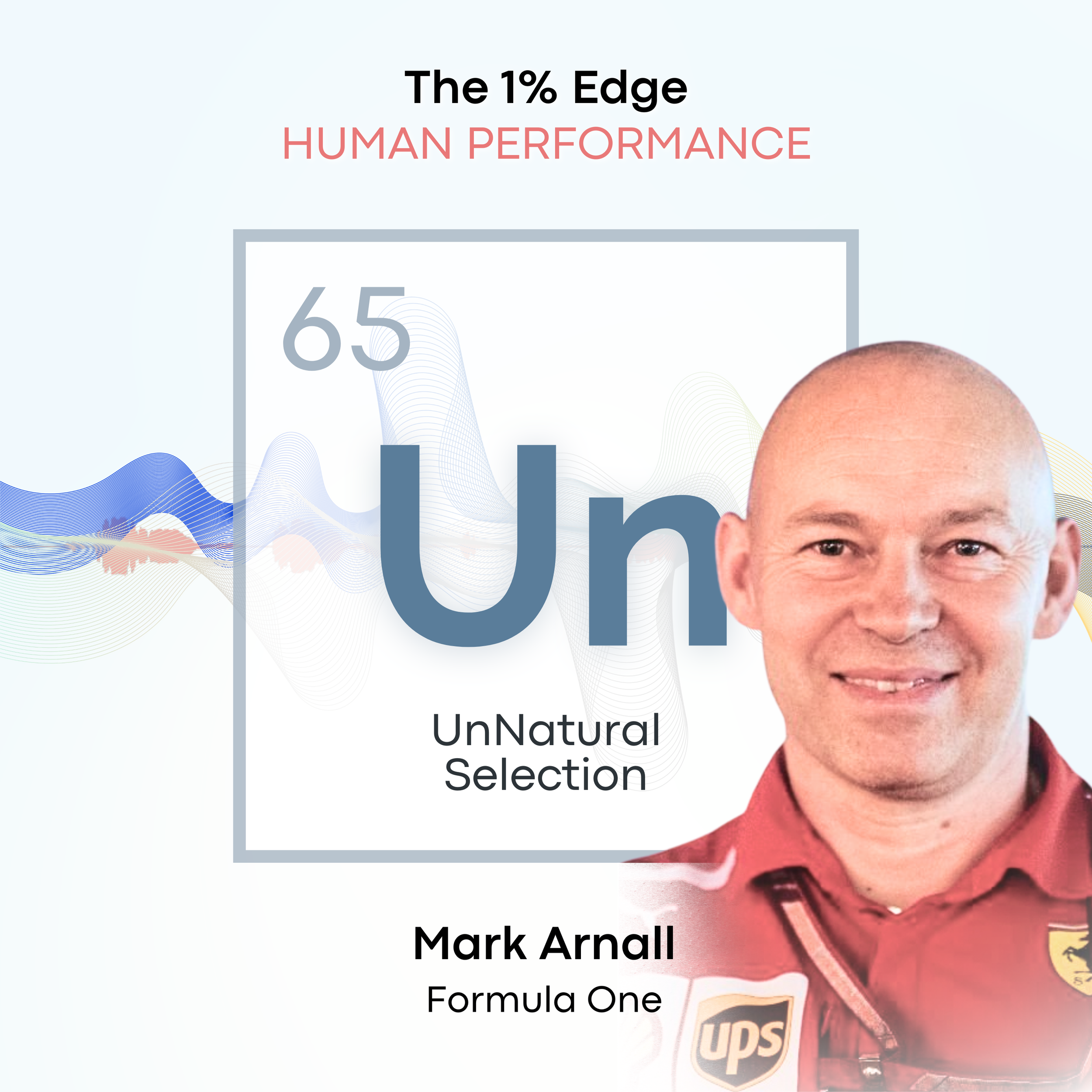
Systemic Infrastructure vs. Heroics in Peak Performance
What does it take to perform at the limit – again and again – in one of the most demanding environments on earth?
Mark Arnall spent 26 years as a performance coach in Formula One, working with world champions including Mika Häkkinen, Kimi Räikkönen and Sebastian Vettel. Today, he leads human performance for Formula One and applies the lessons of elite racing to the people behind the entire sport.
In this episode, Mark takes us inside the hidden system behind an F1 driver's performance: training, recovery, nutrition, sleep, travel, mental resilience, visualization and the relentless pursuit of marginal gains.
But the most fascinating lessons extend far beyond racing.
Why do elite performers learn to forget the last point? Why can recovery matter more than training? Why does the fastest sport in the world require constant adaptation? And how does a team of dozens turn an individual driver into a winning system?
We explore what separates great from extraordinary—and what Formula One can teach every organization about competition, adaptation and human performance.
-
Nic (00:00)
Mark, welcome to a natural selection.
Mark Arnall (00:02)
Nice to be here Nick.
Nic (00:04)
It's it's it's great to have you here. I'm really looking forward to this conversation because you and I have spoken before, and obviously the the the field of Formula One it pushes human capacity to its limits and and trying to retain that and then overcome that in order to to win races and to keep people these elite trainers, these elite physical athletes.
at
at the peak of their shape to be able to respond to all kinds of things is is fascinating. How that maps to other areas is also really, really interesting. Other fields, other sports, but even other professions. And and then the mentality that goes behind some of this very like cutting edge training. But before we get into that, I'd like to start off with a signature question to give you a chance to tell the audience
What motivates the work that you do? And so before we get started, can you please let us know what need or impact drives your work, Mark?
Mark Arnall (01:04)
I think it's evolved over the years. It was previously working with Formula One drivers to make sure they were in the best shape possible to compete at the highest level. My role shifted now more into looking after the staff in Formula One. And the goal really is to make sure they stay fit and healthy on the road is probably the easiest way to sum it up.
Nic (01:27)
And so for I guess for people that are are not familiar with with Travel Fit and what you do with Formula One, can you let us know a little bit about just a quick overview of what what you do and and how the broader fitness travel industry actually works?
Mark Arnall (01:42)
Yeah, sure sir. For 26 years of my career I worked with Formula One drivers so I was a performance coach which really covers four main pillars so it's the physical training of the Formula One driver.
It's the physiotherapy work that goes alongside that. It's the nutritional component. So looking at their whole nutritional package, hydration and the travel wellness side. In Formula One, we currently have 24 races and the role of a performance coach would be to get the driver to all of those races with number one, as little jet lag as possible. And also with all of that travel, reduce the chance of them getting sick.
My transition into Formula One as a company came really because the Formula One drivers I was working with all retired and I had opportunities to stay in that role but Stefano Dominicali who is the CEO of Formula One, he
recognized the fact that Formula One has more races on the calendar. So the demands of all staff in Formula One increase, they get greater. And he really wanted to bring in all of the elite level solutions are created for the drivers, but for his traveling staff of 250 people. So it's really doing what I did for a driver, but then bringing it down to cater really for everyone in Formula One.
Nic (03:07)
That's interesting. And so w what are the kind of things that first of all, you you do for the say the executives of Formula One. How do you take some of the learnings from, like you said, you you have these elite drivers that you have to take from country to country and they have to be prepared at at the peak of their shape on on race day. and then obviously you take a lot of learnings from that and then now you distill that down to something that benefits executives.
And then the next step beyond that would be what are the kind of learnings that you take from that that regular people might be able to use?
Mark Arnall (03:42)
Yeah, I mean, think I work with actually all people in Formula One. It's the executives, it's all of our travelling staff. And I think whilst in Formula One, we're looking to just optimise everything with the driver.
Everyone in Formula One, the teams, the drivers, we all suffer from the same sort of things we're trying to get around the world. There's obviously big time zone shifts. There's triple header races where you literally go from one race to another. And sometimes we're going from Las Vegas to Qatar. So it's a 15 hour flight. It's straight in from one weekend to another. It's a huge time change.
over the course of maybe three races and people get tired. So the immune system gets a little bit run down. It's easier to pick up these bugs and bacterias that we're exposed to. So a big element is sort of staying healthy on the road. In terms of like staying fit on the road, which is another part of my sort of responsibility and how this plays into your question about sort of how other people can.
sort of learn from what we do. I think a lot of it is having the mindset of when you're at home, you can get into a proper routine with your nutrition, with your training. You might have a plan of what you're going to do and there's a goal to that plan. You're aiming for a specific target. I think the mindset when you travel has to be, okay, I'm now in the maintenance phase. What I don't want to do is lose the gains I've made at home. How can I maintain that while I'm traveling?
various ways that that can be done. I travel with bands around the world, sort of bands that I can use in a hotel room, which is one option. I can do a full body workout with exercise bands with a door anchor attached to a door. combine with body weight, combined with core works. think fundamentally you want to make sure in a workout you're doing that you're doing something that pushes, something that pulls, something for the legs and something for the core.
So I think you just have to have a little bit of a plan of what you're going to do while you're traveling and maybe for business travelers look at okay when do I have my meetings what time do I have because we're all a little bit time constrained when we're traveling so it's kind of
Having a little bit of a plan, how can I fit in what I'm going to do? Am I going to have a wrist day? Am I going to focus on just a quick full body workout? Am I going to pack my trainers so I can go for a run outside and actually get to see the local area? Apps are useful, things like Hello Moves, for example.
host of others you can have on your phone. So you can have your favorite workouts there that you can just set up in the hotel room and sort of bang out a quick 20 minute workout. Sometimes I mean, as an example of what I've had to do with the Formula One role I'm in now, we're in very early in the mornings. I've just come from the Monaco race, and we were leaving the hotel at 5.30. So I'm not going to get up and do a workout at 4.30 to then go and do a full day at the track. So I've had to do is with my appointments at the
where I do all the therapy sessions. At the end of every session, my therapy sessions last maybe 45 minutes, but they're blocked per hour. So at the end of each session, I do 20 push-ups, 20 band pulls with my band attached to the door, and 20 squats. And by the end of the day, I've done 160 to 200 of each. And it feels quite easy because you're just doing that block every hour. But by the end of the day, all of that work adds up. So it's kind of like, how can you...
and look at your time and schedule in some of these almost like health snacks throughout the day.
Nic (07:30)
Yeah. It sounds like it's being more intentional, right? So like a lot of times business travel for me it's an excuse to be unhealthy. You know, I'm only gone for a few days. I can
Mark Arnall (07:39)
Thank
Nic (07:40)
eat whatever I want, I can skip workouts. but here where it's more like for people that travel a lot, you have to be far more intentional because those three cheat days become ten, become thirty, become most of the year before you know it. And so you really have to think about how you carry that.
physical training and the the intentionality and the mentality with you no matter where you are because wherever you're sleeping that night, that's practically home if you travel a lot.
Mark Arnall (08:08)
Yeah, very much so. And I think a lot of people struggle with buffets. Like when you're eating at home, you don't have a buffet set up. You make yourself a meal for a specific purpose. I think when people go into the breakfast buffet, they see all of this food and it's, I think a lot of people tend to overeat from the buffets when they're traveling.
And it depends sort of what environment you're in. Certainly in Formula One, there's a buffet at breakfast in the morning. There's a buffet in the hospitality area at lunchtime. And then normally it might be another meal like that in the evening. So you have to kind of be aware that what would I normally be eating at home in comparison to what I'm eating now? A lot of the questions I get from business travelers is focused around this. They tend to find they overeat when they travel.
their bodies out of sync. So they also don't know how to kind of adjust to that. They tend to drink more because they're at social events with their sort of colleagues. So it's kind of like they find over time that the exercise gets a little bit pushed to the back. They're overeating, they're drinking in the evening, and they find just over time, they just end up putting on weight.
And I think it has to be quite a conscious effort to avoid that from happening because it's a very easy pattern to fit into.
Nic (09:29)
Yeah,
absolutely. and you mentioned before jet lag. Are there specific things that you recommend for avoiding jet lag more? Or, you know, I've heard things like get back in your eating schedule. So as long as you you know you get back onto that, obviously your sleep schedule and all that kind stuff. But what are the kind of things that you would have to do again to keep Formula One racers from suffering?
The jet lag, the travel, the fatigue and all that and be at their prime on race day.
Mark Arnall (10:01)
Yeah, we could probably talk for an hour just about this, but obviously it's been an integral part of my job for many years and I think everyone's different. So you have to take all of the rules and then work with those to find what works the best for you. The first thing I always used to do, I always booked Kimmy's hotels and flights when I was working with him.
And the reason for that is I look after his schedule when he's at home. So before we do any long haul travel, I look at, number one, where we're going to, what plane can we fly on? Airbus A350 Boeing Dreamliner, because of the composite materials those planes are made of, you will just have less jet lag than one of the older planes, because you can have
Nic (10:47)
interesting.
Mark Arnall (10:48)
slightly a
Yeah, you can have slightly higher humidity levels in both of those cabins. And one of the biggest problems with long haul flights is the airline cabin is just like a desert and it just literally sucks moisture out of you. So dehydration is a huge issue on the flights. if I can book, yeah, and
Nic (11:04)
really? Well
Mark Arnall (11:06)
if I can book a flight on a plane.
that will be on one of those airlines. I know that I can reduce slightly the negative effects of dehydration. The cabin is also designed with the pressure to fly at a slightly lower altitude which also is beneficial. Flying direct is useful because it means I can then plan the jet lag schedule a little bit better. Flights that sort of stop somewhere else are a little bit more complex.
So that would be the planning phase. And then three to four days before we travel, I would try and shift our time zone a little bit each day by an hour. So if we're flying
Nic (11:48)
Mm.
Mark Arnall (11:48)
west, we want to be going to bed later by an hour, getting up later by an hour for the three to four days before we travel. And a lot of people do this. And I think one of the mistakes people tend to make is they shift their time, but they don't shift their food and they don't shift their training. They don't shift their meetings.
you really have to shift everything to make that work effectively. So if you're used to training at 9 o'clock in the morning, you need to shift that to 10 o'clock, then 11 o'clock
Nic (12:17)
Mm-hmm.
Mark Arnall (12:17)
to make sure everything shifts.
With Kimi going west, it was actually quite easy because he used to love ice hockey and motocross, watching it in the US. He would stay up till two o'clock in the morning, three o'clock in the morning watching these. One of the rooms in his house would be completely blacked out, so there'd be no light coming through. And then he could sleep until 12, one o'clock in the afternoon. So we could pretty much get him on sort of US time zone.
before we even went to the US. And all I had to do was book a flight late in the afternoon to make sure it didn't mess up that sleeping pattern. Traveling east, you just do the opposite. Go to bed an hour earlier, get up an hour earlier for the three to four days before you travel. Again, shift everything. There are ways to accelerate that, but that's the basics.
I think then when you do travel on the day of travel, you just want to make sure you're completely aware of your destination time zone. Because what you need to be doing is eating and sleeping at the right time to where you're going.
So like I say, no one really wears a watch, no one has a phone, but just being aware of the destination time is very important so that you're not sleeping at a time when you should be awake and you're not eating breakfast at a time where you should be eating dinner, you're not drinking alcohol, especially if you're flying for business at a time where you shouldn't be, because all of these things are going to put your body out of sync. I know a lot of travelers that come from New York to London and you should try and eat as early as possible.
because as soon as you get on that plane, you want to be sleeping because an eight, nine o'clock flight from New York, it's already two, three o'clock in the morning in London. And then if you get on the plane and you start eating, you have a wine and then you
Nic (14:04)
Mm-hmm.
Mark Arnall (14:05)
go to bed, number one, the digestion process is still happening, which is also compromised on the flight. And then, like I say, by the time you get to the destination, you might have had three hours bad sleep and you're completely out of sync with your destination.
Hydration is really important as I touched on before so a lot of the time I think if people just focused on one thing which was hydration and you would feel a lot better at the other end.
And a lot of
Nic (14:32)
Amazing.
Mark Arnall (14:33)
pilots I know really just focus on that. And then the fasting is another way that you can, like, I don't think anyone thinks plain food is designed for its nutrient content.
Nic (14:45)
Mm-hmm.
Mark Arnall (14:46)
It's precooked, it's delivered to the plane, it's reheated. Obviously business class, first class, you get higher quality food. But like I our body doesn't digest food quite so well at altitude, and it tends to be overly salted for flavor because our taste buds also
don't work quite so well. sometimes fasting on the flights is advantageous and I've seen some studies showing that we have a second sort of clock in our body related to food. So I've had quite a lot of success on certain flights, fasting and then just having the first meal as breakfast in my destination. So I think they're fundamentally the basics. I think when you expose yourself to light in combination with when you're sleeping,
pre-travel and when you get to the destination is also very important. And the other side which I touched on at the beginning is just staying healthy while you travel. So I think a lot of people find they get sick when they travel because as soon as we get to an airport we're bombarded with these bugs and bacteria. We're on a small plane which is condensed with people but just little things like the security tray. I mean it's touched by thousands of people every day.
So just going through the security or touching something that's been touched by thousands of people.
Nic (16:07)
Mm-hmm.
Mark Arnall (16:07)
So it's a idea just to have a sort of wipe or gel that you can clean your hands with quite quickly afterwards or better still go to a bathroom and wash your hands. When you're actually on the plane itself, there's not really time or any regulation for airlines to sanitize your seat. So if you're sitting in a seat that's been coughed on and sneezed on by a previous passenger, you're sitting in that environment with all of those bugs.
whether that's the tray table, the belt buckle, the screen, remote, air bent, all of these sort of things. So what I always used to do or what I still do and what I did with the drivers was just get them to completely clean their own environment. So again, reduce as much as possible the chance of picking up some of those bugs and bacteria from other people because like any athletes, it doesn't matter whether it's a Formula One driver or a tennis player, if you get sick while you're traveling, it's going to compromise your performance at the other end.
Nic (17:01)
Mm.
Mark Arnall (17:02)
I'd say it was really a combination of those two factors with the travel.
Nic (17:07)
That's fascinating. I mean, it's so much there. And it sounds like a lot of that is in the preparation and in the flight itself. Are there things that you would do then once you arrive? Obviously, in your preparation, there's a lot of that because you want to arrive like if you're arriving at 8 a.m. in the morning, you want to be ready to go through the day, not go straight to sleep and your your diet and what you eat. Everything leads up to kind of arriving on time where you're going to be. But then are there additional things there? Obviously, maybe competition.
Continue drinking water because you're probably dehydrated from the flight. Other kind of tricks that people can do, because it sounds like there's a lot in the preparation. My guess is it probably doesn't solve for a hundred percent of jet lag. So there's probably stuff that you can still do once you arrive, right?
Mark Arnall (17:50)
Yeah, for sure. And I think this is where you have to have a little look at what do I need to do when I arrive and when do I want to arrive? Are you quite good at following a plan on a plane where
You can sleep for a certain period of time knowing you're going to land in the morning and then be awake. Or do you really struggle to fall asleep? Or are better at staying awake on the plane so you can then fall asleep in your destination? So personally, I tend to like to arrive at a destination sort of.
mid to late evening and then go to sleep because most people find it easier to stay up later than they do fall asleep on demand. I think if you're a business traveler looking at what time your meetings are during the day and trying to place the important meetings at a time when you would be awake at your previous destination there's more of a chance that you're going to have
Put on a good performance then than at a time that would be when you're asleep in your previous destination. If that makes sense. So
Nic (18:54)
yeah, absolutely.
Mark Arnall (18:55)
I think there are certain things like that that you can factor in certainly with us. I always tried to create a situation where we arrived in the evening and then could get a decent night's sleep before doing something in the morning getting early morning light for a lot of people is very beneficial at the destination. Just trying to get into that.
as much light into your body early on as possible. Eat at the correct time for your destinations. Eat breakfast at the right time. And you can play around with supplementation. created a supplement with my biochemist, Vakimi, that worked on hydration and immune system support for the flights. But things like creatine, a lot of people, and there's a lot of information about creatine now. But there was an interesting study just about sleep deprivation and creatine and using quite big doses
25 to 30 grams of creatine. And in a sleep deprived person, taking that amount of creatine would offset sleep deprivation. So if you're in a situation where you really haven't had much sleep, you can play around with these sort of things as well. Being active when you're actually in the destination, we sometimes, many years ago when I was working with Mika Akin, we went to Australia and we would set things up in the afternoon, which is normally
when you start feeling really sleepy, when we go rowing on the river. there's a big rowing community there, so you book something in water or go for a swim. It's very difficult to fall asleep when you're wet and sort of
Nic (20:29)
Yeah.
Mark Arnall (20:30)
in the water. So you try and do things to keep you awake at certain times, but certainly the activity side of things is important, getting light at the right time.
with just the general feeling we always used to run through like a mobility program when we arrived in the destination just to unwind the body because again
Nic (20:49)
Mm.
Mark Arnall (20:50)
it doesn't really matter obviously it's worse if you're in economy it's better for first-class passengers but we're still stiff and achy when we get out of a plane on
Nic (20:58)
Yeah.
Mark Arnall (20:58)
a 14-16 hour flight so running through a quick mobility program
is also useful just to unwind the body. Let's say I always carry a massage ball around with me so you can use that on your feet, your hips, your neck, and if you need to on the travels. So yeah, they're the sort of things that we would focus on.
Nic (21:21)
W what about foods? Are there are are there benefits from more protein, less protein, vegetables, carbs? Does that factor in at all in kind of like the whole jet lag and preparation?
Mark Arnall (21:35)
I've seen studies in the past that did focus on kind of like high protein, carb, high protein. I think with travellers you just want to try and make life as easy as possible and adding things in that people find complicated normally means they don't do them. I haven't personally, specifically followed anything like that for jet lag per se. I just focus on healthy food, so protein is a big part of that.
staying hydrated is a big part of that on planes you don't digest so well so sometimes having your broccoli cauliflower and lots of stuff that requires sort of
decent digestion might sort of make people quite airy on the flight and quite bloated. So I'm not saying that there isn't a benefit to certain nutritional strategies, but like I said, probably the biggest one I've used is fasting, so not eating at all on some of the long alcohol flights and then eating when I get to the destination.
I think it's more like looking at what time you're traveling and then arranging your food. If you know that you've got to fall asleep as soon as you get on the plane, just making sure you've eaten like three or four hours before that. So it might before going to the airport, before you check in, you've had your big meal and then maybe you just have a little snack if you're hungry after check in because as soon as you sort of want to go to sleep on the plane, if you just eat and it's going to be harder. So so that's how I would play around with the food.
Nic (23:06)
Okay. Right. So obviously, like, a a lot of your experience comes from training Formula One drivers. you spent many years doing that and these drivers compete in one of the most demanding environments on earth, right? For f for those unfamiliar with the sport, what what does it actually look like to train someone whose job requires split second decisions at extreme speeds while enduring intense physical and mental stress?
Mark Arnall (23:33)
Yeah, it's, I mean, obviously, it's a unique sport, and I think every sport is unique in its own way. I think with Formula One drivers, there's a couple of different things. One, you can't make them too big, because if you add a lot of muscle to these guys, muscle, waist, full time, as much as fat, and there's always a weight limit in Formula One cars, you need to work on the conditioning side. So the cardiovascular fitness, have to have a certain level of
conditioning just to do what we're able to do. So there's a base level of cardio. And I think when I was sort of working with the drivers, it was always pretty much 80 % cardio in terms of zone two work and then 20 %
It might be 75, 25, but roughly that sort of amount of zone two training, which is the easier form of training. And then the 20 to 25 % would be high intensity work. So you're looking to then make the driver fitter. You've got the muscular conditioning. And I think there are so many complexities working with the Formula One driver because they have left foot braking. So the left leg puts so much pressure on the brake pedal. The right foot is doing this on the accelerator.
So you develop this asymmetrical load through the pelvis, which means there's more strength developing in the left side and the pelvis works slightly differently. So we have to kind of look at that in our training and balance it out just to make sure that doesn't cause lower back issues.
because if you
Nic (25:05)
Mm-hmm.
Mark Arnall (25:06)
have any sort of asymmetry in that area, lower back problems are quite common in Formula One. The driver sits very close to the ground. They're not in a particularly great position. They're pretty much lying down with a rounded spine. So a lot of the training I did for the driver on a muscular skeletal side was more all the muscles they didn't use in the car, which was a lot of muscles in the back, that whole posterior chain, because they work in a very kind of like
externally rotated environment with a fairly poor spinal position. So it's kind of like getting the spine to work through extension, strengthening the hips, glutes, hamstrings, and actually taking tension off the front.
So you kind of put that together. I think the difficult thing with training Formula One driver is I used to split the season up. So we used to do our block of preseason training, which was really January, February and half of March.
because as soon as we start traveling for the first race, there's just with the racing, with the travel, with the media commitments, with the testing, there's just not enough time to train flat out for the whole year. So you did the big block of training at the beginning of the year, which really just kind of like was something you were focused on. So that might be the engineers call me and say, OK, Mark, look, we've got an extra 10 points of downforce on the car this year. We're expecting much higher cornering speeds. There's going to be much more stress.
on the neck and certain other parts of the body. So my focus would be more on that. And there was one year where a new battery system came in the KERS system where it was just heavy and all the trainers had to get weight off the driver because the driver in the car meant everything was overweight. And if you're just a little bit overweight, you're losing time on the track. So Kimi at the time in Ferrari was heavier than Felipe Massa just naturally. And
Kimi, I think, was losing tenths, tenth and a half of a second per lap just with the weight. So
Nic (27:12)
Well
Mark Arnall (27:12)
we had to really try and get the weight off all drivers. I'd say we were very clearly told that any weight you can get off the driver is going to be beneficial for the car.
And I had to say to them, OK, yeah, but there's a line where if I take too much off, it's going to compromise his performance. So there's
Nic (27:27)
Mm-hmm.
Mark Arnall (27:27)
always a balance. For that first period of the year was always, OK, what are we trying to achieve in our training? And the rest of the year was maintaining that. So maintaining those cardiovascular levels, maintaining the strength levels. And I always used to start here and then taper the training off as the season went on. And then you just ramp up the recovery. Because especially if you're fighting for a championship with traveling,
much. It has a mental load as well that you need to try and manage because like I it's not just the physical performance, the mental side of Formula One is quite extreme as well.
Nic (28:03)
yeah. I mean what fascinates me about this is that it's it's everybody pays attention to the driver, but it it's a whole team behind the any
Mark Arnall (28:11)
.
Nic (28:12)
one of these races, right? I mean, they're the engineers, the people that manage the cars, there's the trainers, there's a driver, and and what you end up getting is a is a product, a package that's tons of technology and training and preparation with this human being that's like sliced in the middle in a very awkward position.
And so you Formula One, like I said, it's it's viewed as a technology competition, but ultimately with the human in the cockpit, what what have you seen are like the primary determinants of elite performance at that level? Like when you have two drivers that have extraordinary talent, what separates the very best from everybody else? And and I ask that because I I grew up playing tennis. And so when you look at tennis players, there's
if you can be really good at the college level, but you're still not the same as if you're in the professional level. And even at the professional level, there's difference between one hundred and top twenty. But even in at top twenty, there's a big difference between that and say top three or top one. And and at each one of those there's this like super thin layer that separates that from the rest, but it could also feel like a mile. So so on the Formula One side. On the Formula One side, what what what separates
Great from extraordinary.
Mark Arnall (29:30)
It's a very good question and I think number one, you don't get into Formula One if you're not really at the top of your sport. mean, all of these guys that drive those cars are super talented and what separates them is such a finite, minuscule difference. I think some of it is natural talent.
I think it's like in any sport you have these, if you like, freaks of nature that are just unbelievable at something. I think it depends maybe a little bit on your upbringing. I mean, Kimi Raikkonen, when I worked with him, I think he started driving something when he was three. Certainly his son, who's now go-karting, started when he was three. And I think before you can really learn to master your own body in terms of functional movement, your ass is in a car driving
Nic (30:19)
Mm-hmm.
Mark Arnall (30:20)
in Formula One.
So you get to understand what that car is doing underneath you in a way that if you were to start when you were seven you will miss out on a lot of what would come naturally. So I think some of it is dependent on how you learn when you're younger, how early you get into these sports and of course all of these guys have been go-karting from a very young age.
So some of it is that natural talent. Some of it is spatial awareness. Being aware of what's happening around you while you're driving. If you look at this formula one start, mean, how these guys manage to miss each other in the corner sometimes, and obviously sometimes they don't. But
Nic (31:03)
Yeah.
Mark Arnall (31:05)
some of these guys just have almost like a sixth sense of where they are on the track. So it's something that
I think is very, difficult to train. And you can do some sort of training work around that. again, some of that is also a natural talent. The fitness side definitely comes into it. And I think that whole sort of fitness side, hydration side, nutritional side.
getting that dialed in and 100 % right helps. The mental side is huge. And I think a lot of what separates great athletes from good athletes is that mental ability to absorb everything and not be flustered by it. And I think a lot of top athletes work with
sports psychologists and people that are expert in that field if they need to because it can make a big difference. I remember when I was sort of first in Formula One, sports psychology wasn't a big part of it and it was almost viewed as a weakness if a driver had to work with a sports psychologist and I think there was a big transition in this whole mental health, mental wellness some time ago and I think it transitioned into more like if he's working
with
a sports psychologist, maybe that's going to give him an advantage, maybe I should too. So I think there's a lot of work that a sports psychologist can do to help an athlete and of course it's finding the right one that can layer in the right message and work with you on your training. I've never really, I was quite lucky with the drivers I worked with, I mean used to do a lot of work with Kimi and he was actually sort of very mentally strong, it was like say
for him he approached a race weekend in a certain way and we had our way of working but it didn't matter whether he had a crash, whether he won the race, as soon as that race was over he moved on and there was no dwelling on the past it was like from a team perspective if something didn't go well we'd try and learn from that and I think you learn way more from your failures and things that go wrong than when things go perfectly but
letting go of something you can have no control over is a very healthy thing and I think a lot of athletes and some drivers kind of like still great and grind about what happened in the last race. I think like I once I think Roger Federer actually said it really well he was like he could play the best shot that's going to be replayed 10 times a week on sort of all of the channels or he could hit the ball into the net.
But he just said a point, he's just a point. It's like as soon as you finish one point you've got to move on to the next one. It doesn't matter if the last one was amazing or went into the net, you've got to focus on the next one. And I think Formula One's very similar, it's just a race. So that mental side in Formula One is also sort of huge.
I think in terms of the work that I did with that, found very sort of successful visualization was one. So I used to sit Mika in a driving position in a very dark room before qualifying and he would describe to me his perfect lap. So he'd be there sort of going through the lap, going through the corners. And I would say to him at the end of it, okay, what is the time that you think you can do in qualifying? And he was always within a tenth of a second.
of what he visualized
Nic (34:44)
Well
Mark Arnall (34:46)
and he was an unbelievable qualifier. so he was able to visualize that happen. Sometimes the times he said to me were like so ridiculously quick in comparison to what we've done in the practice sessions. And he was always so close and sometimes bang on with what he said he could do. Breath work is really important. So I used to use just a basic form of box breathing, which is quite standard. So you breathe in for
four seconds, hold that breath for four seconds, breathe out for four seconds, hold that for four seconds, set a timer for five minutes. And it was amazing the response that would have on the body, lowering heart rate, calming the athlete down. So that was something that I always thought was very useful. Music can amp you up or calm you down depending on how you want to use that. So there are certain
thing you can play around with but again I think a lot of it is just looking at the individual as an individual
Nic (35:49)
Mm-hmm.
Mark Arnall (35:50)
and thinking okay what do they need to perform at their best and what can I bring in to allow that to happen.
Nic (35:58)
You know, that's we the the things that you just said are are fascinating on so many different levels. for starters, w as we spoke in the beginning, one of the things about this podcast why I started was because I felt that there would be learnings that you can pull out from some fields and disciplines that are transferable to others. you can learn from how people compete and innovate in some areas that transfer to wildly different areas. And
When you were talking about some of the things that differentiate elite drivers, I I wouldn't have thought about this. But one of the things that came out in one of my interviews last year, I interviewed the former coach of Serena and Venus Williams, professional tennis coach, Rick Macy. And and he said that the the thing that differentiates the great tennis players from the very best is their ability to forget the previous point.
And you mentioned it right now with Roger Federer, right? It's like your ability to very quickly acknowledge what happened and learn from it, but then you have to put it behind you. Like it cannot be any sort of weight in the pla in the point you're playing right now, which is all you have any control over, you don't control that previous point anymore. The ability to move on and and same thing. I I interviewed an elite MMA fighter who said to me the same thing that it's like no matter what happens in the previous fight or in the previous round.
You've got to put that behind and you just can't quit. You just every single moment, you have to just keep fighting. And it's amazing that at these elite levels, whether you're MMA, ten professional tennis, or formula one, the physicality is obviously a big part, but I don't know how it is in Formula One. In tennis, everybody's in really great shape, right? So at a certain point, that's kind of like the the it's the bar to entry. You've got to be an elite physical shape.
Mark Arnall (37:43)
Yeah.
Nic (37:44)
everybody's got a great forehand, a great backhand. So there's no longer like, well, you've got a great servant forehand, but you don't have a great backhand. Everybody's got a great game. What differentiates people now is that mental strength at that peak one percent level. And and so much of it blows out to just your your ability to move on and keep fighting.
Mark Arnall (38:02)
Yeah, very much so. I think there's kind of like quite a few different sort of things there. 100 % you're correct. And I think when you look at tennis, I remember reading an article
Roger Federer's coach and as he was getting older, they changed their philosophy of training a little bit because they knew they couldn't outpower younger players. Younger players
Nic (38:24)
Yes.
Mark Arnall (38:25)
come in and they're just younger. They've got more strength, power, explosive ability than an older athlete, even when the older athletes training as well as they can. So they had to change the training to be more sensible about the way they were playing. OK, how can we be more tactical about X, Y and Z? And it was quite an interesting article in the
that you recognize that you're getting older, so you're not in your sort of mid-20s where you're at your peak, you're now in your sort of early 30s, maybe 35. So how do you change your training to be smarter so that you don't expend quite as much energy? So I thought that was actually quite interesting. I think the other thing that's interesting is kind of like what is considered successful. I mean, I think everyone would say Roger Federer is definitely one of them.
successful players in the world. He only won 54 % of the points he ever played. So it's kind of like, like it's only a small margin, but he still was one of the best players that's ever existed.
I think it was quite interesting because you don't always have to be the best. don't always have to win. You have to be consistent and like those big points matter and that's where the mental side can sort of come into it. But yeah, 100%. I think there's a lot of people in life that spend a lot of time worrying about a lot of stuff that never happens. And a lot of stuff that's happened already that they can't do anything about as opposed to focusing on what can you learn from that. But let me focus on
the present and plan for the future to make sure I've learned from what's happened before. And in sport, it just happens a lot quicker, I think. Every week is a new game or a new match that you have to learn from and adapt.
to your next event. I think the other big thing and something you mentioned before about teamwork, think Formula One is quite interesting because you've got one driver driving the car, but you've also got 15, 20 guys in the pit stop. So you can do all of the work to make that driver as good as possible if you're not looking after the mechanics that are in that pit stop. And I mean a pit stop, a good pit stop.
is 1.8 seconds to get the car in the air, take four tires off, put four tires back on and go. So they aim for two seconds, two to 2.2 just for consistency, but like 1.8 is probably the gold standard. But if you've got a mechanic that makes a mistake for one and a half seconds, that could cost you three places in Formula One. So it's kind of, it's an individual sport for the driver, but that whole team
around in a pit stop and depending on the race they might do two pit stops they might do five or six per car if it's really really chaotic with wet weather stuff tires changing all the time so those mechanics also have to be very on the ball so so it's there's lots of things that can go wrong and there's
obviously there's a focus on making sure the pit crew are in good shape as well and can focus on their jobs. it's very much a team sport from that point of view. And again, from a driver perspective, when we've got a season, I sit down with the driver and say, okay, look, we've got 20, 22, 24 races. know four are going to be disaster. You might get taken out by someone else. You might crash. The pit wall might make the wrong strategy call in difficult conditions.
so that when those things do go wrong, they don't start panicking. They just take it off as, well, that's one of those races that was going to be a disaster because it's very, very...
Unlikely you have a perfect season and everything's going to go right. So when you manage those expectations initially and sometimes you might think, okay, we've got a car that's super quick in a straight line, but pretty bad around corners. So you focus on your Monza or your Azerbaijan race that's got super long straights. So you can optimize the performance there. And then if you've got a car that's great around corners, then you look at Singapore.
and some of these sort of tighter sort of tracks where you can then try and extract as much as you can from the card there. So you try and be as strategic as possible with your planning throughout the season.
Nic (42:45)
that's fascinating. Yeah. It's like you said, all the tracks are different. The the climates, the environments are different, the teams are different and in so many different variables from the the pit crew to the driver to the technology to the elements. there I'm sure there's an element of luck in all of this as well when you have so many variables fly floating around. it's it's amazing that with with so much variability, you you still end up getting consistent
wins, sometimes teams and drivers do really well. You just
Mark Arnall (43:19)
Yeah.
Nic (43:20)
edging past the competition by, you know, a millionth of a second or something like that, but they're still consistently winning. Right. So it's like it's it's amazing to see that.
Mark Arnall (43:28)
Yeah,
yeah, I think in Formula One is probably one of the biggest difference between Formula One and some of the sports. In tennis, your racket, no one's got the best racket and no other racket is going to come close. In Formula One, the car does make a difference. And of course, difference between the fastest car on the grid and the slowest is not much. But if you
lucky as a driver to have a car that's one of the quickest on the grid. I've been lucky to work with drivers probably out of the 26 years for six, seven of those years, we had a very quick car. And sometimes it was pretty much the same speed as Ferrari when I was in McLaren. Sometimes in Ferrari, it was the same as something else. So it's really then down to the driver who's going to win from.
one race to the other. Sometimes one team just has a car that's half a second quicker than everyone else. So you just hope as a driver, you're going to be in that car and then the person you have to beat your teammate, which creates its own kind of sort of battles. But the car that you're in does make a difference. So I think, I say, it's one of the differences between Formula One and some other sports. But like I say, it doesn't take away from the fact that it's you still have to perform.
at that highest level in that car.
Nic (44:50)
Yeah.
And and y obviously you were in Formula One for a long time and and at these elite levels, obviously with such a long history of being there, I'm sure there were learnings and experiences that you came across that probably were surprising even to you, right? wha what are the kind of things, either misconceptions that people have about recovery, fitness, performance at those levels, or even
surprising things that you may have learned or seen in some of the best drivers out there when it came to commitment or their perseverance or w do you remember any kind of situations where you were like genuinely surprised, you felt like you unlocked something that you hadn't anticipated beforehand?
Mark Arnall (45:36)
it's a good question. mean, I think you try and...
optimize everything as much as possible. think from a recovery point of view, recovery is huge. Sleep is huge. In Kimmy's house, we had cryo chamber, had saunas, infrared saunas, we had all of the different modalities you could think of to try and accelerate recovery as quickly as possible. So I think recovery is probably a very underrated part of what people think about. A lot of people think from a training perspective, just have to
train,
train, train. Really it's about recovery and sleep. So you try and optimize those things. I think certainly when I was working with Kimmy in McLaren, he had this ability just to drag more out of the car than most people thought the car was capable of.
So in 2004, I think our car was particularly bad. He still managed to win in Spa and it's like a proper driver's track and he just managed to drag so much more performance out of it than that car should have been able to deliver. So I think sometimes you see some of these drives from certain drivers, like I've worked obviously with three drivers that were all world champions and that they had this ability sometimes just to drag more.
out of the car than it should have really been able to deliver and you don't quite know where that comes from.
what gets them going like that. Kimi was 17th on the grid in Japan, won the race by making overtake on the last lap. But he wound his way through the field to be in that position. Whereas like saying that, in other years, he just managed to drag a car that should have maybe tenthed and won the race out with it. Everyone in the garage just looks at each other and going, how did he do that? And I think there's a few drivers. And that's for staff.
at the moment is one of them that I think he's able to extract more from the car than that car should really be able to deliver. And I think that's the difference really between an exceptional driver and a very good driver. It's that ability to be able to extract a maximum from the equipment they have that makes everyone think, how did he do that?
Nic (48:00)
Yeah, it's like a sixth sense. You know, it's like something you
Mark Arnall (48:03)
Mm.
Nic (48:03)
just can't really explain. Hey, did you see, and obviously you were in Formula One for a long time, training drivers. How did the field evolve during your tenure? As, from when you first walked in to when you exited training drivers, were there big shifts in clearly technology, but on the on the drivers and the mentality and the training, it w were some of the major kind of
evolutionary shifts that you saw in the field while you were there.
Mark Arnall (48:32)
I think within the health and fitness world, everything evolves. And I think it's one of the reasons I love that industry is because we constantly learn more. I learn more still now about the human body. And I think it's fascinating that we always have that ability to learn more. think tracking certain things is easier now with technology than we ever had before. think recovery is easier now because number one, we understand more about it, but we have more options
use. So I think if I look back to 1997 when I started, we didn't have a lot of what we have now available to us. So I think that has definitely changed. The cars have definitely evolved. They've gotten quicker. I mean, the technology behind them is mind blowing. And I don't think any other industry that I've ever witnessed moves as fast as Formula One. I mean, is just the pace of development is insane.
And even the way the sport develops is incredible. So I think the technological side behind the cars has always improved. Tires improved, fuel improves, aerodynamics improved, the car goes faster. All of those things definitely change. From a, like I say, human performance point of view, understanding more about...
human body like at beginning of every year we always used to do very detailed blood urine stone analysis to get a full like sort of overview of what's happening inside the driver's body and then I worked with a very good biochemist that would kind of extrapolate all of that data would look at anything that was out of range would firstly try and correct all of that with real food because the body absorbs and digests real food better than it does anything else and then would retest and if things were still out of range then we'd use very targeted
supplementation and then working with a biochemist and a driver that had money I could get him to create all of these different very very high-end supplements that focused on sleep, hydration, immune system support, recovery from driving and training, all of these different things. like I said that wasn't really available in 1997 when I started it's something that sort of we developed and that came in later. So you're always trying to learn and sort of try and
incorporate all of these new technological advances to try and improve the package you're offering for the driver. And I think from my point of view, I think it's always good to understand and realize what your area of expertise are. So my expertise of the training side, the sort of physio side.
I understand a lot about nutrition because I've worked with great nutritionists and biochemists but that's not my sort of studied area. So I just try and bring in the best nutritionists, the best biochemists I can find that can do all of this.
for me that I can work with and then incorporate into the Drivers Program. Kimi had a very bad sort of crash in his first year in 2001 in Salbury, hit a wall at 200 miles an hour and had two degenerative discs in his lower back that we constantly had to manage. And every now and then it would flare up, mean, like an eight year period, maybe twice where, okay, this is now something that I
We had a guy in University Strasbourg Hospital that could do a very non-invasive kind of work on the spine and like 10 days later Kimi was driving in a Formula One car. So I tried to surround myself with as many sort of people that were super specialists in certain areas so that if Kimi needed something I could go to those experts as opposed to try and do it myself which like say if there's someone better to do
that job, you bring them into the mix. So I tried to create a network around me that I could tap into of of super high-end expertise. like we had a wrist guy in Geneva, and he was just a wrist specialist. And for Formula One drivers, if you're holding a Formula One steering wheel and you hear a wall at 150 kilometers an hour and you don't remember to let go of the wheel, that wheel can spin very quickly. And of course, that can damage the wrists.
So a lot of drivers learn the hard way, normally before they get into Formula One, but sometimes things happen so quickly they forget to let go. So having a wrist specialist is quite useful at times, but he was like, don't give me a knee, I don't know about knees. And the guy's an orthopedic surgeon, but he just specialises on the wrists. So like I it was fascinating for me because I got to learn from these sort of specialists in their field about a wrist, knee, a spine, but I could tap into their expertise if I needed to.
Nic (53:33)
Well. I and you know, you hear as you're talking, you're you're tweaking at such fine grain levels. Like you said, there are specialists for knees and for wrists and for different joints and mechanics and everything. Have you found that there's a point at which the pursuit for optimization starts becoming counterproductive? Is there a line or have we just not hit that yet?
Mark Arnall (53:56)
I think you can go overboard on some of these things and I think again it's kind of recognizing who you're working with and what they need.
I worked with just one person, okay, three different people, but just one person at a time for 26 years. So it's kind of like, hey, what does this person need? What can I provide to them that's going to optimize their performance? And it got to the point with Kimi, I didn't think I could do any more to optimize it than where we actually were. so like you tweak things and you fine tune things and you try and take as much stress away from the athlete you're working with as possible. So
If we're going to a hotel, these guys, as soon as they walk into an airport, a hotel, fans kind of run to them. They want autographs. When you're just trying to focus and concentrate on sleep, checking into a hotel, I used to contact the hotel in advance and say, okay, look, we're arriving at this time. Can we come around the back? Can you check him into the room? I'll bring his passport with mine to the front desk and do the sort of checking if we need to. But if you can check him in the room,
That would be great. you try and find a way into the hotel that just avoids the stress of you've just got off a 15 hour flight. You've got to the hotel. You like say you don't want to say no to fans to sign stuff, but it's also add stress to their life. So like how could I kind of manage the situation to type? Try and take away a lot of that stress. So again, it's the fine tuning stuff. But but yeah, and other people might be different.
there are other athletes that they might sort of have other needs and you might need to optimize different things but certainly from my experience I think I took it as far as I could in terms of what I thought I could do maybe I missed a few things you never know but like I I certainly tried to sort of see what limits I could take it to. I don't think we ever got to the point where it's too much.
supplementation side, was kind of like Kimi was very good. It's just like, you tell me what to drink and I'll drink it. You tell me what's taken the time I should take it, I'll take it. So he just let me kind of manage everything and sort of get on with all of that. So he was very easy to work with in that respect. But again, like I everyone's different. So I think it's just really if you're working with an athlete or business executive, you have to understand their needs and tailor what you offer to them.
Nic (56:33)
Yeah. it's a it's it's fascinating. I really have to make it to to one of these races at some point. But Mark, it's this has been extraordinary. I I think, for finishing off with a signature question, you've seen so much over thirty years span or so in the in your career in this field, working, like you said, with three elite drivers. you've been a part of winning teams, you've been to all the races, you've seen some extraordinary things. If you could reflect for a moment, just you know, fast forward into the future.
at a point where you can you're ready to reflect back into your entire body of work, both things that you've done to date and things that you're still working on. it's really totally up to you on what scope you look at this. What do you think a best case scenario would look like where you can kind of reflect back and and think about what accomplishment or changes that you would have made to the field or to drivers or anything specific would bring you the greatest level of pride and fulfillment over what you would have accomplished.
Mark Arnall (57:32)
I think the obvious one, and it's going to sound very obvious, but...
been lucky to work with drivers and teams that have won world championships. And it's been amazing to be part of that journey. With Nick Hacken, we won two world championships together with Kenny. We won one. I worked with Sebastian, but he'd already won his world championships then. So think looking back, it's always amazing to go through that process and actually work with a driver that's achieved their lifetime ambition.
And also learning what happens when things don't go right, I think is a really valuable lesson because as I said before, I think we learn so much more from failure than we do from success. So I think they're the obvious ones. I think going forward, because my role has changed now, and I work with the staff in Formula One, I think what I could do with the driver, you're looking for that last...
one percent of optimization because you've done everything else as much as you can with some of the people like our camera guys or whoever it may be in the team. The difference I can make is 30 or 40 percent. So going through the basics with them and it's been very rewarding helping them with issues that they've had that to me seem super obvious in the basics that they don't know about. So I think fundamentally looking forward I'll be really happy
to look back and think I made their life traveling healthier, more comfortable, less problems, created an awareness for them, how they could train on the road, how they can sort of look at their nutrition, how they can look at their hydration, giving them tools that they can use to work on themselves from a self-care point of view like the massage balls and great mobility programs for them. So think in the future if someone
sort of was to sort of say something that, yeah, Mark's great because he taught me all of this stuff and it made my traveling life that much easier. I think I'll be very happy.
Nic (59:44)
Well, sounds great. I I've learned so much from preparation to dehydration to the the mentality of Formula One. This has been really fascinating to hear from somebody that's been in the field for such a long time. Mark, I can't thank you enough. Thank you so much for being under Natural Selection.
Mark Arnall (1:00:03)
My pleasure, my pleasure. Look forward to seeing you again Nick.
