

Narrative Framing: Storytelling as an Organizational OS
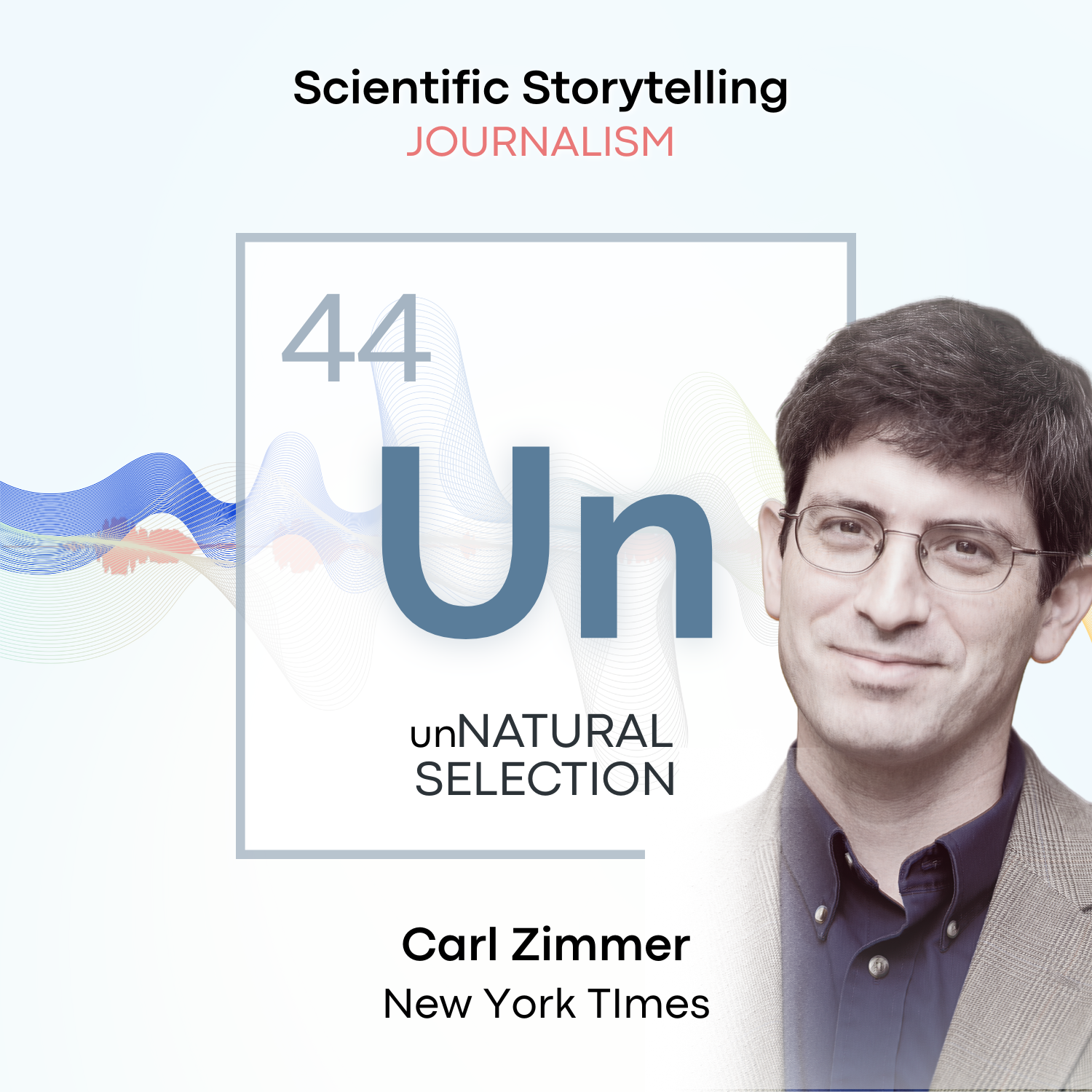
Airborne Ideas. What makes a science story worth telling — and how do you make it stick? In this episode, Nic speaks with Carl Zimmer, the award-winning science journalist behind the New York Times “Origins” column and author of fifteen books, including She Has Her Mother’s Laugh and Air-Borne.
Carl’s work has earned the Stephen Jay Gould Prize, a National Academies Communication Award, and contributed to Pulitzer Prize-winning coverage during the COVID-19 pandemic. Together, he and Nic explore how storytelling can bring complex science to life, how Carl chooses which discoveries to follow, and how the field of journalism is evolving under pressure from AI and fragmented media.
Whether you're a scientist, communicator, or just curious, this episode is a deep dive into the craft of making science matter.
-
(Auto-generated by Spotify. Errors may exist.)
Carl Zimmer is the author of 15 books about science. His latest book is Airborne: The Hidden History of the Life We Breathe. Zimmer writes the "Origins" column for The New York Times. His writing has earned a number of awards, including the Stephen Jay Gould Prize, awarded by the Society for the Study of Evolution. During the COVID-19 pandemic, he contributed to the coverage that won The New York Times the Public Service Pulitzer Prize in 2021.
Three of his books have been named Notable Books of the Year by The New York Times Book Review. His book She Has Her Mother's Laugh won the 2019 National Academies Communication Award. The Guardian named it the best science Book of 2018. In addition to his written journalism, Zimmer has hosted, produced, and appeared on numerous podcasts. His seven-episode series, "The Future of Aging," was released in spring 2025. He is also a familiar voice on podcasts such as The Daily and Radiolab. Zimmer is a Professor Adjunct at Yale University, where he teaches writing. He is, to his knowledge, the only writer after whom both a species of tapeworm and an asteroid have been named.
Host
Carl, welcome to unNatural Selection.
Carl
Thanks for having me.
Host
I'm really looking forward to this conversation, and I always start with a question to level set and get from your perspective why it is that you do what you do. So, could you please tell us, Carl, what need or impact drives your work?
Carl
I am trying to sort of take in the incredible advances and changes that are happening in the world of science, particularly in biology. And I think there's a need among the public at large to understand what's happening. And I'm trying to meet that need by telling stories.
Host
I have to take a step back because I'm really curious: What's the story behind the tapeworm and the asteroid?
Carl
Well, the tapeworm is the result of my writing a book called Parasite Rex. And that was a book where I was making the case that parasites were neglected. They had this reputation for being freeloaders and being unimportant, when in fact, you could argue that parasites are the most successful life form on earth, and they're surely quite sophisticated.
[5:00]
Carl
And we could learn a lot from parasites. And so there was a graduate student named Carrie Filer, who reached out because she said that she had read the book when she was in college and realized, "Oh, I could actually do this as a scientist." And so she went off to get her PhD in parasitology. And part of her PhD was describing several new species of tapeworms. And so she did me the very kind gesture of naming one of them: Acanthocephalus zimmeri. And yeah, so that was very cool. The asteroid, somebody who looks for new asteroids just reached out one day and said, "Hey, guess what? I named an asteroid for you." And I said, "Oh, thank you."
Host
Well, I'm hoping that at some point we discover a nice, cute, fuzzy mammal that you can be named after, because those are two things that typically terrify human beings.
Carl
Yeah. Well, you know, I mean, that may start to speak to my interests in science—that science goes way beyond sort of the cute and the fuzzy to all sorts of things that are sometimes frightening but always surprising.
Host
Yeah, I mean, I've taken a look at your books, and obviously you've written 15, which is extraordinary. And the topics: they definitely delve into science, but they're quite diverse, right? From evolution to genomics to parasites, and you mentioned the microcosm. So when you are thinking about writing, how do you decide what makes a science story worth telling?
Carl
Well, it sort of depends on the format. So for books, I'm looking for a really big story to tell. Something that really warrants 80, 90, 100,000 words. And often that's a story that makes a big difference to how we look at the world, but also has a lot of history to delve into. And then, at the other end of the spectrum, when I'm writing a newspaper article for The New York Times, that might be 800 to 1,000 words, sometimes longer, but short. And so there you want to figure out the kinds of events that you can report on that are significant in one way or the other. I mean, that doesn't need to be the cure for malaria, but maybe in some field, somebody has discovered, let's say, a fossil that kind of changes how we think about the evolution of some group. And I personally have a temperament where I like to sort of move around from one field to another. And the nice thing about writing about biology is that it really gives you an incredible range of scope. And so I will one day be writing about a fossil of a dinosaur with feathers, say. And then the next day I might be writing about astronomers who are looking at a planet orbiting another star, trying to figure out from its atmosphere if there's life on it. And so there are very different realms of inquiry. But they really follow a lot of the same principles, even as different as those stories might be.
Host
Do they typically—does the seed of an idea start with public relevance or personal curiosity, or a combination of things?
Carl
Well, I would say for newspaper articles, a lot of that is tied to the publication of new studies. So if there is a big paper coming out in Nature, we'll get wind of it and then we'll decide whether one of us is going to write about it or not. So there, it's like these things are out there on the horizon, and we decide whether to write about them or not. For books, there does need to be more of a personal curiosity. I mean, it has to speak to me because I'm going to be the one working on it for a year or two, maybe three years. And so it needs to be something that really is going to keep me eager to get up in the morning and get back at it. An example is my most recent book, Airborne. That had a seed in the pandemic, which was, I was reporting with my colleagues about the new science of COVID. The new virus is behaving in some unusual ways, and scientists are trying to make sense of it. And I was really fascinated and perplexed by the fact that it was so hard to agree on how it spread. And initially, we were wiping down our groceries and things like that because there was this idea that they spread through contact or very short distances.
[10:00]
Carl
So if you just kept three feet away from someone, you'd be fine. And the reality is that COVID is airborne, which means that it is a disease that can spread through the air, kind of like smoke. It can go long distances, and in a poorly ventilated space, it can infect a lot of people. And that was so interesting to me. And as I would talk to people who were involved in the debate, I discovered that there was a whole history to this field. And this field had a name, Aerobiology, which I didn't really appreciate. And that just opened up all these doors. And I just started learning so much about scientists who did really important work. Many of them have just been lost to our collective memory. So it was really exciting to rediscover them. Yeah.
Host
And I guess while we're on the topic of the pandemic, you were part of the team that won the Pulitzer for covering COVID-19. What did that experience teach you about communicating science in real time? Like you mentioned, right? I mean, we're wiping our groceries, we're wearing face masks. There was a lot of information, a lot of misinformation, a lot of breaking information. And even for those of us in science, things were evolving very quickly, and you were reporting on it. So what did that teach you about that experience as things are kind of evolving so quickly, trying to get that information out to the public?
Carl
I think one thing we were keenly aware of was that we wanted to get things out fast, but not too fast, because something that might seem tremendously important might actually not turn out to be the case. And that's okay. I mean, that happens in general in science; science evolves, but this was happening so quickly. And you also had a sort of 24-hour-a-day schedule of things that were showing up on Twitter, or as a preprint on bioRxiv, or just all over the place. And so we were figuring out how we could determine if these stories were in fact legitimate, and then how to get them out quickly and write about them clearly. But then we also had to be ready to turn around and say, "Okay, what we told you about last month, that doesn't look to be the case now," or "There's a new wrinkle to this." I can remember writing about the evolution of the virus, because that evolution is something I'm really interested in. And I had so many experts saying, "This is a coronavirus. Coronaviruses evolve very slowly. This is not really going to be an issue." And that was really important to know for the design of vaccines and the design of antivirals and all sorts of strategies for reining in this disease. And then in December 2020, we start seeing reports from England about a new variant that is surging up and spreading faster than the virus had spread before. Suddenly we had to say, "Well, guess what? Turns out there are variants." And then we had Omicron, which just totally turned everything upside down later on. And so we had to be ready to update our readers that way. And we needed to do so clearly and without jargon. That was really important, just to make sure that people really understood the gist of what was happening without trying to bury them with a lot of esoteric language.
[15:00]
Host
And this is not a political podcast, and I'm not trying to make it, but I actually do think it factors in because during this time, there was a lot of misinformation. There were a lot of attacks on the CDC and on the media as well for trying to report on the facts. Did that affect how you reported, in any way? Did it make you second-guess: "Should we put this out there? Should we not?" because the environment was a little bit hostile? Or did you just focus on your work and say, "We need to report the facts as they are"? How did the environment affect you, if at all?
Carl
Well, we were certainly aware that all sorts of things were happening. And you would have people making statements that were just not true—and we're talking about politicians, people in positions of power. And so in those cases, we'd have to write an explanation of why those things are not true. One thing that comes to mind: I was working a lot on keeping track of all of the research that was going into looking for medications for COVID. Some of that was being done by trying to develop fundamentally new drugs. And then there were also people who were trying to repurpose old drugs. It was a huge effort. And some people kind of took some of that preliminary work on one drug, ivermectin, and grabbed onto that and became convinced that ivermectin was the cure for COVID. And so, as the trials came out that demonstrated no benefit of ivermectin, I would report on that. And I knew that that was in the context of a lot of people using it and thinking that it was helping them. So, it certainly was something that was part of how we were thinking about our reporting.
Host
So now, if we take a step back to the actual storytelling part of what you do, over the years, what have you found to be the most effective storytelling techniques for making science engaging without oversimplifying? And this comes from a personal space because I'm in the genomics world. And obviously, the goal of genomics is to use it to be able to screen people and identify risks, potentially prevent it, and in many cases, diagnostic as well. But there's always an element which is once the tests are run, or even before the tests are run, you have to communicate to people why this is being done. And as science evolves, the information in the context of science becomes much more complex, which means it becomes harder to convey the meaning of why you're doing what you're doing to a layperson that may not understand the abstract thinking behind what a virus is or what a gene is, let alone DNA. And so as scientists and clinicians, there is consent that you have to get. You have to inform the patient. That's really hard, doing it in the span of a few minutes when there's a whole science behind it. You write about this stuff, and so where do you draw the line behind, again, oversimplifying science so that everybody can get it, while at the same time making it engaging, but at the same time being as factual as you can?
Carl
One fundamental rule there is that I do not write for an audience of scientists. Scientists read my work sometimes, and that's great, but I do not think I'm sitting down and writing a story that I can expect scientists to read. And so then I think to myself: "Well, what would somebody who maybe hasn't taken a science class since high school, what could I expect them to know about? And what will it be up to me to explain?" And that doesn't mean that I then have to deliver a semester's worth of genetics to explain things. I have to actually cut away and figure out what's the least that I can get away with explaining. What is the central point of my story? My story is not just dumping data on people. So I think that that really helps to give writing and storytelling a focus—is to say, "What am I doing here?" And certainly, that is important in journalism. And I think it's important in a lot of other contexts. It can be also true in the context of a doctor with a patient or a researcher working with volunteers in a trial. You have a story to tell, and you have to figure out what that story is and how you can actually tell that story in an engaging way.
[20:00]
Host
Speaking of engagement, as you write, obviously there is the context in the story behind what you're writing. And at the end, when you put out a book, let's say, for example, the goal is to get the information into as many people's hands as possible. But then what that means is you're competing with other books or other forms of attention for getting to as broad of an audience as possible. And so when you think about—and we talked a little bit about what goes into the stories that you choose—but then you also have titles that hopefully draw the attention of potential readers. And you've got really compelling titles, you know, from She Has Her Mother's Laugh to Airborne, obviously, as we've spoken about, and Parasite Rex. So you have titles that kind of capture the imagination, but if we can unpack that a little bit, when you think about trying to engage readers and capture their attention and then take them through a journey that is partially scientific, maybe partially emotional as well, how do you think about putting the whole package together? How do you make it so a Carl Zimmer book stands out among the other ones, captivating somebody enough to pick it up and then eventually go through and reading the whole book?
Carl
I try to write books, I guess that I maybe myself would enjoy reading. And that doesn't just involve learning something new, but also to be sort of carried along in a story. And there are a lot of important ingredients to successful stories. One of them is that stories have characters, and those characters do things and they say things. And that may sound like I'm stating the obvious, but those are actually really important, fundamental aspects of storytelling and are really hard. And I struggle with them every day. And I think if people are just getting into this kind of thing, that's the sort of stuff that can prove to be something you really have to work hard to learn about. So when I'm interviewing people, I listen very carefully to the words that they're telling me. And I'm thinking, what would be a great part of what they're saying that I could quote? Like something that really has an amazing metaphor in it or just really drives home some point. What is the emotional tenor of what I'm writing about? You know, what is it like to live through a pandemic? How do you survive it? And how do you feel? Those things are important. And sometimes people feel like, when you're writing about science, they feel like, "Oh no, no, no, science should just be kind of unemotional and clinical." And I just disagree. And I think that science is a human endeavor, and people do it because they're passionate about it. They get into big emotional fights about it. There's plenty of emotion, and in order to tell the story accurately and engagingly, you need to bring that in.
Host
I've interviewed a lot of people through this podcast and a thread does come out about storytelling, how important it is in motivating teams and moving nations, that the storytelling has proven to be one of the most powerful tools in motivating people. And I do think that scientists often, because they try to stick to the facts and be dry and very factual, they miss the part about you're not just delivering facts to people.
[25:00]
Host
And especially if your audience are scientists, that's one thing. If your audience are lay people, you want to deliver facts, but you also want to move the spirit, you want to move the heart so that they actually kind of relate to your story, right? And I think there's a lot to be said for popularizing science in a way that people can relate. And you kind of see it also in a lot of the misinformation that's out there: misinformation around masks, misinformation around vaccines, misinformation around genomics. And I think that it's a hard fight to win when scientists are being very dry and factual. And then the misinformation campaigns are attacking science with stories that go after the heart or minds or fear that are a little bit more relatable than facts. And so I do agree. And I think it's important to recognize that, you know, even if you are a scientist and you are focused on facts, there is an art to presenting those facts in a way that they can be received. So I think it's very important.
Carl
You know, if you are spreading misinformation, sometimes the most effective thing to do is to find an emotional story that you can tell. And, you know, often that is the story of, you know, a child who got a vaccine and now the child is hurt. And isn't that terrible? And why would they do that to your child? And I mean, it's all very emotional, and it can be frustrating for people who are trying to demonstrate that, you know, vaccines do in fact save millions upon millions of lives. Vaccines do not cause autism. What you've got as a scientist might be a graph. Look, here's the placebos and the treatment group. And that there may not feel like there's a lot of emotion there, but the fact that vaccines do save lives, I mean, there's a story to tell there. And so I would say that just because people are using stories to spread misinformation doesn't mean that other people shouldn't try to understand that it's important to tell stories too.
Host
Yeah. And you've written deeply about evolution, which is compelling to me, obviously for the whole context behind this podcast, not just as biological processes, but as a way of understanding change over time. And has that perspective shaped how you view the evolution of journalism itself over the past few decades? How do you think about what's been gained and lost in scientific journalism, in general, as the industry has changed?
Carl
I started writing about science when I was in college in the 1980s. And back then, you know, magazines were really important vehicles for science journalism. And there were a lot of very good ones, some of which no longer exist. And also, you know, newspapers, you know, had a science section, where they would put a lot of emphasis on science news and things like that.
[30:00]
Carl
And yeah, looking back on that, I started a magazine called Discover, which had a huge circulation back then. And now it's just kind of a shadow of its former self. And meanwhile, you know, you have so many other media for telling stories about science that are out there. So I have tried as best I can to explore these things as they come up. And sometimes things seem like they're the future and then they're not, or, you know, like there were blogs, for example, in the early 2000s were really mind-blowing to a lot of people. It was this, "Wow, this amazing new form of journalism is emerging." And it was, but then a lot of that went into things like Substack and, and things like that. So I think what has been, you know, lost is a certain kind of sort of security for journalists, the sense that you could spend your entire career at one newspaper or one magazine. And then what has been gained is this really incredible range of ways that you can tell stories. And the nice thing is that despite all the turbulence in the world of journalism, there's still a hunger and appetite for good information about all of the advances in science and what they mean to us.
Host
And, you know, it's really interesting, you know, I think we both share a lot of the same interests, not just in science and technology, but also in, in journalism. And I think that you've been a mentor and a teacher to a lot of journalists and writers. So I'm interested, you know, given how quickly things are changing—you mentioned blogs, obviously social media, and now, you know, we have AI, which is, is one of the biggest changes in terms of how things are produced. How do you advise or teach emerging science communicators and journalists to navigate this rapidly evolving landscape?
Carl
Well, it's, it's interesting because, you know, I, I am a professor at Yale, and I teach undergraduates there. And so some of them are, might be thinking about going on into journalism, but plenty of them don't.
[35:00]
Carl
And that's okay because, you know, if you are a doctor, you need to know how to communicate with your patients. You need to listen to the stories that they tell you. And if you become a research scientist and you become prominent, you may want to become a sort of public intellectual where you're sharing your opinions on important matters by writing opinion pieces or being on TV, like, and you have to then again, be thinking about the language that you're using. And so I encourage people, I take a very big tent approach and tell people, like, you can go in lots of different directions. And there are all sorts of things that didn't exist when I was starting out. Like, you mentioned podcasts, for example, this podcast. We're talking to each other with really wonderful, powerful, sophisticated audio equipment, and we're not even in the same room. And the fact that you're going to be able to make a professional grade podcast out of this is fantastic. So I want to encourage people to experiment and to try different formats that might appeal to them. But the bedrock of it all has to be sort of the basic principles of writing and reporting: how to structure a story, how to craft a sentence that is actually like going to communicate your idea, and how to report a story that you have to talk to people and you have to read papers. And so those things still matter, and you need to understand why they matter. It's one thing to just dump some information into ChatGPT and say, "Tell it, write me a story." Sure, I can write you a story, but if you look at that story, do you understand why it's working or not working? So that's why I really focus on those basics with students.
Host
Well, you know, when I think about the field, obviously it's facing big headwinds, but I think it's a solvable problem. I also think that, if removing ourselves from the situation, I think it's a problem that has to be solved as well. Storytelling, again, it's just so important. Sharing facts, getting information out there, educating the public, all those things are such human traits—by humans, for humans. I think there's a place for AI. I don't think it's a replacement for humanity and deep thinking and generating of original ideas and original concepts. And so I'm hopeful that we can come to a solution sometime soon. Because, you know, it would be a shame to lose bright minds that are really eager to be able to do this and do so for fear of a field that's in flux right now. But with all this, I think this has been a fascinating conversation for me. Carl, I want to thank you for your time. I want to thank you for all of the work that you've done. I mean, you have such a decorated and wonderful career, and it's been an honor having you here and a privilege learning from you in this last hour that we had together. So I want to thank you for your time and I hope that we can catch up again sometime soon.
Carl
Great. Well, thank you.
