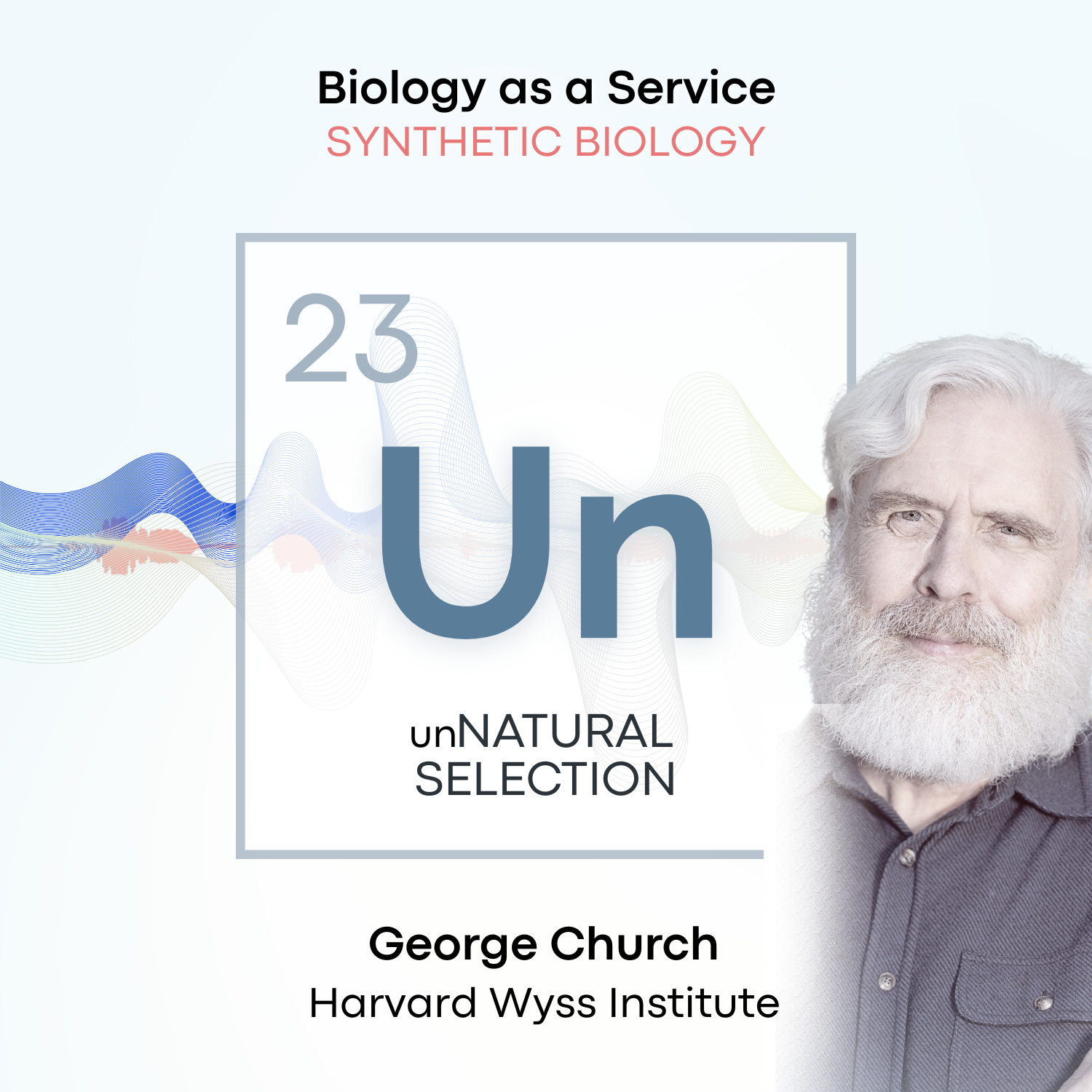
Synthetic Biology: Harvard Wyss Institute • George Church


Bio-Infrastructure: Refactoring Legacy Biological Code
From Extinction to Immortality. George Church, one of the most influential figures in modern biology, joins us to explore the breathtaking frontiers of synthetic biology. From his foundational role in the Human Genome Project to his groundbreaking work on gene editing, de-extinction, and engineered immunity, Church has helped transform biology from a descriptive science into a design discipline.
In this episode, we trace the arc of synthetic biology—from sequencing DNA to programming life itself. We discuss how the field is converging with artificial intelligence and neuromorphic engineering, unlocking the potential to rewire aging, revive extinct species, and radically extend the human condition. Can biology become as programmable as software? Can we fend off death entirely? And what does it mean to be human when evolution is no longer natural?
-
(Auto-generated by Spotify. Errors may exist.)
George Church is professor of genetics at Harvard Medical School and director of personal genomes.org, which provides the world's only Open Access information on human genomic, environmental, and trait data.
GET Conference.
His 1984 Harvard PhD included the first methods for direct genome sequencing, molecular multiplexing, and barcoding.
1:36
These led to the first genome sequence pathogen Helicobacter pylori in 1994.
His innovations have contributed to nearly all next generation DNA sequencing methods and companies CGIBGI Life, Illumina Nanopore.
This, plus his labs work on chip DNA synthesis, gene editing and stem cell engineering resulted in founding additional application based companies spanning fields of medical diagnostics, GNOME, Period DX, Elikris, Nebula, Veritas, and synthetic biology and therapeutics at Vitro, Juno, Gene 9 and Viva, Zimmergen Ward, Dr. Ginkgo Editas and E Genesis.
2:17
He's also pioneered new privacy, biosafety, LC, environmental and bio security policies.
He was director of an IARPA Brain project and three NIH Centers for Excellence in Genomic Sciences between nine, 2004 and 2020.
2:33
His honors include election to Nas and NAE and Franklin Bauer Laureate for Achievement in Science.
He's co-authored 716 papers, 156 patent publications and they book regenesis.
George, welcome to a natural selection.
2:50
Speaker 1
Thank you, Nick.
It's great to be here.
2:52
Speaker 2
It's really an honor to have this conversation, George, as we've spoken before, I was a part of the Human Genome Project way back in the day, which you helped spearhead.
And we're so influential and not only the process itself, but the science that led to it.
But before going down that road, for the sake of the audience listening to hear from your perspective, can you please tell us what need or impact drives your work and how do you view your role in addressing it?
3:20
Speaker 1
I I think our role in addressing it is mostly technology development, sort of radical technology development, not incremental.
And what we're addressing is various aspects of preventative and curative medicine, in particular age-related diseases.
3:37
We're interested in sequencing as many humans as want to be sequenced, maybe 8 billion.
And the biosphere.
This would of course be collaboratively with lots of groups and interested in safety and security technology and applications to environmental and climate change problems.
3:56
So these are all connected by technology.
4:00
Speaker 2
Absolutely.
And and for those new to the field, how would you explain synthetic biology and its relationship to genomics?
4:08
Speaker 1
Right.
So genomics classically was analytic.
It was surveying and, and, and studying the genomes of diverse organisms with a slight emphasis on human.
Once the technology worked well enough to get up to that scale.
4:27
But that was, that was genomics that was mostly analytic.
Synthetic genomics says the name implies mostly synthetic.
It's mostly about writing rather than reading.
But you need the, you need both of them.
You need synthetic biology to make tools for reading.
You need the reading in order to to know what it is that you're you're doing as you synthesize, but updated with more rigorous engineering principles, more safety engineering components, more developmental biology at at one end and more non biological synthetic biology at the other end.
5:04
Meaning you know minerals and and inorganics.
5:08
Radical Leaps: George Church's Approach to Scientific Innovation
And you mentioned earlier that you're focused on kind of radical leaps forward versus incremental innovation, and you've helped pioneer foundational tools from human genome project to CRISPR Multiplex editing.
How do you decide which bold ideas to pursue next, And what makes an idea kind of worth the risk in your mind versus something that could be distracted?
5:33
Speaker 1
A really excellent question.
The question really it, it's, well, first of all, I have never really dropped the project.
It's just you just dial down the heat a little bit and put it on the wall on display.
I think, I think a lot of people have, you know, very creative ideas and but there's a tendency to reject them more quickly before you've really given them a a good chance.
5:59
And, and rightly so, because some of them do take a long time or short time with a lot of money.
I tend to be cheap.
I don't like spending a lot of money.
So I consider, you know, I have a fairly low threshold for for when it's getting too expensive.
6:15
And the first thing I do when I enter a a challenging field, which everybody might think is high hanging fruit rather than low and, and, or that it's impossible or, or useless or, or both as as very common description of, of the public or, or other scientists opinions of my work.
6:34
When I start out, I think that that I try to lower the price as a first step.
And, and it's not, I mean, that doesn't sound that sounds a little prosaic and, and ordinary, but is it?
It isn't when it when you start getting up to the 20 million fold changes in price, it changes from something that was just basically an idea toy into something that's this has whole new properties like like DNA sequencing.
7:00
It goes from something that you can do for teeny little RNAs back in the 70s when I started and what and what got me excited and I'm still working on 50 years later to now, you know, whole biospheres and and ecosystems and and human population.
7:22
So these are transformative at just just the price alone.
But the other thing is, is the is doing things that just weren't really possible before, you know, you know, like Multiplex engineering of mammalian germline and making a virus resistant cell, you know, making organ transplants from animals to humans.
7:47
These are applications of those transformative technologies which sometimes are transformative themselves.
7:53
Speaker 2
It doesn't sound to me prosaic or mundane at all.
I have a long history of being in startups and I have found that starting with very minimal budgets has an amazing ability to focus the mind on the things that really matter and iterate versus the opposite extreme, which is like sometimes you have too much money can actually do the opposite.
8:16
You end up concealing glaring errors that you might have discovered otherwise if you're really counting your pennies.
And so I actually, I like that approach it, it sounds very startup you.
So you know, you, you kind of touch upon how you focus on the ideas and how you were finding that first.
8:33
Does your lab operate more like an academic lab, more like a startup environment with teams working on certain topics?
Or is it some kind of a mix in between because your lab has also been very prolific and launching companies and so is there, Does your ecosystem look more like a startup or more like an academic lab or or somewhere in between?
8:54
Speaker 1
I think it's it's it's unapologetically multidisciplinary.
Almost everybody in the lab is themselves cross trained in more than one field.
I think it's hard to build a multidisciplinary team with only disciplinarians.
9:11
And so it does have components that are basic pure science, pure, even pure engineering sounds like an awesome moron.
And then and then, but with a look to what societal needs are and how we could quickly bridge the two.
9:28
It used to be you had to choose because, you know, everything was so slow and but now, because we've been an exponential technology simply for my entire career since the 70s, is that now you, you can do both at once and you should when you, when you have, we try to pick things that are both basic, fundamental, philosophical almost things that involve orders of magnitude of technology and things that are societally beneficial.
9:55
And and that involves a, a startup mentality that you mentioned.
We, we don't have a large company mentality.
It's we, we just can't.
I can't wrap my head around it, but occasionally do collaborate with them.
10:10
Can We Control Aging? Synthetic Biology's Real-World Impact
And we talked about the science, synthetic biology promises everything from virus proof humans, as you mentioned, virus proof cells to biofuels, the extincted species, which is something we'll dive into.
Even aging, reversal of the radical applications that you're pursuing or have pursued like genome recoding, cellular rejuvenation, which do you believe are closest to real world impact and implementation?
10:37
Speaker 1
So going to the societal impact edge, I'd say we have one kidney that came from a pig that was engineered at 69.
So Multiplex editing is the the basic engineering, but it's delivered pigs that are human compatible the they're hearts, livers, kidneys, etcetera.
11:03
There is at least one patient of the record holder right now from from our is from one of our kidneys is getting close to six months name is Tim Andrews.
He lives in the Boston area.
So that's one that we have about 15 different pharmaceuticals, mostly, you know, proteins and gene therapies, but some cell therapies, some small molecules that are, that are in clinical trials are, are very close to admit it through preclinical.
11:37
So that's another category.
We've made a, a, a new strains of bacteria that have new amino acids in them and, and those look like they're ready for industry, but but not yet.
11:56
There's nothing of no product out there in the supermarket.
So those are some examples.
12:01
Speaker 2
That's amazing.
And you know, I think the aging 1 is, is a really interesting one as well.
And, and there are companies obviously working on this.
Do you believe that aging is ultimately something that's programmable or do you, given, you know, there are companies like Calico and others out there that have been working on this for at least a decade?
12:20
Are we seeing boundaries that seem beyond re engineering or do you feel that ultimately human aging is something that we can control?
12:32
Speaker 1
Yeah, I I don't see any barrier to controlling aging.
I mean, we've, we've got a few examples, some of them are cellular where we can go from 80 year old human cells to basically embryonic, you know, day 5 type embryo like cells.
12:51
We have a few that work at the whole Organism level.
And, and among the, the things that are moving into clinical trials that I mentioned just a second ago, Rejuvenate Bio has two triple gene therapies, each of which looks very promising for reversing specific ages, age-related diseases, which is what FDA cares about, as well as evidence that they're working at a fundamental level of, of aging because it causes a longevity effect even when delivered very late in life, meaning at the point where half of the animals are dying of, of, of age-related
13:32
diseases.
So yeah, I, I think it could be reprogrammed.
Clearly, you know, rodents are about a year or so is their longevity lifespan.
Bowhead whales, which are also mammals are about 200 years.
13:49
Humans are pretty long lived in between those.
So I think, I think it's programmed by evolution and it can be reprogrammed.
I don't think it's easy.
I think that there's been a lot of wishful thinking that it's just some food or maybe 2 foods or some pill, you know, that's based on natural products or serendipitously came out of some other study.
14:13
I think it's much, I think it's harder than that, but it's not, it's not something that we can't do now because of all the exponential technologies.
I think it's going to go very quickly now.
You know, in the same sense, there are a lot of really complicated things in the world like, you know, supercomputers and jet engine, jet planes and so forth, that that we we're good at engineering complicated things and we now have the tools for engineering complex age-related diseases.
14:41
Speaker 2
So as an extension of that question, then what does death mean to you?
If we're obviously reprogramming, kind of like the code of life, it begs the question of what death is.
Is it a disease or an illness that can be prevented?
14:57
Is that the way that how would you see death then if we can extend life?
15:03
Speaker 1
Well, I think before, before we get to preventing death, we're preventing age-related diseases and and poor health.
So we want to restore youthful physiological functions and we know a lot of those things that need to be restored.
15:20
We have kind of lists of all the RNAs and proteins that are required for that youthfulness and there, and even though it's a long list, we, we could just put them into cells and show that they, the cells repair better and just function more youthfully.
15:38
So that's the big step.
And to some extent, if that works well enough, then you don't need to talk about death per SE, because as long as you stay youthful and stay out of accidents and you know, asteroid doesn't hit us, then, then that then lack of death comes as a bonus.
15:54
I think the FDA does not recognize aging as a disease.
And I'm, I'm OK with accepting their definition because, you know, they're kind of in charge of safety and efficacy for the, for the United States and setting example for the world.
16:13
And I don't think we need to define it as a disease in order to get, you know, drugs that reverse one or two disease age-related diseases by affecting all of them.
But you don't need to prove it affects all of them.
You just have to prove it, for one, and then then you have something that, as a side benefit, will address almost all or all age-related diseases.
16:40
Speaker 2
And and you mentioned earlier how you know, working on all this stuff, it's not impossible, but it is complex.
16:46
AI and Biology: Designing the Future of Human Experience
And when you think about the genetics, the cellular processes, multi omics that go into all these things, much of your work relies on high throughput data, big data, sequencing, phenotyping, screening, and so on.
17:01
Is as AI advances, how do you see it playing a role in designing some of the work and the processes that you've been working on and kind of maybe even expanding beyond what human imagination can conjure at this point?
17:20
Speaker 1
I think at this point is a key phrase because human imagination is subject to change just like AI is subject to change.
I think one of our attractions to AI is you can do, you can do manipulations of, of an intelligent brain without getting IRB approval for, you know, you can do brain surgery without a license.
17:41
I think that's going to change.
I think we're going to need similar ethical conduct with respect to both artificial and natural intelligence and sentient beings in general.
17:52
Speaker 2
Just really thinking about synthetic biology and the evolution of the field as it basically becomes more advanced, new tools are created and and somehow we start morphing between our biological beings and more technology.
18:08
I guess the question is, and we're still very early obviously, like this level of AI really kind of exploded when through the Transformer paper from Google just eight years ago.
But how do you see synthetic biology evolving over the years with this new very powerful tool of AI, both in its ability to design, but also even its ability to integrate with our biology through neuro technologies and other ways that we can enhance the human experience.
18:41
Speaker 1
Yeah, I think AI has had a number of kind of I think show off things that it does, you know like translating languages and and things like that.
It's kind of like an elephant balancing on the balls.
They're they are useful, but not I think they're slightly over hyped.
19:02
One thing I think is not over hyped is, is, is AAS ability to do protein design that the my lab's been working on since I don't have 2019 or so.
And, and, and I think that has really had profound influence on a a variety of biotech research development and products.
19:22
I think that we are already hybrids, you know, we have, you know, intimate connection to, to computers visually.
We could have, you know, electronic wire connections not clear that that would be that much faster or better, certainly harder and less safe for the time being.
19:50
But I, you know, our, our, our input and output is, is fairly good right now.
And I think that both the human and the AI components will advance rapidly now helping each other, you know, there I think there will be differences in our intelligences for for quite a while.
20:12
Complementarity in ways, you know, we may not be able to predict in detail, but I think it's safe to say that we're, there's some, certainly some room for, you know, learning some of the evolutionary lessons that took, you know, trial and error over billions of years is all encoded in the, in the biology and it and the, the electronics is still kind of raw and incomplete there.
20:38
And so it wouldn't be a good time to just like turn everything over to, you know, it's like you don't want to take the, the wisdom of, of, of a, you know, legislative body and hand it over to a kidney murder school just because they're very bright.
20:57
So I think we're, we're at a very interesting time.
We're very narrow use of AII think is extremely productive and the broad application to artificial general intelligence or artificial super intelligence is not guaranteed and is it's not guaranteed to deliver something good and it and it has a very high probability of turning returning something bad or something where you have a partially educated incredibly intelligent being.
21:28
And I think we need to go more cautiously towards, you know, sort of narrow definition AI for a while.
21:38
Speaker 2
And, and you're, you know, clearly in your career you've been a big thinker, a generator of, of radical ideas.
And so my background is both in genomics, in stem cell biology, but also computer science.
So when I look at synthetic biology, I can't think of, I can't help but think of the evolution of software and almost like synthetic biology is like creating that operating system of, of evolving the, the human makeup.
22:06
The is it fair to say?
And obviously we're way early, but again, if we think in kind of like at the at the stratosphere where you live really thinking forward in in terms of decades, Is it fair to say that or to think that synthetic biology might follow a similar evolution and trajectory is software development where it started with assembly language and low level processing up to like higher level programming, no code local environments.
22:34
Do you think that although we're early, synthetic biology and synthetic biology tools might follow a similar trajectory where we might see more advanced programming and reprogramming of what it means to be human?
Or is that way to sci-fi?
22:52
Speaker 1
Well, let's put aside what it means to be human as we'll get to that.
But whether it will follow a similar trajectory, I think it it will be at a very broad sense similar.
But I think what's more interesting is the differences.
So some of the differences are that it that synthetic biology came in after the revolution in software already existed.
23:15
So we could use that revolution to do computer aided design and AI for our biological experiments.
That's number one.
Number two is something that came from the biological land is biology is atomically precise, which electronics typically is not.
23:33
So with biology you can design things where a fraction of an atom bond length, you know, Angstroms let's call it is important to the catalysis or the otherwise function of complicated biological systems.
That's the second thing.
23:49
The third thing that's different is, is we've got billions of years of evolution and the ability of having accelerated love of evolution in the labs.
We got two different kinds of evolution that you don't really have for building bridges or or even computers and that sort of thing.
24:04
It typically you'll make at great cost, one prototype of 1 cell phone or one new gadget of any sort.
And then you'll make a few variations on it and then you'll debug it and and launch the product.
But with biology, you can make billions of things and then put them in a big soup together and let them compete in the in the winner take all that's that's you can do that in the lab in very short period of time.
24:30
So that's a fundamental difference and there are a few others.
But back to, you know what, what makes us human?
You know, I think that what has made us human historically keeps keeps changing, But it is, I think it's our ability to think about the past and, and reference it to, to the future, to, to things that that, you know, are, you know, Contra factual, meaning they're not yet factual.
25:01
And we can think of multiple different outcomes and then choose the ones that we like.
I think that's one of the things that has made us human and that will be continue to augment and, and we'll be the only species for a while.
If we don't bite ourselves out, we'll be the only species that could save all the other species.
25:18
In other words, we could, if something's destructive as coming towards Earth, solar flare, asteroid, whatever, we could get a little Noah's ark going and, and go other places, but we need to, we should prepare for that long before the threat actually arrives.
25:37
But these are all these are things that, that sound like they're, they're new aspects of our species, but I think they really represent and, and, and, and also, I think as as horrible as we can be to, to our, our fellow species and, and people, we're basically a caring species.
25:55
And, or at least there's a, a high fraction of the population and a high fraction of time where they, they care about each other and about the, the planet we live on.
So I think hopefully that will be something that will continue to be augmented.
Our our peaceful and caring nature is something that we can in principle engineer if we put our mind to it.
26:17
Reviving Species: George Church's Enduring Impact on Science
Yeah.
And, and, and ultimately, obviously we all have a, a common objective which is a survival of the species.
And so that that definitely unifies.
If we were to see an asteroid barreling our way, I think that would unite people much faster than most other things.
26:35
And you work on some of these things, right?
I mean, you actually do look into how do we re engineer cells to be virus free and resistant to certain diseases, pandemics and so on.
So I think at the core of what you're doing is really looking at how do we elevate the human experience and, and potentially in some ways save ourselves from long term threats from viruses, diseases and other things that may come our way.
27:03
Speaking of kind of evolution and really life and, and, and extinction.
One of the big projects that you're very well known for is also the extinction and you have been vocal about and you're engaged in work on resuscitating the woolly mammoth.
27:26
I believe there is you, you even have a company that's focused on some of that work.
Can you tell us a little bit about how that's going?
And will we see a woolly mammoth sometime in the near future or in the process of trying to de extinct species?
27:42
Are you finding are we learning something about life and the synthetic biology approach to de extinction that's creating additional hurdles?
27:54
Speaker 1
Right.
So first of all, to clarify, we, we have already distinctive de extincted mini genes and, and, and really the goal is to focus on functionality of genes that would be helpful in the modern world, in particular with endangered species for conservation, Environmental Conservation for, you know, for a variety of of of things like that.
28:26
And so we're developing technology through that.
We are learning quite a bit to your question that about developmental biology of plants and animals about, you know, complex Biosystems.
And yeah, in fact, another example of that was talking about earlier the difference between biological engineering and and, you know, historically almost all the other forms of engineering is it with biology, we're gifted ability to engineer really complicated things without working our way all the way up from atoms to these things because it's already been worked out by a process that looks a little bit like engineering and its outcomes, but is is much more random.
29:12
Although even engineering involves a lot of trial and error.
So we can take bits of of, you know, one kind of tissue and put it somewhere else and it'll form an eye and work and wire up to the nervous system, even though it's not in the head, it's in the tail and it and it responds and so forth.
29:29
So these are we can use very complicated.
If you could have two headed organisms, which never happened in the history of, you know, never was under natural selection to to the the theme of this podcast.
29:45
But it never lets works well because the interoperability and and the flexibility is there.
29:53
Speaker 2
You know, so being in the genomics world and now downstream in the newborn screening world, obviously there are monogenic diseases and monogenic traits, but the vast majority of diseases are polygenic in nature and much more complex.
30:09
Can you tell us a little bit more about, as you're going down this path, let's say towards the extinction, not just of genes but as of organisms and species?
How is that additional level of complexity that we've discovered in the DNA affecting those initiatives?
30:27
Speaker 1
Right.
So I think we've known that things were polygenic since even before the genome project and started in 1984.
We are getting better at doing polygenic like I mentioned that we engineered a pig with 69 different edits that all of which were necessary to make a safe and effective kidney, let's say for a for a living patient that was otherwise on dialysis.
30:56
That's one example.
You know, what we're doing with with Colossal, the company that's doing the de extinction is we're the extincting genes so that we can have greater diversity, not just diversity of a polygenic sense, but a diversity in the multiple options for each of those genes.
31:20
And, you know, some cases that's already known in great detail, for example, like the genes are involved in tissue rejection, HLA or is the compatibility?
There's some nice goal and we needed to deal with that for the transplants.
But so we're, we're learning, we're introducing diversity.
31:38
We know that's been valuable from an evolutionary standpoint in the past and the future.
We're trying, but we're not aiming for a particular to make a copy of something that existed in the past or the present, because those are, you know, what we want is something that that satisfies the needs of the ecosystem and humans.
31:58
So for example, we might want our elephants to be cold, very cold resistant, meaning they can handle -40° for all winter long, which is what it is still in the Arctic.
The Arctic has just changed by a couple of degrees still -40 in the winter.
32:17
So but we might also want to do things that weren't that that was represented in mammoth jeans.
So we could bring those back, but we might want to do new things like have more control over their their tusks so that we can make it so that they're less attractive to poachers.
32:33
We might have might have them resistant to multiple viruses, you know, so like, you know, herpes viruses, canine disease of a virus, foot and mouth disease.
There's just there are a lot of animal specific that diseases that black plague these these affect endangered species.
32:57
So so though so we're not dependent on on entirely on a present past species.
We can use synthetic biology to produce a common combination.
This it's quite interesting, but but we're learning we're learning the polygenics and what an interesting thing we learned is to cap this question off.
33:17
Is it that things that might have by genetic association studies may involve 9000 genes?
For example, height, stature of of humans and animals probably involves 9000 genes.
But one of them can be or, or maybe even various examples of 1 can do have such a big impact, maybe under unnatural circumstances that they that they account for the biggest range from the tallest person to the smallest is really changing the somatotropin gene, the human growth hormone gene, sometimes called and that's so powerful that that seven different medical conditions are treated with just using that pure hormone.
34:06
So it's, it is complicated and there are practical things you can do with a simple version of it.
Not to oversimplify things, but to be medically pragmatic, it's.
34:16
Speaker 2
Amazing.
So George, just with my final question, this has been a fascinating conversation, but, and obviously we could spend 6 hours because you've worked on so many different things, but you know, you've already shaped modern biology, genome sequencing, CRISPR, the extinction, synthetic life.
34:36
When you think about your legacy, what part of your work do you believe will define your influence the most?
Or or do you feel like you're still working on the, you know, the the thing that will define your career the most?
34:51
Speaker 1
Well, definitely, I'm still working.
I'm still a student.
I think I'm just getting good at it.
And it would be kind of unplugged with the supercomputer at this moment and, and turn it into recycled parts.
35:08
So, yeah, I'm, I'm, I'm still learning a lot and I've never felt more productive in a creative sense.
But I think, I think 1 legacy is going to be my students themselves.
They, they help train me and, and, and, and they're out there and they're very nice to each other, which is one of my, my selection criteria, my natural selection criteria.
35:35
And, and that pays off.
You know, it takes decades to pay off, but they're, they're helping each other.
They're helping the next generation come along in, in ways that I don't often see out there in, in the industry, some exceptions.
35:51
And so that's one thing I think that everything that you've described will I, I don't think it's going to go away, Just just going to keep getting better and more and more people working on it means that, that, that I can, I can watch it even if I don't keep contributing to it.
36:10
Because I, you know, there's a lot of other things that I am trying to start things more than I try to finish them.
36:17
Speaker 2
That's extraordinary With that, George, your, your influence over human health and science has been so disproportionate to other people.
It's clearly affected my career because I'm, you know, so much of my time is spent on stem cell biology, genomics, screening, and so on.
36:35
It's been truly an honor getting to know you and a pleasure having you here.
Thank you very much for spending time with us today.
I look forward to hopefully catching up sometime soon.
36:45
Speaker 1
Thank you, I look forward to it as well.
